Anomalous finite-size effects in the Battle of the Sexes
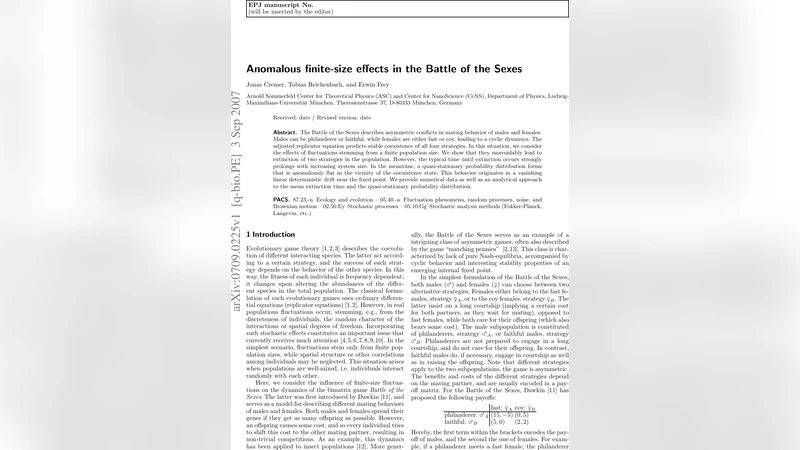
The Battle of the Sexes describes asymmetric conflicts in mating behavior of males and females. Males can be philanderer or faithful, while females are either fast or coy, leading to a cyclic dynamics. The adjusted replicator equation predicts stable coexistence of all four strategies. In this situation, we consider the effects of fluctuations stemming from a finite population size. We show that they unavoidably lead to extinction of two strategies in the population. However, the typical time until extinction occurs strongly prolongs with increasing system size. In the meantime, a quasi-stationary probability distribution forms that is anomalously flat in the vicinity of the coexistence state. This behavior originates in a vanishing linear deterministic drift near the fixed point. We provide numerical data as well as an analytical approach to the mean extinction time and the quasi-stationary probability distribution.
💡 Research Summary
The paper investigates how finite‑population stochasticity alters the dynamics of the classic “Battle of the Sexes” game, a non‑symmetric 2×2 evolutionary game in which males can be either philanderers or faithful and females either fast or coy. In the deterministic limit, the adjusted replicator equation predicts a single interior fixed point where all four strategies coexist stably. The authors replace the deterministic flow with a stochastic Moran process that respects the same payoff matrix, thereby introducing demographic noise that scales as 1/√N, where N is the total population size.
From the master equation of the Moran process they derive a diffusion approximation (Fokker‑Planck equation) valid for large N. A crucial observation is that the linear deterministic drift term vanishes at the interior fixed point; the Jacobian evaluated at the fixed point has zero eigenvalues for the first‑order term. Consequently, near the coexistence state the dynamics are dominated by the second‑order diffusion term. This “vanishing linear drift” leads to two striking consequences.
First, the quasi‑stationary probability distribution that the system settles into before absorption is anomalously flat in the vicinity of the fixed point. Unlike the usual Gaussian peak expected from a linear restoring drift, the distribution spreads almost uniformly over a sizable region around the coexistence point. The authors obtain this distribution analytically by solving the stationary Fokker‑Planck equation with reflecting boundaries in the interior and by matching to absorbing boundaries at the edges of the simplex.
Second, because only diffusion drives the system toward the absorbing states (where two strategies become extinct), the mean time to absorption grows exponentially with population size. Using a Wentzel–Kramers–Brillouin (WKB) approximation and a boundary‑layer analysis, they derive an explicit expression τ ≈ C exp(α N), where the constants C and α depend on the payoff parameters and on the initial composition of the population. Numerical simulations for N ranging from 10² to 10⁵ confirm the exponential scaling and the flatness of the quasi‑stationary distribution. For moderate N (≈10⁴) the mean extinction time exceeds any realistic observational window, making the system appear permanently stable even though extinction is inevitable in the long run.
The paper also discusses the broader implications of this phenomenon. Any evolutionary game that possesses an interior fixed point with a vanishing linear drift will exhibit similar finite‑size effects: a long‑lived quasi‑stationary state and an extinction time that scales super‑linearly with N. Therefore, empirical observations of persistent coexistence in biological or social systems should not be taken as proof of deterministic stability; demographic noise can sustain apparent coexistence for astronomically long periods while ultimately driving the system to an absorbing state.
In summary, the authors combine analytical techniques (diffusion approximation, WKB, boundary‑layer methods) with extensive Monte‑Carlo simulations to demonstrate that finite‑size fluctuations fundamentally reshape the long‑term behavior of the Battle of the Sexes game. Their results highlight the necessity of incorporating stochastic finite‑population effects when interpreting evolutionary dynamics, especially in non‑symmetric games where the deterministic drift may vanish near the coexistence equilibrium.
Comments & Academic Discussion
Loading comments...
Leave a Comment