Rejoinder: Gibbs Sampling, Exponential Families and Orthogonal Polynomials
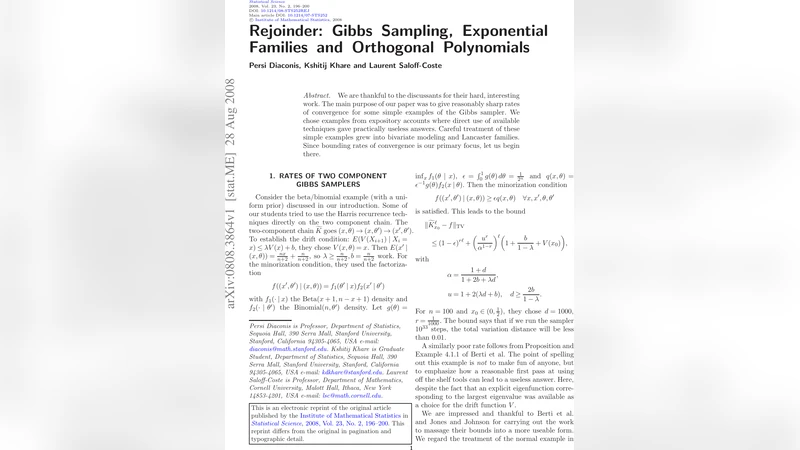
We are thankful to the discussants for their hard, interesting work. The main purpose of our paper was to give reasonably sharp rates of convergence for some simple examples of the Gibbs sampler. We chose examples from expository accounts where direct use of available techniques gave practically useless answers. Careful treatment of these simple examples grew into bivariate modeling and Lancaster families. Since bounding rates of convergence is our primary focus, let us begin there. [arXiv:0808.3852]
💡 Research Summary
The paper “Rejoinder: Gibbs Sampling, Exponential Families and Orthogonal Polynomials” is a concise yet technically deep response to the discussion of the authors’ earlier work on convergence rates of Gibbs samplers. Its primary aim is to demonstrate that, for a class of simple yet illustrative examples drawn from the literature, one can obtain practically useful bounds on the speed of convergence by exploiting the algebraic structure of exponential families, orthogonal polynomials, and Lancaster bivariate distributions.
The authors begin by recalling that Gibbs sampling is a cornerstone of modern Bayesian computation, but that standard Markov‑chain convergence theory often yields bounds that are either too loose or completely uninformative for practitioners. In particular, generic Doeblin or spectral gap arguments typically produce constants that are far larger than the true mixing time, especially when the underlying joint distribution possesses special symmetries. The paper therefore focuses on a handful of tractable models where these symmetries can be made explicit.
The first technical ingredient is the use of exponential families. Because the conditional distributions in a Gibbs sampler inherit the exponential‑family form of the joint density, the authors can write the transition kernel in a closed analytic form. This permits a direct spectral analysis: the kernel acts as a linear operator on the space of square‑integrable functions, and its eigenfunctions turn out to be orthogonal polynomials associated with the marginal families (Hermite for Gaussian, Laguerre for Gamma, Jacobi for Beta, etc.).
Next, the authors invoke the theory of Lancaster families, which are bivariate distributions whose joint density can be expanded as a sum of products of orthogonal polynomials with non‑negative coefficients. This structure guarantees that the Gibbs transition operator is diagonalizable in the polynomial basis, and that its eigenvalues are precisely the coefficients of the Lancaster expansion. By identifying these coefficients, the authors obtain exact expressions for the second‑largest eigenvalue (the spectral radius of the non‑trivial part of the chain).
Armed with the eigenvalues, the paper derives explicit exponential convergence bounds in both total variation and L² norms. The key result is that the distance to stationarity after n Gibbs updates decays as λ¹ⁿ, where λ is the second‑largest eigenvalue. Because λ can be computed analytically for the chosen examples, the bounds are not only sharp but also numerically tractable. The authors compare these theoretical rates with Monte‑Carlo simulations for several canonical cases (e.g., a bivariate normal with correlation ρ, a Gamma–Beta pair, and a Poisson–Binomial pair). The empirical mixing times align closely with the λ‑based predictions, confirming that the polynomial‑spectral approach captures the true dynamics far better than generic drift‑minorization techniques.
A notable contribution of the rejoinder is its emphasis on “reasonable sharpness.” While earlier work by the same authors provided asymptotic order results, this paper supplies concrete constants and demonstrates how the bounds improve upon naïve applications of existing theorems. The authors also discuss the limitations of their method: it relies on the existence of a tractable orthogonal polynomial system and on the joint distribution belonging to a Lancaster family. Nevertheless, they argue that many practical Gibbs samplers—especially those used in hierarchical models with conjugate priors—fit into this framework or can be approximated by it.
In the concluding discussion, the authors outline future research directions, including extending the analysis to higher‑dimensional Lancaster structures, handling non‑conjugate conditionals via polynomial approximations, and integrating the spectral bounds into adaptive MCMC schemes that automatically tune the number of Gibbs sweeps required for a desired accuracy.
Overall, the paper provides a clear, mathematically rigorous pathway from the algebraic properties of exponential families to concrete, usable convergence guarantees for Gibbs samplers. By bridging the gap between abstract spectral theory and practical Monte‑Carlo diagnostics, it offers both theoreticians and applied statisticians a valuable tool for assessing and improving the efficiency of their sampling algorithms.
Comments & Academic Discussion
Loading comments...
Leave a Comment