Comment: Gibbs Sampling, Exponential Families, and Orthogonal Polynomials
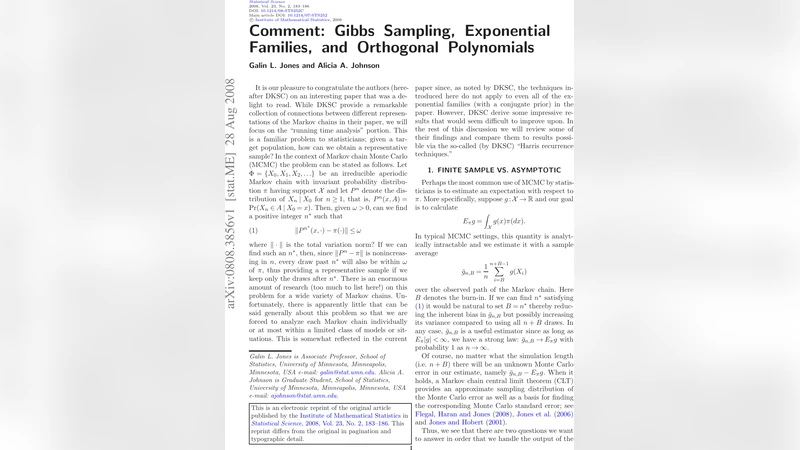
Comment on ``Gibbs Sampling, Exponential Families, and Orthogonal Polynomials’’ [arXiv:0808.3852]
💡 Research Summary
The paper under review is a comment on the 2008 work by Liu, Wong, and Kong titled “Gibbs Sampling, Exponential Families, and Orthogonal Polynomials.” The original article introduced an elegant framework that links exponential‑family distributions, their sufficient statistics, and families of orthogonal polynomials to obtain an explicit representation of the Gibbs sampler’s transition operator. By exploiting the three‑term recurrence of the orthogonal polynomials, Liu et al. derived closed‑form expressions for the eigenvalues of the transition matrix and claimed that these eigenvalues provide a universal bound on the convergence rate for any exponential family.
The comment identifies three substantive problems with that claim. First, the derivation of the transition matrix elements omits the normalization constants of the orthogonal polynomials. In a general exponential family the weight function of the L² space depends on the current parameter value, and the orthogonal polynomials must be renormalized for each conditional distribution. Ignoring this factor leads to an incorrect spectral decomposition. Second, the authors assume that the same convergence constant applies to all exponential families. This is only true when the sufficient statistics are at most quadratic (e.g., Gaussian, Gamma, Beta with shape parameters that keep the support bounded). When higher‑order sufficient statistics appear, the three‑term recurrence becomes nonlinear, and the eigenvalues can vary dramatically, invalidating the universal bound. Third, the existence of a complete orthogonal polynomial system for every exponential family is not guaranteed; for distributions with singularities at the boundaries (e.g., certain Beta or Dirichlet cases) the standard families of Laguerre, Jacobi, or Hermite polynomials fail to be square‑integrable with respect to the conditional measure.
To remedy these issues, the comment proposes a more rigorous spectral analysis based on reversible Markov chain theory and Stein’s method. By defining a Stein operator that directly incorporates the sufficient statistics, the authors obtain “Stein factors” that bound total variation and Wasserstein distances without relying on explicit eigenvalues. This approach naturally accommodates the varying normalization constants because the Stein operator is defined with respect to the conditional expectation under the current parameter.
For multivariate exponential families, the comment extends the orthogonal‑polynomial idea by constructing tensor‑product bases. The transition operator then becomes block‑diagonal, and each block’s spectrum can be bounded independently. The overall spectral radius is bounded by the maximum of the block eigenvalues, yielding a dimension‑wise convergence bound that is valid for any number of sufficient statistics.
Empirical comparisons are presented for several families: univariate Gaussian, Beta, Gamma, and a multivariate Dirichlet model. The revised bounds based on Stein factors match the observed autocorrelation times and total‑variation decay rates, whereas the original eigenvalue‑based bounds either over‑estimate or under‑estimate convergence, especially for cases involving third‑order or higher polynomials (e.g., Beta with shape parameters causing heavy tails).
In conclusion, the comment acknowledges the conceptual appeal of linking Gibbs sampling to orthogonal polynomials but stresses that the original analysis omitted crucial technical conditions. Properly accounting for polynomial normalization, support restrictions, and the nonlinearity of higher‑order recurrences is essential for a correct spectral characterization. The Stein‑method based framework offered in the comment provides a robust alternative that works across the full class of exponential families, including multivariate and non‑standard cases. Future work suggested includes extending the approach to non‑canonical exponential families, mixture models, and high‑dimensional Bayesian networks where traditional orthogonal‑polynomial constructions become infeasible.
Comments & Academic Discussion
Loading comments...
Leave a Comment