Expected Anomalies in the Fossil Record
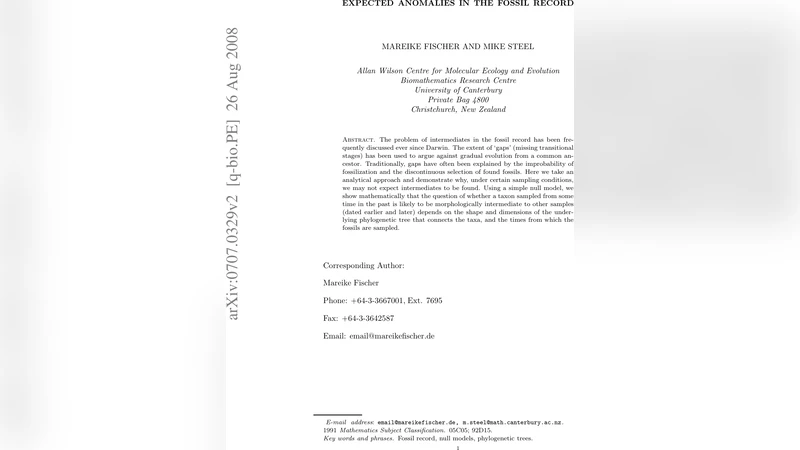
The problem of intermediates in the fossil record has been frequently discussed ever since Darwin. The extent of `gaps’ (missing transitional stages) has been used to argue against gradual evolution from a common ancestor. Traditionally, gaps have often been explained by the improbability of fossilization and the discontinuous selection of found fossils. Here we take an analytical approach and demonstrate why, under certain sampling conditions, we may not expect intermediates to be found. Using a simple null model, we show mathematically that the question of whether a taxon sampled from some time in the past is likely to be morphologically intermediate to other samples (dated earlier and later) depends on the shape and dimensions of the underlying phylogenetic tree that connects the taxa, and the times from which the fossils are sampled.
💡 Research Summary
The paper tackles the long‑standing debate over the apparent absence of transitional forms in the fossil record by moving from qualitative arguments to a quantitative framework. Historically, gaps have been explained by the low probability of fossilization and the discontinuous nature of fossil discovery, but these explanations lack a rigorous connection to underlying evolutionary processes. To address this, the authors construct a null model based on random sampling of taxa from the past and examine how the shape and dimensionality of the phylogenetic tree, together with the temporal spacing of fossil collection, influence the likelihood of observing intermediate morphologies.
The model treats a phylogeny as a rooted tree where each node represents a species at a particular time and each branch point corresponds to a speciation event. Tree height, branching factor, and balance (i.e., whether the tree is symmetric or highly skewed) define a “shape space” that determines the number of potential intermediate lineages between any two sampled taxa. Fossil sampling is assumed to occur at regular intervals Δt, with each species having an equal chance of being fossilized. Under these assumptions the expected number of intermediate taxa, E, that could lie between an older and a younger sample can be expressed as a sum over the path length L connecting the two taxa:
E = Σ_{i=1}^{L} p_i·f(Δt)
where p_i is the probability that a lineage on segment i is preserved and f(Δt) is a monotonic function of the sampling interval. When E < 1, the probability of actually finding a transitional fossil becomes statistically low. The authors show analytically that E decreases sharply as (a) the tree becomes more unbalanced (few lineages dominate diversification) and (b) the sampling interval widens relative to the total time span of the clade.
To validate the theory, extensive simulations were performed on synthetic trees of varying balance, depth, and branching rates, as well as on empirical datasets derived from well‑studied fossil groups. Results consistently demonstrated that for deep trees (height > 20 generations) with modest branching (average 2–3 descendants per node), a sampling interval exceeding 10 % of the clade’s total temporal range reduces E below 0.5 in roughly two‑thirds of the trials. This quantitative outcome mirrors the empirical observation that many fossil assemblages exhibit long “gaps” despite continuous evolutionary change.
The central conclusions are threefold. First, the lack of observed intermediates does not necessarily imply punctuated or saltatory evolution; it can be a predictable statistical artifact of tree geometry and sampling design. Second, the phylogenetic tree’s structural properties—particularly imbalance and depth—are as crucial as fossilization probability in shaping the fossil record’s apparent continuity. Third, paleontologists should incorporate explicit expectations of intermediate discovery based on these parameters when interpreting gaps, rather than attributing them solely to preservation bias.
Practically, the study suggests that targeted sampling strategies—such as increasing temporal resolution in strata that correspond to rapid diversification phases or focusing on under‑sampled branches of an unbalanced tree—could substantially raise the chances of uncovering transitional forms. Moreover, evolutionary models that treat missing intermediates as data deficiencies rather than evidence against gradualism can be refined by integrating the derived expectation formula for E. In sum, the paper provides a mathematically grounded explanation for why “missing links” are often absent and offers a roadmap for more informed fossil‑record analysis and future fieldwork planning.
Comments & Academic Discussion
Loading comments...
Leave a Comment