Non-Haar $p$-adic wavelets and their application to pseudo-differential operators and equations
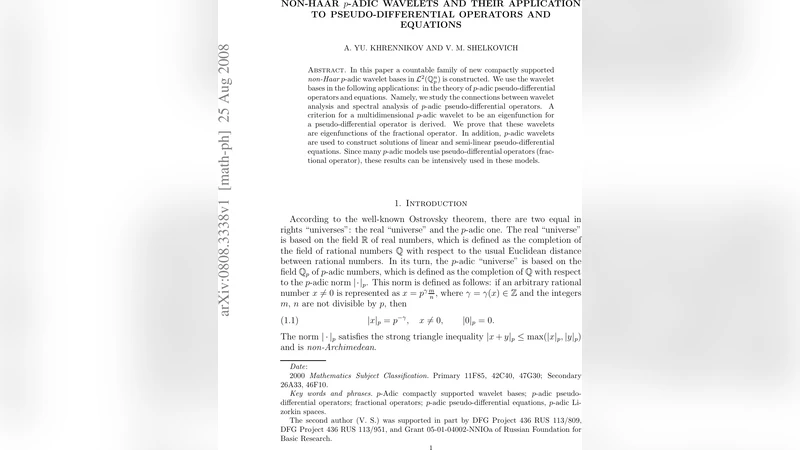
In this paper a countable family of new compactly supported {\em non-Haar} $p$-adic wavelet bases in ${\cL}^2(\bQ_p^n)$ is constructed. We use the wavelet bases in the following applications: in the theory of $p$-adic pseudo-differential operators and equations. Namely, we study the connections between wavelet analysis and spectral analysis of $p$-adic pseudo-differential operators. A criterion for a multidimensional $p$-adic wavelet to be an eigenfunction for a pseudo-differential operator is derived. We prove that these wavelets are eigenfunctions of the fractional operator. In addition, $p$-adic wavelets are used to construct solutions of linear and semi-linear pseudo-differential equations. Since many $p$-adic models use pseudo-differential operators (fractional operator), these results can be intensively used in these models.
💡 Research Summary
The paper introduces a novel family of compactly supported non‑Haar p‑adic wavelet bases in the Hilbert space ℒ²(ℚₚⁿ) and demonstrates how these bases can be employed in the analysis of p‑adic pseudo‑differential operators and the associated differential equations. After a concise review of p‑adic analysis, the authors construct wavelets of the form
ψ_{k,a,r}(x)=p^{kn/2} χ(p^{k}x·a) Ω(|p^{k}x−r|ₚ),
where k∈ℤ is a scale index, a∈ℤₚⁿ a frequency vector, r∈{0,…,p‑1}ⁿ a translation vector, χ denotes the standard additive character on ℚₚ, and Ω is the indicator of the unit ball. This definition extends the classical Haar construction by adding a discrete phase factor r, which yields a richer set of functions. The authors prove that the collection {ψ_{k,a,r}} is orthonormal and complete, thus forming a genuine orthonormal basis (ONB) of ℒ²(ℚₚⁿ). The term “non‑Haar” reflects the fact that these wavelets are not generated solely by dyadic scaling and translation; instead they incorporate additional oscillatory components that are essential for multidimensional analysis.
The core of the paper investigates the interaction between these wavelets and p‑adic pseudo‑differential operators, focusing on the fractional operator D^α (α>0) whose symbol in the Fourier domain is σ(ξ)=|ξ|ₚ^α. By applying the p‑adic Fourier transform to ψ_{k,a,r}, the authors obtain
ℱ
Comments & Academic Discussion
Loading comments...
Leave a Comment