Asymptotical behavior of one class of $p$-adic singular Fourier integrals
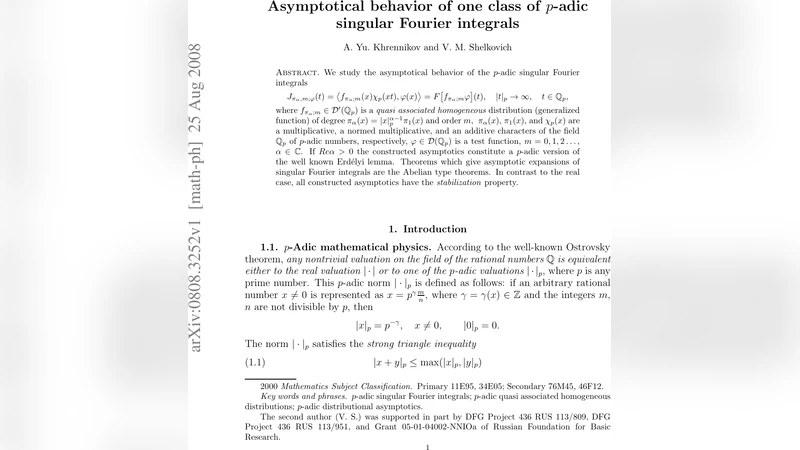
We study the asymptotical behavior of the $p$-adic singular Fourier integrals $$ J_{\pi_{\alpha},m;\phi}(t) =\bigl< f_{\pi_{\alpha};m}(x)\chi_p(xt), \phi(x)\bigr> =F\bigf_{\pi_{\alpha};m}\phi\big, \quad |t|p \to \infty, \quad t\in \bQ_p, $$ where $f{\pi_{\alpha};m}\in {\cD}’(\bQ_p)$ is a {\em quasi associated homogeneous} distribution (generalized function) of degree $\pi_{\alpha}(x)=|x|p^{\alpha-1}\pi_1(x)$ and order $m$, $\pi{\alpha}(x)$, $\pi_1(x)$, and $\chi_p(x)$ are a multiplicative, a normed multiplicative, and an additive characters of the field $\bQ_p$ of $p$-adic numbers, respectively, $\phi \in {\cD}(\bQ_p)$ is a test function, $m=0,1,2…$, $\alpha\in \bC$. If $Re\alpha>0$ the constructed asymptotics constitute a $p$-adic version of the well known Erd'elyi lemma. Theorems which give asymptotic expansions of singular Fourier integrals are the Abelian type theorems. In contrast to the real case, all constructed asymptotics have the {\it stabilization} property.
💡 Research Summary
The paper investigates the asymptotic behavior of a class of p‑adic singular Fourier integrals of the form
(J_{\pi_{\alpha},m;\phi}(t)=\langle f_{\pi_{\alpha};m}(x)\chi_{p}(xt),\phi(x)\rangle =F
Comments & Academic Discussion
Loading comments...
Leave a Comment