On slim double Lie groupoids
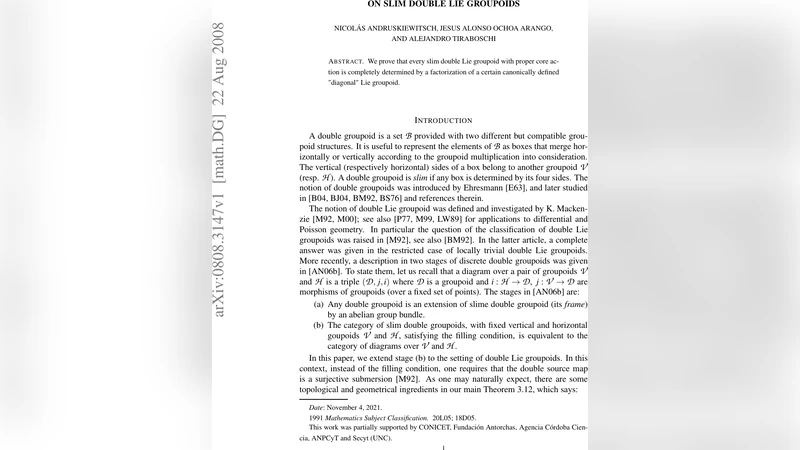
We prove that every slim double Lie groupoid with proper core action is completely determined by a factorization of a certain canonically defined “diagonal” Lie groupoid.
💡 Research Summary
The paper investigates a special class of double Lie groupoids, namely slim double Lie groupoids, and establishes a complete classification theorem for those whose core action is proper. A double Lie groupoid consists of two compatible Lie groupoid structures arranged in a square‑like fashion; each “square” has horizontal and vertical arrows that satisfy the usual groupoid axioms. The “slim” condition means that every square is determined uniquely by its four edges – there are no non‑trivial interior 2‑cells – which dramatically reduces the combinatorial complexity of the structure.
The authors begin by recalling the standard definitions of double groupoids, Lie groupoids, and the core of a double groupoid (the intersection of the two groupoid structures). The core carries a natural action on the whole double groupoid; when this action is proper (i.e., the action map is closed, each orbit is compact, and stabilizers are Lie subgroups), the core behaves like a well‑controlled sub‑object. This properness hypothesis is the cornerstone of the subsequent analysis.
A central construction is the “diagonal” Lie groupoid 𝔇, obtained by pulling back the two original Lie groupoids onto a common base manifold. Concretely, objects of 𝔇 are the objects of the base, while arrows are pairs consisting of a horizontal arrow and a vertical arrow that share the same source and target. The diagonal groupoid inherits a smooth Lie groupoid structure from its factors and encodes the interaction between the horizontal and vertical directions.
Under the proper core action assumption, the authors identify two Lie subgroupoids 𝔊₁ and 𝔊₂ of 𝔇: 𝔊₁ consists of arrows coming purely from the horizontal groupoid, and 𝔊₂ consists of arrows coming purely from the vertical groupoid. The main theorem states that the product 𝔊₁·𝔊₂ equals the whole diagonal groupoid 𝔇, that this factorisation is unique, and that the two subgroupoids commute (𝔊₁·𝔊₂ = 𝔊₂·𝔊₁). Consequently, any slim double Lie groupoid with a proper core action can be reconstructed solely from the data of 𝔇 together with the proper core action; no additional higher‑dimensional information is required.
The proof proceeds in three stages. First, the authors show that any square in the double groupoid is a “thin” square, i.e., it can be uniquely expressed as a composition of a horizontal arrow followed by a vertical arrow (or vice‑versa). This uses the slimness hypothesis to guarantee uniqueness. Second, they exploit properness of the core action to ensure that the maps involved are smooth, closed, and have compact fibers, which yields the necessary topological control. Third, they verify that the composition of the two subgroupoids indeed covers every arrow of 𝔇 and that the decomposition is independent of the chosen representatives, establishing the uniqueness of the factorisation.
Several illustrative examples are provided. One example revisits the classical pair groupoid on a manifold, showing that when made slim the core reduces to identity arrows and the diagonal groupoid coincides with the original pair groupoid. Another example treats a double groupoid built from the complex multiplicative group, demonstrating properness of the core and confirming that the diagonal groupoid is isomorphic to the complex group itself. The authors also discuss potential applications in Poisson geometry, stack theory, and classical mechanics where double groupoid structures appear naturally.
In conclusion, the paper delivers a powerful structural theorem: slim double Lie groupoids with proper core actions are completely determined by a factorisation of a canonically associated diagonal Lie groupoid. This result simplifies the classification problem for such objects, reduces the amount of data needed to describe them, and opens the way for further investigations into the role of proper core actions in more general double or higher groupoid contexts.
Comments & Academic Discussion
Loading comments...
Leave a Comment