Twisted cyclic theory, equivariant KK theory and KMS States
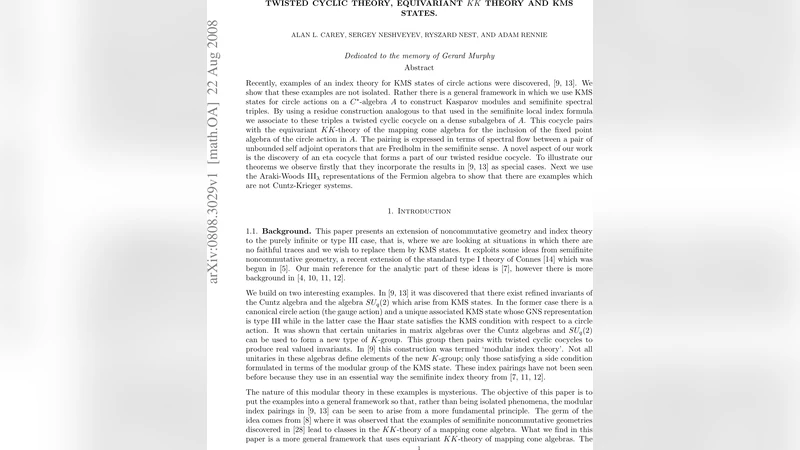
Recently, examples of an index theory for KMS states of circle actions were discovered, \cite{CPR2,CRT}. We show that these examples are not isolated. Rather there is a general framework in which we use KMS states for circle actions on a C*-algebra A to construct Kasparov modules and semifinite spectral triples. By using a residue construction analogous to that used in the semifinite local index formula we associate to these triples a twisted cyclic cocycle on a dense subalgebra of A. This cocycle pairs with the equivariant KK-theory of the mapping cone algebra for the inclusion of the fixed point algebra of the circle action in A. The pairing is expressed in terms of spectral flow between a pair of unbounded self adjoint operators that are Fredholm in the semifinite sense. A novel aspect of our work is the discovery of an eta cocycle that forms a part of our twisted residue cocycle. To illustrate our theorems we observe firstly that they incorporate the results in \cite{CPR2,CRT} as special cases. Next we use the Araki-Woods III_\lambda representations of the Fermion algebra to show that there are examples which are not Cuntz-Krieger systems.
💡 Research Summary
The paper develops a unified framework that starts from a KMS state for a circle (𝕋) action on a C*‑algebra A and produces Kasparov modules, semifinite spectral triples, and a twisted cyclic cocycle. The authors first observe that a β‑KMS state φ for the action α:𝕋→Aut(A) yields a canonical semifinite trace τ on the GNS Hilbert space H_φ by averaging φ over the circle. This trace is not tracial in the usual sense, but it is τ‑finite on a dense *‑subalgebra and is compatible with the generator δ of the action.
Using τ, they construct a semifinite spectral triple (A, H, D) where D is the self‑adjoint operator implementing the infinitesimal generator of the circle action on H. D has τ‑compact resolvent and bounded commutators
Comments & Academic Discussion
Loading comments...
Leave a Comment