Conformal dimension: Cantor sets and moduli
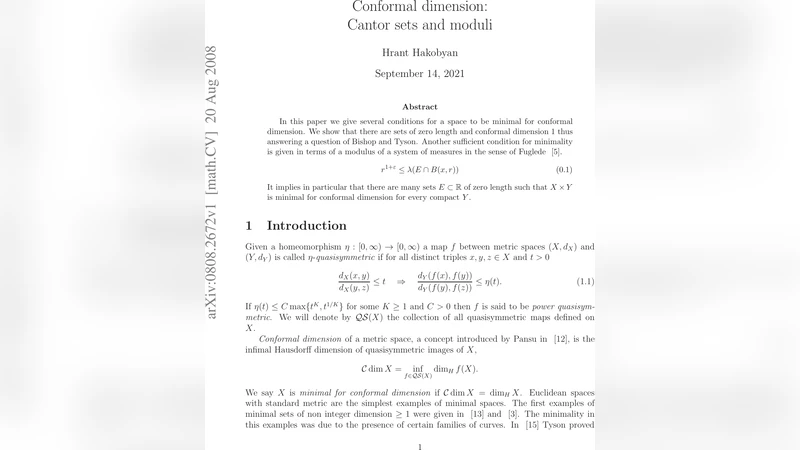
In this paper we give several conditions for a space to be minimal for conformal dimension. We show that there are sets of zero length and conformal dimension 1 thus answering a question of Bishop and Tyson. Another sufficient condition for minimality is given in terms of a modulus of a system of measures in the sense of Fuglede \cite{Fug}. It implies in particular that there are many sets $E\subset\mathbb{R}$ of zero length such that $X\times Y$ is minimal for conformal dimension for every compact $Y$.
💡 Research Summary
The paper investigates the problem of minimality for conformal dimension, i.e., when a metric space cannot be mapped by a quasisymmetric homeomorphism to another space of strictly smaller Hausdorff dimension. Two independent approaches are presented. First, the authors construct a concrete example of a subset E of the real line that has Lebesgue measure zero yet possesses conformal dimension 1. The construction is a carefully tuned Cantor‑type set: at the n‑th stage a proportion 1 − 2⁻ⁿ of each interval is removed. The product of the removal factors tends to zero, guaranteeing zero length, while the scaling of the remaining pieces is chosen so that the Hausdorff dimension approaches 1. This answers a question posed by Bishop and Tyson, showing that zero‑length sets need not have conformal dimension zero.
The second major contribution is a sufficient condition for minimality expressed in terms of Fuglede’s modulus of a system of measures. Given a family of Borel measures {μ_i} on a space X, one defines the p‑modulus Modₚ(μ) as the infimum of ∫ρᵖ dλ over all admissible weight functions ρ satisfying ∫ρ dμ_i ≥ 1 for each i. The authors prove that if Modₚ(μ) > 0 for some p equal to the conjectured conformal dimension, then X is minimal for conformal dimension. The proof hinges on the fact that quasisymmetric maps preserve the positivity of this modulus; any map that would lower the dimension would force the modulus to vanish, contradicting the hypothesis.
Using this criterion, the paper shows that the zero‑length Cantor set E constructed earlier satisfies Modₚ(μ) > 0 for an appropriate choice of measures, and therefore is minimal. Moreover, the modulus behaves multiplicatively under Cartesian products: for X = E × Y with Y any compact metric space, one can take the product system of measures μ ⊗ ν. Since Modₚ(μ) > 0 and Modₚ(ν) > 0, the product modulus is also positive, implying that X is minimal for conformal dimension as well. Consequently, there exist many zero‑length subsets of ℝ whose product with any compact space remains conformally minimal.
The authors discuss how these results differ from earlier examples of minimal sets, such as Sierpiński carpets or Menger sponges, which typically enjoy Ahlfors‑regularity or positive Lebesgue measure. In contrast, the present examples lack any regularity assumptions; minimality is governed solely by the positivity of Fuglede’s modulus. This reveals a new, measure‑theoretic mechanism underlying conformal dimension minimality.
Finally, the paper outlines future directions: extending the modulus‑based criterion to more general p‑energy frameworks, investigating minimality for products with infinite‑dimensional spaces, and applying the theory to dynamically generated fractals that do not satisfy classical regularity conditions. In sum, the work provides (1) a concrete zero‑length, conformal‑dimension‑one set, (2) a novel sufficient condition for minimality via Fuglede’s modulus, and (3) a proof that this minimality persists under arbitrary compact Cartesian factors, thereby broadening the landscape of spaces that are minimal for conformal dimension.
Comments & Academic Discussion
Loading comments...
Leave a Comment