Mean asymptotic behaviour of radix-rational sequences and dilation equations (Extended version)
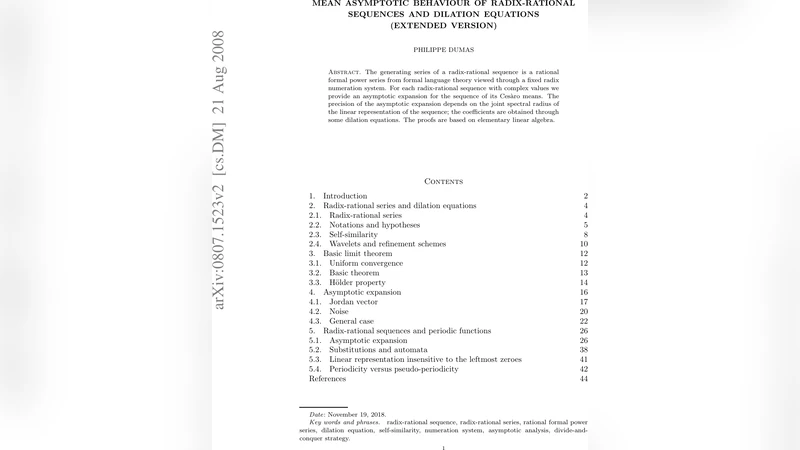
The generating series of a radix-rational sequence is a rational formal power series from formal language theory viewed through a fixed radix numeration system. For each radix-rational sequence with complex values we provide an asymptotic expansion for the sequence of its Ces`aro means. The precision of the asymptotic expansion depends on the joint spectral radius of the linear representation of the sequence; the coefficients are obtained through some dilation equations. The proofs are based on elementary linear algebra.
💡 Research Summary
The paper investigates the asymptotic behavior of Cesàro means of radix‑rational sequences, a class of sequences that can be described by a finite‑dimensional linear representation together with a fixed radix (base) b. A radix‑rational sequence (also called a b‑automatic sequence in the literature) is defined as follows: let V be a complex vector space of dimension d, let A₀,…,A_{b‑1}∈End(V) be a collection of d×d matrices, let v₀∈V be an initial vector and ℓ:V→ℂ a linear output functional. For any integer n≥0, write its b‑adic expansion n = d₁d₂…d_k (most significant digit first). The term of the sequence is then
uₙ = ℓ(A_{d₁}A_{d₂}…A_{d_k}v₀).
When the matrices are 0‑1 and ℓ is a coordinate projection, this reduces to the classical automatic sequences of Allouche and Shallit; the present work allows arbitrary complex matrices and output functionals, thereby covering a much broader family.
The main object of study is the Cesàro mean
S(N) = (1/N)∑{n<N} uₙ,
and the goal is to obtain an explicit asymptotic expansion for S(N) as N→∞. The authors introduce the joint spectral radius (JSR) of the matrix family,
ρ = ρ(A₀,…,A{b‑1}) = limsup_{k→∞} max_{i₁,…,i_k} ‖A_{i₁}…A_{i_k}‖^{1/k},
which measures the maximal exponential growth rate of arbitrary products of the A_d. The JSR is the key parameter governing the quality of the asymptotic formula.
Two regimes are distinguished:
-
Subcritical case (ρ < b).
Here the matrix products grow more slowly than the natural scaling factor b associated with the radix. The authors prove that S(N) converges to a constant C, which can be expressed as ℓ(v*), where v* is a fixed point of the averaged linear operator (1/b)∑_{d=0}^{b‑1}A_d. Moreover, the error term decays geometrically: S(N) = C + O\big((ρ/b)^{\log_b N}\big) = C + O\big(N^{\log_b(ρ/b)}\big).
The exponent log_b(ρ/b) is negative, so the convergence is faster the smaller ρ is relative to b. The constant C and the implied constant in the O‑term are explicitly computable from the matrices, the initial vector, and the functional ℓ. -
Critical case (ρ = b).
When the joint spectral radius matches the radix, the simple geometric decay disappears and a more delicate, self‑similar structure emerges. The authors show that the Cesàro mean can be described by a dilation equation (also known as a refinement or subdivision equation): f(x) = ∑_{d=0}^{b‑1} A_d f(bx – d), x∈
Comments & Academic Discussion
Loading comments...
Leave a Comment