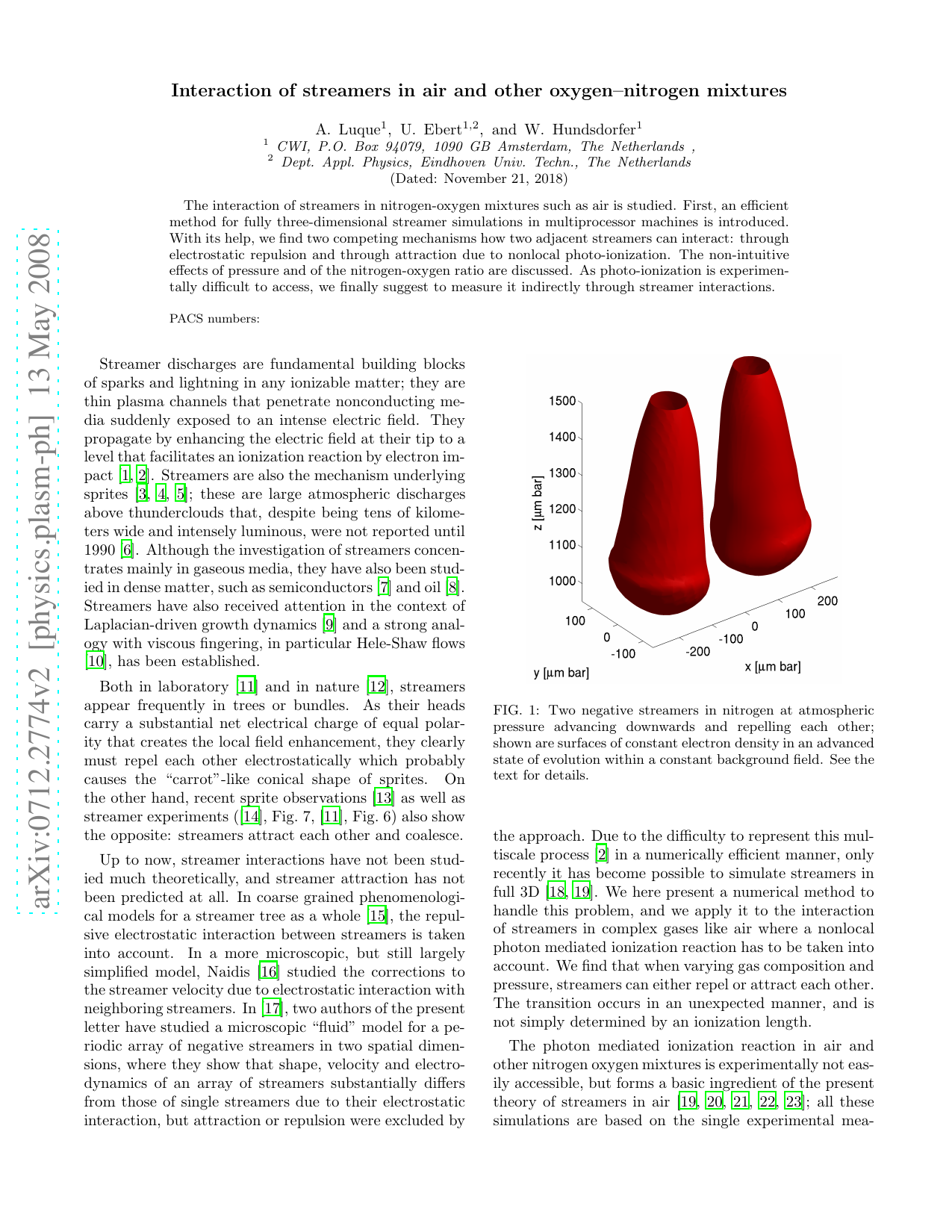
The interaction of streamers in nitrogen-oxygen mixtures such as air is studied. First, an efficient method for fully three-dimensional streamer simulations in multiprocessor machines is introduced. With its help, we find two competing mechanisms how two adjacent streamers can interact: through electrostatic repulsion and through attraction due to nonlocal photo-ionization. The non-intuitive effects of pressure and of the nitrogen-oxygen ratio are discussed. As photo-ionization is experimentally difficult to access, we finally suggest to measure it indirectly through streamer interactions.
Deep Dive into Interaction of streamers in air and other oxygen-nitrogen mixtures.
The interaction of streamers in nitrogen-oxygen mixtures such as air is studied. First, an efficient method for fully three-dimensional streamer simulations in multiprocessor machines is introduced. With its help, we find two competing mechanisms how two adjacent streamers can interact: through electrostatic repulsion and through attraction due to nonlocal photo-ionization. The non-intuitive effects of pressure and of the nitrogen-oxygen ratio are discussed. As photo-ionization is experimentally difficult to access, we finally suggest to measure it indirectly through streamer interactions.
Streamer discharges are fundamental building blocks of sparks and lightning in any ionizable matter; they are thin plasma channels that penetrate nonconducting media suddenly exposed to an intense electric field. They propagate by enhancing the electric field at their tip to a level that facilitates an ionization reaction by electron impact [1,2]. Streamers are also the mechanism underlying sprites [3,4,5]; these are large atmospheric discharges above thunderclouds that, despite being tens of kilometers wide and intensely luminous, were not reported until 1990 [6]. Although the investigation of streamers concentrates mainly in gaseous media, they have also been studied in dense matter, such as semiconductors [7] and oil [8]. Streamers have also received attention in the context of Laplacian-driven growth dynamics [9] and a strong analogy with viscous fingering, in particular Hele-Shaw flows [10], has been established. Both in laboratory [11] and in nature [12], streamers appear frequently in trees or bundles. As their heads carry a substantial net electrical charge of equal polarity that creates the local field enhancement, they clearly must repel each other electrostatically which probably causes the "carrot"-like conical shape of sprites. On the other hand, recent sprite observations [13] as well as streamer experiments ( [14], Fig. 7, [11], Fig. 6) also show the opposite: streamers attract each other and coalesce.
Up to now, streamer interactions have not been studied much theoretically, and streamer attraction has not been predicted at all. In coarse grained phenomenological models for a streamer tree as a whole [15], the repulsive electrostatic interaction between streamers is taken into account. In a more microscopic, but still largely simplified model, Naidis [16] studied the corrections to the streamer velocity due to electrostatic interaction with neighboring streamers. In [17], two authors of the present letter have studied a microscopic “fluid” model for a periodic array of negative streamers in two spatial dimensions, where they show that shape, velocity and electrodynamics of an array of streamers substantially differs from those of single streamers due to their electrostatic interaction, but attraction or repulsion were excluded by the approach. Due to the difficulty to represent this multiscale process [2] in a numerically efficient manner, only recently it has become possible to simulate streamers in full 3D [18,19]. We here present a numerical method to handle this problem, and we apply it to the interaction of streamers in complex gases like air where a nonlocal photon mediated ionization reaction has to be taken into account. We find that when varying gas composition and pressure, streamers can either repel or attract each other. The transition occurs in an unexpected manner, and is not simply determined by an ionization length.
The photon mediated ionization reaction in air and other nitrogen oxygen mixtures is experimentally not easily accessible, but forms a basic ingredient of the present theory of streamers in air [19,20,21,22,23]; all these simulations are based on the single experimental mea-surement of Penney and Hummert in 1970 [24]. Our theoretical results suggest that this reaction could be deduced from experiments on coalescence or repulsion of adjacent streamers as a function of pressure and gas composition.
We study the minimal streamer model [25] extended by the nonlocal photo-ionization reaction characteristic for nitrogen oxygen mixtures like air. It consists of continuity equations for electron and ion densities n e,+ coupled to the electrical field E that is determined by the potential on the outer boundaries and space charge effects
Here µ e is the electron mobility, D e is the electron diffusion coefficient and e is the elementary charge. Ion mobility, much smaller than electron mobility, is neglected. To fully focus on the influence of photo-ionization, electron attachment on oxygen is here neglected as well, and we use transport parameters for pure nitrogen as in previous work [2,26]. The source terms for additional electron-ion pairs are the local impact ionization S i in Townsend approximation, S i = n e µ e |E|α(|E|) = n e µ e |E|α 0 e -E0/|E| , where α 0 is the ionization cross section and E 0 is the threshold field, and the nonlocal photo-ionization according to the model for oxygen-nitrogen mixtures developed by Zhelezniak et al. [27] S ph (r) = ξA(p) 4π
with A(p) = p q /(p + p q ). Here it is assumed that accelerated electrons excite the b 1 Π u , b ′1 Σ + u and c ′1 4 Σ + u states of nitrogen by impact with a rate ξS i where S i is the local impact ionization rate and ξ a proportionality factor. These nitrogen states can deexcite under emission of a photon in the wavelength range 980 -1025 Å that can ionize oxygen molecules [24,27]. The absorption length of these photons by oxygen is obviously inversely proportional to the oxygen partial pressure p O2 .
…(Full text truncated)…
This content is AI-processed based on ArXiv data.