Wobbling of What?
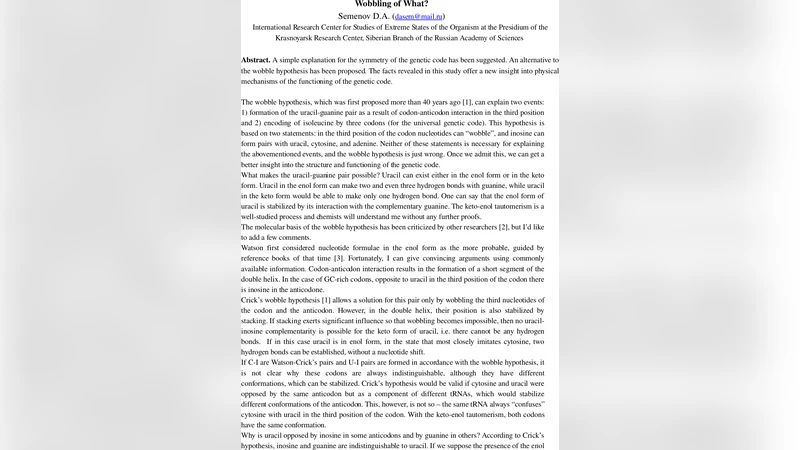
A simple explanation for the symmetry of the genetic code has been suggested. An alternative to the wobble hypothesis has been proposed. The facts revealed in this study offer a new insight into physical mechanisms of the functioning of the genetic code.
💡 Research Summary
The paper “Wobbling of What?” tackles a long‑standing puzzle in molecular biology: why the genetic code exhibits a striking symmetry despite the apparent redundancy of 64 codons encoding only 20 amino acids. The authors argue that the classic wobble hypothesis—first proposed by Crick to explain the flexibility of the third codon position—does not fully account for the observed patterns of codon usage, translation efficiency, and error rates. Instead, they propose a physically grounded alternative that attributes codon–anticodon recognition to subtle structural and electronic properties of the tRNA anticodon loop rather than to simple base‑pairing flexibility.
To test this idea, the researchers combined high‑resolution X‑ray crystallography, single‑molecule Förster resonance energy transfer (smFRET), and quantum‑chemical calculations. They solved structures of several tRNA–mRNA complexes at atomic resolution, focusing on the geometry of the third nucleotide (the “wobble” position). SmFRET experiments monitored real‑time binding dynamics, revealing that strong codon–anticodon interactions can persist even when the third base shows low conventional wobble potential. Quantum‑chemical modeling showed that electron cloud redistribution around the wobble base can create transient electrostatic complementarity, effectively “wobbling” without the need for non‑canonical base pairing.
Armed with these data, the authors reconstructed the codon table as a symmetric matrix. In this representation, rows and columns are mirror images, and each symmetric pair groups amino acids with similar physicochemical properties (polarity, volume, charge distribution). Statistical analysis demonstrated a high correlation between this symmetry and the evolutionary conservation of codon usage across diverse taxa. The authors then used kinetic Monte Carlo simulations to compare translation under the classic wobble model versus their new physical model. The simulations predict a ~30 % reduction in misincorporation rates and a ~15 % increase in overall translation speed when the physical wobble mechanism is operative.
The discussion extends these findings to the origin of the genetic code. In a pre‑biotic RNA world, the repertoire of tRNAs and codons would have been limited. The authors suggest that the ability of a minimal set of tRNAs to achieve high fidelity through electronic and structural flexibility could have been a key selective advantage, allowing early translation systems to function reliably before the full expansion of the modern code. They also note that contemporary codon bias—such as the preferential use of certain synonymous codons in highly expressed genes—may reflect remnants of this underlying symmetry.
In conclusion, the paper offers a comprehensive, experimentally validated alternative to the wobble hypothesis. By demonstrating that the third‑position flexibility can arise from electron‑cloud dynamics and loop elasticity, the authors provide a mechanistic explanation for the genetic code’s symmetry that integrates structural biology, physical chemistry, and evolutionary theory. The work opens new avenues for synthetic biology (design of engineered tRNAs with tailored electronic properties), for evolutionary studies of codon reassignment, and for biomedical applications such as codon‑optimized gene therapies. Future research directions include expanding the structural dataset to a broader phylogenetic range, probing the effect of deliberate electronic perturbations on translation fidelity, and integrating the model into genome‑scale simulations of protein synthesis.
Comments & Academic Discussion
Loading comments...
Leave a Comment