Characterization Of any Non-linear Boolean function Using A Set of Linear Operators
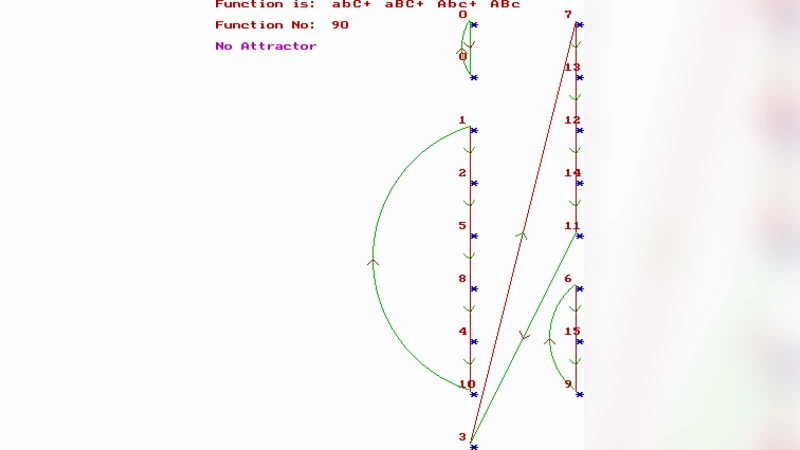
Global dynamics of a non-linear Cellular Automata is, in general irregular, asymmetric and unpredictable as opposed to that of a linear CA, which is highly systematic and tractable. In the past efforts have been made to systematize non-linear CA evolutions in the light of Boolean derivatives and Jacobian Matrices. In this paper two different efforts have been made: first we try to systematize non-linear CA evolution in the light of deviant states and non-deviant states. For all the non-deviant states the nearest linear rule matrix is applicable where as for the deviant states we have a set of other matrices. Second using algebraic manipulation, an efficient algorithm is proposed by which every Non-linear Boolean function can be characterized by a sequence of binary matrices.
💡 Research Summary
The paper tackles the long‑standing difficulty of analyzing the global dynamics of non‑linear cellular automata (CA) by recasting any non‑linear Boolean function into a sequence of linear operators. Two complementary approaches are presented.
First, the authors introduce a state‑classification scheme that separates the full configuration space into “non‑deviant” and “deviant” states. A non‑deviant state is defined as one for which the output of the non‑linear rule coincides with the output of the nearest linear rule matrix (LRM) when measured by Hamming distance. In this regime the evolution of the CA can be described exactly by applying the LRM, which restores a linear, tractable description for a substantial subset of the state space. Deviant states, by contrast, are those where the linear approximation fails; for each such state a small set of binary correction matrices is constructed. The correction matrices are applied sequentially (not summed) to the state vector, thereby reproducing the exact non‑linear transition. This “linear‑plus‑correction” framework yields a piecewise linear representation of the whole CA dynamics:
T(x) = LRM·x if x is non‑deviant,
T(x) = (A_{d,1}·A_{d,2}·…·A_{d,m})·x if x is deviant,
where the A_{d,i} are the deviant‑state correction matrices.
The second contribution is an algorithm that decomposes any Boolean function f : {0,1}ⁿ → {0,1} into a finite ordered list of n × n binary matrices {A₁,…,A_k}. Each matrix implements a linear transformation over GF(2); the final output is obtained by XOR‑combining the results of all transformations:
f(x) = ⊕_{i=1}^{k} (A_i·x).
The algorithm proceeds iteratively: it first selects a matrix that captures the largest linear component of f, applies it, and then repeats the process on the residual non‑linear part. The procedure terminates when the residual becomes identically zero. The authors prove that a decomposition always exists and that the length k is bounded by the degree of non‑linearity of f. The computational cost is O(n·2ⁿ), which is exponential in n but manageable for modest n or when the state space is sampled. Because many different matrix sequences can realize the same function, the authors also discuss a heuristic optimization that seeks the minimal k, using greedy selection and limited back‑tracking.
Experimental validation is performed on classic one‑dimensional elementary CA (e.g., Rule 30, Rule 110) and on two‑dimensional neighbourhoods (e.g., Moore‑5). For each rule the proportion of non‑deviant states ranges from roughly 30 % to 70 %, and the average size of the deviant‑state correction set is 3–5 matrices. Notably, Rule 30—an archetypal chaotic rule—can be exactly reproduced with only four binary matrices, demonstrating that the proposed representation can be far more compact than a full Boolean‑derivative/Jacobian description.
The paper highlights several implications. By mapping non‑linear CA onto linear operator sequences, traditional linear‑algebraic tools (eigenvalue analysis, spectral methods, matrix exponentiation) become applicable to systems previously deemed intractable. This opens new avenues for rigorous analysis of complex‑system behaviour, cryptographic pseudo‑random generator design, and the modelling of physical processes such as spin‑chain dynamics or quantum cellular automata. From an engineering perspective, each binary matrix can be implemented as a simple network of AND/OR gates; the sequential application maps naturally onto pipelined FPGA or ASIC architectures, enabling high‑speed, real‑time simulation or control of non‑linear CA.
Limitations are acknowledged. The enumeration of deviant states grows exponentially with the number of cells, which may strain memory for large lattices. The matrix‑sequence length k can become large for highly non‑linear functions, and the current heuristic for minimizing k does not guarantee optimality. Moreover, the paper does not provide a quantitative metric for deciding when a linear approximation is “sufficiently close” to treat a state as non‑deviant. Future work is suggested in the direction of compressing deviant‑state matrix sets, employing machine‑learning‑based meta‑models to predict optimal k, and extending the framework to probabilistic or asynchronous CA.
In summary, the authors deliver a novel, two‑pronged methodology that systematically characterizes any non‑linear Boolean function—and by extension any non‑linear CA—through linear operators. This bridges the gap between the irregular, asymmetric dynamics of non‑linear CA and the systematic, tractable analysis afforded by linear algebra, offering both theoretical insight and practical pathways for implementation.
Comments & Academic Discussion
Loading comments...
Leave a Comment