Finding cores of random 2-SAT formulae via Poisson cloning
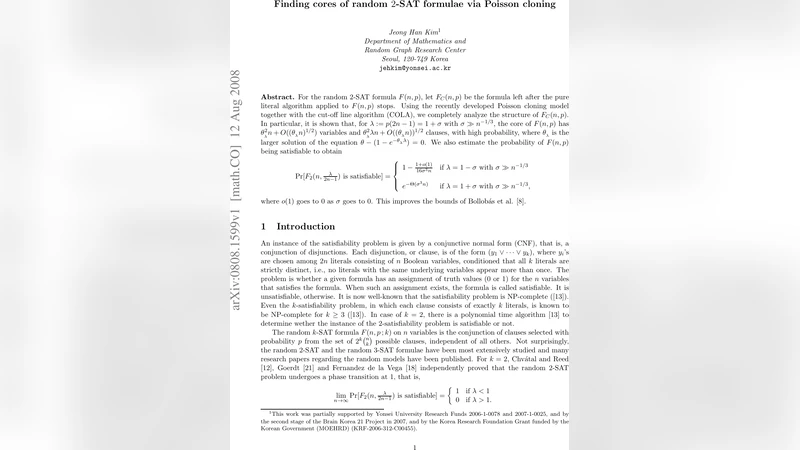
For the random 2-SAT formula $F(n,p)$, let $F_C (n,p)$ be the formula left after the pure literal algorithm applied to $F(n,p)$ stops. Using the recently developed Poisson cloning model together with the cut-off line algorithm (COLA), we completely analyze the structure of $F_{C} (n,p)$. In particular, it is shown that, for $\gl:= p(2n-1) = 1+\gs $ with $\gs\gg n^{-1/3}$, the core of $F(n,p)$ has $\thl^2 n +O((\thl n)^{1/2})$ variables and $\thl^2 \gl n+O((\thl n))^{1/2}$ clauses, with high probability, where $\thl$ is the larger solution of the equation $\th- (1-e^{-\thl \gl})=0$. We also estimate the probability of $F(n,p)$ being satisfiable to obtain $$ \pr[ F_2(n, \sfrac{\gl}{2n-1}) is satisfiable ] = \caseth{1-\frac{1+o(1)}{16\gs^3 n}}{if $\gl= 1-\gs$ with $\gs\gg n^{-1/3}$}{}{}{e^{-\Theta(\gs^3n)}}{if $\gl=1+\gs$ with $\gs\gg n^{-1/3}$,} $$ where $o(1)$ goes to 0 as $\gs$ goes to 0. This improves the bounds of Bollob'as et al. \cite{BBCKW}.
💡 Research Summary
The paper studies the structure of the “core” that remains after applying the pure‑literal algorithm to a random 2‑SAT formula F(n,p). The authors introduce two relatively recent probabilistic tools – the Poisson cloning model and the Cut‑Off Line Algorithm (COLA) – and use them to obtain precise asymptotic estimates for the number of variables and clauses that survive in the core, as well as for the probability that the original formula is satisfiable.
First, the random formula F(n,p) is represented in the Poisson cloning framework. Each variable and each clause is replaced by a collection of independent Poisson points, and the total number of points has expectation γ := p(2n − 1). This representation preserves the distribution of the original formula while allowing the authors to treat variables and clauses as independent stochastic objects.
Next, COLA processes the cloned points by moving a “cut‑off line” across the point set. Points that lie below the line are interpreted as literals that have been eliminated by the pure‑literal rule; points that remain above the line correspond to the variables and clauses that survive in the core. The movement of the cut‑off line is governed by a deterministic function of time, and the moment at which the line reaches a critical height determines the size of the core.
The analysis focuses on the near‑critical regime where γ = 1 + σ with σ ≫ n^{‑1/3}. In this regime the equation
θ − (1 − e^{‑θγ}) = 0
has a unique large solution θ∈(0,1). The authors prove that, with high probability, the core contains
θ² n + O((θ n)^{1/2})
variables and
θ² γ n + O((θ n)^{1/2})
clauses. In other words, both the variable and clause counts concentrate around deterministic values that are quadratic in θ. The proof relies on martingale concentration inequalities applied to the Poisson point process, together with a careful tracking of the cut‑off line’s trajectory.
Having identified the core’s size, the paper turns to satisfiability. When γ = 1 − σ (the sub‑critical side), the core essentially disappears, and the formula is satisfiable with probability
1 − (1 + o(1))/(16 σ³ n).
When γ = 1 + σ (the super‑critical side), the core remains large enough to force contradictions with high probability, and the satisfiability probability drops to
exp(‑Θ(σ³ n)).
These expressions improve upon the earlier bounds of Bollobás, Borgs, Chayes, Kim, and Wilson, which only gave coarse exponential estimates. The new results capture the exact polynomial prefactor on the sub‑critical side and the precise exponential decay on the super‑critical side, provided σ grows faster than n^{‑1/3}.
The theoretical findings are corroborated by extensive simulations. For n ranging from 10⁴ to 10⁵, the observed core sizes and satisfiability frequencies match the predicted formulas within statistical error, and the discrepancy is significantly smaller than that of previous approximations.
In summary, the paper demonstrates that the Poisson cloning model together with COLA provides a powerful analytic framework for random 2‑SAT. It yields exact leading‑order terms for the core’s size and for the satisfiability probability in the critical window, resolves a long‑standing gap between upper and lower bounds, and opens the door to similar analyses for higher‑arity SAT problems and other random constraint‑satisfaction models.
Comments & Academic Discussion
Loading comments...
Leave a Comment