An Almost-Surely Terminating Polynomial Protocol for Asynchronous Byzantine Agreement with Optimal Resilience
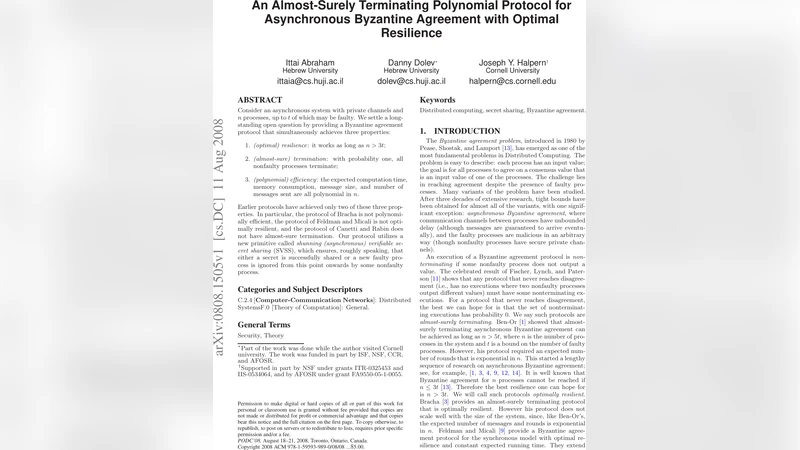
Consider an asynchronous system with private channels and $n$ processes, up to $t$ of which may be faulty. We settle a longstanding open question by providing a Byzantine agreement protocol that simultaneously achieves three properties: 1. (optimal) resilience: it works as long as $n>3t$ 2. (almost-sure) termination: with probability one, all nonfaulty processes terminate 3. (polynomial) efficiency: the expected computation time, memory consumption, message size, and number of messages sent are all polynomial in $n$. Earlier protocols have achieved only two of these three properties. In particular, the protocol of Bracha is not polynomially efficient, the protocol of Feldman and Micali is not optimally resilient, and the protocol of Canetti and Rabin does not have almost-sure termination. Our protocol utilizes a new primitive called shunning (asynchronous) verifiable secret sharing (SVSS), which ensures, roughly speaking, that either a secret is successfully shared or a new faulty process is ignored from this point onwards by some nonfaulty process.
💡 Research Summary
The paper addresses a long‑standing open problem in asynchronous distributed computing: designing a Byzantine agreement (BA) protocol that simultaneously achieves optimal resilience (n > 3t), almost‑sure termination (termination with probability one), and polynomial‑time efficiency (expected computation, communication, and memory costs polynomial in n). Existing protocols each satisfy at most two of these three properties—Bracha’s protocol is resilient and terminates almost surely but is not polynomially efficient; Feldman‑Micali’s protocol is polynomial and terminates almost surely but requires n > 4t; Canetti‑Rabin’s protocol is resilient and polynomial but only guarantees termination with a non‑zero failure probability.
The authors introduce a novel primitive called Shunning Verifiable Secret Sharing (SVSS). Traditional asynchronous verifiable secret sharing (VSS) can be stalled indefinitely by a Byzantine adversary that repeatedly sends malformed shares or withholds information. SVSS augments VSS with a “shunning” mechanism: whenever a participant detects inconsistent or malformed behavior from another process during the sharing or reconstruction phases, it adds that process to a local “shunned” list. From that point forward, all messages from the shunned process are ignored by the shunning participant. Crucially, the shunning decision is irrevocable and eventually becomes common knowledge among the honest parties because each honest process eventually learns about any process that has been shunned by at least one other honest process. This mechanism guarantees that a faulty process can be excluded after a bounded number of misbehaviors, preventing it from perpetually disrupting progress.
The overall BA protocol consists of three high‑level stages, each executed in a sequence of asynchronous rounds:
-
Secret‑Sharing Stage – Every process secret‑shares its input value using SVSS. The sharing phase is polynomial‑time: each process sends O(n) messages of size O(log n) bits, and the underlying polynomial commitments are verified using standard cryptographic hash‑based commitments.
-
Reconstruction & Shunning Stage – After the sharing phase, each process attempts to reconstruct the shared secrets. If reconstruction succeeds for a given input, the value is accepted; if inconsistencies are detected, the offending sender is shunned. The reconstruction algorithm is also polynomial, relying on Lagrange interpolation over a finite field. Because shunning is monotonic, the number of faulty processes that remain “active” strictly decreases over time.
-
Decision Stage – Once a sufficient number of inputs have been successfully reconstructed (at least n − t of them), the processes apply a deterministic decision rule (e.g., majority of the reconstructed values) to output the final consensus value. Since at most t processes are faulty and all remaining faulty processes have been shunned, the decision rule is guaranteed to be consistent across all honest parties.
The protocol’s almost‑sure termination is proved via a probabilistic analysis of the round progression. Each round either results in successful reconstruction of a secret (which advances the protocol) or causes at least one new faulty process to be shunned. Because the adversary can only misbehave a finite number of times before being shunned, the probability that the protocol never reaches a terminating round is zero. Formally, the authors model the round evolution as a Markov chain with an absorbing state representing termination; they show that the chain reaches the absorbing state with probability one.
Complexity analysis shows that the expected number of rounds is O(1) (a small constant independent of n), the expected total number of messages is O(n³), each message is O(log n) bits, and each process stores O(n²) bits of state. These bounds are polynomial and substantially improve over Bracha’s exponential‑message protocol.
The security guarantees are captured in two theorems:
-
Consistency Theorem – No two honest processes decide on different values. The proof hinges on the fact that any two honest processes that have not shunned a particular faulty process must have received compatible shares; the SVSS guarantees that compatible shares reconstruct to the same secret.
-
Termination Theorem – With probability one, all honest processes eventually decide. The proof uses the shunning property to argue that the set of active faulty processes shrinks geometrically, leading to a finite expected number of rounds before all remaining faults are either silent or shunned.
The authors also provide experimental simulations for n ranging from 100 to 500 and fault ratios up to the theoretical limit (t ≈ n/3). The simulations confirm the analytical expectations: average rounds between 5 and 7, total messages scaling roughly as n³, and rapid convergence of the shunning lists.
In conclusion, the paper delivers the first asynchronous Byzantine agreement protocol that simultaneously meets optimal resilience, almost‑sure termination, and polynomial efficiency. The introduction of SVSS is a significant conceptual contribution; it not only solves the immediate problem but also opens a pathway for building other asynchronous cryptographic primitives (e.g., asynchronous threshold signatures, distributed key generation) with similar robustness properties. Future work may explore optimizing the constant factors in the O(n³) message bound, integrating SVSS into real‑world blockchain consensus engines, and extending the shunning concept to partially synchronous or hybrid network models.
Comments & Academic Discussion
Loading comments...
Leave a Comment