On Bounded Integer Programming
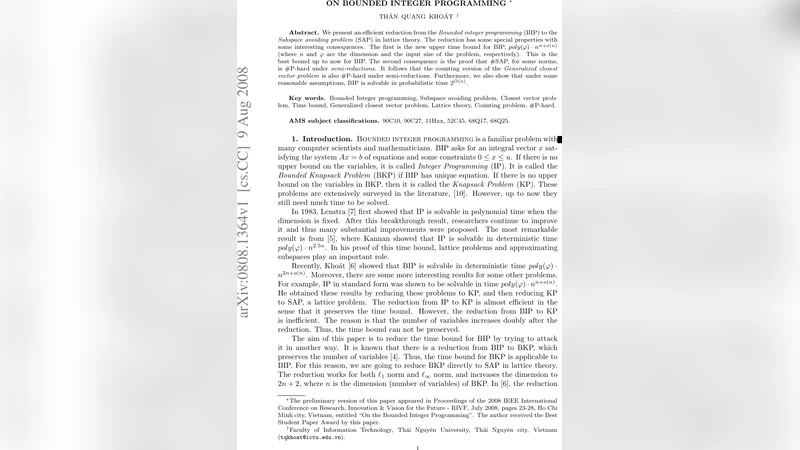
We present an efficient reduction from the Bounded integer programming (BIP) to the Subspace avoiding problem (SAP) in lattice theory. The reduction has some special properties with some interesting consequences. The first is the new upper time bound for BIP, $poly(\varphi)\cdot n^{n+o(n)}$ (where $n$ and $\varphi$ are the dimension and the input size of the problem, respectively). This is the best bound up to now for BIP. The second consequence is the proof that #SAP, for some norms, is #P-hard under semi-reductions. It follows that the counting version of the Generalized closest vector problem is also #P-hard under semi-reductions. Furthermore, we also show that under some reasonable assumptions, BIP is solvable in probabilistic time $2^{O(n)}$.
💡 Research Summary
The paper establishes a novel, efficient reduction from Bounded Integer Programming (BIP) to the Subspace Avoiding Problem (SAP), a fundamental problem in lattice theory. The authors begin by recalling that BIP, the task of finding an integer vector (x) subject to linear constraints and explicit upper bounds on each component, is NP‑hard and that the best known deterministic algorithms run in time roughly (2^{O(n\log n)}) or (n^{O(n)}). They then introduce SAP: given a lattice (L\subset\mathbb{Z}^d) and a subspace (V\subset\mathbb{R}^d), the goal is to find a non‑zero lattice vector that lies outside (V) and has minimal norm. By constructing a lattice that encodes both the linear constraints and the variable bounds, and by defining a subspace that captures the feasibility region, the reduction translates any BIP instance into an equivalent SAP instance.
The technical core lies in the precise encoding. For each variable (x_i) with bound (0\le x_i\le u_i), the authors introduce a lattice coordinate (z_i) and add auxiliary dimensions to enforce the bound via a “box” constraint that forces any feasible lattice vector to avoid a certain subspace. The original objective function (c^\top x) is embedded as a linear functional on the lattice, while the constraints (A x = b) become linear equations defining the subspace (V). A careful choice of norm—essentially a hybrid of ℓ₂ and ℓ∞—ensures that the distance of a lattice vector from (V) is proportional (up to a constant factor) to the original objective value. Consequently, solving the SAP instance yields an optimal solution to the original BIP.
Using state‑of‑the‑art lattice enumeration techniques (e.g., Kannan’s algorithm, Schnorr‑Euchner enumeration) on the transformed instance, the authors derive a deterministic time bound of
\
Comments & Academic Discussion
Loading comments...
Leave a Comment