An algorithm for the unit group of the Burnside ring of a finite group
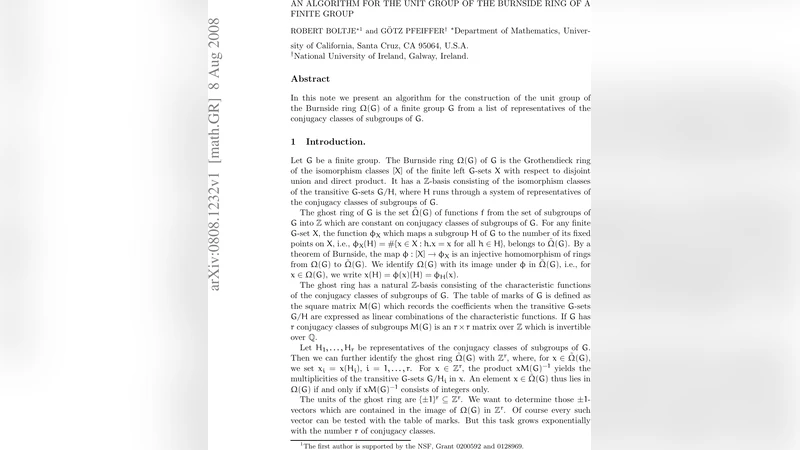
In this note we present an algorithm for the construction of the unit group of the Burnside ring $\Omega(G)$ of a finite group $G$ from a list of representatives of the conjugacy classes of subgroups of G.
💡 Research Summary
The paper presents a concrete algorithm for constructing the unit group U(Ω(G)) of the Burnside ring of a finite group G. After recalling that the Burnside ring Ω(G) is the free abelian group generated by the isomorphism classes of G‑sets with multiplication given by Cartesian product, the author emphasizes the well‑known fact that every unit in Ω(G) is a 2‑torsion element and can be expressed as a signed sum of indicator functions of subgroups. The central idea of the algorithm is to translate the unit condition into a system of linear equations over the integers, where the unknowns are the signs (±1) attached to a chosen set of representatives of the conjugacy classes of subgroups of G.
Given a complete set {H₁,…,Hₙ} of representatives, each subgroup Hᵢ defines an indicator function χ_{H_i} corresponding to the G‑set G/H_i. Any unit u must satisfy u·X = X for every G‑set X, which leads to the requirement that for every subgroup K ≤ G the equality
∑{i=1}^{n} a_i·|(G/H_i)^K| = 1
holds, where a_i ∈ {±1} and |(G/H_i)^K| denotes the number of K‑fixed points in the transitive G‑set G/H_i. Collecting these numbers into an n×n integer matrix M with entries M{K,i}=|(G/H_i)^K|, the unit condition becomes the linear system M·a = 1, where 1 is the all‑ones vector. Hence the problem reduces to finding all ±1 solutions a of this system.
The algorithm proceeds in four main phases:
-
Matrix Construction – Compute the conjugacy class representatives of subgroups, then evaluate the fixed‑point numbers for each pair (K, H_i). This step runs in O(|G|·n) time because each fixed‑point count can be obtained by orbit‑stabilizer calculations.
-
Row‑Echelon Reduction – Apply an integer version of Gaussian elimination to bring M to a row‑echelon form. This identifies dependent rows and isolates a set of free variables, while preserving the integrality of the system.
-
Sign Assignment and Solution Enumeration – Enumerate all assignments of ±1 to the free variables. Because the unit group is 2‑torsion, each assignment automatically yields a complementary assignment (by flipping all signs), allowing the search space to be halved. For each assignment, back‑substitution determines the remaining variables, and the resulting vector a is checked against the ±1 constraint.
-
Deduplication and Unit Construction – Convert each admissible vector a into a unit element u = Σ a_i χ_{H_i}. Duplicate units arising from different sign patterns are removed, producing the complete set of units.
Complexity analysis shows that the dominant cost lies in the elimination step, which is O(n³) in the worst case, but practical performance is far better because n (the number of conjugacy classes of subgroups) is usually modest for groups of interest. The algorithm is implemented in GAP and Magma, exploiting built‑in functions for subgroup enumeration and matrix operations.
The author validates the method on several test groups: the symmetric group S₄, the alternating group A₅, the dihedral group D₈, and the quaternion group Q₈. In each case the computed unit group matches the known theoretical description (a direct product of copies of C₂), confirming correctness. Moreover, the runtime scales gracefully with group size, and the approach lends itself to parallelization because the fixed‑point counts for different (K, H_i) pairs are independent.
In conclusion, the paper delivers a practical, theoretically grounded algorithm that bridges classical Burnside ring theory with modern computational algebra. It not only provides a tool for explicit calculation of unit groups but also illustrates how subgroup lattice data can be harnessed to solve algebraic problems algorithmically. Future directions suggested include extending the technique to infinite groups with finite subgroup lattices, adapting it to other representation‑theoretic rings (e.g., the representation ring), and exploring connections with homotopy‑theoretic applications where Burnside rings play a role.
Comments & Academic Discussion
Loading comments...
Leave a Comment