A Formal Foundation for XrML
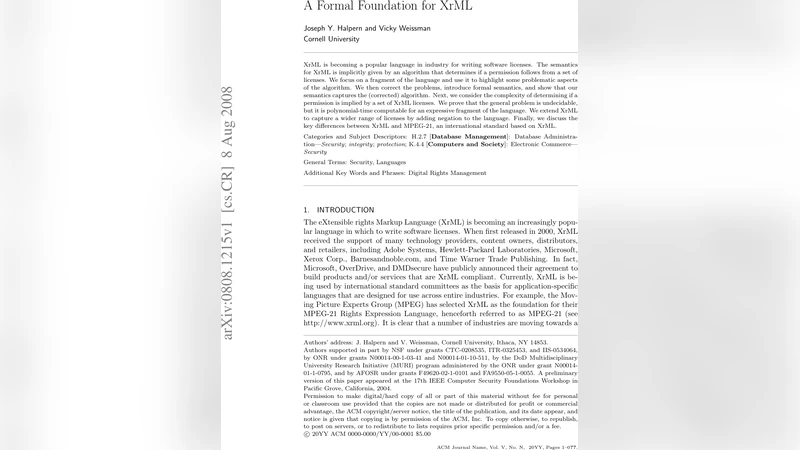
XrML is becoming a popular language in industry for writing software licenses. The semantics for XrML is implicitly given by an algorithm that determines if a permission follows from a set of licenses. We focus on a fragment of the language and use it to highlight some problematic aspects of the algorithm. We then correct the problems, introduce formal semantics, and show that our semantics captures the (corrected) algorithm. Next, we consider the complexity of determining if a permission is implied by a set of XrML licenses. We prove that the general problem is undecidable, but it is polynomial-time computable for an expressive fragment of the language. We extend XrML to capture a wider range of licenses by adding negation to the language. Finally, we discuss the key differences between XrML and MPEG-21, an international standard based on XrML.
💡 Research Summary
The paper addresses the growing industrial adoption of XrML (eXtensible rights Markup Language) by providing a rigorous formal foundation for its semantics, exposing flaws in the existing inference algorithm, and proposing corrected semantics together with complexity results. The authors first isolate a core fragment of XrML that captures the most frequently used constructs: licenses, grants, principals, rights, conditions, and delegation. By analysing real‑world XrML documents they show that this fragment covers the majority of practical cases.
Next, they scrutinise the algorithm originally supplied with XrML, which decides whether a permission (a query Q such as “User X may read File Y”) follows from a set of licenses L. Through concrete counter‑examples they demonstrate that the algorithm fails when multiple delegations and composite conditions interact. For instance, when A grants B the right to read and B subsequently delegates that right to C, the algorithm may incorrectly conclude that C lacks the permission because the propagation rule for delegations is not formally defined.
To remedy these defects the authors adopt a two‑step approach. First, they augment the algorithm with explicit inference rules: (1) a delegation propagation rule that allows a principal who has obtained a right to re‑grant it, (2) a condition satisfaction rule that requires all antecedent predicates to hold before a right becomes effective, and (3) principal equivalence/grouping rules. Second, they introduce a formal semantics built on a combination of subset logic and modal operators. A license set L is interpreted as a logical structure; a query Q is translated into a logical formula, and the satisfaction relation ⟦L⟧ ⊨ Q is decided by constructing a graph of licenses and performing a systematic traversal. The authors prove that this semantics is equivalent to the corrected algorithm, i.e., they always produce the same answer for any L and Q.
The paper then turns to computational complexity. In the unrestricted fragment, conditions may be arbitrary first‑order predicates, and delegations can be nested without bound. By reducing from the halting problem, the authors show that the general permission‑implication problem is undecidable. However, they identify an expressive yet tractable fragment: conditions are limited to atomic propositions, and the depth of delegation chains is bounded by a constant k. For this fragment they devise a polynomial‑time algorithm that topologically sorts the license graph and evaluates conditions in a bottom‑up dynamic‑programming fashion. The runtime is O(|L|·k), making it practical for real‑world deployments.
A further contribution is the extension of XrML with explicit negation. Negation allows statements such as “User X is not permitted to copy” to be expressed directly, moving XrML away from the implicit closed‑world assumption of the original specification. The authors integrate negation into their formal semantics without breaking the previously established equivalence or complexity bounds; the extended language remains decidable in the tractable fragment and retains the same polynomial runtime.
Finally, the paper compares XrML with MPEG‑21, an international standard that was derived from XrML. While both share a common heritage, MPEG‑21 differs in three key respects: it provides native support for revocation and conditional allowances as separate constructs, it adopts a different metadata model for rights expressions, and it does not incorporate a formal negation operator, relying instead on explicit revocation statements. These differences have practical implications for interoperability and for the design of rights‑management systems.
In summary, the work delivers a solid theoretical underpinning for XrML, corrects critical flaws in its inference mechanism, delineates the boundary between undecidable and efficiently solvable cases, and broadens the language with negation. The results are directly applicable to the development of reliable rights‑management tools and inform future standardisation efforts.
Comments & Academic Discussion
Loading comments...
Leave a Comment