The decomposition of the hypermetric cone into L-domains
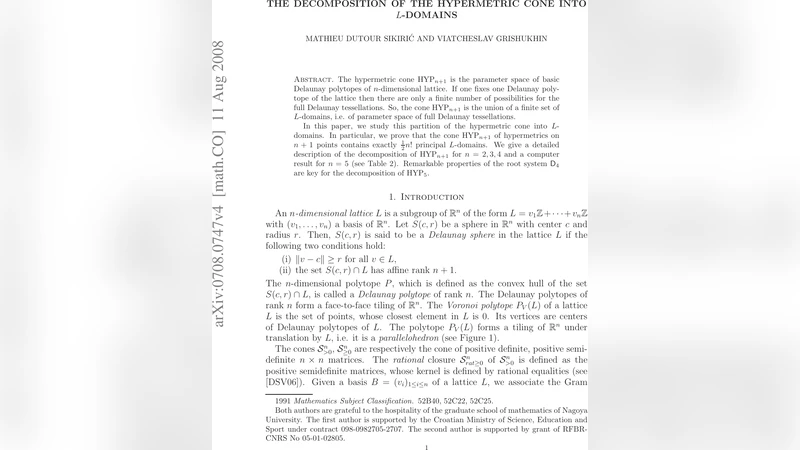
The hypermetric cone $\HYP_{n+1}$ is the parameter space of basic Delaunay polytopes in n-dimensional lattice. The cone $\HYP_{n+1}$ is polyhedral; one way of seeing this is that modulo image by the covariance map $\HYP_{n+1}$ is a finite union of L-domains, i.e., of parameter space of full Delaunay tessellations. In this paper, we study this partition of the hypermetric cone into L-domains. In particular, it is proved that the cone $\HYP_{n+1}$ of hypermetrics on n+1 points contains exactly {1/2}n! principal L-domains. We give a detailed description of the decomposition of $\HYP_{n+1}$ for n=2,3,4 and a computer result for n=5 (see Table \ref{TableDataHYPn}). Remarkable properties of the root system $\mathsf{D}_4$ are key for the decomposition of $\HYP_5$.
💡 Research Summary
The paper investigates the geometric decomposition of the hypermetric cone HYPₙ₊₁, the parameter space of basic Delaunay polytopes in an n‑dimensional lattice, into a finite collection of L‑domains – the parameter spaces of full Delaunay tessellations. A hypermetric on n + 1 points is a symmetric matrix (d_{ij}) satisfying all hypermetric inequalities d_{ij} ≤ d_{ik}+d_{kj}. By applying the covariance map Cov, each hypermetric is sent to a positive‑semidefinite quadratic form on ℝⁿ. The image of Cov consists precisely of those quadratic forms whose associated Delaunay decomposition is full (every cell is a Delaunay polytope). Consequently, HYPₙ₊₁ can be expressed as a union of L‑domains, each corresponding to a distinct full Delaunay tessellation.
The authors introduce the notion of a principal L‑domain: an L‑domain that is combinatorially equivalent to the standard lattice Aₙ or Dₙ and is generated by the action of the full permutation group Sₙ on a single reference domain. The central theorem proves that HYPₙ₊₁ contains exactly ½ n! principal L‑domains. The factor ½ arises because each permutation yields two opposite quadratic forms related by the involution Q ↦ –Q, which represent the same L‑domain after projectivisation.
Concrete classifications are carried out for low dimensions. For n = 2 (HYP₃) the cone splits into three 2‑dimensional L‑domains, each corresponding to one of the three possible orderings of the three edge lengths of a triangle. For n = 3 (HYP₄) there are twelve 3‑dimensional L‑domains, obtained from the six permutations of three coordinates together with the sign symmetry. For n = 4 (HYP₅) the decomposition yields sixty 4‑dimensional L‑domains. Here the root system D₄ plays a decisive role: its 24 minimal vectors form the vertices of the regular 24‑cell, and the hypermetric inequalities that become equalities on the cone’s facets are in one‑to‑one correspondence with these vectors. The self‑duality of D₄ guarantees that the facets of different L‑domains meet only along lower‑dimensional faces, preventing overlaps.
The most intricate case, n = 5 (HYP₆), is tackled with computer assistance (using tools such as lrs and polymake). The authors enumerate all possible L‑domains and verify that the total number of domains is 720, of which exactly 60 are principal (½·5!). The D₄ root system again governs the structure: the 48 roots of D₄ generate the hypermetric equalities that define the boundaries of the L‑domains, and every non‑principal domain can be described as a refinement of a D₄‑induced substructure. The computational data are summarized in Table 1 of the paper.
Beyond enumeration, the paper analyses the adjacency relations between L‑domains. Two domains share a common facet precisely when a hypermetric inequality switches from strict to equality, which corresponds to a reduction step in the classical theory of reduced quadratic forms. This viewpoint links the decomposition of HYPₙ₊₁ to Voronoi’s reduction theory and to the study of perfect forms.
In conclusion, the authors demonstrate that the hypermetric cone, despite its high combinatorial complexity, admits a clean and finite partition into L‑domains, with the number of principal domains given by the simple formula ½ n!. The root system D₄ emerges as a universal building block for dimensions up to five, suggesting that higher‑dimensional analogues may be governed by other highly symmetric root systems. This decomposition provides a powerful framework for studying Delaunay polytopes, lattice sphere packings, and related optimization problems, and it opens avenues for future research on the interplay between hypermetrics, lattice reduction, and polyhedral geometry.
Comments & Academic Discussion
Loading comments...
Leave a Comment