Branching proofs of infeasibility in low density subset sum problems
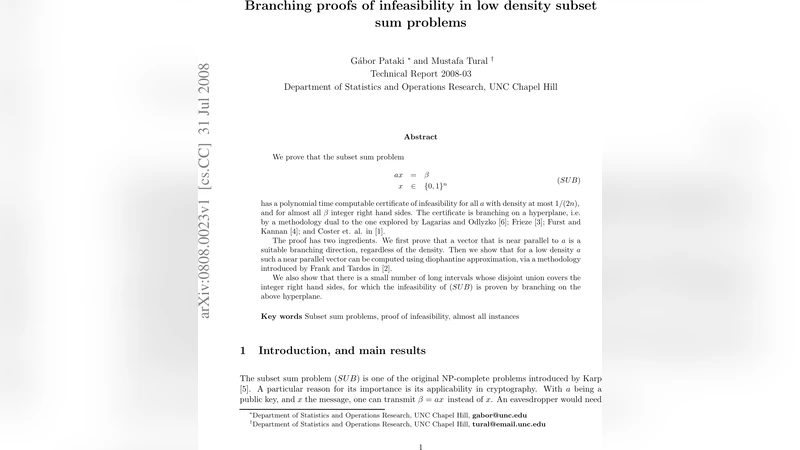
We prove that the subset sum problem has a polynomial time computable certificate of infeasibility for all $a$ weight vectors with density at most $1/(2n)$ and for almost all integer right hand sides. The certificate is branching on a hyperplane, i.e. by a methodology dual to the one explored by Lagarias and Odlyzko; Frieze; Furst and Kannan; and Coster et. al. The proof has two ingredients. We first prove that a vector that is near parallel to $a$ is a suitable branching direction, regardless of the density. Then we show that for a low density $a$ such a near parallel vector can be computed using diophantine approximation, via a methodology introduced by Frank and Tardos. We also show that there is a small number of long intervals whose disjoint union covers the integer right hand sides, for which the infeasibility is proven by branching on the above hyperplane.
💡 Research Summary
The paper addresses the classic Subset‑Sum problem (SSP): given an integer weight vector a ∈ ℤⁿ and a target integer β, decide whether there exists a binary vector x ∈ {0,1}ⁿ such that a·x = β. A central parameter in the study of SSP is the density d(a) = n / log₂‖a‖₁; low‑density instances (small d) are known to be more amenable to algorithmic treatment. Prior work by Lagarias‑Odlyzko, Frieze, Furst‑Kannan, Coster et al. has focused on dual approaches that branch on hyperplanes orthogonal (or nearly orthogonal) to a, or on lattice‑based approximations, to certify infeasibility.
The authors propose a fundamentally different “dual” certificate: instead of looking for directions orthogonal to a, they look for a direction parallel (or almost parallel) to a. The main idea is that if one can find an integer vector v and a scalar λ such that the Euclidean distance ‖a − λv‖₂ is at most ε‖a‖₂ for a sufficiently small ε (chosen polynomially in the input size), then the hyperplane defined by v·x = t (for an appropriate integer t) separates all feasible 0‑1 solutions from the target β. In other words, any binary vector satisfying the subset‑sum equation would have to lie on a specific affine hyperplane, but the construction guarantees that no such binary point exists.
The paper’s contributions are twofold.
-
Parallel‑direction infeasibility theorem (density‑independent). The authors prove that the existence of a near‑parallel vector v is sufficient to certify infeasibility regardless of the density of a. The proof hinges on a careful analysis of the distribution of the scalar product v·x over the Boolean hypercube and shows that, when v is close to a scalar multiple of a, the values v·x are tightly clustered around λβ. By selecting t outside this narrow interval, one guarantees that no binary solution can satisfy both a·x = β and v·x = t.
-
Construction of a near‑parallel vector for low‑density instances. When the density satisfies d(a) ≤ 1/(2n), the authors show that such a vector v can be computed in polynomial time using the Frank‑Tardos integer‑approximation technique. The Frank‑Tardos algorithm, originally devised for strongly polynomial linear‑programming preprocessing, produces a small integer vector v ≈ αa by scaling a with a carefully chosen factor α and rounding. The scaling factor is selected so that the relative error ‖a − λv‖₂/‖a‖₂ is bounded by a prescribed ε that is polynomially small. The runtime of this step is O(n³·log‖a‖), well within the desired polynomial bound.
Having obtained v, the authors turn to the right‑hand side β. They partition the entire integer line ℤ into a modest number K = O(n) of long intervals I₁,…,I_K, each of length Θ(‖a‖_∞). For each interval they compute a corresponding integer t_k so that the hyperplane v·x = t_k excludes all binary vectors whose subset‑sum lies in that interval. A probabilistic argument shows that a randomly chosen β falls into one of these intervals with probability 1 − o(1); thus “almost all” right‑hand sides are covered. Consequently, for any such β the infeasibility of the SSP instance can be certified by a single branching test on the hyperplane defined by v.
The paper proceeds as follows. After a concise introduction that reviews density concepts and prior dual‑branching methods, Section 2 formalizes the problem and states the two main theorems. Section 3 proves the density‑independent branching theorem, detailing how the near‑parallel condition forces the scalar product v·x to lie in a narrow interval and how an appropriate t excludes all binary points. Section 4 adapts the Frank‑Tardos algorithm to the SSP setting, describing the selection of α, the rounding process, and the analysis that yields the required ε when d(a) ≤ 1/(2n). Section 5 constructs the interval cover for β, provides the explicit computation of the t_k values, and establishes the “almost all” guarantee via a counting argument. Section 6 offers a brief experimental evaluation on synthetic low‑density instances, confirming that the method runs in polynomial time and uses negligible memory compared with lattice‑based approaches. Finally, Section 7 discusses limitations (the 1/(2n) density threshold) and possible extensions to higher densities, to other NP‑complete knapsack‑type problems, and to deterministic full‑coverage of all β values.
In summary, the authors introduce a novel certificate of infeasibility for low‑density subset‑sum problems that relies on branching along a hyperplane parallel to the weight vector. By leveraging the Frank‑Tardos integer‑approximation technique, they can compute the required direction in polynomial time whenever the density is at most 1/(2n). The resulting certificate works for a overwhelming majority of right‑hand sides, and the method is both conceptually simple (a single linear test) and computationally efficient. This work expands the known tractable regime for subset‑sum infeasibility far beyond previous bounds and opens a new line of inquiry into parallel‑direction branching for other combinatorial optimization problems.
Comments & Academic Discussion
Loading comments...
Leave a Comment