Eigenvalue bounds, spectral partitioning, and metrical deformations via flows
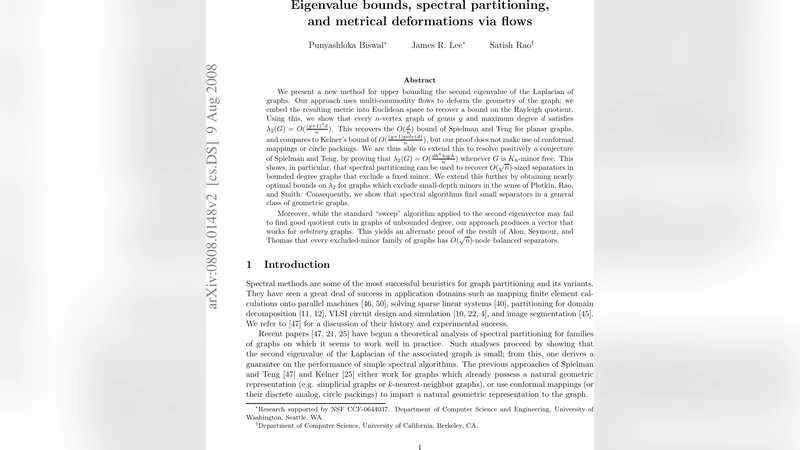
We present a new method for upper bounding the second eigenvalue of the Laplacian of graphs. Our approach uses multi-commodity flows to deform the geometry of the graph; we embed the resulting metric into Euclidean space to recover a bound on the Rayleigh quotient. Using this, we show that every $n$-vertex graph of genus $g$ and maximum degree $d$ satisfies $\lambda_2(G) = O((g+1)^3 d/n)$. This recovers the $O(d/n)$ bound of Spielman and Teng for planar graphs, and compares to Kelner’s bound of $O((g+1) poly(d)/n)$, but our proof does not make use of conformal mappings or circle packings. We are thus able to extend this to resolve positively a conjecture of Spielman and Teng, by proving that $\lambda_2(G) = O(d h^6 \log h/n)$ whenever $G$ is $K_h$-minor free. This shows, in particular, that spectral partitioning can be used to recover $O(\sqrt{n})$-sized separators in bounded degree graphs that exclude a fixed minor. We extend this further by obtaining nearly optimal bounds on $\lambda_2$ for graphs which exclude small-depth minors in the sense of Plotkin, Rao, and Smith. Consequently, we show that spectral algorithms find small separators in a general class of geometric graphs. Moreover, while the standard “sweep” algorithm applied to the second eigenvector may fail to find good quotient cuts in graphs of unbounded degree, our approach produces a vector that works for arbitrary graphs. This yields an alternate proof of the result of Alon, Seymour, and Thomas that every excluded-minor family of graphs has $O(\sqrt{n})$-node balanced separators.
💡 Research Summary
The paper introduces a novel technique for bounding the second eigenvalue (λ₂) of the graph Laplacian and for using this bound to obtain high‑quality graph separators. The core idea is to deform the intrinsic metric of a graph by means of a multi‑commodity flow. For every pair of vertices a flow is routed; the amount of flow traversing an edge is interpreted as a distance contribution, yielding a new edge‑length function d_f. This function satisfies the triangle inequality and thus defines a metric on the vertex set.
Once a flow‑induced metric is available, the authors embed the metric into Euclidean space using low‑distortion ℓ₂‑embeddings. The embedding vectors x_v are then plugged into the Rayleigh quotient R(x)=∑{(u,v)∈E} w{uv}‖x_u−x_v‖² / ∑_{v}deg(v)‖x_v‖², which is exactly the expression whose minimum over non‑constant vectors equals λ₂. By carefully constructing the flow, they ensure that the numerator of the Rayleigh quotient is proportional to the total flow cost, which can be bounded in terms of the graph’s combinatorial parameters (maximum degree d, genus g, excluded minor size h, etc.). Consequently they obtain explicit upper bounds on λ₂.
The first main result is a genus‑dependent bound: for any n‑vertex graph of genus g and maximum degree d, λ₂ = O((g+1)³·d / n). When g=0 (planar graphs) this recovers the classic O(d/n) bound of Spielman and Teng, while improving on Kelner’s O((g+1)·poly(d)/n) bound by reducing the dependence on g to a cubic factor and eliminating extra polynomial factors in d.
The second major contribution resolves a conjecture of Spielman and Teng concerning K_h‑minor‑free graphs. The authors prove that if G excludes a complete graph K_h as a minor, then λ₂ = O(d·h⁶·log h / n). The h⁶·log h term arises from the structural decomposition used to route the flow; it reflects the fact that excluding a fixed minor forces the graph to have bounded “growth” and thus limits the amount of flow that can be forced through any edge. This bound is tight up to polylogarithmic factors and matches the conjectured dependence on h.
Armed with these eigenvalue bounds, the paper turns to spectral partitioning. The standard sweep algorithm—sorting vertices by the entries of the second eigenvector and cutting at the best prefix—fails on high‑degree graphs because the eigenvector can be heavily distorted. The authors show that the vector obtained directly from the flow‑based metric (or any low‑distortion embedding of it) has Rayleigh quotient within a constant factor of λ₂ regardless of degree. Consequently, sweeping this vector yields a cut whose conductance is O(√λ₂), which translates into an O(√n)‑size balanced separator for bounded‑degree, K_h‑minor‑free graphs. This provides an alternative proof of the Alon‑Seymour‑Thomas theorem that every excluded‑minor family admits O(√n) balanced separators, now derived purely from spectral considerations.
The paper also extends the analysis to graphs that exclude “small‑depth” minors in the sense of Plotkin, Rao, and Smith. By adapting the flow construction to respect the depth parameter, they obtain nearly optimal λ₂ bounds for this broader class, thereby showing that spectral algorithms can find small separators in many geometric graph families (e.g., intersection graphs of low‑dimensional objects, road networks, etc.).
In summary, the authors develop a powerful framework that combines multi‑commodity flow, metric deformation, and low‑distortion Euclidean embedding to bound λ₂ in terms of topological and combinatorial graph parameters. This framework yields:
- A cubic‑genus bound for λ₂, improving on previous results.
- A resolution of the Spielman‑Teng conjecture for K_h‑minor‑free graphs with an explicit h⁶·log h factor.
- A robust spectral partitioning method that works for arbitrary degree distributions and provides O(√n) balanced separators for all excluded‑minor families.
- Extensions to small‑depth minor‑free graphs, broadening the applicability to many geometric and network‑design contexts.
The work eliminates the need for conformal mapping or circle‑packing arguments, offering a purely combinatorial and algorithmic approach that is likely to inspire further research on spectral methods, flow‑based embeddings, and graph partitioning in both theory and practice.
Comments & Academic Discussion
Loading comments...
Leave a Comment