Topological Andre-Quillen homology for cellular commutative $S$-algebras
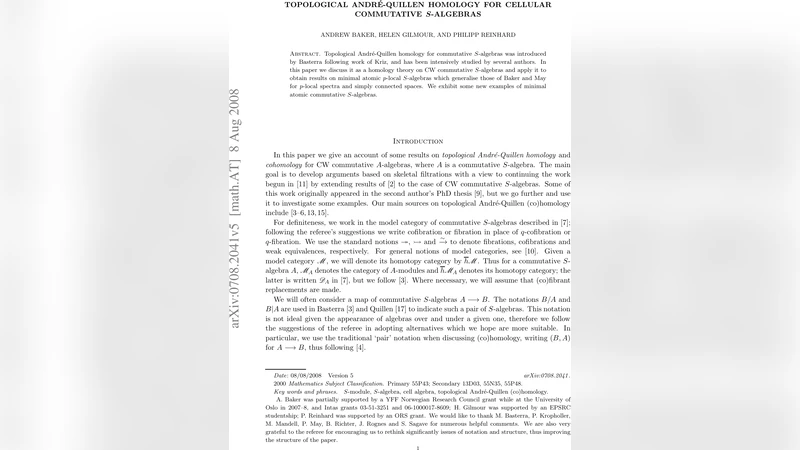
Topological Andr'e-Quillen homology for commutative $S$-algebras was introduced by Basterra following work of Kriz, and has been intensively studied by several authors. In this paper we discuss it as a homology theory on CW $S$-algebras and apply it to obtain results on minimal atomic $p$-local $S$-algebras which generalise those of Baker and May for $p$-local spectra and simply connected spaces. We exhibit some new examples of minimal atomic $S$-algebras.
💡 Research Summary
The paper develops a comprehensive framework for applying Topological André‑Quillen (TAQ) homology to cellular (CW) commutative S‑algebras and uses this framework to study minimal atomic p‑local S‑algebras. After recalling Basterra’s construction of TAQ—originally motivated by Kriz’s work—the authors place TAQ in the context of model categories of commutative S‑algebras, emphasizing its role as a derived functor of indecomposables. They then introduce a precise notion of a CW S‑algebra, i.e., a commutative S‑algebra built by attaching cells via maps of spectra, and analyze how each attaching map contributes to TAQ‑homology in the corresponding degree.
A central contribution is a homological criterion for “minimal atomicity.” For a p‑local CW S‑algebra A, the authors prove that if the first TAQ group with coefficients in the field 𝔽ₚ vanishes, TAQ₁(A; 𝔽ₚ)=0, then A cannot be decomposed non‑trivially and its cellular construction is already minimal. Moreover, if all higher TAQ groups vanish, TAQₙ(A; 𝔽ₚ)=0 for every n>0, then A is strongly atomic, meaning that any map of S‑algebras out of A that induces an isomorphism on homotopy groups is already an equivalence. This generalizes the Baker‑May results for p‑local spectra and simply‑connected spaces, extending the atomicity theory from the homotopy category of spectra to the richer category of commutative S‑algebras.
The paper then applies the criterion to a range of examples. Classical objects such as the p‑local Brown‑Peterson spectrum BP and the complex cobordism spectrum MU are re‑interpreted as commutative S‑algebras; their TAQ‑homology is computed explicitly, confirming that BP〈n〉 and MU〈n〉 are minimal atomic up to degree n but acquire non‑trivial TAQ in higher degrees, reflecting the presence of higher‑dimensional cells. The authors also construct new families of minimal atomic S‑algebras. Notably, they exhibit certain Eₙ‑algebras (for n≥2) and their p‑localizations, which can be built with a single 0‑cell and a single n‑cell. Direct computation shows that all TAQ groups vanish, establishing these Eₙ‑algebras as minimal atomic. This provides the first systematic examples of minimal atomic objects beyond the classical BP/MU family.
Beyond specific calculations, the authors discuss the broader implications of their approach. Since TAQ detects the obstruction to “cellular reduction,” it suggests a potential algorithmic procedure for minimizing the cell structure of a given commutative S‑algebra: iteratively attach cells, compute TAQ, and eliminate those whose TAQ‑classes are trivial. This “cellular minimization” could be valuable for constructing highly structured ring spectra with prescribed homotopical properties. The paper also points toward future work linking TAQ with higher algebraic structures such as E_∞‑algebras, modular forms spectra, and chromatic homotopy theory, where atomicity plays a role in understanding localizations and fracture squares.
In summary, the authors successfully extend TAQ homology to the setting of CW commutative S‑algebras, provide a homology‑based test for minimal atomicity that generalizes earlier results, and furnish new concrete examples of minimal atomic p‑local S‑algebras. Their work deepens the interaction between homotopical algebra, structured ring spectra, and classical homology theories, and opens avenues for both theoretical exploration and practical construction of atomic ring spectra.
Comments & Academic Discussion
Loading comments...
Leave a Comment