Weighted distance transforms generalized to modules and their computation on point lattices
This paper presents the generalization of weighted distances to modules and their computation through the chamfer algorithm on general point lattices. The first part is dedicated to formalization of definitions and properties (distance, metric, norm) of weighted distances on modules. It resumes tools found in literature to express the weighted distance of any point of a module and to compute optimal weights in the general case to get rotation invariant distances. The second part of this paper proves that, for any point lattice, the sequential two-scan chamfer algorithm produces correct distance maps. Finally, the definitions and computation of weighted distances are applied to the face-centered cubic (FCC) and body-centered cubic (BCC) grids.
💡 Research Summary
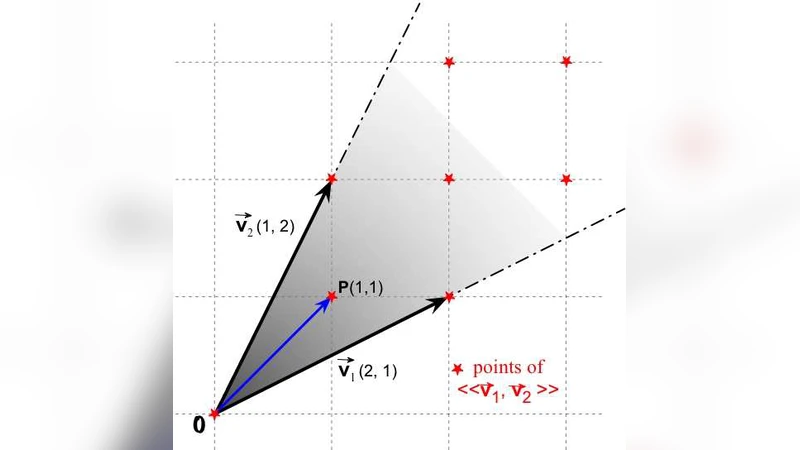
This paper extends the concept of weighted distance transforms (WDT) from the classical integer lattice ℤⁿ to the much broader algebraic structure of modules, thereby enabling distance computation on arbitrary point lattices. The authors begin by formalizing the notions of distance, metric, and norm on a module M, which is defined as a free abelian group over the integer ring ℤ. This definition naturally includes not only the standard orthogonal grids but also non‑orthogonal lattices such as the face‑centered cubic (FCC) and body‑centered cubic (BCC) structures. Within this framework, a weighted distance is generated by a finite mask – a set of neighbor vectors – each assigned a positive weight. The distance from any point to the origin is expressed as the minimal sum of weighted steps along paths composed of mask vectors. The paper proves that when the mask induces a strongly connected directed graph on the module, the resulting function satisfies symmetry, non‑negativity, identity of indiscernibles, and the triangle inequality, thus qualifying as a true metric; if it also respects positive homogeneity, it becomes a norm.
The second major contribution is the adaptation of the classic two‑scan chamfer algorithm to any point lattice. In orthogonal grids the algorithm proceeds by a forward scan followed by a backward scan, updating each voxel with the minimum of its current value and the values of its already‑processed neighbors plus the corresponding mask weights. Extending this to non‑orthogonal lattices is non‑trivial because neighbor relationships are no longer aligned with the coordinate axes, and path crossing can introduce errors. The authors resolve this by exploiting the basis representation of the module and the symmetry of the mask: during the forward scan only neighbors that are positive integer combinations of the basis vectors are considered, while the backward scan uses the negative combinations. They provide a rigorous proof that, under these conditions, the two‑scan process yields the exact weighted distance map for any lattice, regardless of its geometry.
A further focus of the work is the determination of optimal mask weights that minimize directional bias, i.e., achieve rotation invariance. The authors formulate a linear programming problem that minimizes the maximum relative error (MRE) between the weighted distance and the true Euclidean distance over all directions, subject to constraints enforcing the triangle inequality and non‑negativity. Solving this problem yields optimal weight sets for a variety of masks: the familiar 3‑, 4‑, and 5‑point masks in 2‑D, the 6‑, 10‑, and 14‑point masks in 3‑D orthogonal grids, and newly derived 12‑, 14‑, and 18‑point masks for FCC and BCC lattices. Experimental results demonstrate that the optimized masks dramatically reduce MRE compared with previously published values, and that the resulting distance fields remain essentially constant under arbitrary rotations.
The paper concludes with concrete applications to FCC and BCC grids. For the FCC lattice, a 12‑neighbor mask is extended to 14‑ and 18‑neighbor configurations; for the BCC lattice, analogous extensions are performed. Optimal weights are computed for each configuration, and the two‑scan chamfer algorithm is applied to generate distance maps. Quantitative evaluation shows that the BCC lattice, despite its non‑orthogonal nature, provides higher sampling efficiency and comparable or better accuracy than a standard orthogonal grid at the same sampling density.
In summary, this work provides a unified algebraic foundation for weighted distances on modules, proves the correctness of the two‑scan chamfer algorithm on any point lattice, and supplies practical methods for deriving rotation‑invariant mask weights. The results open the door to efficient, accurate distance transforms on a wide variety of lattice structures, with potential impact on image processing, computer graphics, and scientific computing where non‑standard sampling grids are advantageous.
Comments & Academic Discussion
Loading comments...
Leave a Comment