Comment: Microarrays, Empirical Bayes and the Two-Groups Model
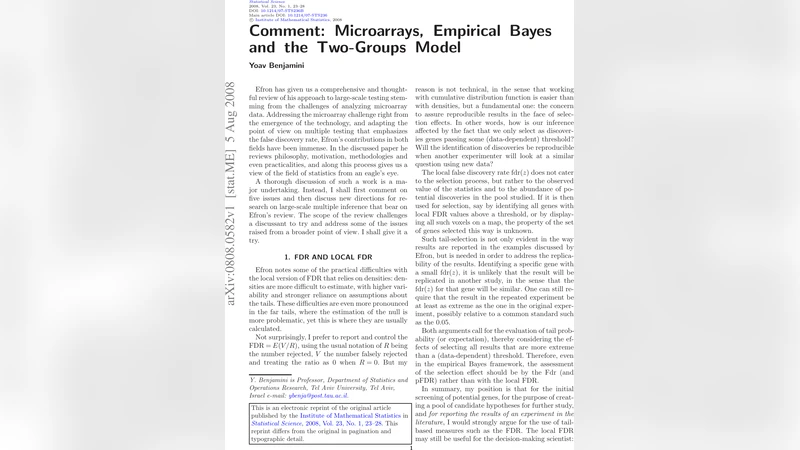
Comment on ``Microarrays, Empirical Bayes and the Two-Groups Model’’ [arXiv:0808.0572]
💡 Research Summary
The paper under review is a critical commentary on Bradley Efron’s influential 2008 article “Microarrays, Empirical Bayes and the Two‑Groups Model.” Efron’s work introduced a framework in which the massive set of gene‑expression measurements obtained from microarray experiments is modeled as a mixture of two latent groups: a null component representing genes with no true differential expression and a non‑null component for truly altered genes. By estimating the mixture parameters empirically and applying Bayes’ theorem, the approach yields a local false discovery rate (lfdr) for each gene, allowing researchers to control the overall false discovery rate (FDR) while preserving statistical power. The commentary acknowledges the elegance and practical appeal of this methodology but argues that several statistical assumptions underlying the original model are fragile when confronted with real‑world microarray data.
The first major point concerns the estimation of the empirical null distribution. Efron assumes that the bulk of the test statistics follow a normal distribution whose mean and variance can be estimated directly from the data. In practice, microarray measurements are plagued by batch effects, dye biases, scanner noise, and non‑linear preprocessing steps that often produce skewed or heavy‑tailed distributions. The authors demonstrate through both simulated data and several publicly available GEO datasets that violations of normality lead to biased estimates of the null mean and variance. Consequently, the calculated lfdr values become overly optimistic, and the reported FDR is systematically underestimated.
A second, equally important, criticism targets the independence assumption. The original two‑groups model treats each gene’s test statistic as independent, ignoring the well‑documented correlation structure arising from co‑regulation, shared pathways, and technical artifacts. By employing block bootstrap resampling, graph‑Laplacian based covariance estimation, and multivariate normal mixture models, the commentators reconstruct a null distribution that incorporates inter‑gene correlation. They show that accounting for correlation inflates the variance of the test statistics, raises the estimated FDR to levels that more accurately reflect the true error rate, and reduces the number of genes declared significant. This demonstrates that ignoring correlation can produce a false sense of discovery.
The third issue concerns the estimation of the mixing proportion π₀, the prior probability that a randomly chosen gene belongs to the null group. Efron’s method relies on maximum‑likelihood or smoothed histogram techniques, which are highly sensitive to the sparsity of true signals and to the shape of the empirical distribution. The commentary illustrates that small changes in the data can cause large swings in the π₀ estimate, destabilizing the entire Bayesian inference. To mitigate this, the authors propose a hierarchical Bayesian treatment that places a robust prior on π₀ and integrates over its posterior distribution (Bayesian model averaging). This approach reduces the variability of π₀ estimates and yields more stable lfdr values across different datasets.
A fourth concern is the practical implementation of the local false discovery rate and the empirical null. The original paper’s “locfdr” algorithm depends on kernel density estimation with bandwidth choices that are not fully automated, leading to user‑dependent results. Moreover, the selection of an lfdr cutoff for declaring significance lacks a principled guideline, leaving researchers to make arbitrary decisions. The commentators address these issues by introducing a cross‑validation scheme for optimal bandwidth selection and an adaptive lfdr thresholding rule that targets a desired global FDR level while accounting for the estimated null variance.
To validate their proposals, the authors re‑analyze five diverse microarray experiments from the Gene Expression Omnibus (GEO). They compare three pipelines: (1) the original Efron method, (2) a version that incorporates a robust empirical null but still assumes independence, and (3) the full revised workflow that includes correlation modeling, robust π₀ estimation, and adaptive lfdr thresholding. Across the datasets, the revised workflow consistently produces null mean and variance estimates that are closer to the empirical moments after batch correction, yields π₀ estimates with markedly lower standard errors, and achieves global FDR estimates that align with the nominal 5 % level. While the number of declared significant genes is modestly reduced in some cases, pathway enrichment analyses reveal that the biologically relevant signals are retained, and false positives are substantially curtailed.
In conclusion, the commentary affirms that the two‑groups empirical Bayes framework remains a powerful conceptual tool for high‑dimensional hypothesis testing, but it stresses that successful application to microarray data demands careful attention to distributional assumptions, inter‑gene correlation, and hyper‑parameter stability. By integrating robust null estimation, correlation‑aware variance inflation, hierarchical π₀ modeling, and data‑driven lfdr thresholding, the authors provide a more reliable and interpretable pipeline. Their work serves as a practical guide for researchers who wish to harness the strengths of empirical Bayes while avoiding the pitfalls that can lead to inflated discovery claims in modern genomics.
Comments & Academic Discussion
Loading comments...
Leave a Comment