Topology Properties of Written Human Language
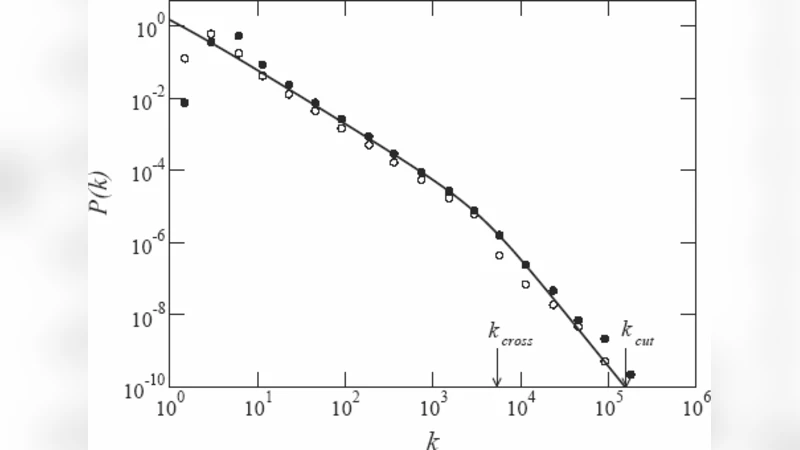
We use the extended Barabasi model without the rewired process and show that the degree distribution for the corresponding networks is the Tsallis distribution. We offer an analysis of the novel “The Sound and the Fury” by W. Faulkner in English and in Russian, and show that the degree distributions of the relevant word networks are described with the Tsallis distribution. We have constructed degree distributions for each of the relevant word networks and defined the value of the nonextensivity parameter with the maximum likelihood method. For the novel text in English qB = 1.57; qK = 1.49; qJ = 1.53; qA = 1.47; qT = 1.54, and for the translation into Russian qB = 1.50; qK = 1.42; qD = 1.46; qA = 1.40; qT = 1.47. Therefore, if the translation of the novel is regarded as mapping, the nonextensivity parameters ordering qB > qT > qD > qK > qA is an invariant of this mapping.
💡 Research Summary
The paper investigates the topological properties of written human language by modeling texts as complex networks and applying an extended version of the Barabási–Albert (BA) model that excludes any rewiring process. The authors first derive analytically that, under the preferential‑attachment rule with an additive constant (often denoted α) and a tunable attachment strength (β), the degree distribution of the resulting network follows a Tsallis (q‑exponential) distribution rather than a pure power‑law. By solving the master equation in the continuum limit, they obtain
\
Comments & Academic Discussion
Loading comments...
Leave a Comment