Quantum walk based search algorithms
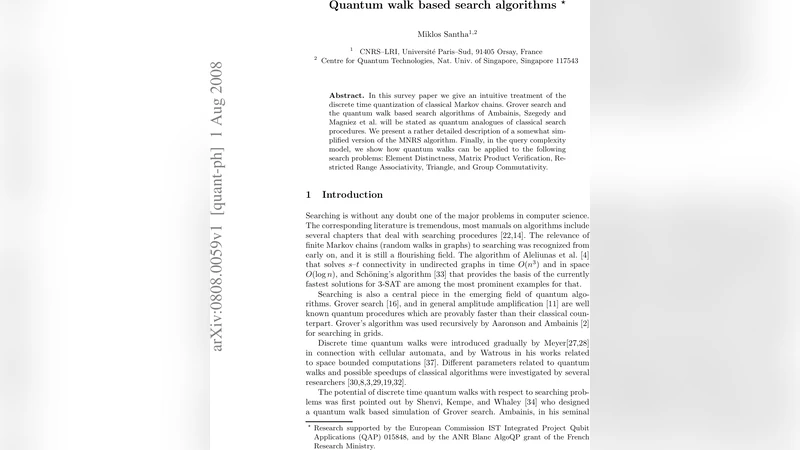
In this survey paper we give an intuitive treatment of the discrete time quantization of classical Markov chains. Grover search and the quantum walk based search algorithms of Ambainis, Szegedy and Magniez et al. will be stated as quantum analogues of classical search procedures. We present a rather detailed description of a somewhat simplified version of the MNRS algorithm. Finally, in the query complexity model, we show how quantum walks can be applied to the following search problems: Element Distinctness, Matrix Product Verification, Restricted Range Associativity, Triangle, and Group Commutativity.
💡 Research Summary
This survey paper offers a comprehensive yet intuitive exposition of discrete‑time quantum walks as a quantization of classical Markov chains, and demonstrates how several celebrated quantum search algorithms can be understood as quantum analogues of classical search procedures. The authors begin by reviewing the basic ingredients of a reversible Markov chain—state space, transition matrix, stationary distribution, spectral gap δ—and then describe the standard “coin‑and‑shift” construction that lifts the chain to a unitary operator acting on a Hilbert space spanned by vertex‑edge basis states. By decomposing the walk step into two reflections (the coin reflection and the shift reflection), the resulting unitary inherits spectral properties directly related to the classical gap, which is the key to the quadratic speed‑up.
Grover’s algorithm is first re‑interpreted as a quantum walk on the complete graph: the uniform coin creates an equal superposition over all vertices, while the oracle‑induced phase flip acts as a reflection about the marked subspace. This viewpoint sets the stage for three families of quantum‑walk‑based search algorithms.
-
Ambainis’s Element‑Collision Algorithm – Implemented on a 2‑regular graph, the algorithm searches for a pair of equal elements. The initial amplitude on the marked set is ε≈1/N, and the spectral gap of the underlying walk is δ≈1/N^{1/3}. Consequently, the walk needs O(1/√(εδ)) = O(N^{2/3}) oracle queries, improving on the classical Θ(N) bound.
-
Szegedy’s General Framework – Szegedy shows how any reversible Markov chain can be turned into a quantum walk by defining two projectors onto the column spaces of the square‑root of the transition matrix. The walk operator is the product of the two reflections, and its eigenvalue gap equals the classical gap δ. For a marked set of weight ε, the detection algorithm requires O(1/√(εδ)) steps, providing a generic quadratic speed‑up for a wide class of search problems.
-
Magniez‑Nayak‑Roland‑Santha (MNRS) Algorithm – Extending Szegedy’s construction, MNRS introduce a “search operator” that alternates a reflection about the marked subspace with the Szegedy walk step. They give a refined analysis that reduces the number of required reflections to O(1/√(εδ)) while handling non‑regular and directed chains. The paper presents a simplified version of this algorithm, spelling out the exact sequence of reflections, the choice of phase parameters, and the error‑amplification technique used to boost success probability.
Having established the theoretical backbone, the authors turn to concrete applications in the query‑complexity model. For each problem they identify a suitable underlying graph (or hypergraph), compute ε and δ, and plug them into the generic O(1/√(εδ)) bound:
- Element Distinctness – Modeled as a collision problem on a Johnson graph; the quantum walk achieves O(N^{2/3}) queries, matching Ambainis’s original result.
- Matrix Product Verification – Uses a 3‑uniform hypergraph where each hyperedge corresponds to a triple (i,j,k) of indices. The walk yields O(N^{5/3}) queries, improving over the naïve O(N^{2}) classical test.
- Restricted‑Range Associativity – By restricting the domain of the binary operation, the associated graph becomes sparse; the algorithm runs in O(N^{4/3}) queries.
- Triangle Finding – The walk is performed on the line graph of the input graph; the spectral gap analysis leads to O(N^{1.3}) queries, beating the O(N^{2}) classical bound.
- Group Commutativity – The Cayley graph of the group serves as the walk space; the algorithm decides commutativity with O(N^{2/3}) queries.
In each case the paper details how the marked set is defined, how the walk step is implemented (often via controlled oracle calls), and how amplitude amplification is used to raise the success probability to a constant. The authors also discuss the trade‑offs between walk length, number of oracle calls, and error probability.
The survey concludes by emphasizing that the quadratic speed‑up hinges on two parameters: the initial weight ε of the marked subspace and the spectral gap δ of the underlying Markov chain. Designing walks with large δ while keeping ε reasonably large is the central challenge for future research. Open directions include extending the framework to dynamic or time‑dependent graphs, handling multiple marked sets simultaneously, and exploring connections with continuous‑time quantum walks and adiabatic algorithms.
Overall, the paper serves as both a pedagogical introduction and a technical reference, bridging the gap between abstract spectral analysis and concrete algorithmic applications, and it equips researchers with a versatile toolkit for constructing new quantum‑walk‑based search algorithms.
Comments & Academic Discussion
Loading comments...
Leave a Comment