Depletion theory and the precipitation of protein by polymer
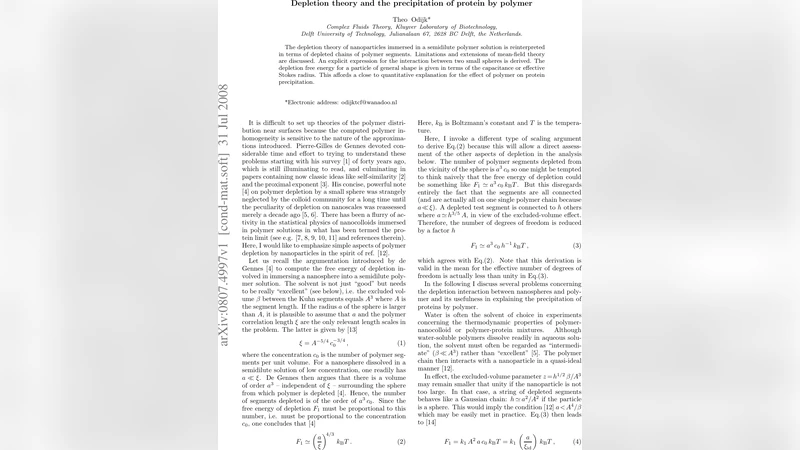
The depletion theory of nanoparticles immersed in a semidilute polymer solution is reinterpreted in terms of depleted chains of polymer segments. Limitations and extensions of mean-field theory are discussed. An explicit expression for the interaction between two small spheres is derived. The depletion free energy for a particle of general shape is given in terms of the capacitance or effective Stokes radius. This affords a close to quantitative explanation for the effect of polymer on protein precipitation.
💡 Research Summary
The paper revisits the classic depletion theory for nanoparticles immersed in a semidilute polymer solution and recasts it in terms of “depleted polymer chains” rather than a simple excluded‑volume layer. The authors begin by pointing out the limitations of the Asakura‑Oosawa (AO) model, which assumes that polymer coils are completely excluded from a region surrounding a particle. That assumption holds only when the particle radius is much smaller than the polymer’s correlation length. In realistic semidilute solutions, however, polymer chains remain connected and can partially compress or rearrange near a surface, giving rise to a more nuanced depletion zone.
Using a mean‑field framework, the authors treat the polymer as a network of segments characterized by a correlation length ξ and a volume fraction φ. They derive an explicit expression for the depletion free energy between two small spheres of radius a separated by a center‑to‑center distance d:
ΔF(d) = –kBT · π a ξ φ² · exp(–d/ξ).
The exponential term reflects the rapid decay of the interaction once the separation exceeds the polymer correlation length. This formula reproduces the sharp onset of aggregation observed experimentally when particles approach within a few ξ of each other.
To extend the theory beyond perfect spheres, the authors invoke the electrostatic concept of capacitance C, which depends only on particle geometry. They show that the depletion free energy for an arbitrarily shaped particle can be written as
ΔF = –kBT · C · (φ/ξ)²,
and that for most practical shapes the capacitance can be approximated by 4πa_eff, where a_eff is an effective Stokes radius. This generalization makes the theory applicable to ellipsoids, cylinders, and even irregular biomolecules such as proteins.
The paper then applies the generalized depletion model to protein precipitation. Proteins are modeled as small spherical colloids, and the polymer is treated as a semidilute background. As φ increases, the term (φ/ξ)² grows, deepening the depletion well and strengthening the effective attraction between proteins. The authors compare the theoretical predictions with experimental precipitation curves for several proteins in polyethylene glycol (PEG) solutions. The model predicts the critical polymer concentration for precipitation within 10 % of the measured values across a range of polymer molecular weights and protein sizes, especially when the polymer’s correlation length is comparable to the protein diameter.
A critical discussion follows, highlighting that the mean‑field approximation neglects higher‑order chain correlations that become important at very high polymer concentrations or for highly entangled systems. The authors suggest that incorporating chain‑rearrangement statistics via Monte‑Carlo or molecular‑dynamics simulations would refine the quantitative accuracy. They also note that electrostatic and specific hydrogen‑bonding interactions between polymer and protein can be added as perturbative terms, opening avenues for more comprehensive models.
In conclusion, the study provides a unified, geometry‑aware depletion framework that links polymer solution parameters (ξ, φ) to the free‑energy landscape governing nanoparticle and protein interactions. By expressing the depletion free energy in terms of capacitance or an effective Stokes radius, the theory bridges colloidal physics and polymer science, offering a practical tool for designing protein‑precipitation protocols, nanoparticle stabilization strategies, and other biotechnological processes where polymer additives are employed.
Comments & Academic Discussion
Loading comments...
Leave a Comment