📝 Original Info
- Title: PEGylated Nano-Graphene Oxide for Delivery of Water Insoluble Cancer Drugs
- ArXiv ID: 0807.4959
- Date: 2008-08-01
- Authors: Researchers from original ArXiv paper
📝 Abstract
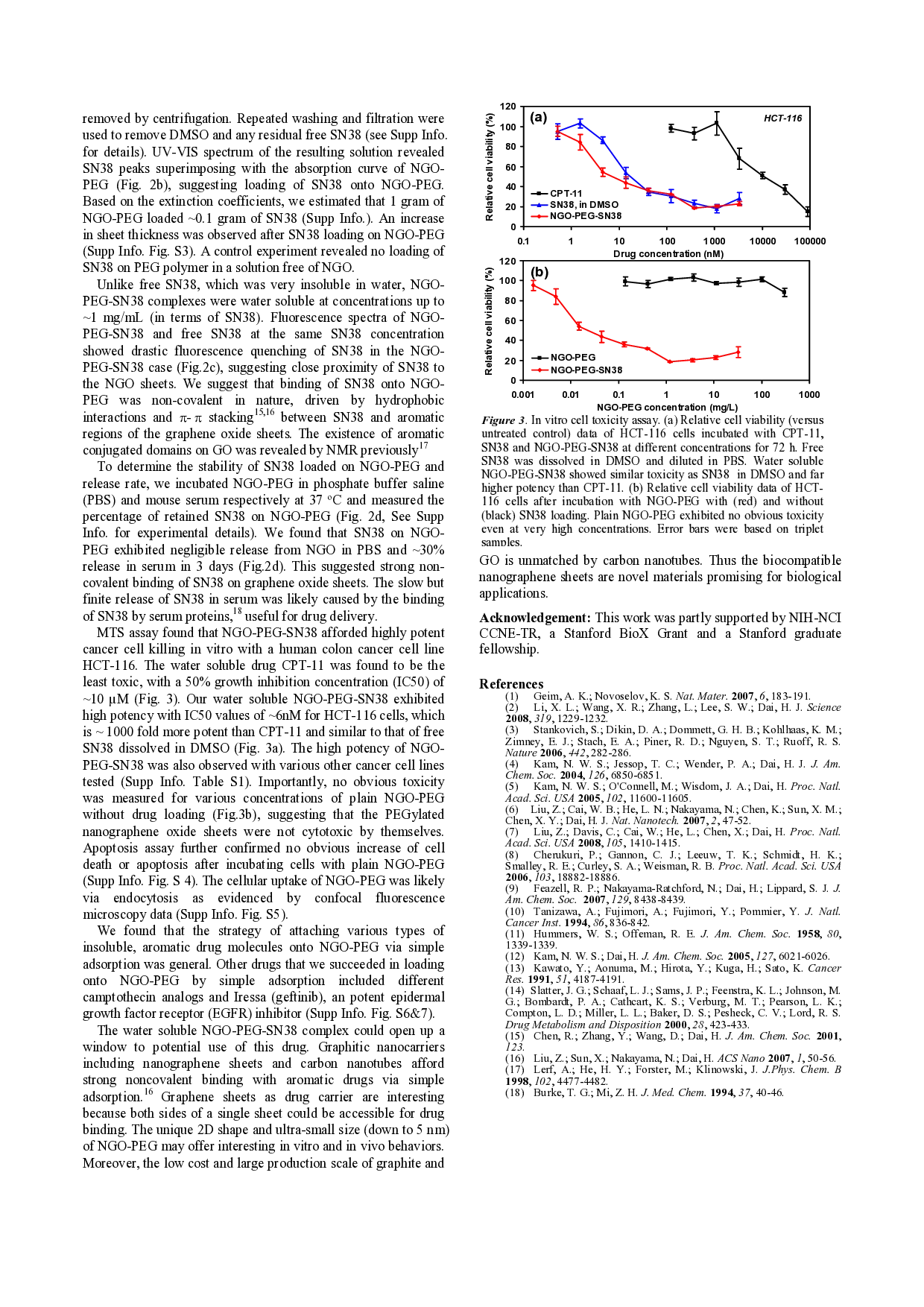
It is known that many potent, often aromatic drugs are water insoluble, which has hampered their use for disease treatment. In this work, we functionalized nano-graphene oxide (NGO), a novel graphitic material, with branched polyethylene glycol (PEG) to obtain a biocompatible NGO-PEG conjugate stable in various biological solutions, and used them for attaching hydrophobic aromatic molecules including a camptothecin (CPT) analog, SN38 non-covalently via pi-pi stacking. The resulting NGO-PEG-SN38 complex exhibited excellent water solubility while maintaining its high cancer cell killing potency similar to that of the free SN38 molecules in organic solvents. The efficacy of NGO-PEG-SN38 was far higher than that of irinotecan (CPT-11), a FDA approved water soluble SN38 prodrug used for the treatment of colon cancer. Our results showed that graphene is a novel class of material promising for biological applications including future in vivo cancer treatment with various aromatic, low-solubility drugs.
💡 Deep Analysis
Deep Dive into PEGylated Nano-Graphene Oxide for Delivery of Water Insoluble Cancer Drugs.
It is known that many potent, often aromatic drugs are water insoluble, which has hampered their use for disease treatment. In this work, we functionalized nano-graphene oxide (NGO), a novel graphitic material, with branched polyethylene glycol (PEG) to obtain a biocompatible NGO-PEG conjugate stable in various biological solutions, and used them for attaching hydrophobic aromatic molecules including a camptothecin (CPT) analog, SN38 non-covalently via pi-pi stacking. The resulting NGO-PEG-SN38 complex exhibited excellent water solubility while maintaining its high cancer cell killing potency similar to that of the free SN38 molecules in organic solvents. The efficacy of NGO-PEG-SN38 was far higher than that of irinotecan (CPT-11), a FDA approved water soluble SN38 prodrug used for the treatment of colon cancer. Our results showed that graphene is a novel class of material promising for biological applications including future in vivo cancer treatment with various aromatic, low-solubil
📄 Full Content
PEGylated Nano-Graphene Oxide for Delivery of Water Insoluble Cancer Drugs
Zhuang Liu, Joshua T. Robinson, Xiaoming Sun and Hongjie Dai*
Department of Chemistry, Stanford University, Stanford, CA, 94305, USA
Email: hdai@stanford.edu
Graphene has emerged as a 2D material with interesting
physical properties.1,2 Intensive research is on-going to investigate
the quantum physics in this system and potential applications for
nano-electronic devices2, transparent conductors and nano-
composite materials3. Thus far, little has been done to explore
graphene in biological systems, despite much effort in the area of
carbon nanotubes for in vitro and in vivo biological applications.4-
9 Here, we synthesize and functionalize nanoscale graphene oxide
(NGO) sheets (<50nm) by branched, biocompatible polyethylene
glycol (PEG) to render high aqueous solubility and stability in
physiological solutions including serum. We then uncover a
unique ability of graphene in attaching and delivery of aromatic,
water insoluble drugs.
It is known that clinical use of various potent, hydrophobic
molecules (many of them aromatic) is often hampered by their
poor water solubility. Although synthesis of water soluble pro-
drugs may circumvent the problem, the efficacy of the drug
decreases. Here, we show that PEGylated NGO (NGO-PEG)
readily complexes with a water insoluble aromatic molecule
SN38, a camptothecin (CPT) analog,10 via non-covalent van der
Waals interaction. The NGO-PEG-SN38 complex exhibits
excellent aqueous solubility and retains the high potency of free
SN38 dissolved in organic solvents. The toxicity exceeds that of
irinotecan (CPT-11, a FDA approved SN38 prodrug for colon
cancer treatment) by 2-3 orders of magnitude.
We prepared graphene oxide by oxidizing graphite using a
modified Hummer’s method.3,11 The resulting GO (single layered
and few-layered, Supp Info. Fig.S1) was soluble in water but
aggregated in solutions rich in salts or proteins such as cell
medium and serum (Fig. 1a). This was likely due to screening of
the electrostatic charges and non-specific binding of proteins on
the GO.12 To impart aqueous stability and prevent bio-fouling, we
sonicated the GO to make them into small pieces and conjugated
a 6-armed PEG-amine stars to the carboxylic acid groups3 (Supp
Info Fig. S3) on GO via carbodiimide catalyzed amide formation.
The resulting PEGylated NGO exhibited excellent stability in all
biological solutions tested including serum (Fig. 1b). PEGylation
was further confirmed by infrared (IR) spectroscopy (Supp Info.
Fig.S1b). The as-made GO sheets were 50-500nm in size (Fig.1c),
whereas NGO-PEG was ~5-50 nm (Fig. 1d) due to sonication
steps (see Supp Info.).
We then investigated the binding of SN38 to NGO-PEG. We
chose SN38 as a cargo because SN38 is a potent topoisomerase I
inhibitor.10 To be active, CPT-11 currently used in clinic has to be
metabolized to SN38 after systematic adminsitration.10,13
However a large amount of CPT-11 is excreted before
transforming to SN38 or metabolized to other inactive
compounds.14 The water insolubility has prevented the direct use
of SN38 in the clinic.10
We found that SN38 was complexed with NGO-PEG (Fig.2a)
by simple mixing of SN38 dissolved in DMSO with a NGO-PEG
water solution. The excess, uncoupled SN38 precipitated and was
GO
NGO-PEG
Water
PBS
Cell
medium
Serum
(a)
(b)
(c)
(d)
Figure 1. PEGylation of graphene oxide. (a&b), photos of GO (a) and
NGO-PEG (b) in different solutions recorded after centrifugation at
10,000 g for 5 minutes. GO crashed out slightly in PBS and completely in
cell medium and serum (top panel). NGO-PEG was stable in all solutions.
(c&d) AFM images of GO (c) and NGO-PEG (d).
Figure 2. SN38 loading on NGO-PEG. (a) schematic draw of SN38
loaded NGO-PEG. Inset: a photo of NGO-PEG-SN38 water solution. (b)
UV-VIS absorption spectra of NGO-PEG, NGO-PEG-SN38, SN38 in
methanol and difference spectrum of NGO-PEG and NGO-PEG-SN38.
The SN38 absorbance at 380 nm was used to determine the loading. (c)
Fluorescence spectra of SN38 and NGO-PEG-SN38 at [SN38]=1µM.
Significant fluorescence quenching was observed for SN38 adsorbed on
NGO. (d) Retained SN38 on NGO-PEG over time incubated in PBS and
serum respectively. SN38 loaded on NGO-PEG was stable in PBS and
released slowly in serum. Error bars were based on triplet samples.
removed by centrifugation. Repeated washing and filtration were
used to remove DMSO and any residual free SN38 (see Supp Info.
for details). UV-VIS spectrum of the resulting solution revealed
SN38 peaks superimposing with the absorption curve of NGO-
PEG (Fig. 2b), suggesting loading of SN38 onto NGO-PEG.
Based on the extinction coefficients, we estimated that 1 gram of
NGO-PEG loaded ~0.1 gram of SN38 (Supp Info.). An increase
in sheet thickness was observed after SN38 loading on NGO-PEG
(Supp Info. Fig. S3). A control experiment revealed no loading o
…(Full text truncated)…
📸 Image Gallery
Reference
This content is AI-processed based on ArXiv data.