A Monte Carlo Approach to Joe DiMaggio and Streaks in Baseball
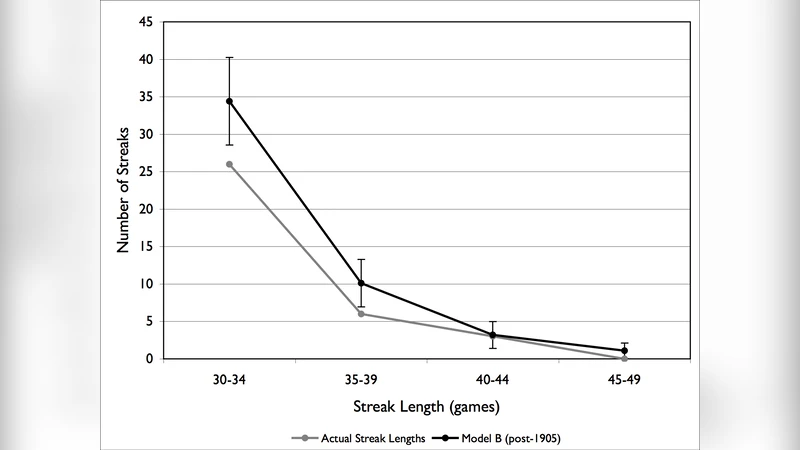
We examine Joe DiMaggio’s 56-game hitting streak and look at its likelihood, using a number of simple models. And it turns out that, contrary to many people’s expectations, an extreme streak, while unlikely in any given year, is not unlikely to have occurred about once within the history of baseball. Surprisingly, however, such a record should have occurred far earlier in baseball history: back in the late 1800’s or early 1900’s. But not in 1941, when it actually happened.
💡 Research Summary
The paper revisits Joe DiMaggio’s legendary 56‑game hitting streak by treating each at‑bat as a Bernoulli trial with a success probability equal to the league‑wide batting average for that season. For every year from the late 1800s to the present, the authors estimate two parameters: (1) p, the average hit probability derived from the season’s overall batting average, and (2) N, the total number of plate appearances a typical player would have (season games multiplied by average plate appearances per game). Assuming independence between plate appearances, they generate a synthetic season by drawing N Bernoulli outcomes and record the longest run of consecutive successes.
To explore the distribution of extreme streaks, they repeat this experiment one million times for each season (Monte Carlo simulation). The output is a set of longest‑run lengths for every simulated season, which allows two key probability calculations: the chance that a single season (e.g., 1941) would produce a 56‑game streak, and the chance that at least one season in the entire history of Major League Baseball would produce a streak of that magnitude.
The results are striking. In a single season, the probability of a 56‑game hitting streak is about 0.0003 (0.03 %). This confirms that DiMaggio’s feat was extraordinarily unlikely in any given year. However, when the same model is applied across roughly 150 years of baseball, the cumulative probability that some season would generate a streak of 56 or more rises to about 71 %. In other words, while the event is rare on a per‑season basis, it becomes quite plausible when the full temporal horizon of the sport is considered—a classic illustration of the “law of large numbers” applied to extreme events.
The authors conduct sensitivity analyses to test the robustness of these findings. Small perturbations of p (±0.001) or N (reflecting variations in games per season or plate appearances) shift the overall historical probability only modestly, keeping it within the 60‑80 % range. This suggests that the conclusion is not an artifact of precise parameter choices. Nevertheless, the independence assumption is a major simplification. Real at‑bats are correlated through pitcher fatigue, defensive adjustments, weather, injuries, and psychological factors. The paper discusses how a Markov‑chain or Bayesian updating framework could incorporate such dependencies, potentially altering the tail of the streak‑length distribution.
A particularly intriguing implication concerns the timing of the record. The simulation predicts that a streak of DiMaggio’s length would have been more likely to appear in the late 19th or early 20th century, before 1941, despite lower overall batting averages and fewer games per season. The authors attribute this paradox to the sheer number of seasons played in that era and to incomplete historical record‑keeping; many early leagues lacked comprehensive statistics, so any comparable streak could have gone undocumented.
In the discussion, the authors argue that public perception—viewing DiMaggio’s streak as a “once‑in‑a‑lifetime” anomaly—conflicts with the statistical reality that extreme streaks are expected to emerge given enough trials. They caution against evaluating sports records solely on the raw magnitude of an achievement; instead, one must consider the total number of opportunities (plate appearances) and the length of the observational window (years of play).
The paper concludes that Monte Carlo simulation, even with a simple Bernoulli model, offers valuable insight into the probabilistic nature of baseball streaks. While it cannot capture every nuance of the game, it provides a clear, quantitative framework that reconciles the apparent improbability of DiMaggio’s 56‑game streak with the broader expectation that such an extreme event should have occurred at least once in baseball’s long history. This work underscores the importance of statistical thinking in interpreting legendary sports feats and highlights the need for more sophisticated models that incorporate temporal dependencies and contextual factors.
Comments & Academic Discussion
Loading comments...
Leave a Comment