A new method for fast computing unbiased estimators of cumulants
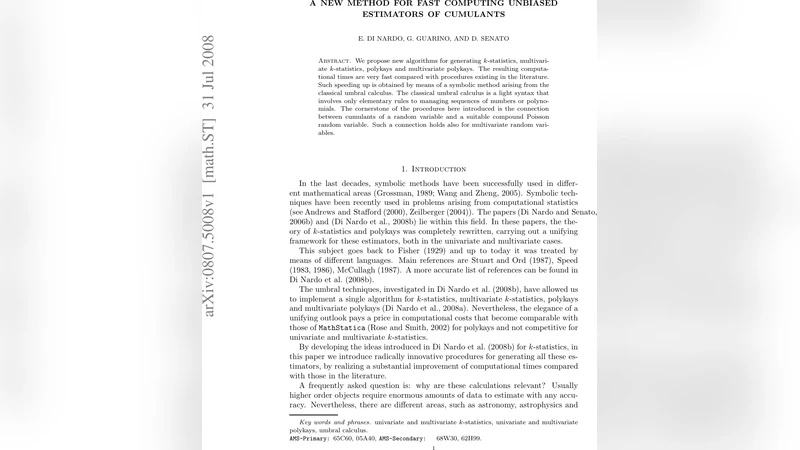
We propose new algorithms for generating $k$-statistics, multivariate $k$-statistics, polykays and multivariate polykays. The resulting computational times are very fast compared with procedures existing in the literature. Such speeding up is obtained by means of a symbolic method arising from the classical umbral calculus. The classical umbral calculus is a light syntax that involves only elementary rules to managing sequences of numbers or polynomials. The cornerstone of the procedures here introduced is the connection between cumulants of a random variable and a suitable compound Poisson random variable. Such a connection holds also for multivariate random variables.
💡 Research Summary
The paper introduces a novel symbolic‑computational framework for the fast generation of unbiased estimators of cumulants, namely $k$‑statistics, multivariate $k$‑statistics, polykays and their multivariate analogues. The core of the approach is the classical umbral calculus, a lightweight algebraic language that treats sequences of numbers or polynomials as abstract “umbrae” and manipulates them through a small set of substitution and composition rules. By recasting the relationship between cumulants and a suitably defined compound Poisson random variable in umbral terms, the authors avoid the direct, combinatorially explosive expansion of moments into cumulants that plagues traditional methods.
The theoretical development proceeds in two stages. First, for a univariate random variable $X$, the authors prove that its cumulant generating function coincides with the moment generating function of a compound Poisson variable $Y=\sum_{i=1}^{N}Z_i$, where $N\sim\text{Poisson}(\lambda)$ and the $Z_i$ are i.i.d. copies of an auxiliary variable whose moments encode the original cumulants. In umbral notation this is expressed as $κ(α)=\log E
Comments & Academic Discussion
Loading comments...
Leave a Comment