Let $X$ be a normed space that satisfies the Johnson-Lindenstrauss lemma (J-L lemma, in short) in the sense that for any integer $n$ and any $x_1,\ldots,x_n\in X$ there exists a linear mapping $L:X\to F$, where $F\subseteq X$ is a linear subspace of dimension $O(\log n)$, such that $\|x_i-x_j\|\le\|L(x_i)-L(x_j)\|\le O(1)\cdot\|x_i-x_j\|$ for all $i,j\in \{1,\ldots, n\}$. We show that this implies that $X$ is almost Euclidean in the following sense: Every $n$-dimensional subspace of $X$ embeds into Hilbert space with distortion $2^{2^{O(\log^*n)}}$. On the other hand, we show that there exists a normed space $Y$ which satisfies the J-L lemma, but for every $n$ there exists an $n$-dimensional subspace $E_n\subseteq Y$ whose Euclidean distortion is at least $2^{\Omega(\alpha(n))}$, where $\alpha$ is the inverse Ackermann function.
Deep Dive into The Johnson-Lindenstrauss lemma almost characterizes Hilbert space, but not quite.
Let $X$ be a normed space that satisfies the Johnson-Lindenstrauss lemma (J-L lemma, in short) in the sense that for any integer $n$ and any $x_1,\ldots,x_n\in X$ there exists a linear mapping $L:X\to F$, where $F\subseteq X$ is a linear subspace of dimension $O(\log n)$, such that $\|x_i-x_j\|\le\|L(x_i)-L(x_j)\|\le O(1)\cdot\|x_i-x_j\|$ for all $i,j\in \{1,\ldots, n\}$. We show that this implies that $X$ is almost Euclidean in the following sense: Every $n$-dimensional subspace of $X$ embeds into Hilbert space with distortion $2^{2^{O(\log^*n)}}$. On the other hand, we show that there exists a normed space $Y$ which satisfies the J-L lemma, but for every $n$ there exists an $n$-dimensional subspace $E_n\subseteq Y$ whose Euclidean distortion is at least $2^{\Omega(\alpha(n))}$, where $\alpha$ is the inverse Ackermann function.
The J-L lemma [24] asserts that if H is a Hilbert space, ε > 0, n ∈ N, and x 1 , . . . , x n ∈ H then there exists a linear mapping (even a multiple of an orthogonal projection) L : H → F, where F ⊆ H is a linear subspace of dimension O(c(ε) log n), such that for all i, j ∈ {1, . . . , n} we have
This fact has found many applications in mathematics and computer science, in addition to the original application in [24] to a Lipschitz extension problem. The widespread applicability of the J-L lemma in computer science can be (somewhat simplistically) attributed to the fact that it can be viewed as a compression scheme which helps to reduce significantly the space required for storing multidimensional data. We shall not attempt to list here all the applications of the J-L lemma to areas ranging from nearest neighbor search to machine learning-we refer the interested reader to [27,20,28,18,43,19,1] and the references therein for a partial list of such applications. The applications of (1) involve various requirements from the mapping L. While some applications just need the distance preservation condition (1) and not the linearity of L, most applications require L to be linear. Also, many applications are based on additional information that comes from the proof of the J-L lemma, such as the fact that L arises with high probability from certain distributions over linear mappings. The linearity of L is useful, for example, for fast evaluation of the images L(x i ), and also because these images behave well when additive noise is applied to the initial vectors x 1 , . . . , x n .
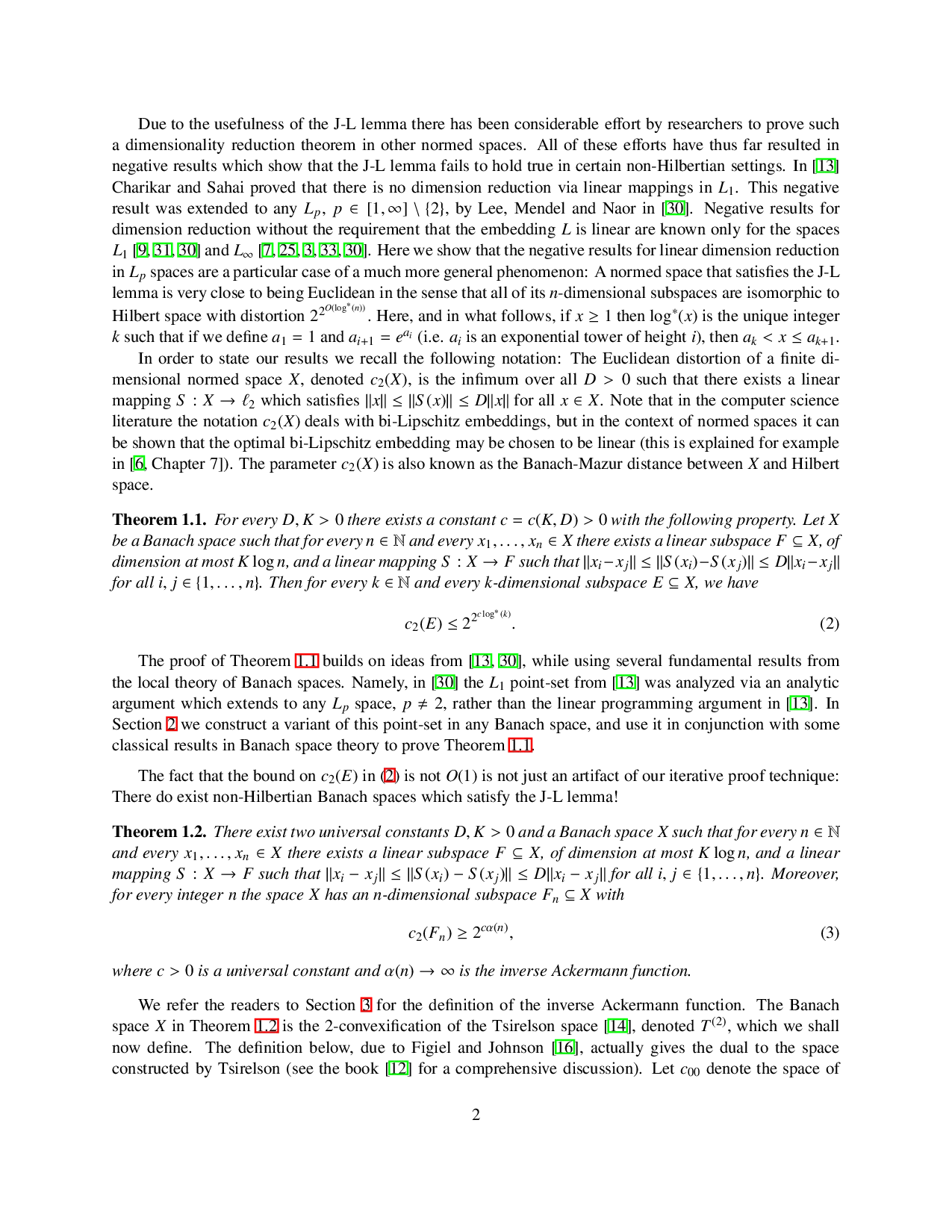
Due to the usefulness of the J-L lemma there has been considerable effort by researchers to prove such a dimensionality reduction theorem in other normed spaces. All of these efforts have thus far resulted in negative results which show that the J-L lemma fails to hold true in certain non-Hilbertian settings. In [13] Charikar and Sahai proved that there is no dimension reduction via linear mappings in L 1 . This negative result was extended to any L p , p ∈ [1, ∞] \ {2}, by Lee, Mendel and Naor in [30]. Negative results for dimension reduction without the requirement that the embedding L is linear are known only for the spaces L 1 [9,31,30] and L ∞ [7,25,3,33,30]. Here we show that the negative results for linear dimension reduction in L p spaces are a particular case of a much more general phenomenon: A normed space that satisfies the J-L lemma is very close to being Euclidean in the sense that all of its n-dimensional subspaces are isomorphic to Hilbert space with distortion 2 2 O(log * (n)) . Here, and in what follows, if x ≥ 1 then log * (x) is the unique integer k such that if we define a 1 = 1 and a i+1 = e a i (i.e. a i is an exponential tower of height i), then a k < x ≤ a k+1 .
In order to state our results we recall the following notation: The Euclidean distortion of a finite dimensional normed space X, denoted c 2 (X), is the infimum over all D > 0 such that there exists a linear mapping S : X → ℓ 2 which satisfies x ≤ S (x) ≤ D x for all x ∈ X. Note that in the computer science literature the notation c 2 (X) deals with bi-Lipschitz embeddings, but in the context of normed spaces it can be shown that the optimal bi-Lipschitz embedding may be chosen to be linear (this is explained for example in [6,Chapter 7]). The parameter c 2 (X) is also known as the Banach-Mazur distance between X and Hilbert space.
Theorem 1.1. For every D, K > 0 there exists a constant c = c(K, D) > 0 with the following property. Let X be a Banach space such that for every n ∈ N and every x 1 , . . . , x n ∈ X there exists a linear subspace F ⊆ X, of dimension at most K log n, and a linear mapping S : X → F such that x i -x j ≤ S (x i )-S (x j ) ≤ D x i -x j for all i, j ∈ {1, . . . , n}. Then for every k ∈ N and every k-dimensional subspace E ⊆ X, we have
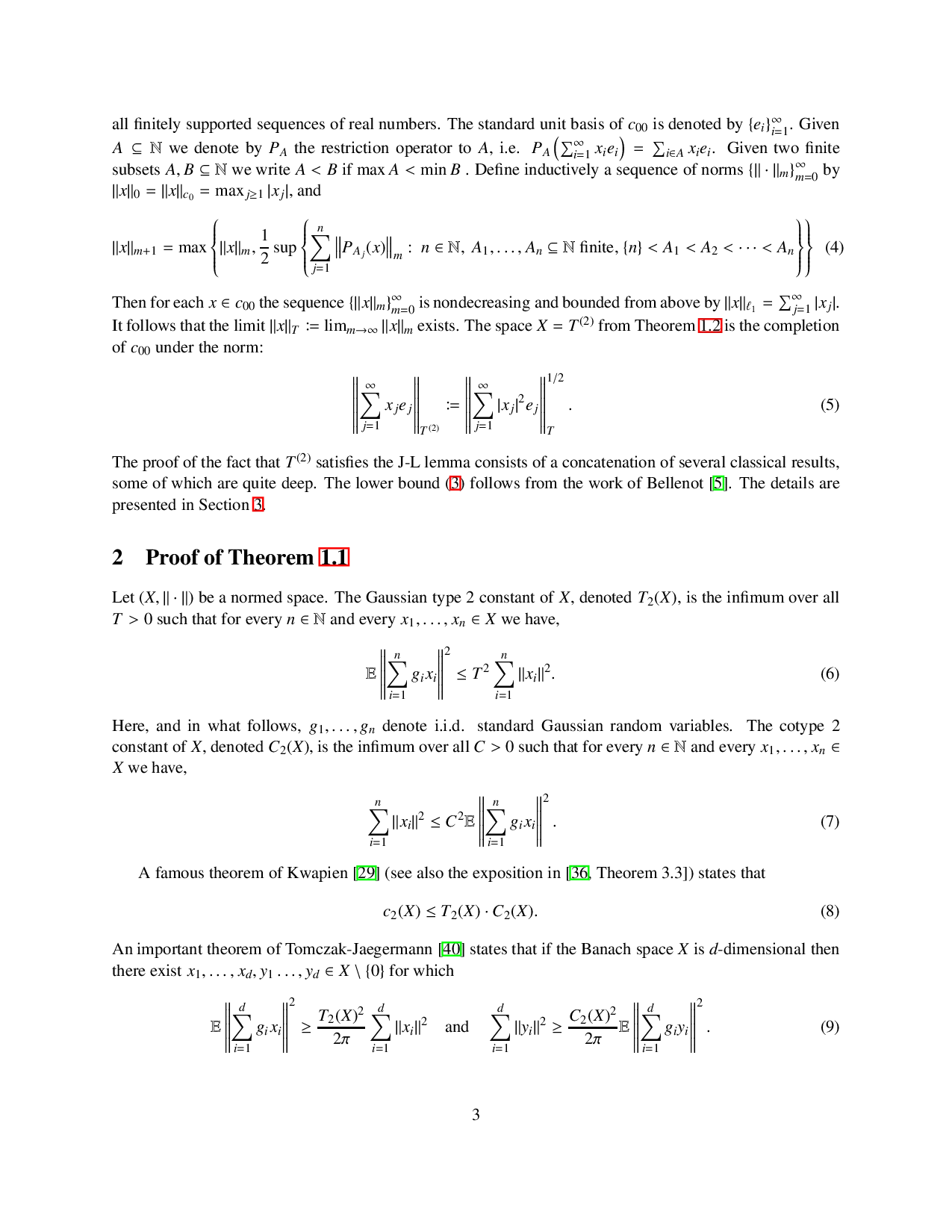
The proof of Theorem 1.1 builds on ideas from [13,30], while using several fundamental results from the local theory of Banach spaces. Namely, in [30] the L 1 point-set from [13] was analyzed via an analytic argument which extends to any L p space, p 2, rather than the linear programming argument in [13]. In Section 2 we construct a variant of this point-set in any Banach space, and use it in conjunction with some classical results in Banach space theory to prove Theorem 1.1.
The fact that the bound on c 2 (E) in (2) is not O(1) is not just an artifact of our iterative proof technique: There do exist non-Hilbertian Banach spaces which satisfy the J-L lemma! Theorem 1.2. There exist two universal constants D, K > 0 and a Banach space X such that for every n ∈ N and every x 1 , . . . , x n ∈ X there exists a linear subspace F ⊆ X, of dimension at most K log n, and a linear mapping S : X → F such that x i -x j ≤ S (x i ) -S (x j ) ≤ D x i -x j for all i, j ∈ {1, . . . , n}. Moreover, for every integer n the space X has an n-dimensional subspace F n ⊆ X with
where c > 0 is a universal constant and α(
…(Full text truncated)…
This content is AI-processed based on ArXiv data.