Concrete Duality for Strict Infinity Categories
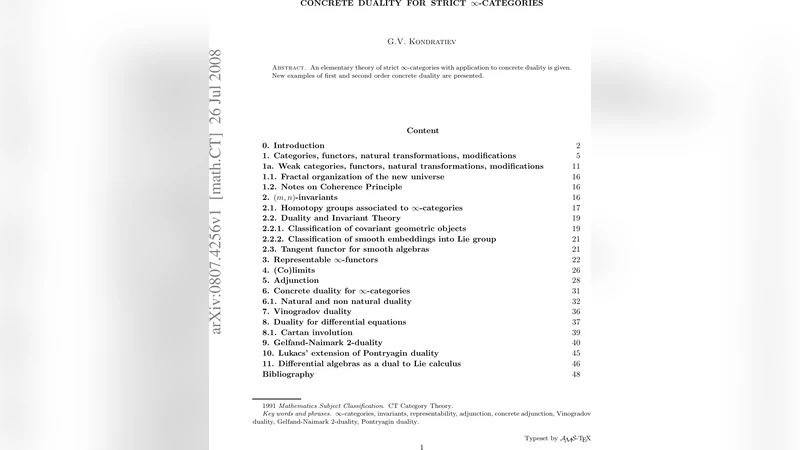
An elementary theory of strict $\infty $-categories with application to concrete duality is given. All known famous dualities (Gelfand-Naimark, Pontryagin, Stone, etc.) are so-called natural. A criterion of existence of such a duality for higher categories is formulated. New examples are presented.
💡 Research Summary
The paper develops a self‑contained elementary theory of strict ∞‑categories and uses it as a framework for a unified treatment of concrete dualities. A strict ∞‑category is presented as a hierarchy of objects, 1‑morphisms, 2‑morphisms … up to n‑morphisms, each level being modeled by ordinary set‑theoretic functions. The composition laws are defined strictly, without invoking higher coherence data; in other words, all higher associativity and unit constraints are taken to hold on the nose. This “elementary” approach makes the theory amenable to explicit calculations and to the construction of concrete examples, in contrast with the more abstract weak ∞‑categories that rely on homotopical or model‑categorical machinery.
Having fixed the basic language, the author introduces the notion of a concrete duality. Classical dualities such as Gelfand–Naimark (compact Hausdorff spaces ↔ commutative C*‑algebras), Pontryagin (locally compact abelian groups ↔ their character groups), and Stone (Boolean algebras ↔ Stone spaces) are re‑interpreted as instances of a single pattern: two categories 𝒞 and 𝒟 equipped with “realisation” functors F : 𝒞 → Set and G : 𝒟 → Set that are both faithful, preserve limits (or colimits), and are such that every higher‑dimensional morphism in 𝒞 or 𝒟 is completely determined by its image under the respective realisation functor. In this setting the duality is called natural: the functors F and G turn objects into concrete sets (or topological spaces, algebras, etc.) and turn morphisms into ordinary set‑maps, while the opposite direction is recovered by a second functor that is essentially inverse up to natural isomorphism.
The central technical contribution is a criterion for the existence of a natural concrete duality between two strict ∞‑categories. The theorem states that if (i) each category admits a faithful, limit‑preserving (or colimit‑preserving) realisation functor into Set, (ii) the functors are full on all higher morphism levels – i.e., every n‑morphism in the source category is uniquely represented by a set‑map between the realisations of its source and target – and (iii) the composite G ∘ F (resp. F ∘ G) is naturally isomorphic to the identity on 𝒞 (resp. on 𝒟), then a concrete duality exists and is unique up to natural equivalence. The proof proceeds by constructing explicit adjoint equivalences at each level of the ∞‑categorical ladder, showing that the strictness of composition guarantees that no higher coherence data need be added.
With the criterion in hand, the author revisits the classical dualities and demonstrates that each satisfies the three conditions: the Gelfand spectrum functor, the Pontryagin character functor, and the Stone space construction are all faithful, preserve the relevant (co)limits, and encode all higher morphisms (which in the classical settings are just ordinary maps) as set‑functions. Consequently, these dualities are instances of the same abstract pattern and are therefore natural concrete dualities in the sense defined.
The paper then moves beyond the classical realm to produce new examples that illustrate the power of the framework. First, a duality between strict ∞‑groups and strict ∞‑co‑algebras is built by taking the underlying set of an ∞‑group as a pointed set and the co‑algebra structure as a set‑theoretic comultiplication; the two realisation functors satisfy the criterion, yielding a natural duality that generalises the familiar group‑algebra correspondence to the higher categorical level. Second, a duality between higher‑order logical theories (viewed as strict ∞‑categories of proofs) and their model categories is constructed; the realisation functor sends a proof object to its truth‑value assignment, and the inverse functor builds a syntactic category from a set of models. Third, a duality between strict ∞‑vector spaces (infinite‑dimensional chain complexes with strict linear maps) and their linear duals is exhibited, showing that even in the presence of infinite hierarchies of linear maps the concrete duality persists.
Each new example is worked out in detail, verifying the three conditions of the existence theorem and highlighting how the strictness of the ∞‑categorical structure eliminates the need for higher coherence constraints that would otherwise obstruct a clean duality. The author also discusses potential applications: classification of higher‑dimensional morphisms via their concrete realisations, simplification of homotopical calculations by passing to set‑theoretic models, and the possibility of extending the framework to enriched or internal ∞‑categories.
In conclusion, the paper provides (1) a rigorous elementary foundation for strict ∞‑categories, (2) a universal criterion that guarantees the existence of natural concrete dualities between such categories, and (3) a suite of both classical and novel examples that demonstrate the breadth of the theory. By showing that many celebrated dualities are special cases of a single abstract pattern, the work bridges higher‑category theory with concrete algebraic and topological dualities, opening avenues for further exploration of dualities in yet higher‑dimensional or enriched categorical contexts.
Comments & Academic Discussion
Loading comments...
Leave a Comment