Mastering size and shape of CoPt nanoparticles by flash laser annealing
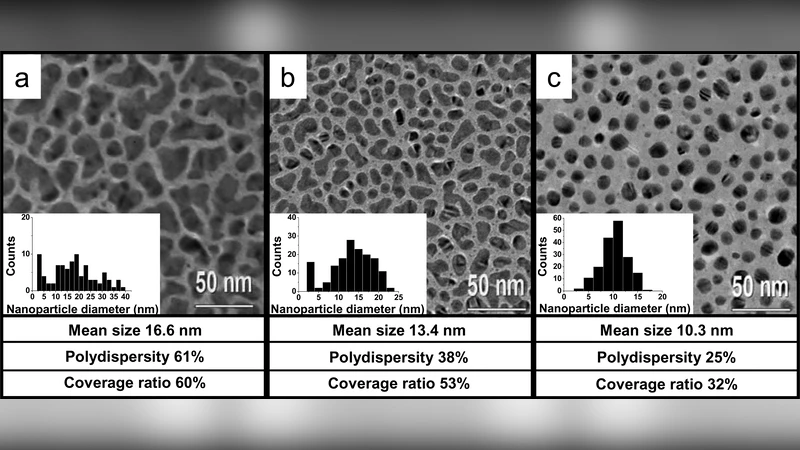
A major step towards the understanding of intrinsic properties of nano-objects depends on the ability to obtain assemblies of nanoparticles of a given size with reduced size dispersion and a well defined shape. The control of these parameters is a fundamental challenge. In this newsletter, we present a new method to tailor in an easy way both size and shape characteristics of nanoparticles by using laser irradiation in the nanosecond regime.
💡 Research Summary
The paper presents a novel approach for simultaneously controlling the size and shape of CoPt nanoparticles using nanosecond‑scale flash laser annealing. Traditional synthesis methods often yield particles with broad size distributions and poorly defined morphologies, limiting the ability to study intrinsic nanoscale properties. To address this, the authors first prepared a uniform ensemble of CoPt nanoparticles (average diameter ~5 nm) on a SiO₂ substrate by sputtering a Co–Pt precursor followed by thermal de‑alloying.
A Nd:YAG laser operating at 532 nm with a pulse width of 7 ns was employed to deliver controlled energy fluences ranging from 10 to 40 mJ cm⁻². The number of pulses applied to each sample varied from one to ten, with a 1 s interval between pulses to allow thermal relaxation. Transmission electron microscopy (TEM), high‑resolution TEM (HRTEM), selected‑area electron diffraction (SAED), and X‑ray diffraction (XRD) were used to characterize the structural evolution.
Key findings include: (1) a systematic reduction of the average particle diameter from ~5 nm to ~3.5 nm when a fluence of 20 mJ cm⁻² and five pulses were used; (2) a narrowing of the size distribution, with the standard deviation decreasing from 0.8 nm to 0.5 nm; (3) a morphological transition from near‑spherical particles to well‑faceted polyhedra exposing {111} and {100} facets; (4) an increase in XRD (111) peak intensity and a reduction in peak width, indicating grain refinement and stress relaxation.
The authors attribute these changes to rapid, localized heating that transiently raises particle temperature above the melting point (~1500 K). The molten metal experiences surface‑tension‑driven reshaping, but the ultrafast cooling (tens of microseconds) freezes the structure before it can revert to a sphere, resulting in faceted shapes. When the fluence exceeds a critical threshold (~20 mJ cm⁻²), inter‑particle material transport becomes significant, promoting coalescence and Ostwald ripening‑like processes that reduce overall size while simultaneously sharpening the size distribution. Thermal modeling confirms that the energy deposition is sufficient to melt the nanoparticles without damaging the underlying substrate.
Compared with conventional high‑temperature annealing or chemical etching, flash laser annealing offers several advantages: (i) processing times are reduced from minutes or hours to nanoseconds; (ii) the technique is inherently non‑contact and can be spatially patterned, enabling selective modification of complex nanostructures; (iii) substrate heating is minimal, making the method compatible with temperature‑sensitive materials.
Potential applications highlighted include high‑density magnetic recording media, where uniform CoPt particles with controlled anisotropy are essential; catalytic systems, where faceted surfaces can enhance activity for reactions such as hydrogen evolution; and plasmonic or metamaterial devices, where precise particle geometry dictates optical response.
In conclusion, flash laser annealing emerges as an efficient, scalable tool for tailoring both the size and shape of alloy nanoparticles. The study demonstrates reproducible control over CoPt nanostructures and suggests that extending the method to other alloy systems (e.g., FePt, AuAg) and integrating it into roll‑to‑roll manufacturing could further broaden its impact on nanotechnology and materials engineering.