Computable bounds for the discrimination of Gaussian states
By combining the Minkowski inequality and the quantum Chernoff bound, we derive easy-to-compute upper bounds for the error probability affecting the optimal discrimination of Gaussian states. In particular, these bounds are useful when the Gaussian s…
Authors: Stefano Pir, ola, Seth Lloyd
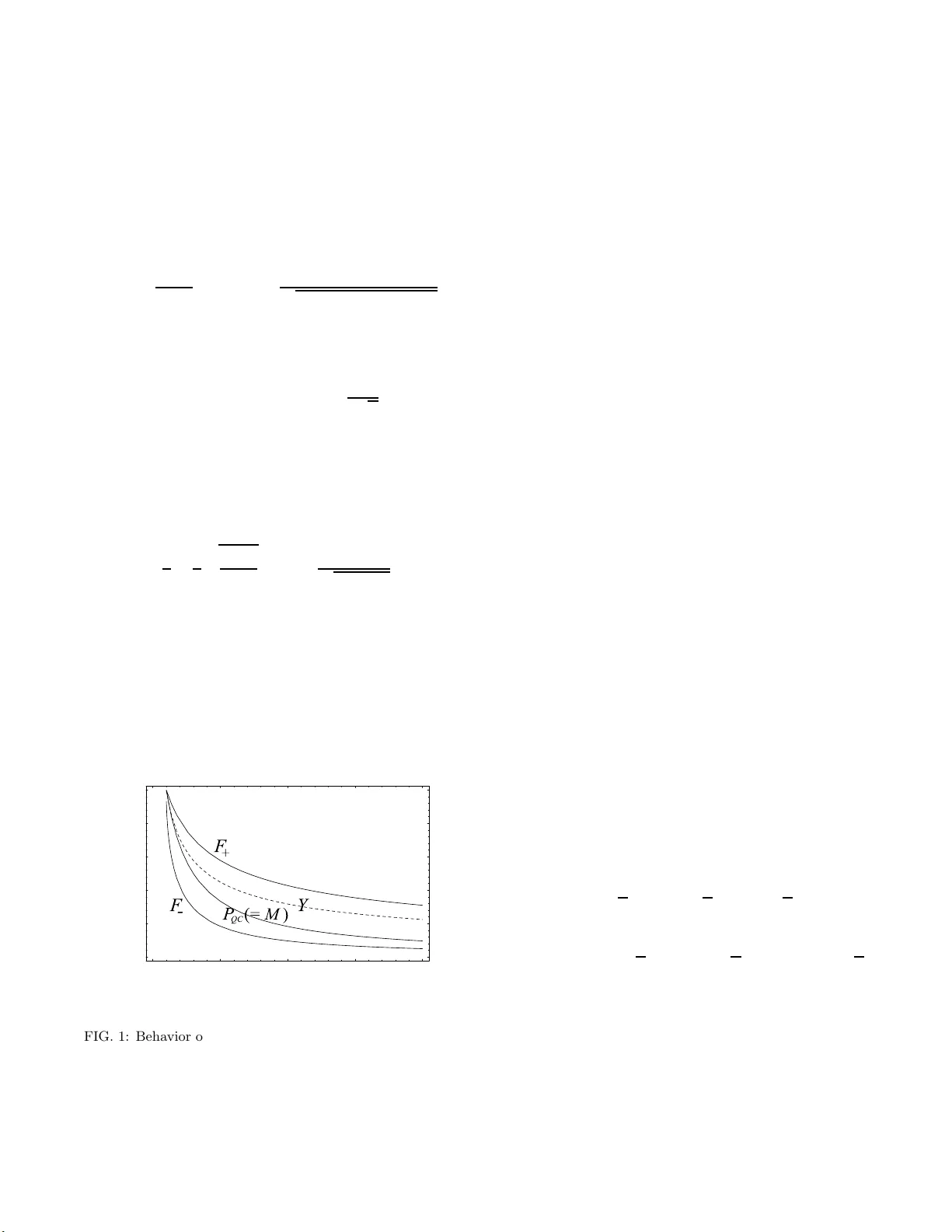
Computable b ounds for the discrimination of Gauss ian states Stefano Pirandola 1 and Seth Llo yd 1, 2 1 MIT - R ese ar ch L ab or ator y of Ele ctr onics, Cambridge MA 02139, USA 2 MIT - Dep artment of Me chanic al Engine ering, Cambridge MA 02139, USA (Dated: No vem b er 10, 2018) By com bining the Mink o wski i nequality and th e quantum Chernoff b ound , we derive easy-to- compute upper b ounds fo r the error probabilit y affecting the optimal discrimination of Gaussian states. I n particular, these b ounds are useful when the Gaussian states are un itarily ineq uiv alent, i.e., they differ in th eir symplectic in v ariants. P A CS n umbers: 03 .67.Hk, 03.65.T a, 02.10.Ud I. INTRO DUCTION One of the central pr o blems in sta tistical dec ision the- ory is the discr imina tion b etw een tw o different pr o ba- bilit y distributions, intended as p otential ca ndidates for describing the v alues o f a sto chastic v ariable. In gener al, this statistical discriminatio n is affected by a minimal error probability p ( N ) , which decrea s es with the num ber N of (independent) obser v ations of the ra ndom v a riable. The general problem o f deter mining p ( N ) was faced by H. Chernoff in 1952 [1]. Remark a bly , he derived an up- per b ound, to day k nown as “Cher no ff b ound”, having the non tr ivial pr op e r t y of providing p ( N ) in the limit of infinite observ ations (i.e., for N → + ∞ ). V ery recently , a quantum version of this b ound has b een c o nsidered in Refs. [2, 3]. Such a “quantum Cher noff b ound” al- lows estimation o f the minimal err or proba bility P ( N ) which affects a co rresp onding quantum problem, known as quantum state discrimi nation . In this pro ble m, a tester aims to dis tinguish b etw een tw o p oss ible quantum states of a sy stem, supp osing that N identical copies of the sys tem ar e av aila ble for a generalize d quantum mea- surement. The problem of quantum state discrimination is fundamental in several area s o f quantum information (e.g., qua n tum c r yptography [4]) and, in particula r, for contin uo us v ariable quantum informatio n [5]. Contin- uous v a r iable (CV) systems a re qua n tum systems with infinite-dimensional Hilber t spaces like, for instance, the bo sonic mo des of a radiatio n field. In par ticular, b oso nic mo des with Gaussia n statistics, i.e., in Gaussian states [6], are to day extremely imp orta n t, thanks to their exp er- imen tal ac cessibility and the relative simplicity of their mathematical description. In the CV framework, the qua n tum discrimination of Gaussian states can b e seen a s a cent ral task. Such a problem was first considered in Ref. [7], whe r e a formula for the quantum Chernoff bo und has already been de- rived. In our pap er, w e recast this formula by making explicit its dep endence on the s ymplectic sp ectra of the inv o lv ed Gauss ian states. The computational difficulty of this formula relies on the fact that, be s ides the sym- plectic spe c tra (eas y to compute), one must also c alculate the symplectic transfor mations that diago nalize the c o r- resp onding correla tion ma tr ices. The deriv a tion o f these symplectic tra nsformations can be in fact very hard, es- pec ially when many bo sonic mo des a re inv olv ed in the pro cess. In order to simplify this computational prob- lem, here we re s ort to sta ndard algebra ic inequalities, i.e., the Minkowski inequality and the Y oung’s inequal- it y . Thanks to these inequalities, we can manipulate the formula of the quantum Chernoff b ound and der ive muc h simpler upp er b ounds for the discrimination of Gaussian states. These bo unds, that we call Minkowski b ound and Y oung b oun d , are m uch e a sier to compute since they de- pend o n the symplectic sp ectra only . Notice that, b e- cause o f this simplifica tion, these b ounds are inevitably weak er than the quantum Cherno ff b ound. In par ticular, they a re useful when the Gaussian states ar e u nitarily in- e quivalent , i.e., not connected by any unitary tr ansforma- tion (e.g., displacement, rota tion o r squeezing ). On the one hand, this is sur ely a restriction for the general a p- plication of o ur results. On the o ther hand, inequiv a len t Gaussian states ar ise in many physical situations, and easy-to- c ompute upp er b ounds can repre s en t the unique feasible so lution when the num ber of mo des is very high. The structur e of the pap e r is the following. In Sec. II we review some o f the basic notions abo ut Ga ussian states, with a sp ecial r egard for their normal mo de de- comp osition. In Sec . I II we review the quantum Cher- noff bound and re-formulate the corres p onding expres- sion for Gaus sian states. The subsequent Sec. IV con- tains the central results of this pa per . Here, we de- rive the computable b ounds for discriminating Gaussian states by c o m bining the quantum Chernoff b ound with the Minkowski de ter minant inequa lit y and the Y oung’s inequality . W e also provide a simple exa mple in order to compare the v arious b ounds. Sec. V is for conclusions. II. GA USSIAN ST A TES IN A NU TSHELL Let us consider a b oso nic sy stem of n mo des. This quantum system is describ ed by a tensor pro duct Hilb ert space H ⊗ n and a vector of quadratur e o pera tors ˆ x T := ( ˆ q 1 , ˆ p 1 , . . . , ˆ q n , ˆ p n ) satisfying the commutation relations [ ˆ x l , ˆ x m ] = 2 i Ω lm (1 ≤ l , m ≤ 2 n ) , (1) 2 where Ω := n M k =1 0 1 − 1 0 (2) defines a sy mplectic form. An arbitrary sta te of the s ys- tem is characterized by a density op erator ρ ∈ D ( H ⊗ n ) or, equiv alen tly , by a Wigner repre sen tation. In fact, by int ro ducing the W eyl op erato r [8] ˆ D ( ξ ) := exp( i ˆ x T ξ ) ( ξ ∈ R 2 n ) , (3) an arbitrary ρ is eq uiv alent to a Wigner characteristic function χ ( ξ ) := T r h ρ ˆ D ( ξ ) i , (4) or to a Wigner function W ( x ) := Z R 2 n d 2 n ξ (2 π ) 2 n exp − i x T ξ χ ( ξ ) . (5) In the previo us Eq. (5) the contin uous v ar iables x T := ( q 1 , p 1 , . . . , q n , p n ) a re the eigenv alues of ˆ x T . They span the r eal symplectic space K := ( R 2 n , Ω ) which is called the phase sp ac e . By definition, a b oso nic state ρ is called Gaussia n if the corres p onding Wigner repres en tation ( χ or W ) is Ga us- sian, i.e., χ ( ξ ) = exp − 1 2 ξ T V ξ + i ¯ x T ξ , (6) W ( x ) = exp − 1 2 ( x − ¯ x ) T V − 1 ( x − ¯ x ) (2 π ) n √ det V . (7) In such a ca se, the state ρ is fully characterized b y its dis- placement ¯ x : = T r( ˆ x ρ ) and its co r relation ma trix (CM) V , with entries V lm := 1 2 T r [ { ∆ ˆ x l , ∆ ˆ x m } ρ ] , (8) where ∆ ˆ x l := ˆ x l − T r( ˆ x l ρ ) and { , } is the a n ticomm utator. The CM is a 2 n × 2 n , rea l and symmetric matrix which m ust satisfy the uncertaint y principle V + i Ω ≥ 0 , (9) directly coming from Eq. (1) a nd implying V > 0 . F undamental pro perties of the Gaussian states can b e easily expressed via the symplectic manipula tion o f their CM’s. By definition, a matrix S is called symple ctic when it preserves the symplectic form of Eq. (2), i.e., SΩS T = Ω . (10) Then, a ccording to the Williamson’s theo rem, for every CM V there exists a symplectic matrix S such that V = S ν 1 ν 1 . . . ν n ν n S T = S " n M k =1 ν k I k # S T , (11) where the set { ν 1 , · · · , ν n } is called symple ctic sp e ctrum [9]. In par ticular, this sp ectrum sa tis fie s n Y k =1 ν k = √ det V , (12) since det S = 1. By a pplying the symplectic diagonaliza - tion of Eq. (11) to Eq. (9), one can wr ite the uncertaint y principle in the simpler fo r m [10] ν k ≥ 1 and V > 0 . (13) A. Normal m ode decomp osition of Gaussian states and i ts application to power states An affine s y mplectic transformation ( ¯ x , S ) : x → Sx + ¯ x , (14) acting on the phase spa ce K := ( R 2 n , Ω ) results in a sim- ple congruence trans fo rmation V → SVS T at the level of the CM. In the space of density op era tors D ( H ⊗ n ), the tra nsformation of Eq. (14) cor r esp onds instead to the transformatio n ρ → ˆ U ¯ x , S ρ ˆ U † ¯ x , S , (15) where the unitary ˆ U ¯ x , S = ˆ D ( ¯ x ) ˆ U S is determined by the affine pair ( ¯ x , S ) and pr e s erves the Gaussian c haracter of the state (Gaussia n unitary ). As a consequence, the symplectic diago na lization of E q. (11) corres ponds to a normal mo de de c omp osition of the Gaus s ian sta te ρ = ˆ U ¯ x , S " n O k =1 σ ( ν k ) # ˆ U † ¯ x , S , (16) where σ ( ν k ) := 2 ν k + 1 ∞ X j =0 ν k − 1 ν k + 1 j | j i k h j | (17) is a thermal state with mean photon num ber ¯ n k = ( ν k − 1) / 2 ( {| j i k } ∞ j =0 are the n um ber states for the k th mo de). Thanks to the nor mal mo de decomp osition ( ¯ x , S , { ν k } ) of Eq. (16), one can easily co mpute every p ositive p ow er of an n -mo de Gaussia n state ρ . In fact, let us introduce the t wo basic functions Φ ± p ( x ) := ( x + 1) p ± ( x − 1) p , (18) which ar e no nnegative for ev ery x ≥ 1 and p ≥ 0. L et us also c o nstruct G p ( x ) := 2 p Φ − p ( x ) = 2 p ( x + 1) p − ( x − 1) p , (19) and Λ p ( x ) := Φ + p ( x ) Φ − p ( x ) = ( x + 1) p + ( x − 1) p ( x + 1) p − ( x − 1) p . (20) Then, we hav e the fo llowing 3 Lemma 1 An arbitr ary p ositive p ower ρ p of an n - mo de Gaussian st ate ρ c an b e written as ρ p = (T r ρ p ) ρ ( p ) , (21) wher e T r ρ p = n Y k =1 G p ( ν k ) , (22) and ρ ( p ) := ˆ U ¯ x , S ( n O k =1 σ [Λ p ( ν k )] ) ˆ U † ¯ x , S . (23) Pro of. By s e tting ν k = 1 + η k 1 − η k ⇐ ⇒ η k = ν k − 1 ν k + 1 (24) int o Eq. (17), we hav e the following equiv alent expressio n for the thermal state σ ( η k ) = (1 − η k ) ∞ X j =0 η j k | j i k h j | . (25) By iterating Eq. (16) we get ρ p = ˆ U ¯ x , S ( n O k =1 [ σ ( η k )] p ) ˆ U † ¯ x , S (26) for every p ≥ 0. Then, fr om Eq . (25), we g et [ σ ( η k )] p = (1 − η k ) p ∞ X j =0 ( η p k ) j | j i k h j | = (1 − η k ) p 1 − η p k σ ( η p k ) , (27) which, inserted into Eq. (26), leads to the expressio n ρ p = " n Y k =1 (1 − η k ) p 1 − η p k # ( ˆ U ¯ x , S " n O k =1 σ ( η p k ) # ˆ U † ¯ x , S ) . (28) Now, from Eq. (2 8) we hav e T r ρ p = n Y k =1 (1 − η k ) p 1 − η p k , (29) and, a pplying Eq. (24), w e g et T r ρ p = n Y k =1 2 p ( ν k + 1) p − ( ν k − 1) p , (30) which is equiv alent to Eqs. (22) a nd (19). Then, we ca n easily derive the symplectic eigenv a lue ν k,p of the ther mal state σ ( η p k ) which is present in Eq. (28). In fact, by using Eq. (24), w e get ν k,p = 1 + η p k 1 − η p k = ( ν k + 1) p + ( ν k − 1) p ( ν k + 1) p − ( ν k − 1) p := Λ p ( ν k ) , (31) i.e., ν k,p is connec ted to the original e ig en v alue ν k by the Λ-function o f Eq . (20). Finally , by inserting all the pr e - vious results int o E q. (28) we get the formula of Eq. (21). Notice that, thanks to the formula of Eq. (2 1), the unnormalize d p ow er s ta te ρ p is simply ex pressed in terms of the symplectic sp e c trum { ν k } and the a ffine pair ( ¯ x , S ) decomp osing the orig inal Ga ussian state ρ a ccording to Eq. (16). In particular, the CM V ( p ) of the normalize d power state ρ ( p ) is simply related to the CM V = V (1) of the o riginal sta te ρ = ρ (1 ) by the r elation V ( p ) = S " n M k =1 Λ p ( ν k ) I k # S T . (32) II I. QUANTUM CHERNOFF BOUND Let us review the genera l pr oblem of quant um state discrimination (which w e sp ecialize to Gaussian states of b osonic mode s fro m the next subsection I II A). This problem co nsists in distinguis hing b et ween t wo p ossible states ρ A and ρ B , which a re equiproba ble for a quan- tum system [1 1]. In this discrimination, we s upp ose that N iden tical copies of the quantum system are av a ilable for a gener alized quantum measurement, i.e., a p ositive op erator v alued measure (POVM) [12]. In other w ords, we apply a POVM to N copies of the quantum system in order to cho ose b etw ee n tw o equipro bable hypo theses ab out its g lobal s tate ρ N , i.e., H A : ρ N = ρ A ⊗ · · · ⊗ ρ A | {z } N := ρ N A , (33) and H B : ρ N = ρ B ⊗ · · · ⊗ ρ B | {z } N := ρ N B . (34) In order to achiev e an optimal discrimination, it is suffi- cient to consider a dichotomic POVM { ˆ E A , ˆ E B } , whose Kraus o per ators ˆ E A and ˆ E B are asso ciated to the hy- po theses H A and H B , resp ectively . By p erfor ming s uch a dichotomic P OVM { ˆ E A , ˆ E B } , we get a cor rect a nswer up to a n err or pro babilit y P ( N ) err = 1 2 P ( H A | H B ) + 1 2 P ( H B | H A ) = 1 2 T r ˆ E A ρ N B + 1 2 T r ˆ E B ρ N A . (35) Clearly , the o ptimal P OVM will b e the one minimizing P ( N ) err . N ow, since ˆ E A = ˆ I − ˆ E B , we c an int ro duce the Helstr om matrix [13] γ := ρ N B − ρ N A , (36) and wr ite P ( N ) err = 1 2 − 1 2 T r γ ˆ E B . (37) 4 The err or probability of E q. (37) ca n be now minimized ov er the Kr aus op era tor ˆ E B only . Since T r ( γ ) = 0, the Helstrom matrix γ has b oth p ositive a nd neg a tiv e eigen- v alues. As a conse quence, the optimal ˆ E B is the pro jec- tor onto the po sitive part γ + of γ (i.e., the pro jector onto the s ubspace spanned by the eig enstates o f γ with po si- tive eig en v alues). By assuming this optimal op era to r, we hav e T r γ ˆ E B = T r ( γ + ) = 1 2 k γ k 1 , (38) where k γ k 1 := T r | γ | = T r p γ † γ (39) is the tra ce no r m of the Helstro m matrix γ . Thus, the minimal err or pro babilit y P ( N ) := min P ( N ) err is e q ual to P ( N ) = 1 2 1 − 1 2 ρ N B − ρ N A 1 . (40) The computatio n of the trace norm in Eq. (40) is ra ther difficult. Luckily , one ca n a lw ays resor t to the qua n tum Chernoff bo und [3 ] P ( N ) ≤ P ( N ) QC , (41) where P ( N ) QC = 1 2 exp( − κN ) , (42) and [1 4] κ := − log inf 0 ≤ s ≤ 1 T r ρ s A ρ 1 − s B . (43) More simply , this b ound can b e written as P ( N ) QC = 1 2 inf 0 ≤ s ≤ 1 Q s N , (44) where Q s := T r ρ s A ρ 1 − s B . (45) Notice that the quantum Chernoff b o und involv es a mini- mization in the v ariable s . By setting s = 1 / 2 in Eq. (44), one can a lso define the quantum version of the Bhat- tacharyy a b o und [15] P ( N ) B := 1 2 [T r ( √ ρ A √ ρ B )] N , (46) which clearly satisfies P ( N ) QC ≤ P ( N ) B . (47) In particular , for ρ A − ρ B = δ ρ ≃ 0 , one can show that P ( N ) QC ≃ P ( N ) B . Notice that we also have the following inequalities [7, 12] F − ≤ P (1) ≤ P (1) QC ≤ F + , (48) where F − := 1 − p 1 − F ( ρ A , ρ B ) 2 , F + := p F ( ρ A , ρ B ) 2 , (49) and F ( ρ A , ρ B ) := T r q √ ρ A ρ B √ ρ A 2 (50) is the fidelit y b etw een ρ A and ρ B [16]. In particular , if one of the tw o states is pure, e.g., ρ A = | ϕ i A h ϕ | , then we simply hav e P (1) QC = F ( | ϕ i A h ϕ | , ρ B ) 2 . (51) A. F ormula for Gaussian states Let us now s pecia lize the problem of quantum state discrimination to Ga us sian s ta tes of n b osonic mo des. In this c ase, the quantum Cher noff b ound ca n b e express ed by a r e latively simple for m ula thanks to the nor mal mode decomp osition ( ¯ x , S , { ν k } ) o f E q. (1 6). Theorem 2 L et us c onsider two arbitr ary n -mo de Gaus- sian states ρ A and ρ B with normal mo de de c omp ositions ( ¯ x A , S A , { α k } ) and ( ¯ x B , S B , { β k } ) . Then, we have Q s = ¯ Q s exp n − 1 2 d T [ V A ( s ) + V B (1 − s )] − 1 d o , (52) wher e ¯ Q s := 2 n n Q k =1 G s ( α k ) G 1 − s ( β k ) p det [ V A ( s ) + V B (1 − s )] . (53) In these formulas d := ¯ x A − ¯ x B and V A ( s ) = S A " n M k =1 Λ s ( α k ) I k # S T A , (54) V B (1 − s ) = S B " n M k =1 Λ 1 − s ( β k ) I k # S T B . (5 5) Pro of. By a pplying Lemma 1 to Eq . (45), we g et Q s = N T r [ ρ A ( s ) ρ B (1 − s )] , (56) where N := (T r ρ s A ) T r ρ 1 − s B = n Y k =1 G s ( α k ) G 1 − s ( β k ) , (57) and ρ A ( s ) , ρ B (1 − s ) are tw o Gaussian states defined ac- cording to E q. (23). In particular, the CM’s of these states are giv en by Eqs. (54) and (55) [according to Eq. (32)]. F or an ar bitrary pair of n -mo de Gaussia n 5 states ρ, ρ ′ with character is tic functions χ, χ ′ and mo- men ts ( V , ¯ x ) and ( V ′ , ¯ x ′ ), we hav e the trace rule T r ( ρρ ′ ) = Z R 2 n d 2 n ξ π n χ ( ξ ) χ ′ ( − ξ ) = 2 n exp h − 1 2 ( ¯ x − ¯ x ′ ) T ( V + V ′ ) − 1 ( ¯ x − ¯ x ′ ) i p det ( V + V ′ ) . (58) Then, b y using Eq. (58) into Eq . (56), we ea sily get Eqs. (52) and (53). Thanks to the previous theorem, the Chernoff quan- tit y Q s can b e directly computed from the normal mo de decomp ositions ( ¯ x A , S A , { α k } ) and ( ¯ x B , S B , { β k } ) of the Gaussian states. Notice that this theorem is a lready contained in Ref. [7] but here the formula of Eqs. (52) and (53) is conv enient ly expressed in terms o f the s y m- plectic sp ectra { α k } and { β k } . In a pplying this theo rem, the mor e difficult task is the algebraic co mputation of the symplectic ma trices S A and S B to be used in Eqs. (54) and (55). In fact, while finding the symplectic eigenv a lues { ν k } is r elatively ea sy (since they are the deg enerate so lutions o f a 2 n -degr ee po ly no- mial), finding the diagonalizing symplectic matrix S is computationally harder (since it corr espo nds to the co n- struction of a sy mplectic basis [17]). F or this r eason, it is very helpful to der iv e b ounds for the minimal err or pro b- ability P ( N ) which do no t dep end on S a nd, therefore, are muc h easier to compute. IV. COMPUT A BLE BOUNDS FOR DISCRIMINA TING GAUSSIAN ST A TES Let us derive b ounds that do not dep end o n the a ffine symplectic transfor mations ( ¯ x A , S A ) a nd ( ¯ x B , S B ), but only on the sy mplec tic sp ectra { α k } and { β k } . This is po ssible by simplifying the determinant in E q. (53) in- volving the t wo p ositive matric es V A ( s ) and V B (1 − s ). Such a deter minan t can b e decomp osed into a sum o f determinants b y res orting to the Minkowski determina n t inequality [18]. In general, such an algebra ic theorem is v alid for non-negative co mplex matric e s in any dimen- sion (see , e.g., App endix A). In particular, it ca n b e sp ecialized to p ositive real matrices in even dimension and, ther efore, to correla tion ma trices. Lemma 3 L et us c onsider a p air of 2 n × 2 n r e al, sym- metric and p ositive matric es K and L . Then, we have the Minkowski determinant ine quality [det ( K + L ) ] 1 / 2 n ≥ (det K ) 1 / 2 n + (det L ) 1 / 2 n . (59) By combining Theo r em 2 and Lemma 3, we can prove the following Theorem 4 L et us c onsider two arbitr ary n -mo de Gaus- sian states ρ A and ρ B with symple ctic sp e ctr a { α k } and { β k } . Then, we have the “Minkowski b oun d” P ( N ) QC ≤ M ( N ) := 1 2 inf 0 ≤ s ≤ 1 M s N , (60) wher e M s := 4 n " n Y k =1 Ψ s ( α k , β k ) + n Y k =1 Ψ 1 − s ( β k , α k ) # − n , (61) and Ψ p ( x, y ) := Φ + p ( x )Φ − 1 − p ( y ) 1 /n . (62) Pro of. By ta k ing the n th p ow er of Eq. (59), we get [det ( K + L )] 1 / 2 ≥ h (det K ) 1 / 2 n + (det L ) 1 / 2 n i n . (63) Such inequalit y can b e directly applied to the CM’s V A ( s ) and V B (1 − s ) o f E qs. (54) and (55). Then, by inserting the result in to E q. (53 ), w e ge t ¯ Q s ≤ 2 n n Q k =1 G s ( α k ) G 1 − s ( β k ) n [det V A ( s )] 1 2 n + [det V B (1 − s )] 1 2 n o n := M s . (64) By using the bino mia l expansion a nd the r elations det V A ( s ) = n Y k =1 [Λ s ( α k )] 2 , (65) det V B (1 − s ) = n Y k =1 [Λ 1 − s ( β k )] 2 , (66) we get M − 1 s = 1 2 n n X i =0 n i n Y k =1 [Λ s ( α k )] i n [Λ 1 − s ( β k )] n − i n G s ( α k ) G 1 − s ( β k ) . (6 7 ) Now, b y us ing the Eq s. (19 ) a nd (20), we g et M − 1 s = 1 4 n n X i =0 n i " n Y k =1 Φ + s ( α k )Φ − 1 − s ( β k ) # i n × " n Y k =1 Φ − s ( α k )Φ + 1 − s ( β k ) # n − i n , (68) and, by using Eq. (62), we der ive M − 1 s = 1 4 n n X i =0 n i " n Y k =1 Ψ s ( α k , β k ) # i × " n Y k =1 Ψ 1 − s ( β k , α k ) # n − i = 1 4 n " n Y k =1 Ψ s ( α k , β k ) + n Y k =1 Ψ 1 − s ( β k , α k ) # n . (69) 6 Latter q uan tit y c o rresp onds to the inv erse of the one in Eq. (61). Now, since every conv ex combination of pos i- tive matrices is still p ositive, we hav e that exp {· · · } ≤ 1 in Eq. (52). Then, we get Q s ≤ ¯ Q s ≤ M s , (70) leading to the fina l result o f E q. (60). The basic a lgebraic prop erty which ha s b een exploited in Theor em 4 is the concavity of the function “ 2 n √ det” on e v ery co nvex combination of 2 n × 2 n p ositive matr ices (like the corre lation matrices). Such a pro per t y is simply expressed by the Eq. (59) of Lemma 3. It enables us to decomp ose the determinant of a sum into a s um o f de ter - minants and, ther efore, to derive the b o und in the “sum form” of Eq. (61). Now, thanks to the Y oung’s inequal- it y [19 ], every conv ex co m bination of pos itiv e num bers is low er b ounded by a pro duct of their p ow ers, i.e., for every k , l > 0 a nd 0 ≤ θ ≤ 1, one ha s θk + (1 − θ ) l ≥ k θ l 1 − θ . (71) As a co ns equence, e very sum of p ositive determina n ts can be b ounded by a pro duct of determinants. Then, by applying the Y oung’s inequality to Theorem 4, we can easily derive a w eaker b ound whic h is in a “pro duct form”. This is shown in the following corolla ry . Notice that this b ound can b e equiv alently found by exploiting the concavit y of the function “ log det” on every conv ex combination of p ositive matrices . ( see App endix A for details.) Corollary 5 L et us c onsid er two arbitr ary n -mo de Gaussian st ates ρ A and ρ B with symple ctic sp e ctr a { α k } and { β k } . Then, we have the “Y oung b ound” M ( N ) ≤ Y ( N ) := 1 2 inf 0 ≤ s ≤ 1 Y s N , (72) wher e Y s := 2 n n Y k =1 Γ s ( α k )Γ 1 − s ( β k ) , (73) and Γ p ( x ) := ( x + 1) 2 p − ( x − 1) 2 p − 1 2 . (74) Pro of. F rom Eq. (71) with θ = 1 / 2, we hav e that e very pair of r eal num ber s k , l > 0 satisfies k + l ≥ 2 √ k l . (75) Then, for po sitiv e K and L , we ca n a pply E q . (75) with k := (det K ) 1 / 2 n > 0 , l := (det L ) 1 / 2 n > 0 . (76) This leads to the further low er b o und h (det K ) 1 / 2 n + (det L ) 1 / 2 n i n ≥ 2 n [det K det L ] 1 / 4 . (77) By apply ing Eq. (77) to the CM’s V A ( s ) a nd V B (1 − s ), and ins erting the r esult in to E q. (64), we get M s ≤ n Y k =1 G s ( α k ) G 1 − s ( β k ) 4 p det V A ( s ) det V B (1 − s ) := Y s . (78) Then, by using Eqs. (65) a nd (66), we ca n write Y s = n Y k =1 G s ( α k ) G 1 − s ( β k ) p Λ s ( α k ) p Λ 1 − s ( β k ) . (79) Exploiting E q s. (19) and (20), we can easily derive Eq. (73), where Γ p ( x ) := Φ + p ( x )Φ − p ( x ) − 1 2 , (80) also equiv alent to Eq. (7 4). Finally , since M s ≤ Y s , the result of Eq. (72) is stra ightf orward. As stated in Theorem 4 and Co r ollary 5, the t w o bo unds M ( N ) and Y ( N ) depe nd only on the symplectic sp ectra { α k } and { β k } of the input states ρ A and ρ B . As a consequence, such bo unds a re useful in dis c r iminat- ing Gaussian states which are unitarily ine quivalent , i.e., such that ρ A 6 = ˆ U ρ B ˆ U † , (81) for every unitary ˆ U . In fact, since ρ A and ρ B are Gaus- sian states, every unitary ˆ U such that ρ A = ˆ U ρ B ˆ U † m ust be a Gauss ian unitary ˆ U = ˆ U ¯ x , S . Its action co rresp onds therefore to a n affine symplectic tr asformation ( ¯ x , S ), which canno t change the symplectic spectr um (so that { α k } = { β k } ). Roughly s peak ing, the previous b ounds are useful whe n the main difference b etw een ρ A and ρ B is due to the noise , whose v aria tions break the equiv - alence and are stored in the symplectic sp ectra. Th is situation is common in several q ua n tum scenar io s. F or instance, in quantum illuminatio n [20, 2 1], wher e tw o dif- ferent thermal- noise channels must b e discriminated, or in qua n tum cloning, when the outputs of an asymmetric Gaussian c lo ner [22] m ust be disting uis hed. A. Discrimi nation of singl e mo de Gaussi an states: an e xample Let us compare the b ounds of Theorem 4 and Corol- lary 5 with the fidelity bo unds of Eq. (4 8) in a simple case. Acco rding to Ref. [23], the fidelity betw een tw o single-mo de Gaussia n states ρ A and ρ B , with moments ( V A , ¯ x A ) and ( V B , ¯ x B ), is given by the formula F ( ρ A , ρ B ) = 2 √ ∆ + δ − √ δ exp − 1 2 d T ( V A + V B ) − 1 d , (82) where ∆ := det( V A + V B ) , δ := (det V A − 1)(det V B − 1) , (83) 7 and d := ¯ x A − ¯ x B . Let us discriminate betw een the t wo single-mo de states: ρ A = σ (1) = | 0 i h 0 | (v a c uum s tate) and ρ B = σ ( β ) (a rbitrary thermal s tate). In such a case, it is very easy to compute the infima o f M s and Y s in Eqs. (60) and (72), resp ectively . In fact, by exploiting Φ ± p (1) = [Γ p (1)] − 1 = 2 p , Φ + p ( x ) + Φ − p ( x ) = 2 ( x + 1 ) p , (84) we get M s = 2 1 + β 1 − s , Y s = 2 s p ( β + 1) 2 s − ( β − 1) 2 s , (85) whose infima are taken at s = 0 and s = 1 , resp ectively . As a consequence, for a single copy of the state, we hav e M (1) = (1 + β ) − 1 , Y (1) = 1 2 √ β . (86) A t the same time, we have F ( ρ A , ρ B ) = 2(1 + β ) − 1 , (87) which implies F − = 1 2 − 1 2 s β − 1 β + 1 , F + = 1 p 2(1 + β ) . (88) By using Eq. (51), w e a lso der ive P (1) QC = (1 + β ) − 1 . (89) As evident from Fig. 1, the Y oung b ound Y (1) is tighter than the fidelity bo und F + , w hile the Minkowski b ound M (1) coincides exactly with P (1) QC in this ca se. 0 5 10 15 20 0 0.1 0.2 0.3 0.4 0.5 β F + F - P QC Y (= M ) FIG. 1: Behavior of the v arious b ounds Y (1) , M (1) , P (1) QC , F + and F − versus the eigenv alue β in the d iscrimination of a thermal state σ ( β ) from a v acuum state. N otice that M (1) = P (1) QC in this example. V. CONCLUSION W e hav e co nsidered the g eneral problem of discriminat- ing tw o Gaussia n states of n b osonic mo des, supp osing that N copies o f the state a re provided. T o face this pr ob- lem, we have suitably recasted the formula for the qua n- tum Cher noff b ound g iven in Ref. [7]. By co m bining this formula w ith c la ssical a lgebraic ineq ualities (Minkowski determinant inequality a nd Y o ung ’s inequality) we have derived easy - to-compute upp e r b ounds whos e computa- tional ha rdness is equiv alen t to finding the symplectic eigenv alues of the in v olved Gaus s ian states. Since these upper bo unds dep end o nly on the sy mplectic sp ectra, they ar e useful in distinguishing Gaussia n states which are unitarily inequiv alen t. This is indee d a common situ- ation in v ario us quantum scenarios wher e the noise is the key element to b e discr imina ted. F o r insta nce, the dis- crimination b etw een t wo differe nt therma l- noise channels is a basic pr o cess in qua n tum sensing and imaging , where nearly tr ansparent ob jects must b e detected [20, 21]. Po- ten tial applications of our r esults concern also quantum cryptogr a ph y , wher e the presence of noise is related to the presence of a malic io us eavesdropper . VI. ACKNO WLED GEMENT S S.P . was supp orted by a Mar ie Curie Outgoing Inter- national F ellowship within the 6th Europ ean Commu nit y F ra mework Progr amme. S.L. was supp orted by the W.M. Keck center for extreme qua n tum informatio n pr o cessing (xQIT). APPENDIX A : BASIC ALGEBRAIC INEQUALITIES F or completeness we rep or t some of the basic algebr aic to ols used in our der iv ation (see also Refs. [18, 24, 2 5]). Here w e denote by M ( m, C ) the set of m × m matrices with complex en tries. Theorem 6 (Minko wski determinant i nequalit y) L et us c onsider K , L ∈ M ( m, C ) such that K † = K ≥ 0 and L † = L ≥ 0 . Then [det( K + L )] 1 m ≥ (det K ) 1 m + (det L ) 1 m . (A1) Mor e gener al ly { det [ θ K + (1 − θ ) L ] } 1 m ≥ θ (det K ) 1 m + (1 − θ ) (det L ) 1 m , (A2) for every 0 ≤ θ ≤ 1 . By taking the m th p ow er o f Eq . (A1), it is tr ivial to chec k that det( K + L ) ≥ det K + det L . (A3) Then, by using the Y oung’s inequa lit y of Eq. (7 1), we can easily prov e the following 8 Corollary 7 L et us c onsider K , L ∈ M ( m, C ) su ch that K † = K > 0 and L † = L > 0 . Then det [ θ K + (1 − θ ) L ] ≥ (det K ) θ (det L ) 1 − θ , (A4) for every 0 ≤ θ ≤ 1 . Pro of. By s etting k := (det K ) 1 /m > 0 and l := (det L ) 1 /m > 0, we can a pply Eq. (7 1) to the r ight ha nd side o f Eq. (A2). Then, we get the result of E q. (A4) by taking the m th power. Notice that, by taking the lo garithm of Eq. (A4), we get f [ θ K + (1 − θ ) L ] ≥ θ f ( K ) + (1 − θ ) f ( L ) , (A5) where f ( M ) := log det( M ) . (A6) In o ther words, the Coro llary 7 states that the function “log det” is co ncav e on conv ex c om binations of p ositive matrices. The Theor em 6 instead states that the function “ m √ det” is co ncav e on co n vex combinations of m -squar e non-negative matrices. [1] H. Chernoff, A n n. Math. Statistics 23 , 493 (1952). [2] M. Nu ssbaum and A . Szkola , arXiv:quant-ph/0607216. [3] K. M. R. Aud enaert, J. Calsamiglia, L. Masanes, R. Munoz-T apia, A. Acin, E. Bagan, and F. V erstraete, Phys. Rev. Lett. 98 , 16050 1 (2007). [4] N. Gisin, G. Rib ordy , W. Tittel, and H. Zbinden, Rev . Mod. Ph ys. 74 , 145 (2002). [5] S. L. Braun stein and A. K. Pati, Quantum inf ormation the ory with c ontinuous variables (K lu w er Academic, Dor- drech t, 2003); S . L. Braunstein and P . v an Lo ock, R ev. Mod. Ph ys. 77 , 513 (2005). [6] A. F erraro, S. O liv ares, and M. G. A. P aris, Gaus- sian states in quantum i nformation (Bibliopolis, Nap oli, 2005); J. Eisert and M. B: Plenio, Int. J. Q uant. Inf. 1 , 479 ( 2003). [7] J. Calsamigli a, R. Munoz-T apia, L. Masanes, A. Acin, and E. Bagan, Phys. R ev. A 77 , 032311 (2008) [8] Notice that our choice of th e W ey l op erator is d iffer- ent from ˆ D ( ξ ) := exp( i ˆ x T Ω ξ ), whose definition directly comes from the standard displacement operator of quan- tum optics. The c hoice of Eq. ( 3) av oids the presence of Ω in the characteris tic functions. [9] The symplectic eigenv alues of V can also b e computed as the ‘standard’ eigenv alues of t he matrix | i ΩV | where the mod u lus m ust b e understo od in the op eratorial sense. In fact, the matrix i ΩV is H ermitian and, therefore, diag- onalizable by a un itary transformation. Then, by taking the mo dulus of its 2 n real eigenv alues, one gets the n symplectic eigenv alues of V . [10] A. Serafini, G. Ad esso and F. Illuminati, Phys. Rev. A 71 , 032349 (2005). [11] More generally , the problem can b e formulated for quan- tum states which are not equiprobable. [12] M. A. N ielsen and I . L. Chuang, Quantum Computation and Quantum Information (Cam bridge U n ive rsit y Press, Cam bridge, 2000). [13] C. W. Helstrom, Quantum dete ction and estimation the- ory (Academic Press, New Y ork, 1976). [14] Notice that the infimum instead of th e minimum is used in this formula since a d iscon tin uity may affect the b order p oin ts s = 0 and s = 1 [3, 7]. [15] T. Kailath, IEEE T rans. Comm. T ech. 15 , 52 (1967). [16] C. A . F uchs and J. V . de Graaf, IEEE T rans. Inf. Theory 45 , 1216 (1999). [17] V. I. Arnold, Mathematic al Metho ds of Classic al Me chan- ics (S pringer V erlag, N ew Y ork, 1978). [18] R. Bhatia, Matrix Analys is ( Springer-V erlag, New Y ork, 1997). [19] W. H. Y oung, Pro c. R. So c. Lond. A 87 , 331 (1912). [20] S. Lloyd, Quantum Il lumination , arXiv:0803.20 22 . [21] B. I. Erkmen, V . Giov annetti, S. Guha, S. Llo yd, L. Mac- cone, S. Pirandola, J. H. Sh apiro, S.-H. T an, Quantum Il lumination with Gaussian states , in preparation. [22] N. J. Cerf, A. Ip e, and X. R ottenberg, Ph ys. Rev. Lett. 85 , 1754 (2000); N. J. Cerf, S. I b lisdir and G. V an Assc he, Eur. Phys. J. D 18 , 211 (2002). [23] H. Scut aru, J. Phys. A 31 , 3659 (1998); H. N ha, and H. J. Carmichael, Phys. Rev. A 71 , 032336 (2005); S. Oliv ares et al., Phys. Rev . A 73 , 062330 (2006). [24] M. Marcus and H. Minc, A survey of matrix the ory and matrix ine qualities (Dov er ed., 1992). [25] R. A. Horn and C. R. Johnson, Matrix Analysis ( Cam- bridge Universit y Press, 2006).
Original Paper
Loading high-quality paper...
Comments & Academic Discussion
Loading comments...
Leave a Comment