Generalized Cantor manifolds and homogeneity
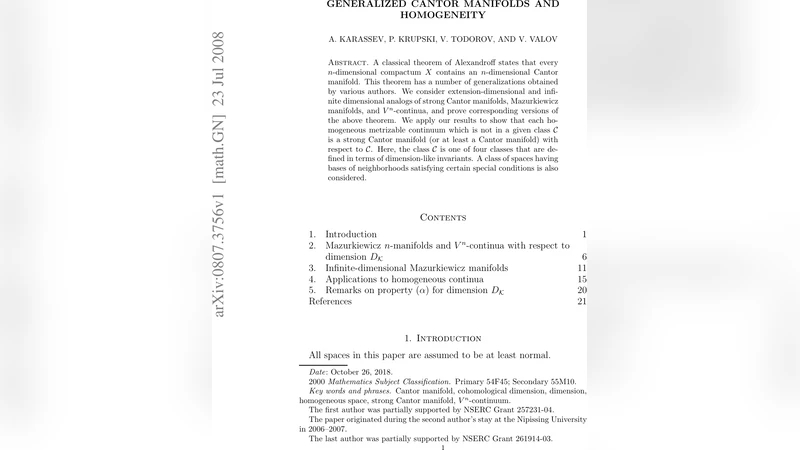
A classical theorem of Alexandroff states that every $n$-dimensional compactum $X$ contains an $n$-dimensional Cantor manifold. This theorem has a number of generalizations obtained by various authors. We consider extension-dimensional and infinite dimensional analogs of strong Cantor manifolds, Mazurkiewicz manifolds, and $V^n$-continua, and prove corresponding versions of the above theorem. We apply our results to show that each homogeneous metrizable continuum which is not in a given class $\mathcal C$ is a strong Cantor manifold (or at least a Cantor manifold) with respect to $\mathcal C$. Here, the class $\mathcal C$ is one of four classes that are defined in terms of dimension-like invariants. A class of spaces having bases of neighborhoods satisfying certain special conditions is also considered.
💡 Research Summary
The paper revisits the classical theorem of Alexandroff, which asserts that every (n)-dimensional compact space contains an (n)-dimensional Cantor manifold, and pushes this result far beyond its original setting. The authors work simultaneously with two modern strands of topology: extension dimension theory (the notion that a space’s “dimension’’ can be measured by the ability to extend maps into a fixed CW‑complex) and infinite‑dimensional topology (where no finite integer bound on dimension exists).
First, the authors generalize the familiar concepts of strong Cantor manifolds, Mazurkiewicz manifolds, and (V^{n})-continua. In the classical setting a strong Cantor manifold is a continuum that cannot be separated by any pair of disjoint open sets whose closures miss each other; a Mazurkiewicz manifold adds the requirement that any two disjoint closed subsets can be joined by a continuum, while a (V^{n})-continuum is a space whose every two disjoint closed sets can be linked by an (n)-dimensional continuum. The paper replaces the integer dimension (\dim) with an arbitrary CW‑complex (K) and defines a space to have “(K)-extension dimension’’ (\operatorname{e!-!dim}X\le K) if every map from a closed subset of (X) into (K) extends over (X). Using this language they introduce extension‑dimensional strong Cantor manifolds and infinite‑dimensional strong Cantor manifolds, the latter being defined relative to a class (\mathcal C) of spaces that capture various dimension‑like invariants.
Four specific classes (\mathcal C) are considered:
- (\mathcal C_{1}) – spaces of finite integer dimension (\dim).
- (\mathcal C_{2}) – spaces of finite cohomological dimension (\operatorname{cdim}).
- (\mathcal C_{3}) – spaces of finite extension dimension with respect to a fixed complex (K).
- (\mathcal C_{4}) – spaces of finite (G)-cohomological dimension (\operatorname{dim}_{G}) for a chosen coefficient group (G).
A space that does not belong to a given (\mathcal C) is therefore “dimensionally large’’ with respect to that invariant.
The central existence theorem (Theorem A) states that any metrizable continuum (X) which is not a member of a chosen class (\mathcal C) contains a subcontinuum that is a strong Cantor manifold relative to (\mathcal C) (and, at the very least, a Cantor manifold). The proof proceeds in two stages. First, the authors exploit homogeneity: if (X) is homogeneous, every point has the same local dimension profile, which forces any attempted separation by disjoint open sets to fail globally. Second, they apply extension‑dimensional techniques: selecting a complex (K) that represents the forbidden class (\mathcal C), they construct maps that cannot be extended past certain closed subsets, thereby creating the “dimension‑blocking’’ phenomenon required for a strong Cantor manifold.
In parallel, the paper defines infinite‑dimensional Mazurkiewicz manifolds and shows that these objects coincide with the infinite‑dimensional strong Cantor manifolds introduced earlier. Consequently, the classical relationship between Mazurkiewicz manifolds and (V^{n})-continua extends to the infinite‑dimensional realm: any infinite‑dimensional strong Cantor manifold automatically satisfies the path‑connecting property characteristic of a Mazurkiewicz manifold, while the (V^{n})-continuum condition is replaced by a “no finite‑dimensional obstruction’’ condition.
A significant application concerns homogeneous metrizable continua. The authors prove that if such a continuum does not belong to one of the four classes (\mathcal C), then it is a strong Cantor manifold with respect to that class. This result generalizes earlier work that dealt only with integer dimensions, showing that homogeneity forces a robust form of indecomposability even when the space is infinite‑dimensional or when dimension is measured by cohomology or extension properties.
The paper also investigates a broader family of spaces whose points admit bases of neighborhoods satisfying special conditions (e.g., each neighborhood is a (\sigma)-compact (\mathcal Z)-set or possesses a particular retract property). For these spaces, the authors demonstrate that the same strong Cantor manifold conclusion holds without assuming full metrizability or ANR‑type conditions, thereby weakening the usual hypotheses needed for such results.
Finally, the authors outline several open problems. They ask for a precise description of the inclusion relations among the four classes (\mathcal C) and for a classification of spaces that lie “between’’ these classes. They also suggest studying the algebraic topology of infinite‑dimensional strong Cantor manifolds (e.g., their shape, homotopy groups, or automorphism groups) and exploring whether the metrizability assumption can be removed entirely.
In summary, the paper provides a comprehensive extension of Alexandroff’s theorem to the setting of extension dimension and infinite dimensionality, establishes a robust link between homogeneity and strong Cantor manifold structure across several dimension‑like invariants, and opens new avenues for research on the interplay between dimension theory, homogeneity, and indecomposability in topological spaces.
Comments & Academic Discussion
Loading comments...
Leave a Comment