Dynamics of gene expression under feedback
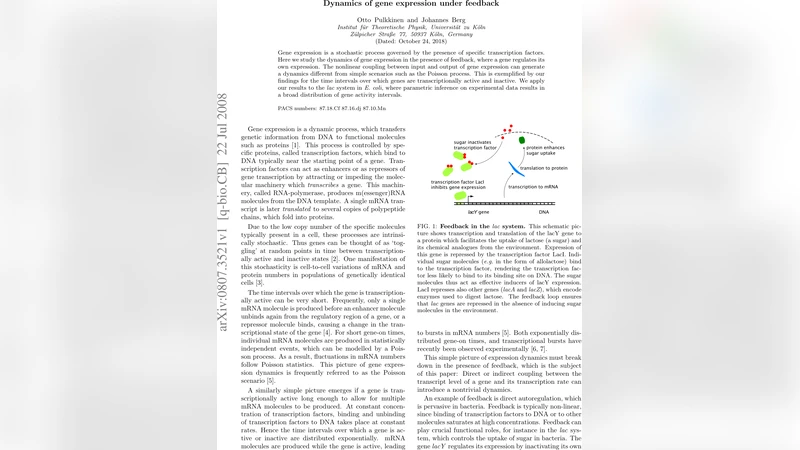
Gene expression is a stochastic process governed by the presence of specific transcription factors. Here we study the dynamics of gene expression in the presence of feedback, where a gene regulates its own expression. The nonlinear coupling between input and output of gene expression can generate a dynamics different from simple scenarios such as the Poisson process. This is exemplified by our findings for the time intervals over which genes are transcriptionally active and inactive. We apply our results to the lac system in E. coli, where parametric inference on experimental data results in a broad distribution of gene activity intervals.
💡 Research Summary
This paper investigates how self‑regulatory feedback influences the stochastic dynamics of gene expression, focusing on the temporal patterns of transcriptional activity and inactivity. Traditional models often treat transcription as a Poisson process, assuming a constant average rate and independent events. The authors argue that such a description is insufficient when a gene product feeds back onto its own promoter, because the transition rates between active and inactive states become functions of the current protein (or mRNA) concentration.
To capture this non‑linear coupling, the authors formulate a two‑state master equation in which the activation rate λ_on(c) and the deactivation rate λ_off(c) depend on the concentration c through Hill‑type functions. The Hill coefficient and the dissociation constant encode the strength and cooperativity of the feedback. By solving the master equation analytically, they derive expressions for the mean dwell times in each state, the coefficient of variation (CV), and higher‑order moments. A key theoretical prediction is that strong feedback can drive the CV of active‑state durations well above 1, indicating a broad, “burst‑like” distribution rather than the exponential distribution expected from a simple Poisson process.
The authors test the theory using the lac operon of Escherichia coli. They fuse the lacZ gene to a GFP reporter, record single‑cell fluorescence trajectories over time, and apply Bayesian inference to estimate model parameters (baseline rates, feedback strength, Hill coefficient, etc.) from the data. The inferred parameters reveal that, under strong positive feedback, the distribution of active‑state intervals approximates a log‑normal shape with a long tail, whereas weak or absent feedback yields intervals that are close to exponential. Moreover, increasing feedback strength raises both the mean active‑state duration and its variability, suggesting that feedback expands the temporal window over which a gene can be “on.”
The discussion interprets these findings in a biological context. A broad distribution of activity intervals may provide a population of cells with heterogeneous response times to environmental cues, thereby enhancing collective adaptability and survival under fluctuating conditions. The good quantitative agreement between the non‑linear master‑equation model and experimental data demonstrates that relatively simple stochastic frameworks can capture complex regulatory dynamics.
Finally, the paper points to future directions. Extending the approach to networks of interacting genes with mutual feedback could uncover emergent phenomena such as synchronization, bistability, or noise‑induced switching. Understanding how feedback‑shaped temporal statistics affect processes like cell differentiation, metabolic regulation, or stress responses could open new avenues for synthetic biology and therapeutic gene control.
Comments & Academic Discussion
Loading comments...
Leave a Comment