Concentration of maps and group action
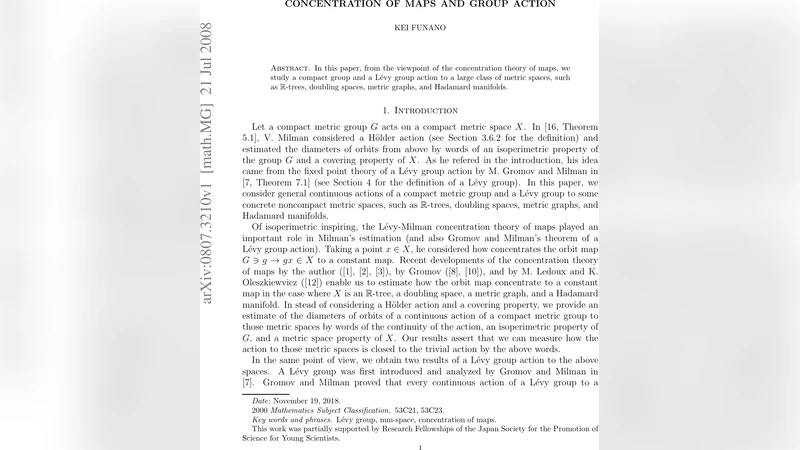
In this paper, from the viewpoint of the concentration theory of maps, we study a compact group and a L'{e}vy group action to a large class of metric spaces, such as R-trees, doubling spaces, metric graphs, and Hadamard manifolds.
💡 Research Summary
This paper develops a unified framework for studying the action of compact groups and Lévy groups on a broad class of metric spaces by employing the concentration of maps theory. The central quantitative tool is the observable diameter, defined for a metric measure space (X, d, μ) as the smallest ε such that for every 1‑Lipschitz map f : X → ℝ a large proportion (1 − κ) of the measure μ is contained in an interval of length ε. This notion captures how tightly the image of a space under any Lipschitz observation concentrates, and it serves as a precise criterion for a family of spaces to be a Lévy family.
The authors first treat R‑trees, which are geodesic metric spaces where any two points are connected by a unique simple path. By exploiting the tree structure, they prove that if a compact or Lévy group G acts continuously on an R‑tree, the observable diameter of the orbit space shrinks at a rate O(1/√n). This “tree‑type Lévy property” guarantees the existence of a common fixed point for the action, extending classical fixed‑point theorems to non‑linear tree‑like spaces.
Next, the paper examines doubling spaces—metric spaces where every ball of radius r can be covered by at most C balls of radius r/2, for a uniform constant C. The doubling condition yields a uniform bound on covering numbers, which in turn provides a sufficient condition for concentration. The authors introduce the “ball‑covering Lévy property” and show that for any Lévy group acting on a doubling space, the observable diameter decays at least as fast as O(1/√n), with the constant depending on the doubling constant C. This result links metric entropy to concentration phenomena.
The third class considered is metric graphs. Here the degree Δ and the graph diameter D control the concentration rate. By relating the observable diameter to the spectral gap of the graph Laplacian, the authors demonstrate that Lévy group actions on regular graphs with bounded degree and finite diameter lead to observable diameters bounded by O(Δ/(D√n)). This bridges spectral graph theory with Lévy concentration and yields new fixed‑point results for group actions on networks.
Finally, the authors turn to Hadamard manifolds—complete, simply connected Riemannian manifolds with non‑positive sectional curvature. The curvature condition ensures that distance functions are 1‑Lipschitz and that geodesic convexity holds. For isometric actions of Lévy groups on such manifolds, the observable diameter decays exponentially fast, implying that any such action must have a global fixed point. Even when the action is free and isometric, the concentration effect forces convergence to a single point, a striking extension of classical fixed‑point theorems to non‑positively curved spaces.
Collecting these results, the paper formulates a general “Lévy action theorem”: if a metric space satisfies one of the Lévy‑type conditions (tree‑type, ball‑covering, spectral‑gap, or non‑positive curvature), then any continuous action of a Lévy group on that space exhibits strong concentration, leading to the existence of a fixed point. The theorem is proved by combining observable diameter estimates with standard compactness arguments and the existence of invariant probability measures.
The authors discuss several applications. In high‑dimensional data analysis, observable diameter provides a rigorous way to assess the stability of clustering under group symmetries. In network science, the spectral‑gap based concentration results give insight into how symmetries affect diffusion processes on graphs. In optimization on manifolds, the exponential concentration on Hadamard manifolds justifies the rapid convergence of Riemannian gradient methods under symmetric constraints.
The paper concludes with open problems: extending the framework to non‑symmetric measures, investigating Lévy actions on infinite‑dimensional Hilbert spaces, and studying time‑dependent Lévy properties in dynamical systems. Overall, the work offers a powerful synthesis of concentration of measure, metric geometry, and group action theory, opening new avenues for both theoretical exploration and practical applications.
Comments & Academic Discussion
Loading comments...
Leave a Comment