Alexandrov curvature of Kaehler curves
We study the intrinsic geometry of a one-dimensional complex space provided with a Kaehler metric in the sense of Grauert. We show that if K is an upper bound for the Gaussian curvature on the regular locus, then the intrinsic metric has curvature at…
Authors: Aless, ro Ghigi
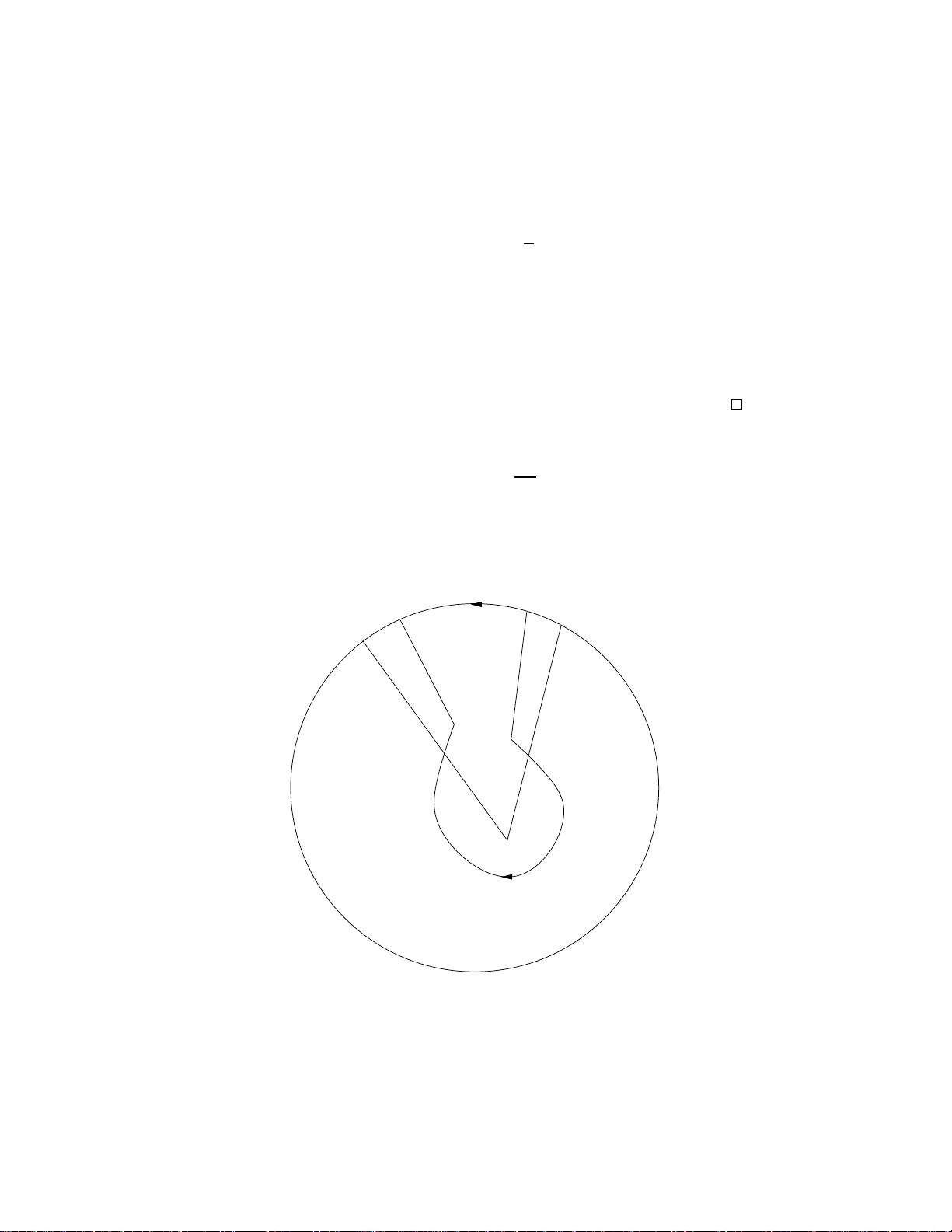
Alexandro v curv ature of K¨ ahler curv es Alessandro Ghigi ∗ No v em b er 25 , 2021 Abstract W e study the in trinsic geometry of a one-dimensional complex space p ro- vided with a K¨ ahler metric in the sense of Grauert. W e show that if κ is an upp er b ound for the Gaussian curv ature on the regular lo cus, then th e intrinsi c metric has curva ture ≤ κ in the sense of Alexandrov. Con ten ts 1 In tro duction 1 2 In trinsic distance 4 3 Regularity of geo desi cs 11 4 T a ngent v ectors i n the normali s ation 17 5 Uniqueness of geode s ics 21 6 Con v exity 29 7 Alexandro v curv ature 36 1 In tro duction Let Ω be a domain in C n and let X ⊂ Ω b e an ana lytic subset, that is a set of the form X = { z ∈ Ω : f 1 ( z ) = · · · = f N ( z ) = 0 } for some functions f j holomorphic on Ω. Denote b y h , i the flat metric on C n and by g the Riemannia n metric induced on the reg ular pa rt X reg of X . Define a distance on X b y setting d ( x, y ) e qual to the infim um of the lengths of curves lying in X a nd joining x to y . Then ( X , d ) is an intrinsic metric space. If X is smo oth, ( X , g ) is a K¨ ahler manifold and one can study the metric pro perties of ( X , d ) using the methods of Riemannian geometry . If X co n tains singularities it is natural to study ( X, d ) ∗ Pa rtiall y supported by MIUR PRIN 2005 “Sp azi di mo duli e T eo rie di Li e” . 1 using the no tions and metho ds of nonr egular Riemannian g eometry develope d by the g reat soviet mathematician A.D. Alexandr o v and his sc ho ol (see e.g. [2], [24], [1], [6], [5 ], [20], [21], [7], [8]). The purpose of this pap er is to inv estigate the Alexandrov geometry o f ( X , d ) in the simplest case, na mely when dim C X = 1 . More gener ally , we cons ider the fo llo wing situation. Let X be a one-dimensional connected reduced complex space and let ω be a K¨ ahler form o n X in the s ense of Gra uert [13]. This means that ω is a K ¨ ahler metric on the regular par t o f X and that for any singular p oint ther e is a r epresentation of X as an ana lytic set in some open se t Ω ⊂ C n such that ω extends to a smo oth K¨ ahler metric on Ω (see § 2 for pr ecise definitions). The K¨ ahler form ω and the complex structure determine a R iemannian metric g on X reg which a llo ws to compute the length of paths in X . Given t wo p oint x, y ∈ X let d ( x, y ) b e the infim um of the le ngths of paths in X from x to y . It turns o ut that d is an intrinsic dis tance on X inducing the original top ology . W e refer to d as the intrinsic distance of ( X , ω ). Our main result is the following. Theorem 8 . L et X b e a one-dimensional c onne cte d r e duc e d c omplex sp ac e. L et ω b e a K¨ ahler metric on X in t he sense of Gr auert and let d b e the intrinsic distanc e of ( X , ω ) . If κ is an u pp er b ound for the Gaussian cu rvatur e of g on X reg , then ( X , d ) is a met r ic sp ac e of curvatur e ≤ κ in the sense of A lexandr ov. This r esult is strictly r elated to a theo rem of Mes e, of which the a uthor was no t aware until the completion of this work. W e explain briefly the rela- tion a mong the tw o r esults. An immediate coro llary of our main r esult is the following. Corollary 1. L et ( M , g ) b e a K¨ ahler manifo ld with se ctional curvatur e ≤ κ for some κ ∈ R . L et X ⊂ M b e a one-dimensional analytic su bset and let d b e the intrinsic distanc e on X . Then ( X , d ) is an inner metric sp ac e of curvatur e ≤ κ in t he sense of Alexandr ov. If X is s mooth this follows fr om Gauss equation together with the K¨ ahler prop erty of g . If X co n tains singularities it is enoug h to apply the Ga uss equa- tion on X reg and Theorem 8. Mor e generally , if ( M , g ) is a Riema nnian manifold with sec tional curv ature ≤ κ and X is a smo oth minimal sur face in M , Gauss equation implies that X has curv ature ≤ κ as well. This lea ds to the following problem: if ( Y , d ) is a metric space with Alexandrov curv ature ≤ κ and X ⊂ Y is a minimal surface (in a sense to be defined) is it true that X with the in- duced metric has cur v ature ≤ κ ? Mese [19] has prov ed this for surfaces that are confor mal and ene rgy-minimizing and Cor ollary 1 immediately follo ws from her res ult. W e a lso mention that Pet runin [22] has gotten the same result for metric minimizing surfaces . W e wish to str ess that in Theor em 8 ther e ar e no a ssumptions on the cur v a- ture of the ambien t manifold. In fact the a m bient manifold is no t sp ecified at all. Therefore o ur res ult is str onger. Nevertheless it follows immediately fro m Mese theorem that a one-dimensional analytic subset with intrinsic metric is 2 CA T( κ ′ ) for some κ ′ po ssibly la rger than κ . This immediately yields unique- ness of geo desics in the small, which is one of the hardest part in our pro of. Nevertheless Mese ar gumen ts dep ends o n quite deep a nalytic to ols, while ours uses only the nor malisation o f a one-dimensiona l sing ularity , Jo rdan curve the- orem, Rauch theor em a nd K lingen b erg lemma from Riemannian geometry , and some bas ic constructs of Alexandrov geometry . Mor eo ver our analys is yields a very concrete description of all the geometric ob jects inv olved. Therefore we b elieve that it is still of so me interest to present the pr oo f of Theorem 8 in this for m. The plan of the paper is the following. In § 2 we reca ll the definition of K¨ ahler forms on a sing ular s pace, define the int rinsic dista nce in the one-dimensional case and prove s ome basic prop erties. Many s tatemen ts hold in more g eneral situations, but we r estrict from the b e- ginning to the o ne-dimensional case in o rder not to burden the pr esen tation. A t the end we sho w that to inv estiga te lo cal problems one might restrict considera - tion to the case in which X is a one-dimensio nal analytic subset in C n provided with a general K¨ ahler metric. Appro priate con ven tions and nota tions a re fixed to b e use d in the study of this par ticular case under the additional hypothesis that ther e is only one singularity whic h is (analytically) ir reducible. This study o ccupies §§ 3 – 6. In § 3 we co nsider different iability prop erties of segments α : [0 , L ] → X . Since X ⊂ C n we can consider the tangen t vector α ( t ) at least when α ( t ) ∈ X reg . The main p oint is a H¨ o lder estimate for ˙ α (Theorem 2). This is proved by ex- pressing the second fundamental for m o f X ⊂ C n in terms of the normalisa tion map. Here is where the K¨ ahler prop ert y is used. Next we mak e v a rious observ a- tions regarding the a symptotic behaviour o f the distance d and of the tangen ts to segment s close to a singular point. In § 4 we study regular it y pro perties of seg men ts through the normalisation. This is useful to compute angles b et ween the tangent vectors at a singular p oin t. § 5 is t he most tec hnical section. W e study uniqueness prop erties of geo desics near the singular p oint. W e constr uct a decreasing sequence of radii r 1 > r 2 > r 3 > r 4 > r 5 > r 6 such that the geo desic balls centred at the singular p oin t hav e better and b etter uniqueness prop erties. As a first step (Pr op. 9 and Theorem 3) we show that if t wo s egmen ts have the same endp oints then the singular po in t lies in the interior of the clo sed curve formed by the segments. T o prov e this we combine extrinsic a nd intrinsic information. The for mer amounts to the H¨ older estimate alluded to ab ov e and the finiteness o f the area of X (Lelong theorem). T he la tter is provided by Gauss–Bo nnet and Ra uc h theorems. The Jordan separation theorem is used on se v eral o ccasions. Th next step (Theor em 4) is to show that if tw o p oint s s ufficien tly clo se to the singular it y ar e joined b y t wo distinct segments one of them has to pass thro ugh the singular p oint. Her e the a rgument is based on the winding n um b er and the fac t that X is a ra mified cov ering o f the disc . In § 6 w e prov e that sufficiently small balls centred at the singular p oin t are geo desically co n vex (Co r. 6). On the wa y we prove (using an idea from [18]) 3 that the distance from a singular po in t is C 1 in a (deleted) neighbourho o d of it. W e establish v ar ious techn ical pr oper ties o f segments emana ting fr om the singular point and the angle their tangent vectors form at the sing ular p oint. In particular we study ”sectors” with vertex at the singular p oint (Lemma 25) and establish their con vexit y (Theorem 5). In § 7 w e recall the ma in co ncepts o f the intrinsic g eometry o f metric spa ces in the sense of A.D. Alexandrov. Next, by combining the informatio n on sectors and angles collected b efore, we show that a sufficiently small ball centred at a singular p oin t is a CA T( κ )–space. This completes the pr oo f of Theor em 8 in the ca se of a n irreducible singular it y . The case of reducible singula rities is dealt with by reaso ning as in Reshetny ak g luing theore m and inv oking the re sult in the irreducible case. A t the end o f the pap er we observe that the statement corresp onding to Theorem 8 with lower bo unds on curv ature ins tead of upper bounds is false. In particular a K ¨ ahler curve ( X, d ) can hav e curv ature b ounded b elow in the sens e of Alexandrov o nly if X is smo oth (Theorem 9). Ac kno wledgeme n ts The author wishes to thank Pro f. Giusepp e Sav a r ´ e for turning his attention to the Alexa ndro v notio ns of cur v ature and b oth him and Prof. Gian P ietro P irola for v arious int eres ting dis cussions o n sub jects connected with this work. He is also g rateful to a n anonymous referee for po in ting out the result of Mese [19]. He also a c knowledges generous support from MIUR PRIN 2005 “Spa zi di mo duli e T e orie di Lie”. 2 In trinsic d istance A Let X b e c omplex curve , that is a one-dimensio nal reduced complex space. By definition for a n y point x ∈ X there is an o pen neig h b ourho od U of x in X , a domain Ω in some affine space C n and a map τ : U → Ω that maps U biholomorphica lly onto so me o ne-dimensional ana lytic subset A ⊂ Ω. W e call the quadruple ( U, τ , A, Ω) a chart around x . Definition 1. A K ¨ ahler form on X is a K¨ ahler form ω on X reg with the fol- lowing pr op erty: for any x ∈ X sing ther e is ar e a chart ( U , τ , A, Ω) ar ound x and a K¨ ahler form ω ′ on Ω such that τ ∗ ω ′ = ω on U ∩ X reg . We c al l ω ′ a lo cal extension of ω . This definition is due to Grauer t [1 3, § 3.3 ]. A K¨ ahler curve is a complex curve with a fixed K¨ ahler for m. Let ( X , ω ) be a K¨ ahler curve. Denote by J the complex structure on X reg . Then g ( v , w ) = ω ( v , J w ) defines a Riemannian metric on X reg . Denote by | v | g the nor m o f v ∈ T x X reg with resp ect to g . A path α : [ a, b ] → X is of cla ss C 1 if τ ◦ α is C 1 for any chart. F o r a piece wise C 1 path α the length is defined b y L ( α ) = Z α − 1 ( X reg ) | ˙ α ( t ) | g dt. (1) 4 Lemma 1. L et ( U, τ , A, Ω) b e a chart and ω ′ a K¨ ahler form on Ω extending ω , with g ′ the c orr esp onding metric. If α : [ a, b ] → U is a pie c ewise C 1 p ath and β = τ ◦ γ , then L ( α ) = Z b a | ˙ β ( t ) | g ′ dt (2) Pr o of. Let E = α − 1 ( X reg ), F = I \ E , B = F 0 , D = ∂ F . Then I = E ⊔ B ⊔ D . Since X has iso lated singula rities α and β are consta n t on the connected comp onen ts of F , so ˙ β ≡ 0 on B . The set D is countable, s o has zero measure. Therefore Z b a | ˙ β | g ′ dt = Z E | ˙ β | g ′ = Z E | ˙ α | g = L ( α ) . F o r x, y ∈ X set d ( x, y ) = inf { L ( α ) : α piecewise C 1 path in X with α (0) = x, α (1) = y } . (3) F o r r > 0 set also B ( x, r ) = { y ∈ X : d ( x, y ) < r } . Recall the following fundamen tal result of Lo jasiewicz. Theorem 1 ( L o jasiewicz , [17, § 18 , Pro p. 3, p.97]) . L et A b e an analytic subset in a domain Ω ⊂ C n and z 0 ∈ A . Then ther e ar e C > 0 , µ ∈ (0 , 1] and a neighb ourho o d V of z 0 in A s uch t hat for any z , z ′ ∈ V ther e is a r e al analytic p ath β : [0 , 1] → A joining z t o z ′ with R 1 0 | ˙ β | dt ≤ C | z − z ′ | µ . (Her e | · | denotes the Euclide an norm in C n .) Prop osition 1. If ( X , ω ) is a c onne cte d K¨ ahler curve, then d is a distanc e on X inducing the original top olo gy. Pr o of. W e start by showing that d ( x, y ) is finite for any ( x, y ) ∈ X × X . If x and y b elong to the same connec ted comp onen t o f X reg this is o b vious. Assume that x ∈ X sing . Let ( U, τ , A, Ω) b e a chart a round x and ω ′ a loca l extension of ω . B y restricting U we may ass ume tha t there is a constant C > 0 such that C − 1 | dτ ( v ) | ≤ | v | g ≤ C | dτ ( v ) | for any v ∈ T U reg . If α : [ a, b ] → U is a piecewise C 1 curve and β = τ ◦ α , then C − 1 L ( β ) ≤ L ( α ) ≤ C L ( β ), where the length o f β is computed with resp ect to the E uclidean norm. B y L o ja siewicz Theorem for any p oin t y ∈ U ther e is a piecewise C 1 path α in A joining τ ( x ) to τ ( y ). Then β = τ − 1 ◦ α is a pa th in X joining x to y with L ( β ) ≤ C · L ( α ) < + ∞ hence d ( x, y ) < + ∞ for a ll y ∈ U . Because the length functional L is additive with resp ect to the conc atenation of paths, it follows that d ( x, y ) < + ∞ for all y in some irreducible comp onent o f X that passes throug h x . Since X is connected this yields finiteness of d . A t this point one might apply the ge neral machinery of [24, p.123ff] or [8, p.26ff]. The class of piecewise C 1 paths is closed under res triction, co ncatenation and C 1 repara metrisations. Mor eo ver L is inv aria n t under C 1 repara metrisation, 5 it is an additive function on the in terv als a nd L ( α [ a,t ] ) is a co n tinuous function of t ∈ [ a, b ]. It follows that d is a distance on X . Let V ⊂ X b e an op en set (for the orig inal topo logy) and le t x ∈ V . Fix a c hart ( U, τ , A, Ω) around x and a lo cal extension ω ′ . Deno te by d Ω the Riemannian distance of (Ω , ω ′ ). Let U ′ be a neighbourho o d of x with compact closure in U ∩ V . Since τ ( x ) 6∈ τ ( ∂ U ′ ), ε = d Ω τ ( x ) , τ ( ∂ U ′ ) > 0. If α : [ a, b ] → X is a co n tinuous path with α ( a ) = x and α ( b ) 6∈ U ′ set c = sup { t ∈ [ a, b ] : α ( t ) ∈ U ′ } . Then L ( α ) ≥ L ( α [ a,c ] ) = L ( τ ◦ α [ a,c ] ) ≥ d Ω τ ( x ) , τ ( ∂ U ′ ) = ε. Hence B ( x, ε ) ⊂ U ′ ⊂ V . This shows that the metric topo logy is finer than the original one. Conv ersely we show that for any x ∈ X and δ > 0 the metric ball B ( x, δ ) is open in the original top ology . Let again ( U, τ , A, Ω) be a chart ar ound x and let ω ′ be a lo cal extension and assume that there is a constant C > 0 such that C − 1 | dτ ( v ) | ≤ | v | g ≤ C | dτ ( v ) | for any v ∈ T U reg . Thanks to Lo jasiewicz Theorem by restr icting U and Ω we can a ssume that for any z , z ′ ∈ A there is a C 1 path joining z and z ′ and having E uclidean length ≤ C ′ | z − z ′ | µ . F or x ′ ∈ B ( x, δ ) put δ ′ = µ p ( δ − d ( x, x ′ )) /C C ′ > 0. Then the set τ − 1 ( { z ∈ Ω : | z − τ ( x ′ ) | < δ ′ } ) is contained in B ( x ′ , δ − d ( x, x ′ )) ⊂ B ( x, δ ). Therefor e B ( x, δ ) is open in the orig inal top ology and the t w o top ologies coincide. Starting fr om the metric spa ce ( X, d ) one can define a new length functiona l L d by the formula L d ( γ ) = sup N X i =1 d ( γ ( t i − 1 ) γ ( t i )) (4) the supremum b eing ov er all partitions t 0 < . . . < t N of the doma in of γ . By definition d ( x, y ) ≤ L d ( γ ) for any contin uous path joining x to y , while the inequality L d ( γ ) ≤ L ( γ ) holds for any piecewise C 1 path. The dis tance d is intrinsic if d ( x, y ) = inf { L d ( γ ) : γ ∈ C ([0 , 1] , X ) , γ (0) = x, γ (1) = y } . Prop osition 2. The distanc e d is intrinsic. Pr o of. This is proved for genera l length structures in [8, Prop. 2.4 .1 p.38]. Definition 2 . We c al l d t he intrinsic distance of the K ¨ ahl er cur ve ( X , ω ) . F o r geo desics in the metr ic space ( X , d ) we adopt the following ter minol- ogy . A shortest p ath is a map γ : [ a, b ] → X such that L d ( γ ) = d ( γ ( a ) , γ ( b )). Minimising ge o desic is synonymous of sho rtest path. One can r eparametrise a shortest path in such a way that d ( γ ( t ) , γ ( t ′ )) = | t − t ′ | for any t, t ′ . In this c ase we sa y that γ has unit sp e e d . A se gment is by definition a unit sp eed shortest path. More generally , we say that γ is parametr ised with constant speed c if d ( γ ( t ) , γ ( t ′ )) = | t − t ′ | for any t, t ′ . If I is any interv al a path γ : I → X is a ge o desic if for a n y t ∈ I there is a co mpact neighbour hoo d [ t 0 , t 1 ] of t in I suc h that γ [ t 0 ,t 1 ] is a shortest path with co nstan t speed. 6 Lemma 2 ( [8, Prop. 2 .5.19 p.49]) . If the b al l B ( x, r ) is r elatively c omp act in X , for any y ∈ B ( x, r ) ther e is a se gment fr om x to y . ( X reg , g ) is a (smo oth) Riemann surface with a nonc omplete smo oth K¨ a hler metric. F or x ∈ X reg denote by U x X the unit s phere in T x X . Let U X reg = S x ∈ X reg U x X b e the unit tangent bundle. W e deno te by ( t, v ) 7→ γ v ( t ) the geo desic flow: that is γ v ( t ) = exp x ( tv ) wher e x = π ( v ). Let U ⊂ R × T X reg be the ma ximal domain o f definition of the g eodes ic flow of ( X reg , g ). It is an open neighbourho o d of { 0 } × T X reg in R × T X reg . Let D ⊂ T X reg denote the maximal domain of definition of the exp onential: D = { v ∈ T X reg : (1 , v ) ∈ U } . F or x ∈ X reg set D x = D ∩ T x X . Then D x is the max imal domain of definition of exp x . Both D and D x are op en in T X reg and T x X resp ectively and the maps exp : D → X reg and exp x : D x → X reg are defined and s mooth. F or v ∈ U x X set T v = sup { t > 0 : tv ∈ D x } . (5) Denote b y B x (0 , r ) the ball in T x X with resp ect to g x . Definition 3. F or x ∈ X reg the injectivity r adius at x , denote d inj x , is t he le ast u pp er b ound of al l δ > 0 such that B x (0 , δ ) ⊂ D x and exp x B x (0 ,δ ) is a diffe omorphism ont o its image. Lemma 3. F or any x ∈ X reg , inj x ≤ d ( x, X sing ) . Pr o of. Let γ : I → X be a piecewise C 1 path in P joining x to so me singular po in t x 0 . F or δ ∈ (0 , inj x ) put U δ = exp x ( B x (0 , δ )). Since U δ ⊂ X reg and x 0 is singular, there is some t ∈ I such that γ ( t ) ∈ ∂ U δ . L et t 0 be the smallest such nu mber. Then γ [0 ,t 0 ] is a path en tirely contained in X reg . It follo ws from Gauss Lemma [12, Prop. 3.6, p.70 ] that L ( γ [0 ,t 0 ] ) ≥ δ . Therefore also L ( γ ) ≥ δ . Since γ , x 0 and δ < inj x are arbitrary w e get d ( x, X sing ) ≥ inj x . Lemma 4. L et x ∈ X reg and y ∈ B ( x, inj x ) . 1. The intrins ic distanc e e quals the Riemannian distanc e in ( X reg , g ) : d ( x, y ) = inf { L ( γ ) : γ pie c ewise C 1 p ath in X reg with γ (0) = x, γ (1) = y } . (6) 2. B ( x, inj x ) = exp x ( B x (0 , inj x )) . 3. Ther e is a unique s e gment joining x to y and it c oincides with the min- imising Riemannian ge o desic in ( X reg , g ) fr om x to y . 4. A ge o desic γ in ( X , d ) is smo oth on γ − 1 ( X reg ) and ther e ∇ ˙ γ ˙ γ = 0 . Pr o of. It follows from the previo us lemma and the hypo thesis d ( x, y ) < inj x that pa ths passing throug h singular points do not contribute to the infimum in (3). This pr o ves (6). F r om this follows that y lies in exp x ( B x (0 , inj x )). So B ( x, inj x ) ⊂ exp x ( B x (0 , inj x )). The reverse implicatio n is ob vious. This prov es 7 2. In particular y ∈ exp x ( B x (0 , inj x )), so there are v ∈ U x X and r ∈ (0 , inj x ) such that y = exp x rv . It follows from Gauss Lemma tha t the inf in (6) is attained only on the path γ ( t ) = exp x tv , t ∈ [0 , r ]. So L ( γ ) = d ( x, y ). But d ( x, y ) ≤ L d ( γ ) ≤ L ( γ ) so L d ( γ ) = L ( γ ) and γ is a segment also in ( X , d ). W e hav e to prov e that it is the unique one. Since d ( x, y ) < inj x it follows from 2 that any other segment α must lie in exp x ( B x (0 , inj x )) ⊂ X reg . If α is smo oth we can aga in apply Gauss Lemma. So it is enough to sho w that α is differentiable, which will yield 4 at once. This is a lo cal pr oblem, so w e just pro ve that α [0 ,t 0 ] is smo oth for some t 0 > 0. By Whitehead theor em [12, Pro p. 4.2 p.76] there is a neighbour hoo d W o f x such that for any z ∈ W , W ⊂ B ( z , inj z ). Let t 0 be small enoug h so that α ([0 , t 0 ]) ⊂ W . Put x 0 = α ( t 0 ) and let β be the unique minimising Riemannian geo desic from x to x 0 . W e alre ady know tha t L ( β ) = d ( x, x 0 ) = t 0 . F or t ∈ (0 , t 0 ) let β 1 and β 2 be the unique Riemannian geo desics from x to α ( t ) a nd from α ( t ) to x 0 resp ectively . Both of them ar e also shortest paths, b y the above. Mor eov er t 0 = L d ( α ) ≥ d ( x, α ( t )) + d ( α ( t ) , x 0 ) = L ( β 1 ) + L ( β 2 ) ≥ L ( β ) = t 0 . So L ( β 1 ∗ β 2 ) = L ( β 1 ) + L ( β 2 ) = L ( β ). Since the concatenation β 1 ∗ β 2 is piecewise smooth β 1 ∗ β 2 = β . T his means that α ( t ) lies on β ([0 , t 0 ]). Since t is arbitrar y we g et α [0 ,t 0 ] = β . I n particular α is s mooth. Prop osition 3. On pie c ewise C 1 p aths the functional L d agr e es with L . Pr o of. The inequality L d ≤ L is ob vious from the definition of d . F or the rev erse inequality consider a piecewise C 1 path γ : [0 , 1] → X and assume at firs t that γ ([0 , 1]) ⊂ X reg . Since L d ( γ ) ≤ L ( γ ) < ∞ the limit lim h → 0 d ( γ ( t + h ) , γ ( t )) | h | . exists for a .e. t ∈ [0 , 1]. It is calle d met ric derivative and denoted b y | ˙ γ ( t ) | d . It is an in tegra ble function o f t and L d ( γ ) = Z 1 0 | ˙ γ ( t ) | d dt. (See [24, p.10 6-109] or [4, p.59ff].) So it is enoug h to chec k that | ˙ γ | d = | ˙ γ | g . This is acco mplished as follows. P ut x = γ ( t ). F o r small h we ca n write γ ( t + h ) = e xp x ( z ( h )) where z = z ( h ) is s ome C 1 path in T x X with z (0) = 0 and and ˙ z (0) = d (exp x ) 0 ( ˙ z (0)) = ˙ γ ( t ). Since d ( γ ( t + h ) , γ ( t )) = | z ( h ) | g | ˙ γ ( t ) | d = lim h → 0 | z ( h ) | g | h | = | ˙ z (0) | g = | ˙ γ ( t ) | g . This pr o ves that L d = L for paths that do not meet X sing . (Ther e is a pro of for C 1 Finsler manifolds due to Bus emann and May er. It can b e found in [9] or a t pp. 134- 140 of Rinow’s bo ok [24].) F or a g eneral path one can r eason 8 as in L emma 1: let E = γ − 1 ( X reg ), F = I \ E , B = F 0 , D = ∂ F . Then I = E ⊔ B ⊔ D . Since γ is constant on the co nnected comp onents of F , if [ a, b ] is one such co mponent then L d ( γ [ a,b ] = L ( γ [ a,b ] ) = 0 . The result follows from additivity of b oth functionals. Corollary 2. The functional L is lower semic ontinuous on t he set of pie c ewise C 1 p aths with r esp e ct to the t op olo gy of p ointwise c onver genc e. Pr o of. It easily follows from the definition that L d is low er semicontin uous on C 0 ([0 , 1] , X ) with r espect to p oin twise co n vergence [8, Prop. 2.3 .4(iv)]. The construction of the in trinsic distance is lo c al in the following se nse. Lemma 5. F or any p oint x 0 ∈ X and any n eighb ourho o d U of x 0 in X t her e is a smal ler neighb ourho o d U ′ ⊂ U such t hat for any x, y ∈ U ′ ther e is a se gment γ fr om x to y and any su ch se gment is c ontaine d in U ′ . In p articular the intrinsic distanc e of ( X , ω ) and that of ( U, ω U ) c oincide on U ′ . Pr o of. Let ε > 0 be s uc h that B ( x 0 , 4 ε ) is a co mpact s ubset of U . P ut U ′ = B ( x, ε ). If x, y ∈ U ′ then d ( x, y ) ≤ d ( x, x 0 ) + d ( x 0 , y ) < 2 ε . By Lemma 2 since B ( x, 2 ε ) is co mpact there is a segment from x to y . Now if γ = γ ( t ) is any such segment d ( γ ( t ) , x 0 ) ≤ d ( γ ( t ) , x ) + d ( x, x 0 ) ≤ L ( γ ) + d ( x, x 0 ) ≤ 3 ε . So γ ( t ) lies in U . Corollary 3. L et ( X , ω ) b e a K¨ ahler curve and let d b e the int rinsic distanc e. If ( U, τ , A, Ω) is a chart ar oun d x ∈ X and ω ′ is a lo c al ext ension of ω ther e is a neighb ourho o d U ′ ⊂ U of x such that τ U ′ is a biholomorphic isometry b etwe en ( U ′ , d ) and τ ( U ′ ) ⊂ A pr ovid e d with the intrinsic distanc e obtaine d fr om ω ′ . It follows that to s tudy lo c al pro perties of the metr ic spa ces ( X , d ) it is enough to co nsider the specia l case in whic h X is an a nalytic se t in a do main of C n with the metric induced from so me K¨ ahler metric o f the doma in. This situation, under the additio nal hypothesis that the sing ularit y be ana lytically irreducible, is the o b ject o f §§ 3 – 6, throughout which we will make the following assumptions and use the following notation. h , i is the standard Her mitian product on C n , v · w = Re h v , w i is the corresp onding s calar product, | · | is the corr esponding norm. Given tw o nonzero v ector s v , w in a Euclidean space ∢ ( v , w ) = a rccos v · w | v | · | w | is the unoriented angle b et ween them. Ω ′ is an open p olydisc centred at 0 ∈ C n , A ⊂ Ω ′ is an analytic curve, ω is a smo oth K¨ ahler form on Ω ′ , g is the corres ponding K¨ ahler metric, 9 g x is the v a lue of g a t x ∈ Ω ′ , | · | g or | · | x denotes the corresp onding norm, g 0 = h , i , Ω is an open subset of Ω ′ with Ω ⊂ ⊂ Ω ′ , X := A ∩ Ω, d is the in trinsic distance of ( X, ω X ), B ( x, r ) is the ball in ( X, d ), B ∗ ( x, r ) = B ( x, r ) \ { 0 } , B x (0 , r ) = { w ∈ T x X : | w | x < r } . X sing = { 0 } , X is ana lytically irr educible a t 0, m = mult 0 X is the multiplicit y of X at 0, K ( x ) is the Gaussian curv ature o f ( X reg , g ) at x ∈ X reg and κ = sup x ∈ X reg K ( x ) . (7) ∆ = { z ∈ C : | z | < 1 } , ∆ ∗ = ∆ \ { 0 } , ∆ ′ ⊂ C is an open subse t containing ∆, ϕ : ∆ ′ → X ′ is the normalisation map, ϕ (∆) = X . There is a holomorphic map ψ = ( ψ 1 , . . . , ψ n ) : ∆ ′ → C n such that ϕ ( z ) = z m ψ ( z ) ψ 1 ( z ) ≡ 1 ψ j (0) = 0 j > 1 . (8) R : ∆ ′ → C n is the holomorphic ma p defined b y R ( z ) := ψ ( z ) − ψ (0) mz + ψ ′ ( z ) m (9) ϕ ′ ( z ) = mz m − 1 ( e 1 + z R ( z )) (10) e 1 = (1 , 0 , . . . , 0). c 0 > 0 is a constan t such that sup ∆ | ϕ ′ | ≤ c 0 sup ∆ | R | ≤ c 0 (11) ∀ x ∈ Ω , ∀ v ∈ C n , ( 1 c 0 | v | ≤ | v | x ≤ c 0 | v | | v | x ≤ | v | (1 + c 0 | x | ) . (12) F r om (11) it follows that fo r a n y z ∈ ∆ | ϕ ( z ) | ≤ c 0 | z | . (13) π : C n → C × { 0 } is the pro jection on the first co or dinate, u := π ◦ ϕ : ∆ → ∆ is the standard m : 1 ramified covering: u ( z ) = z m . F o r θ 0 ∈ R and α ∈ (0 , π ] put S ( θ 0 , α ) = { ρe iθ : ρ ∈ (0 , 1) , | θ − θ 0 | < α } ⊂ ∆ . (14) 10 Then u − 1 S ( θ 0 , α ) = m − 1 G j =0 S θ 0 + 2 π j m , α m (15) and u j := u S θ 0 +2 π j m , α m (16) is a biholomorphism onto S ( θ 0 , α ). The Whitney tangent cone of X at 0 is C 0 X = C × { 0 } ⊂ C n (17) (see e.g. [10, p.122, p.80]). If γ : [0 , L ] → X is a path, γ 0 ( t ) = γ ( L − t ). 3 Regularit y of geo desics Lemma 6 ([17, Lemma 1, p.86 ]) . L et m b e a p ositive inte ger and K > 0 . Put Z = { ( a 1 , . . . , a m , x ) ∈ C m +1 : x m + P m j =1 a j x m − j = 0 , | a j | ≤ K } . Then ther e is an M = M ( m, K ) > 0 with t he fol lowing pr op erty. L et α ( t ) = ( a ( t ) , x ( t )) b e a c ont inuous p ath α : [0 , 1] → Z and L > 0 such that | a ( t ) − a ( t ′ ) | ≤ L | t − t ′ | for t, t ′ ∈ [0 , 1] . Then | x ( t ) − x ( t ′ ) | ≤ M L 1 / m | t − t ′ | 1 / m ∀ t, t ′ ∈ [0 , 1] . (18) Prop osition 4. Ther e is a c onstant c 1 > 1 such t hat for any z , z ′ ∈ ∆ 1 c 1 d ( ϕ ( z ) , ϕ ( z ′ )) ≤ | z − z ′ | ≤ c 1 d ( ϕ ( z ) , ϕ ( z ′ )) 1 / m . (19) Pr o of. Reca ll that Ω ′ is a p olydisc, say Ω ′ = P (0) K,...,K and X is compa ctly contained in Ω ′ . Le t z , z ′ ∈ ∆ and x = ϕ ( z ) , x ′ = ϕ ( z ′ ). F or ε > 0 let γ : [0 , 1] → X be a piec ewise C 1 path with L := L ( γ ) < d ( x, x ′ ) + ε . W e can assume that γ has consta n t spee d equal to L , so d ( γ ( t ) , γ ( t ′ )) ≤ L | t − t ′ | . On the o ther hand w e trivially have | γ ( t ) − γ ( t ′ ) | ≤ d ( γ ( t ) , γ ( t ′ )). Put a m ( t ) = − π γ ( t ) , x ( t ) = ϕ − 1 ( γ ( t )) and α ( t ) = (0 , . . . , 0 , a m ( t ) , x ( t )). The n a m ( t ) = − π ◦ ϕ ( x ( t )) = − u ( x ( t )) = − x m ( t ) x m ( t ) + a m ( t ) = 0 | a m ( t ) − a m ( t ′ ) | = | π ( γ ( t )) − π ( γ ( t ′ )) | ≤ ≤ | γ ( t ) − γ ( t ′ ) | ≤ d ( γ ( t ) , γ ( t ′ )) ≤ L | t − t ′ | . Therefore b y Lemma 6 applied to α | x ( t ) − x ( t ′ ) | ≤ M L 1 / m | t − t ′ | 1 / m . F o r t = 0 and t = 1 w e get | z − z ′ | ≤ M L 1 / m ≤ M d ( x, x ′ ) + ε 1 / m . Letting ε → 0 we get | z − z ′ | ≤ M d ( ϕ ( z ) , ϕ ( z ′ )) 1 / m . O n t he other hand it follo ws from (11) that d ( ϕ ( z ) , ϕ ( z ′ )) ≤ c 0 | z − z ′ | , so c 1 = max { c 0 , M } works. 11 Corollary 4. F or any r with 0 < r < c − m 1 B (0 , r ) ⊂ ϕ ( B (0 , c 1 r 1 / m )) ⊂ B (0 , c 2 1 r 1 / m ) . (20) F o r x ∈ X reg let ( T x X ) ⊥ denote the o rthogonal co mplemen t of T x X ⊂ C n with resp ect to the scala r product g x . If w ∈ C n , w ⊥ denotes the g x –orthog onal pro jection of w on ( T x X ) ⊥ . Let B x : T x X × T x X → ( T x X ) ⊥ be the second fundamen tal form of X reg . Since g is K¨ a hler and X reg is a complex submanifold B x is complex linear. If v is a nonzero v ector in T x X put | B x | = | B x ( v , v ) | x | v | 2 x . (21) Since T x X is co mplex one-dimensional the choice of v is immaterial. Denoting b y K Ω ( T x X ) the sectiona l curv ature o f (Ω , g ) o n the 2-plane T x X , Gauss equatio n yields K ( x ) = K Ω ( T x X ) − 2 | B x | 2 . (22) (See e.g. [16] p. 175- 176.) Prop osition 5. Ther e is a c onstant c 2 such t hat | B ϕ ( z ) | ≤ c 2 | z | m − 1 ∀ z ∈ ∆ (23 ) | B x | ≤ c 2 d ( x, 0) 1 − 1 / m ∀ x ∈ X reg . (24) Pr o of. By (8) we have ϕ ( z ) = z m ψ ( z ), so ϕ ′ ( z ) = z m − 1 v ( z ) wher e v ( z ) = mψ ( z ) + z ψ ′ ( z ). Since ϕ is a holo morphic immer sion o n ∆ ′ \ { 0 } , v ( z ) 6 = 0 and T ϕ ( z ) X = C ϕ ′ ( z ) = C v ( z ) for any z 6 = 0. But also v (0) = me 1 6 = 0. So v : ∆ ′ → C m is contin uous and nonv a nishing, hence inf ∆ | v | g > 0 and sup ∆ | v | g < + ∞ . Similarly s up ∆ | v ′ | g < + ∞ . Let C be such that inf ∆ | v | g ≥ 1 C sup ∆ | v | g ≤ C sup ∆ | v ′ | g ≤ C. Then we hav e B ϕ ( z ) ( v ( z ) , v ( z )) = 1 z m − 1 B ϕ ( z ) ( ϕ ′ ( z ) , v ( z )) = 1 z m − 1 v ′ ( z ) ⊥ B ϕ ( z ) = | ( v ′ ( z )) ⊥ | ϕ ( z ) | z | m − 1 | v | 2 ϕ ( z ) ≤ | v ′ ( z )) | ϕ ( z ) | z | m − 1 | v | 2 ϕ ( z ) ≤ C 3 | z | m − 1 . (25) This prov es (23). F o r x ∈ X reg let z = ϕ − 1 ( x ) and consider the path γ ( t ) = ϕ ( tz ), t ∈ [0 , 1]. Then ˙ γ ( t ) = ϕ ′ ( tz ) z = ( tz ) m − 1 v ( tz ) z = z m t m − 1 v ( tz ) | ˙ γ ( t ) | x = | z | m t m − 1 | v ( tz ) | x ≤ C | z | m d ( x, 0) ≤ L ( γ ) = Z 1 0 | ˙ γ ( t ) | dt ≤ C | z | m | z | ≥ m r d ( x, 0) C . 12 So (24) follo ws from (23). Remark 1 . The m ap v ab ove is a holomorp hic ve ctor field along the map ϕ : ∆ → X . On the other hand the push forwar d of v t o X , that is v ◦ ϕ − 1 , is only we akly holomorphic. In fact any holomorphic ve ctor field on X has to vanish at 0 if X is singular [25, Thm. 3.2]. Lemma 7. If a, b ≥ 0 and s ∈ (0 , 1 ) then | a s − b s | ≤ | a − b | s . Pr o of. Assume a ≥ b . The function η ( x ) = ( b + x ) s − x s belo ngs to C 0 ([0 , + ∞ )) ∩ C 1 ((0 , + ∞ )). Since s < 1 , η ′ ( x ) = s [( b + x ) s − 1 − x s − 1 ] ≤ 0. So η ( a − b ) = a s − ( a − b ) s ≤ b s . Theorem 2. Ther e is a c onstant c 3 such that for any unit sp e e d ge o desic γ : [0 , L ] → X with γ ((0 , L ]) ⊂ X reg we have || ˙ γ || C 0 , 1 / m ≤ c 3 (26) Her e the H ¨ older norm is c ompute d using t he Euclide an distanc e on C n . Pr o of. By 4 of Lemma 4 γ (0 ,L ] is a Riemannian g eodes ic o f X reg . Hence the acceleratio n ¨ γ ( t ) is orthogo nal to T γ ( t ) X with res pect to the scalar pro duct g . So for t > 0, ¨ γ ( t ) = ¨ γ ( t ) ⊥ = B γ ( t ) ˙ γ ( t ) , ˙ γ ( t ) . Using (24), | ˙ γ | ≡ 1 and (12) we get | ¨ γ ( t ) | ≤ c 0 | ¨ γ ( t ) | x = c 0 B γ ( t ) ˙ γ ( t ) , ˙ γ ( t ) x = c 0 B γ ( t ) ≤ C d ( γ ( t ) , 0 ) 1 − 1 / m where C = c 0 c 2 . Set a := d ( γ (0) , 0 ) and β = 1 − 1 /m . F or t > 0 we ha ve d ( γ ( t ) , 0 ) ≥ d ( γ ( t ) , γ (0)) − d ( γ (0) , 0) = | t − a | | ¨ γ ( t ) | ≤ C | t − a | β . (27) W e cla im that | ˙ γ ( t ) − ˙ γ ( s ) | ≤ 2 mC | t − s | 1 / m (28) for any pair of n umbers s, t such that 0 < s ≤ t ≤ 1. Indeed | ˙ γ ( t ) − ˙ γ ( s ) | ≤ Z t s | ¨ γ ( τ ) | dτ ≤ C Z t s dτ | τ − a | β = C I a ( t ) − I a ( s ) where w e put I a ( t ) = R t 0 | τ − a | − β dτ . A simple computation shows that I a ( t ) − I a ( s ) = m | s − a | 1 / m − | t − a | 1 / m for 0 < s ≤ t ≤ a m | s − a | 1 / m + | t − a | 1 / m for 0 < s ≤ a ≤ t m | t − a | 1 / m − | s − a | 1 / m for a < s ≤ t 13 By Lemma 7 | t − a | 1 / m − | s − a | 1 / m ≤ | t − a | − | s − a | 1 / m ≤ | t − s | 1 / m so I a ( t ) − I a ( s ) ≤ m | t − s | 1 / m in the first and the la st case. As for the middle case, namely s ≤ a ≤ t , we hav e | s − a | ≤ | s − t | and | t − a | ≤ | t − s | , so | s − a | 1 / m + | t − a | 1 / m ≤ 2 | t − s | 1 / m . Therefor e in an y case I a ( t ) − I a ( s ) ≤ 2 m | t − s | 1 / m and this finally y ields (28). This prov es (2 6) with c 3 = 2 mC = 2 mc 0 c 2 . Corollary 5. L et γ : [0 , L ] → X b e a se gment with γ (0) = 0 . Then γ is differ ent iable at t = 0 and the m ap ˙ γ : [0 , L ] → C n is a H ¨ older c ontinuous of exp onent 1 / m . Pr o of. Since s hortest paths are injective γ ((0 , L ]) ⊂ X reg . So estimate (26) holds. T herefore ˙ γ is uniformly contin uous on (0 , L ] and extends co n tin uously for t = 0. By the mea n v alue theor em the extension for t = 0 is precisely the deriv ativ e ˙ γ (0). Lemma 8. F or any ε > 0 t her e is a δ > 0 su ch that for any x ∈ B ∗ (0 , δ ) and any v ∈ T x X (1 − ε ) | v | < | v | x < (1 + ε ) | v | (29) | π ( v ) − v | < ε | v | (30) (1 − ε ) | v | < | π ( v ) | < (1 + ε ) | v | . (31) Pr o of. (29) holds for x sufficien tly close to 0 s imply b ecause g 0 = h , i . F or the second condition set δ = ε m h ( c 1 (1 + c 0 )(1 + ε ) i − m where c 0 is the constant defined in (11). By Lemma 4 if x ∈ B (0 , δ ) and z = ϕ − 1 ( x ) ∈ ∆ | z | < c 1 δ 1 / m = ε (1 + c 0 )(1 + ε ) . Therefore | z R ( z ) | < ε 1 + ε . ( R is defined in (9).) It follo ws from ( 10) that T x X = C · ϕ ′ ( z ) = C · ( e 1 + z R ( z )), so any v ∈ T x X is of the form v = λ ( e 1 + z R ( z )) for s ome λ ∈ C . Then | v | ≥ | λ | − | λz R ( z ) | ≥ | λ | − | ελ | 1 + ε = 1 1 + ε | λ | | λ | ≤ (1 + ε ) | v | | v − π ( v ) | = min w ∈ C ×{ 0 } | v − w | ≤ | v − λe 1 | = | λz R ( z ) | < | λ | ε 1 + ε ≤ ε | v | | π ( v ) | − | v | ≤ | π ( v ) − v | < ε | v | . 14 Lemma 9. We have lim inf x, y → 0 x, y ∈ X d ( x, y ) | x − y | ≥ 1 . (32) Pr o of. Given ε > 0 let δ > 0 b e such that (29) holds for any x ∈ B ∗ (0 , δ ) and any v ∈ T x X . If x, y ∈ B ∗ (0 , δ / 3) and α : [0 , L ] → X is a seg men t, then α ([0 , L ]) ⊂ B (0 , δ ) and the se t J = { t ∈ [0 , L ] : α ( t ) = 0 } cont ains a t most one po in t. F or t 6∈ J | ˙ α ( t ) | α ( t ) ≥ (1 − ε ) | ˙ α ( t ) | . Integrating o n [0 , L ] \ J yields d ( x, y ) = L ( α ) ≥ (1 − ε ) Z L 0 | ˙ α ( t ) | dt ≥ (1 − ε ) | x − y | d ( x, y ) | x − y | ≥ 1 − ε. Lemma 10. F or any ε > 0 ther e is a δ > 0 such t hat for any x ∈ B ∗ (0 , δ ) and any p air of nonzer o ve ctors v , w ∈ T x X | ∢ ( π ( v ) , π ( w )) − ∢ ( v, w ) | < ε. (The angle is c ompute d with r esp e ct to h , i .) Pr o of. The angle function ∢ : S 2 m − 1 × S 2 m − 1 → R is the Riemannian distance for the standard metric on unit the sphere. In par ticular it is Lipsc hitz contin- uous with r espect to the E uclidean distance. So one ca n find ε 1 > 0 with the prop erty that that | u 1 − u 2 | < ε 1 , | w 1 − w 2 | < ε 1 ⇒ | ∢ ( u 1 , w 1 ) − ∢ ( u 2 , w 2 ) | < ε. (33) W e ca n as sume ε 1 < 1. Cho ose δ > 0 such that for x ∈ B ∗ (0 , δ ) and v ∈ T x X | π ( v ) − v | < ε 1 2 | v | . This is possible by Lemma 8. Moreover v 6 = 0 ⇒ π ( v ) 6 = 0, becaus e ε 1 < 1. Then for t wo nonzero vectors v , w ∈ T x X , x ∈ B ∗ (0 , δ ) v | v | − π ( v ) | π ( v ) | ≤ 2 | v − π ( v ) | | v | < ε 1 w | w | − π ( w ) | π ( w ) | < ε 1 . T o gether with (33) this yields the result. Lemma 11. F or any ε > 0 ther e is a δ > 0 such that for any se gment γ : [0 , L ] → B (0 , δ ) with γ ((0 , L )) ⊂ X reg and any s, s ′ ∈ [0 , L ] | ˙ γ ( s ) − ˙ γ ( s ′ ) | < ε ∢ ( ˙ γ ( s ) , ˙ γ ( s ′ )) < ε. (34) (The angle is c ompute d with r esp e ct to h , i .) 15 Pr o of. Let ε 1 > 0 be such that | u − w | < ε 1 ⇒ ∢ ( u, w ) < ε ∀ u, w ∈ S 2 m − 1 . (35) Cho ose δ > 0 such that m √ 2 δ < min ε 1 2 c 0 c 3 , ε c 3 . If γ : [0 , L ] → B (0 , δ ) is a segment with γ ((0 , L )) ⊂ X reg at most one o f the po in ts γ (0) a nd γ ( L ) co incides with the or igin. So the H¨ older estimate (26) holds for γ . Then | ˙ γ ( s ) − ˙ γ ( s ′ ) | ≤ c 3 m √ L ≤ c 3 m √ 2 δ < ε . This prov es the first inequality . F ro m (12) it follows that 1 | ˙ γ ( s ) | ≤ c 0 so ˙ γ ( s ) | ˙ γ ( s ) | − ˙ γ ( s ′ ) | ˙ γ ( s ′ ) | ≤ 2 | ˙ γ ( s ) − ˙ γ ( s ′ ) | | ˙ γ ( s ) | ≤ 2 c 0 c 3 m √ 2 δ < ε 1 . Coupled with (35) this yie lds the second ineq ualit y . Lemma 12. F or any ε > 0 ther e is a δ > 0 such that for any se gment γ : [0 , L ] → B (0 , δ ) with γ ((0 , L )) ⊂ X reg and any s, s ′ ∈ [0 , L ] ∢ ( π ( ˙ γ ( s )) , π ( ˙ γ ( s ′ ))) < ε. (The angle is c ompute d with r esp e ct to h , i .) Pr o of. Let ε 1 > 0 be such that | u − w | < ε 1 ⇒ ∢ ( u, w ) < ε 3 ∀ u, w ∈ S 2 m − 1 . (36) Let δ 1 > 0 b e suc h that for an y x ∈ B ∗ (0 , δ 1 ) and an y v ∈ T x X | π ( v ) − v | < ε 1 | v | c 0 . (37) Such a δ 1 exists by Lemma 8. Next, b y Lemma 11, there is δ 2 > 0 such that for any segment γ : [0 , L ] → B (0 , δ 2 ) with γ ((0 , L )) ⊂ X reg and any s, s ′ ∈ [0 , L ] ∢ ( ˙ γ ( s ) , ˙ γ ( s ′ )) < ε 3 . (38) Set δ = min { δ 1 , δ 2 } . If γ : [0 , L ] → B (0 , δ ) is a segment with γ ((0 , L )) ⊂ X reg and s ∈ [0 , L ], then by (37) and (12) π ( ˙ γ ( s )) − ˙ γ ( s ) < ε 1 | ˙ γ ( s ) | c 0 ≤ ε 1 | ˙ γ ( s ) | γ ( s ) = ε 1 16 so b y (36) ∢ π ( ˙ γ ( s )) , ˙ γ ( s ) < ε 3 . Then using (38) w e get for arbitrar y s, s ′ ∈ [0 , L ] ∢ ( π ( ˙ γ ( s )) , π ( ˙ γ ( s ′ ))) ≤ ≤ ∢ π ( ˙ γ ( s )) , ˙ γ ( s ) + ∢ ( ˙ γ ( s ) , ˙ γ ( s ′ )) + ∢ ˙ γ ( s ′ ) , π ( ˙ γ ( s ′ )) < ε as claimed. 4 T ange n t v ectors in the n ormalisa tion In this section we study the regula rit y prop erties of the preima ge in ∆ of seg- men ts in X . Lemma 13. If γ : [0 , L ] → X is a se gment with γ (0 ) = 0 , t he p ath ϕ − 1 ◦ γ : [0 , L ] → ∆ has fi nite length. Pr o of. W e know from Co r. 5 that ˙ γ (0) exists. By (17) ˙ γ (0) = ( ˙ γ 1 (0) , 0 , . . . , 0) and ˙ γ 1 (0) = e iθ 0 for some θ 0 ∈ [0 , 2 π ). Ther e is ε > 0 such that γ 1 ((0 , ε ]) is contained in the se ctor S ( θ 0 , π ) ⊂ ∆ defined in (14). W e can write γ 1 ( t ) = ρ ( t ) e iθ ( t ) for appr opriate functions ρ, θ ∈ C 1 ((0 , ε ]). P ut β = ϕ − 1 ◦ γ . β ((0 , t ]) is contained in one o f the connected comp onent s of ϕ − 1 S ( θ 0 , π ) hence by (15) there is an in teger k , 0 ≤ k ≤ m − 1, such that β ( t ) = u − 1 k ( γ 1 ( t )) = ρ 1 / m ( t ) e iθ ( t ) /m ξ k (39) where ξ k = e 2 π k/m . Then ˙ β = 1 m ρ 1 / m − 1 ( ρ ′ + iθ ′ ρ ) e iθ/m ξ k | ˙ β | = 1 m ρ 1 / m − 1 p ( ρ ′ ) 2 + i ( θ ′ ρ ) 2 (40) lim t → 0 ρ ( t ) = lim t → 0 | γ 1 ( t ) | = 0 lim t → 0 ρ ( t ) t = lim t → 0 γ 1 ( t ) t = | ˙ γ 1 (0) | = 1 . (41) If w e put ρ (0) = 0 and ρ ′ (0) = 1, then ρ ∈ C 1 ([0 , ε ]). Also e iθ 0 = ˙ γ 1 (0) = lim t → 0 γ 1 ( t ) t = lim t → 0 γ 1 ( t ) ρ ( t ) = lim t → 0 e iθ ( t ) lim t → 0 θ ( t ) = θ 0 + 2 N π N ∈ Z . Change θ by subtracting 2 N π to it and put θ (0) = θ 0 . Then θ ∈ C 0 ([0 , ε ]). ˙ γ 1 = ρ ′ + iρθ ′ e iθ lim t → 0 ˙ γ 1 ( t ) = ˙ γ 1 (0) = e iθ (0) = ⇒ lim t → 0 ρ ( t ) θ ′ ( t ) = 0 . 17 Since ρ ′ (0) = 1 and ρθ ′ → 0, w e get from (40) that | ˙ β | ≤ C 1 ρ 1 / m − 1 ≤ C 2 t 1 / m − 1 . Therefore L = R ε 0 | ˙ β | < + ∞ and β has finite length. Definition 4. If γ : [0 , L ] → X is a unit sp e e d ge o desic with γ (0 ) = 0 denote by γ : [0 , L ] → ∆ the ar c-length r ep ar ametrisation of t he p ath ϕ − 1 ◦ γ : [0 , L ] → ∆ (with r esp e ct to t he Euclide an metric on ∆ ). Prop osition 6. If γ : [0 , L ] → X is a unit sp e e d ge o desic with γ (0) = 0 , then γ ∈ C 1 ([0 , L ]) and ˙ γ (0) = ( ˙ γ (0) m , . . . , 0 ) . Pr o of. P ut β = ϕ − 1 ◦ γ . By the previous Lemma β ha s finite length. If we set h ( t ) = R t 0 | ˙ β ( τ ) | dτ then γ ( s ) = β ( h − 1 ( s )). It is clear that γ ∈ C 0 ([0 , L ]) ∩ C 1 ((0 , L ]), but we hav e to chec k that γ is contin uously differentiable at s = 0. This is not immediate since h ′ (0) = 0 and h is not a C 1 -diffeomorphism a t s = 0. So we compute the limit: lim s → 0 γ ( s ) s = lim t → 0 γ ( h ( t )) h ( t ) = lim t → 0 β ( t ) h ( t ) . (42) Since β (0) = 0 and h (0) = 0 we may a pply de L’Hˆ o pital rule: lim s → 0 γ ( s ) s = lim t → 0 ˙ β ( t ) | ˙ β ( t ) | = lim t → 0 ρ ′ + iθ ′ ρ p ( ρ ′ ) 2 + i ( θ ′ ρ ) 2 e iθ/m ξ k = e iθ 0 /m ξ k . (43) (Recall that ρ ′ (0) = 1 and θ ′ ρ → 0.) This shows that γ is C 1 up to s = 0. The last assertion is immediate fr om (43). Lemma 1 4. L et α : [0 , ε ] → X and β : [0 , ε ] → X b e se gment s with α (0) = β (0) = 0 . If ∢ ˙ α (0) , ˙ β (0) < π /m t hen lim t → 0 d ( α ( t ) , β ( t )) 2 t = sin ∢ ( ˙ α (0) , ˙ β (0 )) 2 < 1 . (44) In p articular α ∗ β 0 is not minimising on any subinterval of [ − ε, ε ] whi ch c ontains 0 as an interior p oint. Pr o of. By interc hanging α and β if necessa ry , we can a ssume that ˙ α (0) = e iη 1 and β (0) = e iη 2 with 0 ≤ η i < 2 π a nd 0 ≤ η 2 − η 1 < π /m . According to the previous Pr opos ition ˙ α (0) = ( ˙ α m (0) , 0 , . . . , 0) and ˙ β (0) = ( ˙ β m (0) , 0 , . . . , 0). Hence w e can c ho ose θ i ∈ R such that ˙ α (0) = ( e iθ 1 , 0 , . . . , 0) ˙ β (0) = ( e iθ 2 , 0 , . . . , 0) 0 ≤ θ 1 < 2 π 0 ≤ θ 2 − θ 1 = ∢ ( ˙ α (0 ) , ˙ β (0 )) < π . W e sta rt by sho wing that lim t → 0 | β 1 ( t ) − α 1 ( t ) | 2 t = sin ∢ ( ˙ α (0 ) , ˙ β (0)) 2 . (45) 18 W e ca n find contin uous function ρ α , ρ β , θ α , θ β such that α 1 ( t ) = ρ α ( t ) e iθ α ( t ) β 1 ( t ) = ρ β ( t ) e iθ β ( t ) θ α (0) = θ 1 θ β (0) = θ 2 . And w e know from (41) that ρ α (0) = ρ β (0) = 0, ρ ′ α (0) = ρ ′ β (0) = 1. Therefor e lim t → 0 | β 1 ( t ) − α 1 ( t ) | 2 t = lim t → 0 1 2 t q ρ 2 α + ρ 2 β − 2 ρ α ρ β cos( θ β − θ α ) = = 1 2 lim t → 0 r ρ α t 2 + ρ β t 2 − 2 ρ α t ρ β t cos( θ β − θ α ) = = 1 2 q ( ρ ′ α (0)) 2 + ( ρ ′ β (0)) 2 − 2 ρ ′ α (0) ρ ′ β (0) cos( θ 2 − θ 1 ) = = 1 2 p 2 − 2 c os( θ 2 − θ 1 ) = r 1 − cos( θ 2 − θ 1 ) 2 = sin θ 2 − θ 1 2 . Thu s (45) is prov ed. Next set θ 0 = ( θ 1 + θ 2 ) / 2. Since θ 2 − θ 1 < π b oth ˙ α 1 (0) and ˙ β 1 (0) lie in the sector S ( θ 0 , π / 2). By contin uity there is δ 1 > 0 such that α 1 ((0 , δ 1 ]) ∪ β 1 ((0 , δ 1 ]) ⊂ S ( θ 0 , π / 2) . F o r j = 0 , 1 , . . . , m − 1 set S j := S θ 0 + 2 π j m , π 2 m . Then u − 1 S ( θ 0 , π / 2) = ⊔ m − 1 j =0 S j . Note that α 1 = π α = π ϕϕ − 1 α = uϕ − 1 α and s imilarly β 1 = uϕ − 1 β . Then ϕ − 1 α ( t ) ∈ u − 1 S ( θ 0 , π / 2) for t ∈ (0 , δ 1 ) and by connectedness the image of ϕ − 1 ◦ α must lie inside some comp onen t S j . Similarly the imag e of ϕ − 1 ◦ β is en tirely contained in s ome comp onen t S k . Since the secto rs S j and S k are conv ex ˙ α (0) ∈ S j and ˙ β (0 ) ∈ S k as well. But η 2 − η 1 ∈ (0 , π /m ) so ˙ α (0) a nd ˙ β (0) in the same component of u − 1 S ( θ 0 , π / 2) . Hence S k = S j . The restriction u j := u S j : S j → S ( θ 0 , π / 2) . is a biho lomorphism and ϕ − 1 α ( t ) = u − 1 j ( α 1 ( t )) ϕ − 1 β ( t ) = u − 1 j ( β 1 ( t )) . Fix t ∈ (0 , δ 1 ). Since S 0 ⊂ C is a conv ex set the formula λ t ( s ) = u − 1 j (1 − s ) α 1 ( t ) + sβ 1 ( t ) defines a path λ t : [0 , 1 ] → ∆ and µ t := ϕ ◦ λ t : [0 , 1 ] → X is a smo oth path from α ( t ) to β ( t ). Hence d ( α ( t ) , β ( t )) ≤ L ( µ t ) = Z 1 0 dµ t ds ( s ) g ds. 19 Different iating (in s ) the iden tity u λ t ( s ) = (1 − s ) α 1 ( t ) + sβ 1 ( t ) we get d ds u λ t ( s ) ≡ β 1 ( t ) − α 1 ( t ) . On the other hand d ds u λ t ( s ) = d ds λ t ( s ) m = mλ m − 1 t ( s ) dλ t ds ( s ) dλ t ds ( s ) = β 1 ( t ) − α 1 ( t ) mλ m − 1 t ( s ) . Using first (9) and (10) a nd next (12) and (11) we hav e dµ t ds ( s ) = ( β 1 ( t ) − α 1 ( t )) e 1 + λ t ( s ) R ( λ t ( s )) dµ t ds ( s ) g ≤ dµ t ds ( s ) (1 + c 0 | µ t ( s ) | ) ≤ | β 1 ( t ) − α 1 ( t ) | (1 + c 0 | λ t ( s ) | )(1 + c 0 | µ t ( s ) | ) . By (13) | µ t ( s ) | ≤ c 0 | λ t ( s ) | so dµ t ds ( s ) g ≤ | β 1 ( t ) − α 1 ( t ) | 1 + ( c 0 + c 2 0 ) | λ t ( s ) | + c 3 0 | λ t ( s ) | . Moreov er w e ha ve | λ t ( s ) | m = | u ( λ t ( s )) | = | (1 − s ) α 1 ( t ) + sβ 1 ( s ) | ≤ ≤ (1 − s ) | α ( t ) | + s | β ( t ) | ≤ ≤ (1 − s ) d (0 , α ( t )) + s d (0 , β ( t )) = t | λ t ( s ) | ≤ t 1 / m . So there is a co nstan t C > 0 such that ( c 0 + c 2 0 ) | λ t ( s ) | + c 3 0 | λ t ( s ) | ≤ C t 1 / m dµ t ds ( s ) x ≤ | β 1 ( t ) − α 1 ( t ) | (1 + C t 1 / m ) d ( α ( t ) , β ( t )) ≤ | β 1 ( t ) − α 1 ( t ) | (1 + C t 1 / m ) . This yields the upper b ound lim sup t → 0 d ( α ( t ) , β ( t )) 2 t ≤ lim t → 0 | β 1 ( t ) − α 1 ( t ) | (1 + C t 1 / m ) 2 t = lim t → 0 | β 1 ( t ) − α 1 ( t ) | 2 t . As for the lower b ound, using (32) w e hav e lim inf t → 0 d ( α ( t ) , β ( t )) 2 t ≥ lim inf t → 0 | α ( t ) − β ( t ) | 2 t · lim inf t → 0 d ( α ( t ) , β ( t )) | α ( t ) − β ( t ) | ≥ ≥ lim inf t → 0 | α ( t ) − β ( t ) | 2 t ≥ lim t → 0 | α 1 ( t ) − β 1 ( t ) | 2 t . 20 Thu s using (45) we fina lly co mpute the limit lim t → 0 d ( α ( t ) , β ( t )) 2 t = lim t → 0 | β 1 ( t ) − α 1 ( t ) | 2 t = sin ∢ ( ˙ α (0) , ˙ β (0 )) 2 . Since ∢ ( ˙ α (0) , ˙ β (0 )) < π this co mpletes the proo f. 5 Uniqueness of geo desics Lemma 15. L et γ 1 : [0 , L 1 ] → X b e a se gment b etwe en two p oints x, y ∈ X reg . If γ 2 : [0 , L 2 ] → X is a unit sp e e d ge o desic distinct fr om γ 1 with γ 2 (0) = x and γ 2 ( t 2 ) = y for some t 2 ∈ (0 , L 2 ) , then γ 2 is not minimising b eyond t 2 , that is d ( γ 2 (0) , γ 2 ( t t + ε ) < t 2 + ε for any ε > 0 . Pr o of. If γ 2 were minimising on [0 , t 2 + ε ], then t 2 = L 1 , the concatenation γ 1 ∗ γ 2 [ t 2 ,t 2 + ε ] would be a shortes t path from x to γ 2 ( t 2 + ε ) and ther efore would b e smo oth nea r t 2 . This would for ce γ 1 = γ 2 . In the follo wing we will r epeatedly make use of the following celebra ted idea of Klingenberg (see [14, Lemma 1 ] or [15, Lemma 2.1.11 (iii)]). Lemma 16 (Kling en b erg) . L et x b e a p oint in a Riemannian manifold ( M , g ) and let v 1 , v 2 ∈ U x M b e two distinct un it ve ctors such that γ v 1 and γ v 2 b e define d and minimising on [0 , T ] . A ssume that γ v 1 ( T ) = γ v 2 ( T ) , t hat ˙ γ v 1 ( T ) + ˙ γ v 2 ( T ) 6 = 0 and that γ v i ( T ) is not a c onjugate p oint of x along γ v i . Then ther e ar e ve ctors v ′ 1 , v ′ 2 ∈ U x X arbitr arily close to v 1 and v 2 r esp e ctively and such t hat the ge o desics γ v ′ i ar e minimising on [0 , T ′ ] for some T ′ < T and γ v ′ 1 ( T ′ ) = γ v ′ 2 ( T ′ ) . Lemma 17. L et γ 1 , γ 2 : [0 , L ] → X b e s e gments with the same endp oints. If 0 6∈ γ 2 ([0 , L )) t hen γ 1 ∗ γ 0 2 is a simple close d curve. Pr o of. Assume b y contradiction that ther e ar e t 1 , t 2 ∈ (0 , L ) s uc h that γ 1 ( t 1 ) = γ 2 ( t 2 ). Since x = γ 2 (0) and y = γ 2 ( t 2 ) a re reg ular po in ts Lemma 1 5 implies that γ 2 is not minimising o n [0 , L ], con trary to the h yp otheses. Since X is a to polog ical dis c, by the Jorda n separ ation theo rem the in terior of a simple closed curve con tained in X is well defined and is again a top ological disc. Fix on X reg the orientation given by the complex s tructure. If α : [0 , L ] → X reg is a piecewise s mooth simple closed pa th in X we say that it is p ositively oriente d if its interior lies o n its left [11, p. 26 8]. If x ∈ X reg and u, v ∈ T x X are t wo linearly indep enden t vectors w e let ∢ ( u, v ) denote the unoriente d angle as befo re, while ∢ or ( u, v ) denotes the oriente d angle , whic h is defined by ∢ or ( u, v ) = ∢ ( u, v ) if { u, v } is a positive basis o f T x X a nd by ∢ or ( u, v ) = − ∢ ( u, v ) o therwise. Equiv alen tly , if v = e iθ u with θ ∈ ( − π , π ) then ∢ or ( u, v ) = θ . If α : [0 , L ] → X reg is a p ositively oriented piecewise smoo th simple closed path and t ∈ (0 , L ) is a vertex that is not a cusp, the external angle at α ( t ) is defined a s θ ext ( t ) = ∢ or ( ˙ α ( t − ) , ˙ α ( t +)), and the int erior angle a s θ int ( t ) = π − θ ext . Note that θ ext ( t ) ∈ ( − π , π ), while θ int ( t ) ∈ (0 , 2 π ) [11, p.266ff]. 21 Lemma 18. Ther e is r 1 > 0 su ch that for any p air of se gments γ 1 , γ 2 : [0 , L ] → B ∗ (0 , r 1 ) with t he same endp oints ˙ γ 1 (0) 6 = − ˙ γ 2 (0) and ˙ γ 1 ( L ) 6 = − ˙ γ 2 ( L ) . Mor e- over, if γ 1 ∗ γ 0 2 is p ositively oriente d and 0 do es not lie in its int erior, then the interior angles of γ 1 ∗ γ 0 2 at t he two vertic es ar e b oth smal ler t han π and ∢ or ˙ γ 1 ( L ) , ˙ γ 2 ( L ) < 0 . Pr o of. Using Lemma 11 we can find a δ > 0 with the following pr oper t y: for any segment γ : [0 , L ] → B (0 , δ ) with γ ((0 , L )) ⊂ X reg we hav e ∢ ˙ γ ( s ) , ˙ γ ( s ′ ) < π 2 (46) for any s, s ′ ∈ [0 , L ], the a ngle b eing computed w ith resp ect to the Hermitian pro duct h , i . Let κ ∈ R be defined as in (7). By Wirtinger theorem [10, p.1 59] ω is the volume form of g X reg . By Lelong theorem [10, p.173] a nalytic sets ha ve lo cally finite mass. Hence there is an r 1 ∈ (0 , δ ) such that vol B (0 , c 2 1 r 1 / m 1 ) = Z B (0 ,c 2 1 r 1 / m 1 ) ω < π 1 + | κ | Here c 1 is the constant in Prop. 4. Let γ 1 , γ 2 : [0 , L ] → B ∗ (0 , r 1 ) b e a pair of s egmen ts with the s ame endp oints. Assume by cont ra diction tha t ˙ γ 1 ( L ) = − ˙ γ 2 ( L ). Set α = γ 1 ∗ γ 0 2 and w = ˙ γ 1 ( L ) = − ˙ γ 2 ( L ). By (4 6) ∢ ˙ α ( s ) , w < π 2 i.e. h ˙ α ( s ) , w i > 0 for any s ∈ [0 , 2 L ]. Hence h α (2 L ) , w i − h α (0) , w i = Z 2 L 0 h ˙ α ( s ) , w i ds > 0 . In particula r we w ould get γ 2 (0) = α (2 L ) 6 = α (0) = γ 1 (0) contrary to the hypothesis that the endp oint s coincide. This proves that ˙ γ 1 ( L ) 6 = − ˙ γ 2 ( L ). The same argument o f course yields ˙ γ 1 (0) 6 = − ˙ γ 2 (0) as w ell. Next denote b y V b e the in terior of α and assume that 0 6∈ V and that α is po sitiv ely oriented. B y (20) B (0 , r 1 ) ⊂ U := ϕ ( B (0 , c 1 r 1 / m 1 )) ⊂ B (0 , c 2 1 r 1 / m 1 ) . Since U is a top ological disc and ∂ V ⊂ U , also V ⊂ U ⊂ B (0 , c 2 1 r 1 / m 1 ). Since V ⊂ X reg Gauss–Bo nnet theore m applies and we g et θ int (0) + θ int ( L ) = Z V K ω ≤ κ · vol B (0 , c 2 1 r 1 / m 1 ) < π . Thu s θ int (0) , θ int ( L ) ∈ [0 , π ). T o prove the la st a ssertion set θ = ∢ or ˙ γ 1 ( L ) , ˙ γ 2 ( L ) . Since γ 1 and γ 2 are distinct geo desics θ 6 = 0. It is easy to check that θ int ( L ) = ( 2 π − θ if θ ∈ (0 , π ) − θ if θ ∈ ( − π , 0 ) . Since θ int ( L ) ∈ (0 , π ), θ ∈ ( − π , 0 ). 22 Let δ > 0 be such that B (0 , δ ) ⊂ ⊂ X . Put r 2 = 1 2 min π √ κ , δ, r 1 where π / √ κ = + ∞ if κ ≤ 0. Prop osition 7. F or any x ∈ B (0 , r 2 ) , B x 0 , d ( x, 0) ⊂ D x , exp x has no critic al p oints on B x (0 , r 2 ) ∩ D x and exp x B x (0 , d ( x, 0)) = B x, d (0 , x ) . Pr o of. Let x ∈ B (0 , r 2 ) and v ∈ U x X . Set r = d ( x, 0) a nd let T v be a s in (5). Assume b y contradiction that T v < r and set ε = ( r − T v ) / 2 > 0. F o r a n y t ∈ [0 , T v ) d ( γ v ( t ) , 0) ≤ d ( γ v ( t ) , x ) + d ( x, 0 ) ≤ t + r < 2 r ≤ 2 r 2 ≤ δ d ( γ v ( t ) , 0) ≥ | d ( γ ( t ) , x ) − d ( x, 0) | ≥ r − t ≥ r − T v > ε. So γ v ([0 , T v )) is contained in Q := B (0 , δ ) \ B (0 , ε ) and t 7→ ˙ γ v ( t ) is a tra jectory of the g eodes ic flo w contained in the co mpact set { ( y , w ) ∈ T X reg : y ∈ Q , | w | = 1 } . This contradicts the maximality o f T v . Ther efore T v ≥ r and B x (0 , r ) ⊂ D x . Since K ≤ κ on X reg and r 2 ≤ π / √ κ Ra uc h theore m [12, p.21 5] implies that for any v ∈ U x X the geo desic γ v has no co njugate p oints on [0 , min { T v , r 2 } ). Therefore exp x is a lo cal diffeomorphism on B x (0 , r 2 ) ∩ D x [12, p.114]. This prov es the seco nd claim. The inclusion exp x B x (0 , r ) ⊂ B ( x, r ) is obvious. On the other hand if y ∈ B ( x, r ) let γ : [0 , d ( x, y )] → X b e a s egmen t from x to y . By the tr iangle inequality γ is contained in X reg so γ ( t ) = exp x tv for some v ∈ U x X . Then y = exp x d ( x, y ) v ∈ exp x B (0 , r ). This proves that exp x B x (0 , r ) = B ( x, r ). F o r x ∈ B (0 , r 2 ) define c x : U x X → (0 , r 2 ] b y c x ( v ) = sup { t ∈ (0 , min { T v , r 2 } ) : γ v is minimising on [0 , t ] } (47) and put ˇ c ( x ) = inf U x X c x . If γ v is a segment from x to 0 then c x ( v ) = d ( x, 0), s o ˇ c x ≤ d ( x, 0). In the next t wo lemmata w e adapt to our situation arguments that are c lassical in the study of the cut lo cus o f a complete Riemannian manifold, see e.g. [26, p.102]. F or the reader’s conv enience we pro vide all the details. Lemma 19. L et x ∈ B (0 , r 2 ) , v ∈ U x X and T ∈ (0 , min { T v , r 2 } ) . Then T = c x ( v ) iff γ v is minimising on [0 , T ] and t her e is another se gment γ 6 = γ v b etwe en x and γ v ( T ) . If d ( x, 0) + d (0 , γ v ( T )) > T then γ lies entir ely in X reg , so γ u = γ for some u ∈ U x X , u 6 = v . In p articular this happ ens if T < d ( x, 0) . Pr o of. P ut y = γ v ( T ) ∈ X reg and a ssume T = c x ( v ). Then γ v is minimising on [0 , t ] for a n y t < T , so a lso on [0 , T ]. Since it is not minimising after T , we may cho ose a sequence t n ց T such that γ v is nev er minimising on [0 , t n ]. Put y n = γ v ( t n ) and s n = d ( x, y n ). Then s n < t n and s n → T . Let γ n : [0 , s n ] → X be a seg men t from x to y n . By Ascoli-Arzel` a The orem and Cor. 2 we ca n extra ct 23 a subsequence conv erging to a seg men t γ : [0 , L ] → X fro m x to y . If γ = γ v , then γ n is contained in X reg for lar ge n , so γ n = γ v n for so me v n ∈ U x X and v n → v . But then any neigh b ourho od o f T v in T x X con tains a pair of distinct po in ts s n v n 6 = t n v that a re mapp ed by ex p x to the s ame p oin t y n ∈ X reg . Since T v ∈ B x (0 , r 2 ) ∩ D x this co n tradicts Pr op. 7. Therefore γ 6 = γ v . This proves necessity of the condition. Sufficiency follows directly from Lemma 15. The remaining assertions are trivial. Lemma 20. F or x ∈ B (0 , r 2 ) the fun ct ion c x is lower semic ontinuous. In p articular the minimu m ˇ c x is attaine d. Pr o of. Let v n ∈ U x X b e a sequence such that v n → v . Set T := lim inf n →∞ c x ( v n ). W e wish to prov e that c x ( v ) ≤ T . If T = r 2 this is o b vious from the definition (47). Assume instead that T < r 2 . Passing to a subsequence w e ca n ass ume that T n := c x ( v n ) < r 2 and T n → T . By the theor em of Ascoli-Arzel` a the segments γ v n [0 ,T n ] conv erge to a segmen t α : [0 , T ] → X and α ( t ) = γ v ( t ) for t ∈ [0 , T v ). If there is τ ∈ (0 , T ] such that α ( τ ) = 0 then c x ( v ) ≤ T v ≤ τ ≤ T and we are done. Other wise α ([0 , T ]) ⊂ X reg , so γ v = α is minimising on [0 , T ] and T < T v . F or n la rge γ v n ([0 , T n ] ⊂ X reg as w ell. Hence c x ( v n ) < min { T v , r 2 } . By the previous lemma there are seg men ts γ n 6 = γ v n from x to γ v n ( T n ). Again by the theorem of Ascoli-Arzel` a we can assume, b y pas sing to a subseq uence, that γ n conv erge to a segment β fro m x to γ v ( T ). If β pas ses through 0 then β 6 = γ v and T = c x ( v ) b y the previous lemma. If β is contained in X reg , the same is tr ue of γ n for large n . W rite γ n = γ u n and extra ct a subsequence so that u n → u . Clearly β = γ u . If u = v , a n y neighbourho o d of T v would con tain tw o distinct vectors T n v n 6 = T n u n with the same image thro ugh ex p x . Since T < r 2 this po ssibilit y is r uled out by Pro p. 7. Therefore u 6 = v and the previous lemma implies that c x ( v ) = c x ( u ) = T . Prop osition 8. If x ∈ B (0 , r 2 ) then ˇ c x = inj x = d ( x, 0) . Pr o of. Let x ∈ B (0 , r 2 ) and r = d ( x, 0). F irst of a ll w e pr o ve that exp x is injectiv e on B x (0 , ˇ c x ). In fact let w 1 , w 2 ∈ B x (0 , ˇ c x ) b e s uc h that ex p x ( w 1 ) = exp x ( w 2 ). W rite w i = t i v i with | v i | = 1. Since t i = | w i | < ˇ c x ≤ c ( v i ) the geo desics γ v i are minimising o n [0 , t i ]. Therefore t 1 = d ( x, exp x ( w i )) = t 2 . If v 1 6 = v 2 , Le mma 1 9 would imply that t 1 = c ( v 1 ), but this is imp ossible since t 1 < ˇ c x . So v 1 = v 2 and w 1 = w 2 . This prov es tha t exp x is injective on B (0 , ˇ c x ). Next we prove that ˇ c x = r . W e already k no w that ˇ c x ≤ r . Assume by contradiction that T := ˇ c x < r . By Lemma 20 ther e are u 6 = v ∈ U x X such that γ u ( T ) = γ v ( T ). Since T < r Pro p. 7 ensures that exp x is a diffeomorphism on appropria te neighbour hoo ds of T u and T v in T x X . By Le mma 16 we conclude that ˙ γ u ( T ) = − ˙ γ v ( T ). But this is imp ossible by Lemma 18. Therefor e ˇ c x = r and e xp x is injective o n B x (0 , r ). Hence exp x is a diffeomor phism of B x (0 , r ) onto B ( x, r ). In particular inj x ≥ ˇ c x ≥ r . The reverse inequality is prov en in Lemma 3. 24 Prop osition 9. Ther e is r 3 ∈ (0 , r 2 / 2) such that if α, β : [0 , T ] → X reg ar e distinct se gments with the same endp oints x, y ∈ B ∗ (0 , r 3 ) , then 0 lies in t he interior of α ∗ β 0 . Pr o of. Set r 3 = r 2 2 c 2 1 m where c 1 is the constan t in (19). By (20) B (0 , r 3 ) ⊂ U := ϕ ( B (0 , c 1 r 1 / m 3 )) ⊂ B (0 , c 2 1 r 1 / m 3 ) ⊂ B (0 , r 2 / 2) (48) and U is a topo logical disc. Let α a nd β b e as above a nd set x = α (0) = β (0) , y = α ( T ) = β ( T ). Since x, y ∈ B (0 , r 3 ) ⊂ B (0 , r 2 / 2), α and β lie in B (0 , r 2 ) ⊂ B (0 , r 1 ). By Lemma 1 7 α ∗ β 0 is a simple clos ed curve. Denote by V its interior and as sume by con tradiction that 0 6∈ V . Since ∂ V ⊂ U also V ⊂ U ⊂ B (0 , r 2 / 2) and diam V < r 2 . In particular T < r 2 . By int erchanging α and β we can assume that V lie s on the left of α ∗ β 0 . Set u 0 = ˙ α (0) ∈ U x X and chose θ 0 ∈ (0 , 2 π ) so that ˙ β (0) = e iθ 0 u 0 . By hypothes is θ 0 > 0. Denote by E the set of unit vectors v ∈ U x X of the form v = e iθ u 0 with θ ∈ [0 , θ 0 ] and by int E the subset of those with θ ∈ (0 , θ 0 ). By Le mma 20 the function c x has a minim um on E . W e claim that the minimum p oin t lies in int E . By α β γ v 1 γ u 1 x y γ u 2 . (T’’) y’’ γ . v 2 (T’’) y’ . β α . (T) (T) Figure 1: the hypo theses c x ˙ α (0) = c x ˙ β (0 ) = T < r 2 . Lemma 18 implies that θ 0 < π and ∢ or ˙ α ( T ) , ˙ β ( T ) ∈ ( − π , 0) (see Fig. 1). By Klingenberg Lemma 16 there are vectors u 1 and v 1 arbitrar ily clo se to ˙ α (0) and ˙ β (0) resp ectively , such that T ′ = c x ( u 1 ) = c x ( v 1 ) < T and γ u 1 ( T ′ ) = γ v 1 ( T ′ ). Since ∢ or ˙ α ( T ) , ˙ β ( T ) ∈ 25 ( − π , 0) the point y ′ = γ u 1 ( T ′ ) = γ v 1 ( T ′ ) belo ngs to V . Therefor e γ u 1 ( t ) and γ v 1 ( t ) lie inside V for any t ∈ (0 , T ′ ]: o therwise they would meet either α or β at an interior p oint, which is forbidden b y Lemma 15. This shows that u 1 , v 1 ∈ int E and that ˙ α (0) and ˙ β (0 ) are not lo cal minima of c x E and that the minimum of c x on E m ust be attained at some p oint u 2 ∈ int E . Set T ′′ = c x ( u 2 ) = min E c x and y ′′ = γ u 2 ( T ′′ ). Since u 2 ∈ in t E and T ′′ < T , the po in t y ′′ belo ngs to V , so γ u 2 ( t ) ∈ V for any t ∈ (0 , T ′′ ] (use again Lemma 15). By Lemma 19 there is a s egmen t γ 6 = γ u 2 betw een x and y ′′ and, again by Lemma 15, it is contained in V as w ell. So γ = γ v 2 for some v 2 ∈ int E and c x ( v 2 ) = d ( x, y ′′ ) = c x ( u 2 ). Since y ′′ ∈ V ⊂ B (0 , r 2 / 2) both γ u 2 and γ v 2 are contained in B ∗ (0 , r 2 ) ⊂ B ∗ (0 , r 1 ). Hence by Lemma 18 γ u 2 ( T ′′ ) 6 = − γ v 2 ( T ′′ ). But then we can apply aga in Klingenberg lemma to get a pair of nearby vectors with c x strictly smaller than T ′′ . Since T ′′ is the minim um this yields the desired contradiction. Theorem 3. Ther e is r 4 ∈ (0 , r 3 ) such that for any x ∈ B (0 , r 4 ) ther e is a unique se gment fr om x to 0 . Pr o of. Set r 4 = r 3 c 2 1 m where c 1 is the constan t in (19). By (20) B (0 , r 4 ) ⊂ U := ϕ ( B (0 , c 1 r 1 / m 4 )) ⊂ B (0 , c 2 1 r 1 / m 4 ) ⊂ B (0 , r 3 ) (49) and U is a topolog ical disc. Fix x ∈ B (0 , r 4 ) and assume by con tradictio n tha t there are t wo distinct segments α, β : [0 , r ] → X from x a nd 0. By Lemma 17 α ∗ β 0 is a simple closed curve. Let V b e the interior of α ∗ β 0 . Since ∂ V ⊂ U also V ⊂ U ⊂ B (0 , r 3 ) ⊂ B (0 , r 2 / 2). Assume that V lies o n the left o f α ∗ β 0 and set u 0 = ˙ α (0) ∈ U x X , ˙ β (0) = e iθ 0 u 0 with θ 0 ∈ (0 , 2 π ). Denote by E b e the set of v ∈ U x X of the form v = e iθ u 0 with θ ∈ [0 , θ 0 ] a nd by int E the subset of those with θ ∈ (0 , θ 0 ). If v ∈ in t E then γ v ( t ) ∈ V for small p ositive t . Set r = d ( x, 0). By Pr op. 8 γ v is defined a nd minimising on [0 , r ). Let [0 , T v ) b e the max imal interv al o f definition of γ v . If γ v ((0 , T v )) were not contained in V , there w ould b e a minimal time t 0 such that γ v ( t 0 ) ∈ α ((0 , L ]) ∪ β ((0 , L ]). By Lemma 15 this would imply tha t t 0 > c x ( v ), so there w ould be a p oin t y = γ v ( c x ( v )) ∈ V that is r eached by t wo distinct segments starting fr om x . But this is imp ossible because of Prop. 9 b ecause x, y ∈ B (0 , r 3 ). Therefor e γ v ((0 , T v )) has to b e cont ained in V . This implies that c x ( v ) ≤ diam V < r 2 . If c x ( v ) < T v Lemma 19 would give again a pair of distinct seg men ts with the same endp oints x, γ v ( c x ( v )) ∈ V ⊂ B (0 , r 3 ), th us co n tradicting Prop. 9. So c x ( v ) = T v . Now γ v is minimising hence Lipsc hitz on [0 , c x ( v )) a nd therefo re extends con tinuously to [0 , c x ( v )]. The only p ossibility is that γ v ( c x ( v )) = 0 and c x ( v ) = d ( x, 0) = r . Let S b e the set of v ectors v ∈ T x X o f the form v = ρe iθ v 1 26 with ρ ∈ (0 , r ) and θ ∈ (0 , θ 0 ). W e have just prov ed that the map F : S → V F ( w ) = ( exp x ( w ) if | w | < r 0 if | w | = r is contin uous. Both S and V are topo logical discs, F ( ∂ S ) ⊂ ∂ V and F ∂ S : ∂ S → ∂ V has degree 1 so it is not homotopic to a constant. Therefor e F m ust be onto, exp x ( S ) = V and V ⊂ B ( x, r ). Now we lo ok a t our config uration o f geo desics fro m the p oint of view o f ∆ as in § 4. Set γ 1 = α 0 and γ 2 = β 0 and let γ i : [0 , L i ] → ∆ b e as in Def. 4. By Prop. 6 these γ i are C 1 paths on [0 , L i ]. F or small s , each of them in tersects the cir cle Z s = { z ∈ ∆ : | z | = s } at exactly one po in t p i ( s ). Let t i ( s ) ∈ (0 , r ) b e such that p i ( s ) = ϕ − 1 ( γ i ( t i ( s ))). The functions t i : [0 , ε ) → [0 , r ] are contin uous, strictly decreasing in a neighbour hoo d of 0 and suc h that t i (0) = 0. Since γ 1 and γ 2 do not in tersec t exc ept a t their endpo in ts p 1 ( s ) 6 = p 2 ( s ). Therefor e the cir cle Z s is cut by p 1 ( s ) and p 2 ( s ) in exactly tw o arcs. One of them lies in ϕ − 1 ( V ) the other outside of it. Denote by β s : [0 , 1] → ∆ a C 1 parametrisa tion of the former . Then α s := ϕ ◦ β s is a path of leng th L ( α s ) ≤ || dϕ || ∞ L ( β s ) ≤ 2 π c 0 s = C s lying in exp x ( B x (0 , r )) and connecting γ 1 ( t 1 ( s )) = exp x (( r − t 1 ( s )) u 0 ) to γ 2 ( t 2 ( s )) = exp x (( r − t 2 ( s )) e iθ 0 u 0 ). On the other hand r < r 2 ≤ π 2 √ κ K ≤ κ on B ( x, r ) and exp x is a diffeomorphism of B x (0 , r ) ⊂ T x X onto B ( x , r ). Therefore a classica l corolla ry to Ra uc h theorem [12, Prop. 2.5 p.2 18] ensures that L ( α s ) is b ounded fro m below by some p ositive constant depending o nly on θ 0 and κ . This yields the contradiction and shows that the segments α and β coincide. Lemma 21. Ther e is r 5 ∈ (0 , r 4 / 3) such for any se gment γ : [0 , L ] → B (0 , 3 r 5 ) with γ ((0 , L )) ⊂ X reg and for any s, s ∈ [0 , L ] ∢ ( π ( ˙ γ ( s )) , π ( ˙ γ ( s ′ ))) < π 8 . (50) Pr o of. By Lemma 12 there is δ > 0 such that (50) holds for any segment γ : [0 , L ] → B ∗ (0 , δ ). Set r 5 = min { δ, r 4 / 2 } . If γ : [ a, b ] → C ∗ is a c on tinuous path define its winding num ber by W ( γ ) = Re Z γ dz z . (51) F o r a non- closed pa th W ( γ ) ∈ R . The winding num be r W ( γ ) dep ends only on the homotopy class of γ with fixed endp oin ts. If γ ( t ) = ρ ( t ) e 2 π iθ ( t ) with θ ∈ C 0 ([ a, b ]) then W ( γ ) = θ ( b ) − θ ( a ) . (52) 27 Lemma 22. If γ : [0 , L ] → B ∗ (0 , 3 r 5 ) is a se gment t hen W ( π ◦ γ ) < 1 . Pr o of. Set α = π ◦ γ and write α ( t ) = ρ ( t ) e i 2 πθ ( t ) with θ ∈ C 0 ([0 , L ]). Then W ( α ) = θ ( L ) − θ (0). Assume by co n tradiction that W ( α ) ≥ 1. Pick t 0 ∈ [0 , L ] such that θ ( t 0 ) − θ (0) = 1 and let χ : [0 , t 0 + 1] → ∆ b e defined b y χ ( t ) = ( α ( t ) t ∈ [0 , t 0 ] α ( t 0 ) + ( t − t 0 )( α (0) − α ( t 0 )) t ∈ [ t 0 , t 0 + 1] . The s econd piece of χ is a pa rametrisation of the segment from α ( t 0 ) to α (0). Since θ ( t 0 ) − θ (0) = 1, χ is a lo op that av oids the orig in and has winding num ber 1, so its homotop y class is a gener ator of π 1 (∆ ∗ , α (0)). Set v = α (0) − α ( t 0 ) | α (0) − α ( t 0 ) | u 1 ( t ) = χ ( t ) · v u 2 ( t ) = χ ( t ) · J v ( J is the complex structure on C .) Since W ( χ ) = 1 bo th functions u 1 and u 2 v ( ) 0 α ( t 0 ) α α t 2 ) 1 t ( α 0 ( ) Figure 2: hav e p ositive maximum, so their maximum p oints t 1 and t 2 belo ng to (0 , t 0 ). Therefore ˙ α ( t 2 ) = ± v , ˙ α ( t 1 ) = ± v and ∢ ( ˙ α ( t 1 ) , ˙ α ( t 2 )) ≥ π / 2 (see Fig. 2). But α is the pro jection of the segment γ . This contradicts (50) and proves the lemma. Theorem 4. F or any x, y ∈ B ∗ (0 , r 5 ) ther e is at most one se gment fr om x to y avoiding 0 . 28 Pr o of. Let γ 1 , γ 2 : [0 , L ] → X b e tw o segments from x to y . Both γ 1 and γ 2 are co n tained in B (0 , 3 r 5 ). Assume by co n tradiction that the t wo segments ar e distinct and b oth lie in X reg . By Lemma 17 γ = γ 1 ∗ γ 0 2 is a J ordan curve and by Pr op. 9 the origin lie s in the interior o f γ . Hence [ γ ] is a g enerator o f π 1 ( X reg , γ (0)). Set α i = π ◦ γ i , α = π ◦ γ = α 1 ∗ α 0 2 . Since π : X reg → ∆ ∗ is a degree m unramified covering, the lo op α ha s winding num ber m . Therefore either α 1 or α 0 2 has winding num ber a t least 1. Nevertheless this is imp ossible by Lemma 22. 6 Con v exit y F o r x ∈ B ∗ (0 , r 5 ) denote b y γ x : [0 , d (0 , x )] → X the unique segment from 0 to x . Define three maps F : B ∗ (0 , r 5 ) → S 1 × { 0 } ⊂ C n F : B ∗ (0 , r 5 ) → S 1 G : B ∗ (0 , r 5 ) × [0 , 1] → X F ( x ) = ˙ γ x (0) F ( x ) = ˙ γ x (0) G ( x, t ) = γ x td (0 , x ) . (53) F tak es v alues in S 1 × { 0 } beca use C 0 X = C × { 0 } and g x = h , i . Prop osition 10. The maps F , F and G ar e c ontinuous and F = ( u ◦ F , 0 , . . . , 0 ) . Pr o of. Assume x n → x and set γ n = γ x n . By Theorem 2 || ˙ γ n || C 0 , 1 / m ≤ c 3 . By the Asc oli-Arzel` a theorem there is a s ubsequence, still denoted by γ n , that conv erges in the C 1 -top ology to the unique seg men t γ x from 0 to x . In pa r- ticular F ( x ∗ n ) = ˙ γ n (0) → ˙ γ (0) = F ( x ). This shows that F is contin uous. That F = u ◦ F was a lready prov ed in P rop. 6. If ˙ γ (0) = ( e iθ 0 , . . . , 0), pick t 0 ∈ (0 , d ( x, 0)) sufficiently clo se to 0 that γ 1 ( t 0 ) ∈ S ( θ 0 , π / 2). De- note by S 1 , . . . , S m the connected comp onents o f u − 1 ( S ( θ 0 , π / 2)) a nd as sume that ϕ − 1 γ ( t 0 ) ∈ S j . Then ϕ − 1 γ ((0 , t 0 ]) is entirely contained in S j . Since S j is conv ex it follows that ˙ γ (0) ∈ S j . As γ n → γ uniformly and ϕ − 1 is H¨ older (Prop. 4) also ϕ − 1 γ n ( t 0 ) ∈ S j and ˙ γ n (0) ∈ S j for lar ge n . The map u j = u S j : S j → S is a homeomorphism and u ( ˙ γ n (0)) = ˙ γ n 1 (0) and u ( ˙ γ (0)) = ˙ γ 1 (0). Ther efore ˙ γ n (0) = u − 1 j ˙ γ n 1 (0) → u − 1 j ˙ γ 1 (0) = ˙ γ (0). This prov es that F is contin uous. Finally , if x n → x and t n → t , by passing to a subsequence we ca n assume that γ n = γ x n → γ x uniformly . Then clear ly G ( x n , t n ) = γ n t n d ( x n , 0) → γ x td ( x, 0) = G ( x, t ). This prov es that the third map G is co n tinu ous. Prop osition 11. F or any p air of p oints x, y ∈ B ∗ (0 , r 5 ) with ∢ ( F ( x ) , F ( y )) < π m (54) 29 ther e is a u n ique se gment α x,y : [0 , d ( x, y )] → X s uch that α x,y (0) = x and α x,y ( d ( x, y )) = y . This se gment lies entir ely in X reg . If α x,y ( t ) = exp x tv , then d ( x, y ) < c x ( v ) . Final ly the map ( x, y , t ) 7→ α x,y ( t ) is c ontinuous. Pr o of. Since ∢ ( F ( x ) , F ( y )) < π /m it follows fro m Lemma 14 that the pa th γ x ∗ γ 0 y is not minimising. If γ 1 and γ 2 were tw o distinct segments fro m x to y , by Theorem 4 one of them, say γ 1 , would have to pass through 0. But then γ 1 would coincide wit h γ x ∗ γ 0 y . This is absur d since γ 1 is a segment. This prov es the first tw o assertions . Since r 5 ≤ r 3 ≤ r 2 / 2, x ∈ B (0 , r 2 ) and d ( x, y ) < 2 r 5 < r 2 . Thu s the third assertion follows fr om the fir st and Lemma 19. The last fact follows fr om uniqueness b y a standard use of Asco li-Arzel` a lemma. Prop osition 12. The function d (0 , · ) is C 1 on B ∗ (0 , r 5 ) . If x ∈ B ∗ (0 , r 5 ) , the gr adie nt of d (0 , · ) at x is ˙ γ x ( d (0 , x )) . Pr o of. F or x and γ as ab ov e set L = d (0 , x ) and v = ˙ γ ( L ). Cho ose ε such that 0 < ε < min { L, r 5 − L } a nd extend γ to [0 , L + ε ] by setting γ ( t ) = ex p x tv for t ∈ ( L , L + ε ]. Then L + ε ≤ r 5 ≤ r 2 . By Pr op. 8 the pa th γ [ δ,L + ε ] is a segment for ev ery δ > 0, hence γ is the uniq ue seg men t fro m 0 to γ ( L + ε ). Set x 1 = γ ( L − ε ) and x 2 = γ ( L + ε ). Since ε = d ( x 1 , x ) = d ( x 2 , x ) < L = inj x the functions d ( x 1 , · ) and d ( x 2 , · ) are differentiable at x with gradients v and − v resp ectively (see e.g . [2 6, Prop. 4.8, p.108]). So d ( x 1 , exp x w ) = d ( x 1 , x ) + g x ( v , w ) + o ( | w | ) d ( x 2 , exp x w ) = d ( x 2 , x ) − g x ( v , w ) + o ( | w | ) . By the triangle inequalit y d (0 , exp x w ) ≤ d (0 , x 1 ) + d ( x 1 , exp x w ) = = d (0 , x 1 ) + d ( x 1 , x ) + g x ( v , w ) + o ( | w | ) = = d (0 , x ) + g x ( v , w ) + o ( | w | ) d (0 , exp x w ) ≥ d (0 , x 2 ) − d ( x 2 , exp x w ) = = d (0 , x 2 ) − d ( x 2 , x ) − g x ( v , w ) + o ( | w | ) = = d (0 , x ) + g x ( v , w ) + o ( | w | ) | d (0 , exp x w ) − d (0 , x ) − g x ( v , w ) | = o ( | w | ) . This prov es that d (0 , · ) is differentiable at x with gra dien t v . Next we sho w that the gradient is contin uous. Indeed if { x n } is a sequence con verging to x ∈ X reg and γ n are s egmen ts from 0 to x n , then by Theo rem 2 and the theorem of Ascoli and Arzel` a there is a subsequence γ ∗ n that conv erg es in the C 1 -top ology to the unique seg men t γ from 0 to x . In particular ˙ γ ∗ n ( d (0 , x n )) → ˙ γ ( d (0 , x )). Therefore the v ector field ∇ d (0 , · ) is contin uous o n B ∗ (0 , r 5 ). W e found the ab ov e argument for the differentiabilit y of the distance function in [18, Prop. 6]. 30 Lemma 2 3 . L et ( M , g ) b e a Riemannia n manifold with se ctional curvatur e b ounde d ab ove by κ ∈ R . L et x and y b e p oints of M that ar e c onne cte d by a unique se gment γ ( t ) = e xp x tv , v ∈ U x M so that γ ( t 0 ) = y and t 0 = d ( x, y ) < min n c x ( v ) , π 2 √ κ o wher e as usual √ κ = + ∞ if κ ≤ 0 . Then the funct ion d ( x, · ) is smo oth in a neighb ourho o d of y and its Hess ian at y is p ositive semi-definite. Pr o of. This is a classical r esult in Riemannian geo metry following from Rauch compariso n theorem. It is commonly stated with stronger (and clea ner) hy- po theses, but the us ual pro of, found e.g. in [26, pp.151-1 53] go es through without change with the ab ov e minimal assumptions. In fa ct exp x is a dif- feomorphism in a neighbourho o d of v ∈ T x M , s o d ( x, · ) is smo oth and one can compute its deriv a tiv es using Jacobi fields. The result then follows f ro m Lemm a 4.10 p.109 a nd Lemma 2.9 p.15 3 in [26], esp ecially eq. (2.16) p.153. Notice that we are only interested in the first inequalit y in eq. (2.1 6) and this only dep ends on the upper b ounds for the sectional curv ature of M . Prop osition 13. If α : [0 , L ] → B ∗ (0 , r 5 ) is a se gment, the fun ction d (0 , α ( · )) is c onvex on [0 , L ] . Pr o of. P ic k s 0 ∈ [0 , L ] and set x = α ( s 0 ) and x n = γ x (1 /n ). Then F ( x n ) ≡ F ( x ) since γ x n is a pie ce o f γ x . Since F is con tinuous, ther e is an ε > 0 such that for any s ∈ J := ( s 0 − ε, s 0 + ε ) ∩ [0 , L ] ∢ ( F ( x ) , F ( α ( s ))) < π m . By Pr op. 11 for any s ∈ J there is a unique segment α n,s : [0 , d ( x n , α ( s ))] → X reg , joining x n to α ( s ), it is o f t he form α n,s ( t ) = exp x n tv n,s and d ( x n , α ( s )) < c x n ( v n,s ). So we can apply Lemma 23 to the effect that the function u n = d ( x n , α ( · )) is conv ex on J . Since u n → d (0 , α ( · )) unifor mly , a lso the function d (0 , α ( · )) is co n vex o n J . Since t 0 is arbitrar y and conv exity is a lo cal condition, this prov es convexit y on the whole of [0 , L ] as well. Corollary 6. F or any r ∈ (0 , r 5 ) the b al l B (0 , r ) is ge o desic al ly c onvex, that is: any se gment whose endp oints lie in B (0 , r ) is c ontaine d in B (0 , r ) . Pr o of. Let α : [0 , L ] → X b e a segment with endp oin ts x, y ∈ B (0 , r ). If α passes thr ough the origin the a ssertion is obvious. O therwise the function u ( t ) = d (0 , α ( t )) is conv ex on [0 , L ] by Pro position 13. Since x, y ∈ B (0 , r ), u (0) < r a nd u ( L ) < r s o u ( t ) ≤ 1 − t L u (0) + t L u ( L ) < r. Therefore α ( t ) ∈ B (0 , r ) for any t ∈ [0 , L ]. 31 Now choose a num ber r 6 ∈ (0 , r 5 ) and set C = { x ∈ X : d (0 , x ) = r 6 } . (55) It follows from Pro positio n 12 that C is a smo oth 1-dimensio nal submanifold of X reg . Since it is c ompact, it is diffeomorphic to S 1 . The interior of C is B (0 , r 6 ) whic h is thus a topolo gical disc. Let σ : R → C b e a p ositively oriented C 1 per iodic parametrisa tion of C of per iod 1. Since σ is positively o rien ted the vector J ˙ σ p oin ts inside B (0 , r 6 ). Lemma 24. The maps F ◦ σ and F ◦ σ ar e not c onstant. Pr o of. Since F ( x ) = ( u ( F ( x )) , 0 , . . . , 0) it is eno ugh to prove that F ◦ σ is not constant. Assume by co n tradiction that F ( x ) ≡ v for any x ∈ C . Since the range of F is contained in C 0 ( X ), π ◦ F = F . Using (50) w e get for x ∈ C , s ∈ [0 , r 6 ] ∢ v , π ( ˙ γ x ( s ) ≤ ∢ ( v , F ( x )) + ∢ ( π ( ˙ γ x (0)) , π ( ˙ γ x ( s ))) ≤ π 8 π ( ˙ γ x ( s )) · v > 0 π ( x ) · v = π ( γ x ( r 6 )) · v = Z r 6 0 π ( ˙ γ x ( s )) · v ds > 0 . Therefore π ( C ) = π σ ([0 , 1]) would b e con tained in the half-plane { z ∈ C : z · v > 0 } and π ◦ σ [0 , 1] would be null-homotopic in ∆ ∗ . This is imp ossible sinc e σ [0 , 1] generates π 1 ( X reg , σ (0)) and π : X reg → ∆ ∗ is an m : 1 cov ering. Definition 5 . F or t 0 , t 1 ∈ R set T = { se 2 π it ∈ C : s ∈ (0 , 1 ) , t ∈ ( t 0 , t 1 ) } T = { se 2 π it ∈ C : s ∈ [0 , 1 ] , t ∈ [ t 0 , t 1 ] } b : T → X b ( se it ) = G ( σ ( t ) , s ) (56) S ( t 0 , t 1 ) = b ( T ) S [ t 0 , t 1 ] = b ( T ) . (57) Since d ( σ ( t ) , 0) = r 6 for any t ∈ R b ( se it ) = γ σ ( t ) ( r 6 s ) . Lemma 25. If t 0 < t 1 < t 0 + 1 the map b is a home omorphism of T ont o S [ t 0 , t 1 ] , int S [ t 0 , t 1 ] = S ( t 0 , t 1 ) and ∂ S [ t 0 , t 1 ] = σ ([ t 0 , t 1 ]) ∪ Im γ σ ( t 0 ) ∪ Im γ σ ( t 1 ) . (58) Pr o of. Co n tinuit y of b follows from Prop osition 10. W e prov e that it is inj ective. Let se 2 π it , s ′ e 2 π it ′ ∈ T , b e such that b ( s 2 π it ) = b ( s ′ e 2 π it ′ ) = y . If s = 0 then y = γ σ ( t ′ ) ( r 6 s ′ ) = 0 32 so s ′ = 0 as well and se 2 π it = s ′ e 2 π it ′ = 0. If s, s ′ > 0, write x = σ ( t ), x ′ = σ ( t ′ ). Then γ x ( r 6 s ) = γ x ′ ( r 6 s ′ ) = y . So r 6 s = d (0 , y ) = r 6 s ′ and s = s ′ . Mo reov er, from Theorem 3, we g et γ x ( t ) = γ x ′ ( t ) for t ∈ [0 , d ( y , 0)] and by the unique con tinuation of geo desics also for t ∈ [ d ( y , 0) , r 6 ]. Hence x = γ x ( r 6 ) = γ x ′ ( r 6 ) = x ′ and t = t ′ . This s ho ws that b is injective a nd therefore a homeo morphism of T onto its image b ( T ). Since T is ho meomorphic to a closed disk, Brouw er theor em on the inv a riance of the domain and of the bo undary (see e.g. [23, p.205f]) implies that int b ( T ) = b (in t T ) and ∂ b ( T ) = b ( T ) − b (int T ) = b ( ∂ T ) = σ ([ t 0 , t 1 ]) ∪ Im γ σ ( t 0 ) ∪ Im γ σ ( t 1 ) . Set p ( t ) = e 2 π it and let a a lifting o f F ◦ σ : R R C S 1 ✲ a ❄ σ ❍ ❍ ❍ ❍ ❍ ❍ ❍ ❥ F ◦ σ ❄ p ✲ F (59) Lemma 26. The funct ion a is m onotone incr e asing and F ( C ) = S 1 . Pr o of. Ma rk that we a re not saying that a is strictly increasing. L et t 0 , t 1 ∈ R be such that t 0 < t 1 < t 0 + 1. Set x 0 = σ ( t 0 ), x 1 = σ ( t 1 ), R = ϕ − 1 S ( t 0 , t 1 ) , see (56). Since ϕ − 1 is an or ien tation pr eserving homeomor phism of class C 1 outside the origin, it follows from Lemma 25 and Prop. 6 tha t R is a region of ∆ homeomorphic to a disk with piecewise C 1 bo undary ∂ R = ϕ − 1 σ ([ t 0 , t 1 ]) ∪ Im γ σ ( t 0 ) ∪ Im γ σ ( t 1 ) . Moreov er R lies on the left of γ σ ( t 0 ) and on the right of γ σ ( t 1 ) and for t ∈ ( t 0 , t 1 ) the path γ σ ( t ) lies inside R . According ly its tangent v ector ˙ γ σ ( t ) (0) = e 2 π i a ( t ) po in ts inside R . Let ψ ∈ [0 , 1) b e such that F ( x 1 ) = e 2 π iψ F ( x 0 ). Since γ σ ( t 0 ) (0) = F ( x 0 ) a nd γ σ ( t 1 ) (0) = F ( x 1 ) the unit tang en t vectors at 0 point- ing inside R are exactly those of the form e iθ γ x 0 (0) with θ ∈ [0 , 2 π ψ ]. So a [ t 0 , t 1 ] ⊂ G k ∈ Z [ a ( t 0 ) + k , a ( t 0 ) + ψ + k ] . Since a is contin uous, we hav e a [ t 0 , t 1 ] = [ a ( t 0 ) , a ( t 0 ) + ψ ] and a ( t 1 ) = a ( t 0 ) + ψ . This proves that a ( t 1 ) ≥ a ( t 0 ). It follows that a is increasing o n the real line. Since p a (1) = p a (0), there is k ∈ Z such that a (1) = a (0) + k . By the uniqueness of the lifting a ( t + 1) = a ( t ) + k for any t ∈ R . k ≥ 0 b ecause a is increasing. If k = 0 then a would b e constant on [0 , 1] and s o on the whole real line . But this is not the cas e by Lemma 24. Therefor e k > 0 . It follows that F is surjectiv e. 33 Lemma 27. If x ∈ B ∗ (0 , r 6 ) then ∢ ( π ( x ) , F ( x )) < π 8 . Pr o of. F or x ∈ B ∗ (0 , r 6 ) set L = d (0 , x ) a nd let γ x be as in (53). The set E = { w ∈ C ∗ : ∢ w, F ( x ) < π / 8 } is a con vex cone. Since F ( x ) = ˙ γ x (0) = π ( ˙ γ x (0)), it follows fro m (50) that π ( ˙ γ x ( s )) ∈ E for any s ∈ [0 , L ]. Thus π ( x ) = Z L 0 π ( ˙ γ x ( s )) ds ∈ E . Theorem 5. L et t 0 , t 1 ∈ R b e such that t 0 < t 1 and a ( t 1 ) < a ( t 0 ) + 1 2 m . Then for any x, y ∈ S [ t 0 , t 1 ] ther e is a u nique se gment joining x to y and it is c ontaine d in S [ t 0 , t 1 ] . Ther efo r e S ( t 0 , t 1 ) and S [ t 0 , t 1 ] ar e ge o desic al ly c onvex subsets of ( X , d ) . C x y σ ( t ( α 0 ) σ t 0 ) σ ( t’ ) σ ( t 1 ) σ Figure 3: 34 Pr o of. Since S ( t 0 , t 1 ) can b e exhausted by sets o f the for m S [ t 0 + δ, t 1 − δ ] with ( t 1 − δ ) − ( t 0 + δ ) < 1 / m it is enoug h to pr o ve the conv exity of S [ t 0 , t 1 ]. Let x and y b e p oin ts in S [ t 0 , t 1 ]. If e ither x = 0 o r y = 0 the cla im is immediate from the definition of S [ t 0 , t 1 ]. Otherwise w e can assume that x = G ( σ ( t ) , s ) = γ σ ( t ) ( r 6 s ) y = G ( σ ( t ′ ) , s ′ ) = γ σ ( t ′ ) ( r 6 s ′ ) t 0 ≤ t ≤ t ′ ≤ t 1 s, s ′ ∈ (0 , 1] . Since a is mo notone a ( t 0 ) ≤ a ( t ) ≤ a ( t ′ ) ≤ a ( t 1 ) and ∢ F ( x ) , F ( y ) = 2 π | a ( t ) − a ( t ′ ) | ≤ 2 π a ( t 1 ) − a ( t 0 ) < π m . It follows from Lemma 2 and P rop. 11 that ther e is a unique seg men t α : [0 , L ] → X joining x to y (so L = d ( x , y )). W e need to prove that α ([0 , L ]) ⊂ S [ t 0 , t 1 ]. Assume that it is not. Then α has to cr oss ∂ S [ t 0 , t 1 ] a t least twice. Since d (0 , x ) < r 6 and d (0 , y ) < r 6 , we have α ([0 , L ]) ⊂ B (0 , r 6 ) b y Corolla ry 6. I t follows from (58) that the set Im α ∩ Im γ σ ( t 0 ) ∪ Im γ σ ( t 1 ) contains a t least t wo points. O n the other hand α canno t cross the path γ σ ( t i ) more than once: otherwise b y Theorem 4 it w ould coincide with s ome pro longation o f γ σ ( t i ) . This prov es that α cross es each of the paths γ σ ( t i ) exactly once. Define β : [0 , 3] → X by β ( τ ) = γ σ ( t ) r 6 ( s + τ (1 − s )) if τ ∈ [0 , 1] σ ( t + ( τ − 1)( t ′ − t ) if τ ∈ [1 , 2] γ σ ( t ′ ) r 6 (1 + ( τ − 2)( s ′ − 1)) if τ ∈ [2 , 3] . Then ζ = β ∗ α 0 is a simple closed c urv e, [ ζ ] is the p ositive g enerator of π 1 ( X reg , x ) and W ( π ◦ ζ ) = m . By Lemma 22 W ( π ◦ α ) < 1, so W ( π ◦ β ) > m − 1 ≥ 1 . (60) Let τ ′ : [0 , 3] → [ t, t ′ ] be the function τ ′ ( τ ) = t if τ ∈ [0 , 1] t + ( τ − 1)( t ′ − t ) if τ ∈ [1 , 2] t ′ if τ ∈ [2 , 3] . Clearly F β ( τ ) = F σ ( τ ′ ( τ )) . By Lemma 27 ∢ π ◦ β ( τ ) , F ( σ ( τ ′ ( τ )) < π 8 for any τ ∈ [0 , 3]. Let t 2 ∈ [ t, t ′ ] be such that a ( t 2 ) = a ( t ) + a ( t ′ ) 2 35 and set w = F ( σ ( t 2 )). Then for any τ ′ ∈ [ t, t ′ ] | a ( τ ′ ) − a ( t 2 ) | ≤ | a ( t ′ ) − a ( t ) | 2 ≤ a ( t 1 ) − a ( t 0 ) 2 < 1 4 m so for τ ∈ [0 , 3] ∢ π ◦ β ( τ ) , w ≤ ∢ π ◦ β ( τ ) , F ( τ ′ ( τ )) + ∢ F ( τ ′ ( τ )) , w < < π 8 + 2 π m | a ( τ ′ ) − a ( t 2 ) | < 5 π 8 . This shows that W ( π ◦ β ) ≤ 1 , contradicting (60). Ther efore α ([0 , L ]) ⊂ B (0 , r 6 ) as claimed. 7 Alexandro v curv ature In this section w e will finally conc lude the pro of of Theorem 8. W e start by recalling the basic definitions related to upper curv ature b ounds for a metric space in the sense of A.D.Alexandrov. Next w e will come ba c k to the setting considered in §§ 3 – 6 and we will prov e that B (0 , r 6 ) is a CA T( κ )–spac e (Thm. 7). Theorem 8 follo ws almost immediately from this. A thoroug h treatmen t of the in trinsic geometry of metric spac es, and espe- cially of curv ature bounds in the sense of Alexandr Danilovic h Alexandrov can be found in the b o oks [2], [2 4], [1], [6], [5], [7], [8]. W e mostly follow [7 ]. Let ( X , d ) denote an arbitr ary metric space with intrinsic metric. Given t wo segments α and β in X with α (0) = β (0) = x the Alexandr ov (u pp er) angle is defined as ∠ x ( α, β ) = lim sup t,t ′ → 0 arccos t 2 + ( t ′ ) 2 − d ( α ( t ) , β ( t ′ )) 2 2 tt ′ . (61) Fix κ ∈ R . Set D κ = + ∞ if κ ≤ 0 a nd D k = π / √ κ otherwise. Let M 2 κ denote the co mplete Riema nnian sur face with constant curv ature κ . A triangle T = ∆( xy z ) in X is a triple of po in ts x, y , z together with a choice of three segments connecting them. A c omp arison triangle is a tr iangle T = ∆( ¯ x ¯ y ¯ z ) in M 2 κ such that corr espo nding edges have equal length. W e will o ccasio nally let T denote also the union of the e dges. Definition 6. We say that the angle c ondition holds for a triangle T in a metric sp ac e, if the Alexandr ov angle b etwe en any t wo e dges of T is less or e qu al than the angle at the c orr esp onding vertex in a c omp arison triangle T in M 2 κ . A metric sp ac e ( X , d ) is c al le d CA T( κ )–space if (1) the metric is intrinsic, (2) any p air of p oints x, y ∈ X with d ( x, y ) < 2 D κ is c onne cte d by a se gment and (3) the angle c ondition holds for any triangle in X . A met ric s p ac e has curv ature ≤ κ (in the sens e of Alexandrov) if for every x ∈ X ther e is r x > 0 su ch that the b al l of c entr e x and r adius r x endowe d with the induc e d metric is a CA T ( κ ) –sp ac e. 36 Prop osition 14. L et κ ∈ R and let ( X , d ) b e a D κ –ge o desic metric sp ac e (this me ans that any p air of p oints a distanc e less than D κ ap art ar e c onne cte d by a se gment). Then ( X , d ) is a CA T ( κ ) –sp ac e if and only if for any triangle T in X with p erimeter less than 2 D κ the fol lowing c ondition holds: for x, y ∈ T let ¯ x and ¯ y denote the c orr esp onding p oints on a c omp arison triangle in M 2 κ ; then d ( x, y ) ≤ d ( ¯ x , ¯ y ) . See [7, p.161]. Prop osition 15. L et ( M , g ) b e a Riema nnian manifold with se ctional curvatur e b ounde d ab ove by κ . Then M pr ovide d with t he Riemannian distanc e is a metric sp ac e of curvatur e ≤ κ in the sense of Alexandr ov. F o r a pro of see e.g. [15, Thm. 2.7.6 p. 2 19] o r [7, Thm. 1 A.6 p.1 73]). Prop osition 16. L et ( X, d ) b e a CA T ( κ ) –sp ac e and let α : [0 , a ] → X and β : [0 , b ] → b e two se gments with α (0) = β (0) = x and ∠ x ( α, β ) = π . Then α 0 ∗ β is a se gment. See [8, Prop. 9.1.17 (4) p.313 ]. Lemma 28. L et ( X , d ) b e a D κ –ge o desic sp ac e and let T = ∆( xy 1 y 2 ) b e triangle with p erimeter < 2 D κ and distinct vertic es. Fix a p oint z on t he se gment fr om y 1 to y 2 and a se gment fr om x to z . In this way we get two triangles T 1 = ∆( xy 1 z ) and T 2 = ∆( xz y 2 ) with a c ommon e dge. If the angle c ondition hol ds for b oth T 1 and T 2 then it also holds for T . This is the gluing lemma of [7, p.1 99]. Prop osition 17. Le t ( X, d ) b e a metric sp ac e of curvatur e ≤ κ . Assu m e t hat for every p air of p oints x, y ∈ X with d ( x, y ) < D κ ther e is a unique se gment α x,y which dep ends c ontinuously on ( x, y ) . Then X is a CA T ( κ ) –sp ac e. See [7, Prop. 4.9 p.199]. Prop osition 18. L et ( X, d ) b e a CA T ( κ ) –sp ac e and let α and β b e se gments with α (0) = β (0) = x . Then t he lim sup in (61) is in fact a limit. Ther efor e ∠ x ( α, β ) = lim t → 0 arccos 2 t 2 − d ( α ( t ) , β ( t )) 2 2 t 2 = 2 lim t → 0 arcsin d ( α ( t ) , β ( t )) 2 t . (62) If ( X , d ) is a uniquely geo desic metric space we denote b y [ x, y ] the segment from x to y a nd by ∠ x ( y , z ) the Alexandrov ang le b et ween the segments [ x, y ] and [ x, z ]. Prop osition 19. If ( X , d ) is a CA T ( κ ) –sp ac e the function ( x, y , z ) 7→ ∠ x ( y , z ) is upp er semic ontinuous on the set of triples ( x, y , z ) with d ( x, y ) , d ( x, z ) < D κ . F or fi xe d x the function ( y , z ) 7→ ∠ x ( y , z ) is c ontinuous . 37 See [7, pp.184-185 ]. Let us now co me back to the setting and the notatio n of §§ 3 – 6. F or t ∈ R set t + = sup n τ > t : a ( τ ) < a ( t ) + 1 2 m o t − = inf n τ < t : a ( τ ) > a ( t ) − 1 2 m o . Clearly a ( t ± ) = a ( t ) ± 1 2 m . (63) F r om the mono tonicit y of a it follows that if t ′′ < t < t ′ then a ( t ′ ) < a ( t ) + 1 2 m ⇐ ⇒ t ′ < t + a ( t ′′ ) > a ( t ) − 1 2 m ⇐ ⇒ t ′′ > t − . (64) Prop osition 20. F or any t ∈ R the se ctors S ( t, t + ) and S ( t − , t ) ar e ge o desi- c al ly c onvex subsets of ( X , d ) . Mor e over S ( t, t + ) , S ( t − , t ) , S [ t, t + ] and S [ t − , t ] pr ovid e d with the distanc e induc e d fr om ( X , d ) ar e CA T ( κ ) –sp ac es. Pr o of. W e consider only S ( t, t + ) and S [ t, t + ]. If x 0 , x 1 ∈ S ( t, t + ) then by (57) x i = G ( σ ( t i ) , s i ) with t i ∈ ( t, t + ). Assume t 0 < t 1 and set t ′ 0 = t 0 + t 2 t ′ 1 = t 1 + t + 2 . Then t < t ′ 0 < t 0 < t 1 < t ′ 1 < t + and a ( t ′ 1 ) < a ( t ) + 1 2 m ≤ a ( t ′ 0 ) + 1 2 m . By Theor em 5 there is a unique segment from x 0 to x 1 , and it is contained in S ( t ′ 0 , t ′ 1 ) ⊂ S ( t, t + ). It follows that S ( t, t + ) is a g eodesica lly conv ex s ubset of ( X, d ). In particular S ( t, t + ) pro vided with the distance induced fro m ( X , d ) is a geo desic metric spa ce. By contin uity the same ho lds for S [ t, t + ] = S ( t, t + ): for any x 0 , x 1 ∈ S [ t, t + ] there is at le ast one segment fr om x 0 to x 1 that is contained in S [ t, t + ]. Moreov er the induced dista nce on S ( t, t + ) coincides with the Riemannian distance o f t he smo oth Riemannian surface ( S ( t, t + ) , g S ( t,t + ) ), whose Ga ussian curv ature is ev erywhere ≤ κ . Prop. 15 ensures that ( S ( t, t + ) , d ) is a metr ic spa ce with curv ature ≤ κ in the s ense o f Alexa ndro v. By Thm. 5 it is uniquely geo desic a nd by P rop. 11 segments in S ( t, t + ) depend cont inuously on the endpo in ts. Thus Prop. 17 ensur es tha t ( S ( t, t + ) , d ) is a CA T( κ )–space . Since any triangle in S [ t, t + ] is a limit of tria ngles in S ( t, t + ) a contin uity argument applied to the c ondition in Pro p. 14 yields that S [ t, t + ] is a CA T( κ )– space to o. 38 Prop osition 21. If a ( t 1 ) < a ( t 0 ) + 1 2 m then ∠ 0 γ σ ( t 0 ) , γ σ ( t 1 ) = 2 π m a ( t 1 ) − a ( t 0 ) . (65) Pr o of. Bo th γ σ ( t 0 ) and γ σ ( t 1 ) are seg men ts contained in the CA T( κ )–space S [ t 0 , t + 0 ]. By (62) and (44) their Alexandrov ang le is ∠ 0 γ σ ( t 0 ) , γ σ ( t 1 ) = 2 lim t → 0 arcsin d ( γ σ ( t 0 ) ( t ) , γ σ ( t 1 ) ( t )) 2 t = = ∢ ˙ γ σ ( t 0 ) (0) , ˙ γ σ ( t 1 ) (0) = ∢ ( F ( σ ( t 0 )) , F ( σ ( t 1 ))) . Since F ( σ ( t i )) = e 2 π i a ( t i ) , F ( σ ( t i )) = ( e 2 π mi a ( t i ) , 0 , . . . , 0) a nd 2 π m | a ( t 0 ) − a ( t 1 ) | < π we get ∢ ( F ( σ ( t 0 )) , F ( σ ( t 1 ))) = 2 π m a ( t 0 ) − a ( t 1 ) . Prop osition 2 2 . F or any t ∈ R b oth γ σ ( t ) ∗ γ 0 σ ( t + ) and γ σ ( t ) ∗ γ 0 σ ( t − ) ar e shortest p aths. Pr o of. Co nsider the first path. Tha nks to Props. 20 and 16 it is enough to show that ∠ 0 γ σ ( t ) , γ σ ( t + ) = π . Indeed by Pr ops. 1 9 a nd 21 and (63) ∠ 0 γ σ ( t ) , γ σ ( t + ) = lim τ 1 + t − then a ( t ) < a ( t ′ − 1) + 1 2 m . Since y = G ( σ ( t ′ − 1) , s ′ ) the same ar gumen t prov es that the seg men t is unique, is con tained in S [ t − , t ] and do es no t pass through 0. 3. Finally assume that t ′ ∈ [ t + , 1 + t − ]. This condition is just a r estatemen t of (66 ). In this case it is eno ugh to prov e that any segment α from x to y necessarily passes thro ugh the o rigin: Theo rem 3 then yie lds α = γ 0 x ∗ γ y and in particular uniqueness. Assume by contradiction that α do es no t pa ss thro ugh 0 (see Fig. 4). Then it has to cross either γ σ ( t + ) or γ σ ( t − ) . Assume for exa mple that α ( τ ) = γ σ ( t + ) ( τ ′ ) for so me τ ∈ [0 , d ( x, y )], τ ′ ∈ [0 , r 6 ]. By Pr op. 2 2 γ 0 x ∗ γ σ ( t + ) [0 ,τ ′ ] is a segment. So α [0 ,τ ] and γ 0 x ∗ γ σ ( t + ) [0 ,τ ′ ] are t wo se gmen ts contained in S [ t, t + ] with same endp oin ts. By Pro p. 20 S [ t, t + ] is a CA T( κ )– space, hence uniquely geo desic. Therefo re α [0 ,τ ] and γ 0 x ∗ γ σ ( t + ) [0 ,τ ′ ] m ust coincide, contrary to the assumption that α does not pass throug h the orig in. Contin uous depe ndence from the endp oin ts follows from uniqueness by Asco li- Arzel` a theorem. Theorem 7. The b al l B (0 , r 6 ) pr ovide d with the distanc e induc e d fr om ( X , d ) is a CA T ( κ ) –sp ac e. Pr o of. W e will show that any geo desic tr iangle T = ∆( xy z ) contained in B (0 , r 6 ) satisfies the angle condition, Def. 6. W e dis tinguish v arious cases . 1. Supp ose fir st that the or igin is a vertex, say z = 0 . If ∢ F ( x ) , F ( y ) < π /m by interchanging if necessar y x and y we ca n assume that x = G ( σ ( t ) , s ) a nd y = G ( σ ( t ′ ) , s ′ ) with t ≤ t ′ < t + . Then T ⊂ S [ t, t ′ ]. Since S [ t, t ′ ] is a CA T( κ )– space, the angle c ondition holds for T . 2. If z = 0 and ∢ F ( x ) , F ( y ) ≥ π /m , then α x,y = γ 0 x ∗ γ y by Theo rem 6. So T is degenerate and trivially satisfies the angle condition. 40 3. Next ass ume that 0 b elongs to so me edge but is not a vertex. Say 0 lies on the e dge [ x, y ]. By the ab ov e b oth triangles ∆(0 xz ) and ∆(0 y z ) satisfy the angle condition. By Lemma 28 also T = ∆( xy z ) do es. 4. Assume now that 0 lies in the interior of T (of cours e a non-degener ate tr i- angle is a Jordan curve). Let α : [0 , L ] → X reg be the segment [ x, y ] and let β t : [0 , 1] → X b e a consta n t sp eed pa rametrisation of the seg men t from z to α ( t ). Then F : Q = [0 , 1] 2 → X H ( t, s ) = β t ( s ) is a cont inuous map. Since F ∂ Q : ∂ Q → T is a degree one map F ( Q ) must fill the in terior of T . In particular there is t 0 ∈ (0 , L ) such that β t 0 passes through 0. Then w e can apply the previous argument to bo th triangles ∆( xz α ( t 0 )) a nd ∆( y z α ( t 0 )). Applying ag ain Lemma 28 we get that the angle condition holds for T . 5. Finally consider the case in whic h 0 6∈ R , where R is the interior of T . Assume that ∢ F ( x ) , F ( y ) ≥ max n ∢ F ( x ) , F ( z ) , ∢ F ( z ) , F ( y ) o . (67) Since 0 do es no t b elong to R , in particular it do es no t lie o n [ x, y ]. By The orem 6 this implies ∢ F ( x ) , F ( y ) < π /m. W rite x = G ( σ ( t ) , s ), y = G ( σ ( t ′ ) , s ′ ) and z = G ( σ ( t ′′ ) , s ′′ ). Then (67) reads | a ( t ) − a ( t ′ ) | ≥ max | a ( t ) − a ( t ′′ ) | , | a ( t ′′ ) − a ( t ′ ) | . By interc hanging t and t ′ (that is x a nd y ) we can then assume that t ≤ t ′′ ≤ t ′ < t + . W e cla im that R ⊂ S [ t, t ′ ]. Indeed if ther e is a point of R outside S [ t, t ′ ], there must b e some p oint w ∈ ∂ R outside of S [ t, t ′ ]. But ∂ R = [ x, y ] ∪ [ y , z ] ∪ [ x, z ] and the three segment s are con tained in S [ t, t ′ ]. W e ar e now finally ready to prove the main r esult o f the pa per. Theorem 8. L et ( X , ω ) b e a K¨ ahler curve and let d b e the intrinsic distanc e. If κ is an upp er b ound for t he Gaussian curvatur e of g on X reg , then ( X, d ) is a metric sp ac e of curvature ≤ κ in the s ense of Alexandr ov. Pr o of. W e need to prove that for any x 0 ∈ X there is a geo desic ball centred at x 0 that is a CA T( κ )–s pace. If x 0 ∈ X reg this is well-known (Pro p. 1 5). If x 0 is an ana lytically irreducible s ingular p oint (i.e. a single br anc h singular it y), thanks to Cor . 3 it is enough to consider the s ituation envisaged in §§ 3 – 6. In this ca se the CA T( κ )–pro perty of sufficien tly small balls is what w e hav e just prov en (Theorem 7). Finally we hav e to co nsider the case in which x 0 is a singular p oint and X is analytica lly reducible at x 0 . Let U be a neighbourho o d of x such that U = U 1 ∪ · · · ∪ U N where U j are the irr educible comp onents of 41 U , x 0 ∈ U j for each j and the s ingular set of U j contains at mo st x 0 . Denote by d j the intrinsic dista nce of ( U j , ω U j ). F or r > 0 let B ( x 0 , r ) b e the geo desic ball in ( X , d ), as usual, a nd let B j ( r ) be the g eodesic ball of r adius r cen tred at x 0 in the space ( U j , d j ). By cho osing r > 0 small eno ugh we can assume that any pair of p oin ts in B ( x 0 , r ) is joined by a segment in U . This follows from Lemma 2. It is clear that B j ( r ) ⊂ B ( x 0 , r ). On the other hand if x ∈ B ( x 0 , r ) and α : [0 , L ] → U is a segment from x 0 to x then α ( t ) 6 = x 0 for t > 0. So α ([0 , L ]) ⊂ U j for so me j . Since L ( α ) = d (0 , x ) < r it fo llo ws that x ∈ B j ( r ) and that d j (0 , x ) = d (0 , x ). This shows that B ( x 0 , r ) = B 1 ( r ) ∪ · · · ∪ B N ( r ) . Moreov er if j 6 = k any segment joining x ∈ B j ( r ) to y ∈ B k ( r ) necessa rily passes through x 0 . Therefor e d ( x, y ) = ( d j ( x, y ) if x, y ∈ B j ( r ) d j ( x, 0) + d k (0 , y ) if x ∈ B j ( r ) , y ∈ B k ( r ) , j 6 = k . (68) Since eac h B j ( r ) is either smooth or analytically irreducible, b y further decreas- ing r we can assume that each B j ( r ) is geo desically con vex in ( U j , d j ) and is a CA T( κ )–s pace with the distance d j . It follows from this and (6 8) that g eode sic segments are unique in B ( x 0 , r ). Let T = ∆( xyz ) b e a triang le in B ( x 0 , r ). If the three p oint s lie in the same B j ( r ) the r esult follows from the CA T( κ )–space prop erty of B j ( r ). If x ∈ B 1 ( r ) a nd y ∈ B 2 ( r ) a nd z ∈ B 3 ( r ), then the tr i- angle is a tree with three edges. All the angles v anish a nd the angle conditio n is trivia lly s atisfied. Finally a ssume that x, y ∈ B 1 ( r ) and z ∈ B 2 ( r ). Then x 0 ∈ [ x, z ] ∩ [ y , z ], so the a ngle at z v a nishes, while the ang les at x and y are the same as in T ′ = ∆( xy 0 ). Since T ′ ⊂ B 1 ( r ) the angles in T ′ are smaller than the ones in the compar ison triangle T ′ . But T is obtained by “straig h tening” T ′ . Thu s it follows fro m Alexandrov lemma [8, Le mma 4.3.3 p.11 5] that the a ngle condition holds for T to o. The argument in the last part of the pr oo f is the same as in Reshetn yak Theorem [8, p. 31 6]. O ur case is the simplest poss ible one, since the spaces are glued along a set that cons ists o f a sing le p oint. Theorem 9 . If ( X , ω ) is a K¨ ahler curve and x 0 is a singu lar p oint, every ge o desic arriving at x 0 br anches into a c ontinuu m of differ ent se gments. In p articular as so on as X sing 6 = ∅ , t her e is no κ ∈ R such that ( X , d ) b e a metric sp ac e of curvatur e ≥ κ (in the sense of Alexandr ov). Pr o of. Assume that B ( x 0 , r ) = B 1 ( r ) ∪ · · · ∪ B N ( r ) a s above. If N = 1 the singularity is analy tically irreducible a nd the cla im is alre ady contained in The- orem 6. If N > 1 fix x ∈ B 1 ( r ), x 6 = x 0 . F or any y ∈ B 2 ( r ) \ { x 0 } the segment from x to y passes thro ugh x 0 . This proves that ther e infinitely man y seg men ts prolonging the s egmen t from x to x 0 . Since seg men ts canno t branch in Alexan- drov spaces with curv ature b ounded below it follows that no such bound ca n hold on ( X, d ). 42 Remark 2. The p oint of t he ab ove re sult is that inf X reg K c an in fact b e finite even when X c ontains singularities. F or example c onsider X = { ( x, y ) ∈ C 2 : y 2 = x n } with the Euclide an metric. A simple c omputation using (25) shows that for n > 4 the Gaussian curvatu r e is b ounde d ne ar (0 , 0 ) . Nevertheless by Thm. 9 ther e is no lower b ound in the sen s e of Alexandr ov. Remark 3 . In the c ase of an irr e ducible singularity it would b e inter esting t o understand if differ ent se gments starting at the singular p oint c an have t he same initial tangent ve ctor. If this wer e not the c ase the m ap a in (59) would b e st rictly incr e asing and F C would b e a home omorphism of C onto S 1 × { 0 } ⊂ C 0 ( X ) . Its inverse would shar e many pr op erties of the exp onent ial map of a Riemannian manifold. We le ave the analysis of this pr oblem for the futur e. References [1] A. D. Alek sandrov, V. N. Berestovski ˘ ı, and I. G. Nik olaev. Generalize d Riemannian spaces. Russian Math. Surveys , 41(3):1–5 4, 19 86. [2] A. D. Aleksandrov and V. A. Za lgaller. Intrinsic ge ometry of surfac es . T r anslated from the Russian b y J. M. Danskin. T ransla tions of Mathemati- cal Monogr aphs, V ol. 15. America n Mathematical So ciet y , Providence, R.I., 1967. [3] S. B. Alexander and R. L. Bis hop. Ga uss eq uation a nd injectivity ra dii for subspaces in spa ces of curv ature b ounded above. Ge om. De dic ata , 11 7:65– 84, 2006. [4] L. Am bros io and P . Tilli. Sele cte d topics on “analysis in metric sp ac es” . Appun ti dei Corsi T enuti da Do centi della Scuola . [Notes of Co urses Given by T eachers at the Schoo l]. Scuola Norma le Sup eriore , Pis a, 200 0. [5] W. Ballmann. L e ctur es on sp ac es of nonp ositive curvatur e , volume 25 o f DMV Seminar . Birk h¨ a user V erlag, Ba sel, 19 95. With an app endix by Misha Brin. [6] V. N. B erestovskij and I. G. Nikolaev. Multidimensional generalized Rie- mannian s paces. In Ge ometry, IV , v olume 70 of Encycl op ae dia Math. Sci. , pages 165– 243, 24 5–250. Springer , Be rlin, 1 993. [7] M. R. Bridson and A. Haefliger. Metric sp ac es of non-p ositive curvatur e , volume 319 o f Grund lehr en der Mathematischen Wissenschaften [F unda- mental Principles of Mathematic al Scienc es] . Spring er-V er lag, Berlin, 1999. [8] D. Burago, Y. Bura go, and S. Iv anov. A c ourse in metric ge ometry , vol- ume 3 3 of Gr aduate Studies in Mathematics . American Mathematical So- ciety , Providence, RI, 2001 . [9] H. Busemann and W. May er. On the foundations of ca lculus of v ariations . T r ans. Amer. Math. So c. , 49:173 –198, 19 41. [10] E . M. Chirk a. Complex analytic set s , volume 46 of Mathematics and its Ap- plic ations (Soviet Series) . Kluw er Academic Publishers Group, Dordrech t, 1989. T ranslated from the Russian b y R. A. M. Hoksber gen. 43 [11] M. P . do Carmo. Differ ential ge ometry of curves and surfac es . P rent ice-Hall Inc., Englewoo d Cliffs, N.J ., 1976. T ra nslated from the Portuguese. [12] M. P . do Carmo . Riema nnian ge ometry . Mathema tics: Theory & Appli- cations. Birkh¨ a user Boston Inc., Boston, MA, 19 92. T ranslated from the second Portuguese edition by F rancis Flaherty . [13] H. Grauert. ¨ Uber Mo difik a tionen und exzeptionelle a nalytisch e Mengen. Math. Ann. , 146:33 1–368, 196 2. [14] W. Klinge n b erg. Con tributions to Riemannian geometry in the larg e. A nn. of Math. (2) , 69 :654–666 , 1959 . [15] W. P . A. Klingenberg . Riemannian ge ometry , volume 1 of de Gruyter Studies in Mathematics . W alter de Gruyter & Co., Ber lin, second edition, 1995. [16] S. Kobay ashi and K. Nomizu. F oundations of differ ential ge ometry. Vol. II . Interscience T racts in Pure and Applied Mathematics, No. 15 V ol. II. Interscience Publisher s John Wiley & Sons , Inc., New Y o rk-London- Sydney , 1969. [17] S. L o jas iewicz. Ensembles semi-analytiq ues. Lecture notes IHES, av ailable at http: //perso. univ-rennes1.fr/michel.coste/ , 1965. [18] R. J. McCann. Polar factoriza tion of maps on Riemannian manifolds . Ge om. F u nct. Anal. , 11(3 ):589–608 , 2001. [19] C. Mes e. The curv ature o f minimal surfaces in singula r spaces. Comm. Anal. Ge om. , 9 (1):3–34, 2001. [20] I. G. Nik olaev. Syn thetic methods in Riem annia n Geometry . Lectur e notes, Univ ers it y of Illinois at Urba na-Champaign, 1992. [21] I. G. Nikolaev. Metric Spaces o f Bounded Curv ature. Lecture notes, Uni- versit y of Illino is a t Urbana-Champaign, 1 995. [22] A. Petrunin. Metric minimizing s urfaces. Ele ctr on. R es. Announc. Amer. Math. So c. , 5:4 7–54 (electro nic), 19 99. [23] V. V. Prasolov. Elements of homolo gy the ory , volume 81 of Gr aduate Stud- ies in Mathematics . American Mathematical So ciet y , Providence, RI, 2007. T r anslated from the 2 005 Rus sian o riginal b y Olga Sipac hev a. [24] W. Rino w. Die inner e Ge ometrie der metrischen R¨ aume . Die Grundlehren der mathematischen Wisse nsc haften, Bd. 105. Springer -V erla g, Berlin, 1961. [25] H. Rossi. V ector fields on analytic spaces. Ann. of Math. (2) , 78:45 5–467, 1963. [26] T. Sak ai. Riemannian ge ometry , volume 14 9 of T ra nslations of Mathemat- ic al Mono gr aphs . American Ma thematical Soc iet y , Providence, RI, 19 96. T r anslated from the 1 992 J apanese o riginal b y the author. 44
Original Paper
Loading high-quality paper...
Comments & Academic Discussion
Loading comments...
Leave a Comment