The geometry of unitary 2-representations of finite groups and their 2-characters
Motivated by topological quantum field theory, we investigate the geometric aspects of unitary 2-representations of finite groups on 2-Hilbert spaces, and their 2-characters. We show how the basic ideas of geometric quantization are `categorified' in…
Authors: Bruce Bartlett
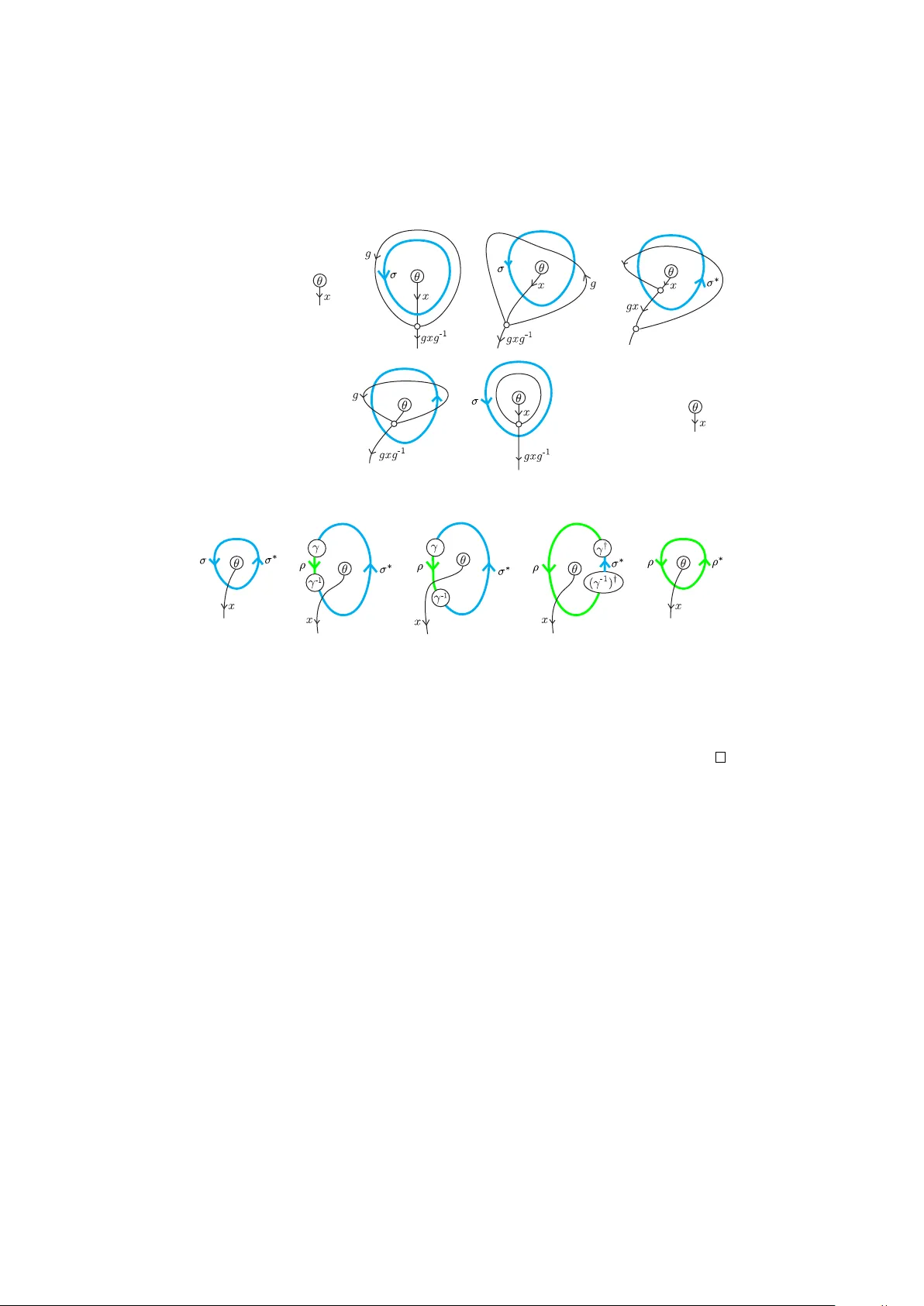
The geometry of unitary 2-represen tations of finite groups and their 2-c haracters Bruce Bartlett Univ ersity of Sheffield b.h.bartlett@sheffield.ac.uk Abstract Motiv ated b y top ological quantum field theory , we in vestigate the ge- ometric asp ects of unitary 2-representations of finite groups on 2-Hilb ert spaces, and their 2-c haracters. W e sho w how the basic ideas of geometric quan tization are ‘categorified’ in this con text: just as represen tations of groups correspond to equiv arian t line bundles, 2-representations of groups corresp ond to equiv arian t gerb es. W e also show ho w the 2-character of a 2-represen tation can b e made functorial with resp ect to morphisms of 2-represen tations. Under the geometric corresp ondence, the 2-character of a 2-represen tation corresp onds to the geometric c haracter of its asso- ciated equiv arian t gerb e. This enables us to sho w that the complexified 2-c haracter is a unitarily fully faithful functor from the complexified ho- motop y category of unitary 2-representations to the category of unitary equiv arian t vector bundles ov er the group. In tro duction One of the main themes of top ological quantum field theory (TQFT) is that abstract yet elementary higher categorical ideas can translate into quite sophis- ticated geometric structures. In this pap er w e work out a concrete toy model of this sort, in the hop e that the same methods will apply in a more adv anced setting. The higher categorical structures we will b e concerned with are unitary 2- r epr esentations of finite gr oups , the 2-c ate gory which they constitute, and their 2-char acters . A 2-represen tation of a group is a group acting coherently on some sort of linear category . They often arise in practice when a group acts on a geometric or algebraic structure, for then the group will act on the c at- e gory of r epr esentations of that structure. A 2-representation can b e thought of higher-categorically as weak 2-functor from the group (though t of as a one- ob ject 2-category with only identit y 2-morphisms) to the 2-category of linear categories. Hence they naturally form a 2-category , if we define the morphisms to b e transformations b etw een the weak 2-functors and the 2-morphisms to b e mo difications (see [31] for our con ven tions). Our main p oint in this pap er is that all these higher-categorical ideas translate into concrete geometric struc- tures — but to understand this correspondence, one first needs to understand the geometric corresp ondence for or dinary represen tations of groups. 1 Figure 1: The section of the line bundle ov er pro jectiv e space asso ciated to a v ector v ∈ V . Geometry of ordinary representations of groups and their c haracters The basic idea of geometric quantization in the equiv arian t context is that ev ery represen tation of a group G arises as the ‘quan tization’ of a classical geometric system ha ving symmetry group G . Normally this is expressed in the language of symplectic geometry and p olarizations [42], but one can find an elementary categorical formulation of it in a simple setting which for our purp oses still displa ys man y of the essential features, as w e now explain (we ap ologize to the reader for being somewhat sketc hy in this subsection; an explicit write-up will app ear elsewhere [10]. W e remark that our approach is in the spirit of the c oher ent states formalism as in [29, 41]). The main thing to understand is that every finite dimensional Hilb ert sp ac e V identifies antiline arly as the sp ac e of se ctions of a holomorphic line bund le . Indeed, given V w e ha ve the asso ciated line bundle o ver its pro jective space τ V → P ( V ) whose fiber at a line l ∈ P ( V ) is the line l itself. Thus to a vector v ∈ V we may assign a holomorphic section of τ V b y orthogonally pro jecting v on to ev ery line l (see Figure 1) 1 , and all holomorphic sections of τ V are of this form. A category theorist should think of this as the ‘decategorified Y oneda lemma’ since it says that a vector is determined by all of its inner products. One can make this corresp ondence equiv ariant and also upgrade it to an equiv alence of categories in the following wa y . Giv en a compact Lie group G , define the category LBun( G ) as follows. An ob ject is a holomorphic equiv arian t unitary hermitian line bundle L → X o ver a compact hermitian manifold X acted on isometrically by G . That is, L is a holomorphic collection of hermitian lines { L x } where x ranges o ver X , equipp ed with unitary maps L x → L g · x for eac h g ∈ G lifting the action of G on X . A morphism from L → X to Q → Y is an e quivariant kernel — an equiv arian t holomorphic collection of linear maps h y | E | x i : L x → Q y from each fib er of L to eac h fiber of Q , and one comp oses these b y in tegration — that is, if E 0 is another equiv ariant kernel from Q → Y to R → Z then h z | E 0 ◦ E | x i = Z Y dy h z | E 0 | y i ◦ h y | E | x i . (1) In this setting the idea of geometric quan tization translates into the statemen t that there is an equiv alence betw een the category of unitary representations of 1 In more ortho dox terminology we are using the inner pro ducts to identify τ V with the dual of the tautological line bundle. 2 G and the category of equiv arian t line bundles: Rep( G ) → LBun( G ) V 7→ τ V Γ( L ) ← [ L There is also a notion of the ge ometric char acter c h L of an equiv arian t line bundle L , defined b y integrating the group action o ver the manifold. One first repac k ages the equiv ariant line bundle as a kernel h y | g | x i : L x → L y and then one defines the geometric character of g ∈ G as the integral c h L ( g ) := Z X dx T r h x | g | x i . Under strong enough conditions on L and X this in tegral lo calizes ov er the fixe d p oints of g on X (for pro jective space, these are precisely the eigenlines , so one is simply summing the eigenv alues) — a statement we will make more precise in [10]. In any ev ent, it is not hard to sho w that that the character of a representation corresp onds to the geometric character of its asso ciated equiv arian t line bundle; in other words, we ha ve the commutativ e diagram [Rep( G )] C ∼ = / / χ $ $ I I I I I I I I I [LBun( G )] C ch y y t t t t t t t t t Class( G ) where [ · ] C refers to the complexified Grothendieck groups of these categories and Class( G ) is the space of class functions on the group. Moreo ver, all the maps ab o ve are unitary with resp ect to the natural inner products in volv ed. Categorifying the geometric corresp ondence The main p oin t of this pap er is to sho w that the abov e geometric corresp on- dence ‘categorifies’ appropriately to the setting of unitary 2 -representations. By a ‘unitary 2-represen tation’ we will mean a group acting unitarily and coher- en tly on a 2-Hilb ert sp ac e (see [3]). These are ab elian linear categories equipp ed with a duality and a compatible inner-pro duct; they stand in the same rela- tion with Kapranov and V o ev o dsky’s 2-ve ctor sp ac es [28] as finite-dimensional Hilb ert spaces are to finite-dimensional v ector spaces. The main thing to b ear in mind is that these categories are semisimple , and this means that the geometric structures we will derive in this paper will alw ays be discrete — in particular, w e are obliged to restrict ourselves to 2-representations of finite groups. Nev- ertheless, w e hop e that similar ideas will apply in the non-semisimple context, suc h as group actions on derived categories of sheav es [18, 25]. 3 2-c haracters The first thing to do is to dev elop a go o d theory of 2-characters. Just as the c haracter of an ordinary representation of a group is an assignment of a numb er to each element of the group, inv ariant under conjugation, the 2-char acter of a 2-represen tation is an assignmen t of a ve ctor sp ac e to each element of the group, together with sp ecified isomorphisms relating the vector spaces assigned to conjugate group elements. No w 2-characters w ere in tro duced indep endently b y Ganter and Kapranov [25] while we were working on this pro ject; how ev er we develop a n umber of re- sults ab out them not present in [25]. Our first step of departure is to use string diagr ams as a conv enient notation for w orking with 2-representations and their 2-c haracters; w e explain this notation in the opening section. Using this nota- tion, we show that not only can one take the 2-character of a 2-representation, but one can also take the 2-character of a morphism of 2-representations. T o do this, one needs to hav e goo d con trol ov er the am bidextrous adjunctions in the 2-category of 2-Hilb ert spaces, or geometrically sp eaking, one needs to en- sure that one can choose a flat section of the ‘ambidextrous adjunction bundle’. W e call this an even-hande d structur e , and the b eha viour of the 2-character on morphisms will in general dep end on the c hoice of this structure. Ho wev er, we sho w that the 2-category of 2-Hilb ert spaces has a canonical even-handed struc- ture, whic h uses the inner pro ducts and duality on the hom-sets in an essential w ay (this is analogous to the w ay that the adjoint of a linear map betw een v ector spaces requires an inner pro duct). This is one of the features of w orking with unitary 2-representations which is not av ailable for 2-representations on unadorned 2-vector spaces. Just as the ordinary character of a representation do es not dep end on the isomorphism class of the representation, the 2-c haracter of a morphism of 2- represen tations do es not dep end on its isomorphism class, hence it descends to a functor from the homotopy c ate gory of unitary 2-representations to the category of equiv ariant vector bundles o ver the group: χ : [2 R ep( G )] → Hilb G ( G ) . Our main result in this paper is that after one tensors the hom-sets in [2 R ep( G )] with C , the resulting functor is unitarily ful ly faithful . This is the categorifi- cation of the fact that the ordinary character is a unitary map from the com- plexified Grothendiec k group of unitary represen tations to the space of class functions. T o pro ve this result, we will dev elop a geometric corresp ondence for unitary 2-representations in terms of finite e quivariant gerb es analogous to the corresp ondence b etw een ordinary representations and equiv ariant line bun- dles ab o ve. Then we show that under this corresp ondence, the 2-character of the 2-represen tation corresp onds to the ge ometric char acter of the asso ciated equiv arian t gerb e, from which the result follo ws since w e can use a theorem of Willerton [40], developed in the c on text of t wisted represen tations of finite group oids, to obtain a detailed understanding of geometric c haracters. Equiv ariant gerb es F or our purp oses, a finite e quivariant gerb e is a U (1)-central extension X of the action groupoid X G asso ciated to a finite G -set X (see [12, 8, 40] for bac kground 4 material on gerb es). That is, X is a group oid having the same ob jects as X G with the prop erty that eac h morphism in X G is replaced by a U (1)-torsor w orth of morphisms in X . An equiv arian t gerb e can also b e thought of as representing a ‘equiv arian t hermitian 2-line bundle’ ov er X ; one w ay to see this is that b y c ho osing a set-theoretic section of the gerb e one can extract a U (1)-v alued group oid 2-co cycle φ , which can b e used to form a fibration of categories X G × φ Hilb → X G (see [40, 13, 16]). Since w e will be dealing with in tegration in v arious forms, we will also equip our gerb es with metrics . Equiv ariant gerb es form a 2-category G erb es( G ), if w e define a 1-morphism X → X 0 b et ween gerb es to b e a unitary equiv ariant vector bundle ov er their pro duct X 0 ⊗ X (this should b e thought of as a c ate gorifie d kernel ) and a 2-morphism to b e a morphism of equiv arian t vector bundles. Unitary 2-representations and equiv arian t gerb es It turns out that from a marked unitary 2-representation of G (a 2-Hilbert space is marke d if it is endow ed with distinguished simple ob jects), one can extract a finite equiv ariant gerbe equipped with a metric, and similarly for the morphisms and 2-morphisms, leading to an equiv alence of 2-categories 2 R ep m ( G ) ∼ → G erb es( G ) . This should b e regarded as a ‘categorification’ (at least in our finite discrete setting) of the aforemen tioned equiv alence b etw een the category of unitary rep- resen tations of G and the category of equiv ariant line bundles. Geometric characters of equiv arian t gerb es W e hav e seen that the geometric character of an equiv ariant line bundle can often b e expressed as a sum ov er the fixed p oints of the group action. Similarly w e define the geometric character of an equiv arian t gerb e as the sp ac e of se c- tions o ver the fixed p oints of the gerb e (readers familiar with these ideas will recognize this as the push-forw ard of the transgression map in our con text, as in [39]). Since the group acts on these fixed p oints by conjugation, the geometric c haracter also pro duces an equiv arian t v ector bundle ov er the group. W e sho w ho w one can also apply the geometric character to a morphism of equiv arian t gerb es, so as to obtain a morphism betw een the corresp onding equiv ariant v ector bundles. Just as for 2-representations, the geometric character on morphisms only dep ends on their isomorphism classes , hence it also descends to a functor from the homotop y category of equiv ariant gerbes to the category of equiv ariant v ector bundles ov er the group, c h : [ G erb es( G )] → Hilb G ( G ) . No w, the morphisms in [ G erbes( G )] may b e regarded as twisted represen tations of groupoids, and it turns out that at the level of morphisms the geometric c haracter functor essentially takes the twiste d char acters of these representa- tions. Thus one can apply the tec hnology of Willerton [40] to conclude that after one tensors the hom-sets in [ G erb es( G )] with C , the geometric c haracter functor is unitarily ful ly faithful . 5 Main result As we ha ve explained, our main result is a ‘categorification’ of the aforemen- tioned geometric corresp ondence for ordinary representations. Theorem. The 2-char acter of a marke d unitary 2-r epr esentation is unitarily natur al ly isomorphic to the ge ometric char acter (i.e. the push-forwar d of the tr ansgr ession) of its asso ciate d e quivariant gerb e: [2 R ep m ( G )] χ % % K K K K K K K K K ' / / [ G erb es( G )] ch y y t t t t t t t t t Hilb G ( G ) Corollary . The c omplexifie d 2-char acter functor χ C : [2 R ep( G )] C → Hilb G ( G ) is a unitarily ful ly faithful functor fr om the c omplexifie d homotopy c ate gory of unitary 2-r epr esentations of G to the c ate gory of unitary e quivariant ve ctor bun- d les over G . Comparison with previous w ork There hav e already b een a n umber of works on 2-representations (see eg. [7, 17, 18, 20, 25, 34, 36]), the most relev an t for this pap er b eing that of Elgueta [20] and that of Ganter and Kaprano v [25]. Elgueta p erformed a thorough and careful inv estigation of the 2-category of 2-represen tations of a 2-group (a 2- group is a monoidal category with structure and prop erties analogous to that of a group [4]) acting on Kapranov and V o evodsky’s 2-v ector spaces, and his motiv ation w as therefore to w ork with co-ordinatized v ersions of 2-vector spaces amenable for direct computation, and to classify the v arious structures which app ear. Gan ter and Kapranov w ere motiv ated by equiv ariant homotop y theory , namely to try and find a categorical construction which would pro duce the sort of gen- eralized group characters whic h crop up in Morav a E -theory; they (indep en- den tly) in tro duced the c ate goric al char acter (which w e call the 2-character) of a 2-representation and show ed that it indeed achiev es this purpose. Since they had no reason not to, they also work ed with co-ordinatized 2-vector spaces (this time of the form V ect n ); also they did not in vestigate in any depth morphisms and 2-morphisms of 2-represen tations. This present pap er was in preparation at the time [25] appeared and the author ap ologizes for the lengthy delay . Our motiv ation has been extended top ological quantum field theory , where the 2-category of 2-representations of a group app ears as the ‘2-category asso ci- ated to the p oint’ in a finite v ersion of Chern-Simons theory called the untwiste d finite gr oup mo del (see [19, 22, 34, 40, 2] for background). W e remark here that in the twiste d mo del (the twisting is giv en b y a group 3-co cycle ω ∈ Z 3 ( G, U (1)) the ‘2-category assigned to the p oint’ is the 2-category of 2-representations of the 2 -group G ω constructed from G and ω . In this pap er w e ha ve restricted our- self to the unt wisted case, since the geometry of the twisted mo del is a bit more in tricate (one must essentially replace equiv ariant gerb es by twiste d equiv ariant 6 gerb es), and also b ecause the un twisted setting mak es for a cleaner analogy b et ween the geometric picture of ordinary unitary represen tations and that of unitary 2-representations. W e hop e to study more carefully the geometry of the t wisted mo del in future work; for now w e refer the reader to the recen t [6] whic h studies strict 2-representations of Lie 2-groups on ‘higher Hilb ert spaces’ (these are categories whose ob jects are ‘measurable fields of Hilb ert spaces’ supp orted o ver a measurable space X , a setting which allows for contin uous geometry). In an y ev en t, the language of Chern-Simons theory is the geometric language of mo duli-stacks, line-bundles, equiv arian t structures, flat sections and such lik e, and this has therefore motiv ated our approac h to 2-representations and is what distinguishes our approach from previous approac hes (though w e remark that related ideas do app ear in [25]). F or instance, as far as p ossible we try to w ork directly with the underlying 2-Hilb ert spaces of the 2-representations themselv es as opp osed to some ‘co-ordinitization’ of them, a strategy which migh t b e imp ortant in a more intricate geometric setting. W e hop e that some of the ideas w e hav e developed in this pap er will also translate into the more adv anced geometric contexts of [25], as w ell as [24]. Ov erview of pap er In Section 1 w e remind the reader of how the string diagram notation for 2- categories works. In Section 2 we recall the notion of a 2-Hilbert space due to Baez [3], and w e define what we mean by the 2-category of unitary 2- represen tations, expanding out all the definitions in terms of string diagrams, where they take a particularly simple form. W e also give a num ber of examples of unitary 2-represen tations. Finally w e develop the idea of an even-hande d structur e on a 2-category as a consistent choice of isomorphism classes of am- bidextrous adjoints, and we show that the 2-category of 2-Hilb ert spaces has a canonical such structure. W e also explain what it means for a 2-representation to b e compatible with a given even-handed structure. In Section 3 we use the string diagram technology to define 2-characters of unitary 2-represen tations, and we show how to mak e this construction functorial with resp ect to morphisms of 2-representations. In Section 4 we introduce the main geometric notions of this pap er: finite equiv arian t gerb es equipp ed with metrics, the 2-category which they constitute, and the twisted c haracter of an equiv arian t vector bundle ov er a gerb e. In Section 5 we use this language to define the geometric c haracter of an equiv ariant gerb e, and we show ho w to make this construction functorial with resp ect to morphisms of equiv ariant gerb es. In Section 6 we explain ho w to extract an equiv ariant gerb e from a unitary 2-represen tation, and similarly for the morphisms and 2-morphisms, leading to an equiv alence of 2-categories. Finally in Section 7 we bring together all these concepts, and show that the 2-character of a 2-representation corresponds naturally to the geometric character of its asso ciated equiv ariant gerb e. W e use this to conclude that the 2-character is a unitarily fully faithful functor after one passes to the complexified homotopy category . 7 Figure 2: Globular notation for 2-categories versus string diagram notation. Ac knowledgemen ts During the preparation of this pap er I hav e b enefited from discussions with and v aluable remarks from Urs Schreiber, James Cranch, John Baez, Jeffrey Morton, Nora Ganter, Mikhail Kapranov, Da vid Gepner, Ric hard Hep worth, Eugenia Cheng, T om Bridgeland, Vic Snaith, Ieke Mo erdijk, F rank Neumann and Mathieu Anel. A sp ecial ackno wledgement go es to my sup ervisor Simon Willerton, who first suggested to me the topic of 2-representations and intro- duced me to the notion of the 2-character; m uch of this present work can b e seen as a follow-up to [40]. I also wish to ackno wledge supp ort from the Excellence Exc hange Scheme at the Univ ersity of Sheffield. Finally I wish to thank the or- ganizers of the Max Kelly conference in Cap e T own for a sp ecial and memorable o ccasion. 1 String diagrams In this section w e briefly recall the string diagram notation for 2-categories. This notation is particularly suited to describ e structures such as adjunctions and monads, and w e will find it very useful when we discuss 2-characters in Section 3. String diagrams are a tw o-dimensional graphical notation for w orking with 2- categories, and may be regarded as the ‘Poincar ´ e duals’ of the ordinary globular notation. The basic idea is summarized in Figure 2. The reader who is still confused by these diagrams is referred to Section 2.2 of [30], Section 1.1 of [14] or [32, 38] for more details. In our diagrams, comp osition of 1-morphisms runs from right to left (so a G to the left of an F means G after F ), and comp osition of 2-morphisms runs from top to b ottom. W e stress that string diagrams are not merely a mnemonic but are a p erfectly rigorous notation. 8 W e make the imp ortant remark here that by a ‘2-category’ w e mean a not- ne c essarily-strict 2-category (also called a bic ate gory ). In this pap er we will almost exclusively b e using string diagrams in the context of the 2-category of 2-Hilb ert spaces, whic h is a strict 2-category . How ev er we will hav e occasion to use them in the con text of a weak 2-category when we discuss even-handed structures for general 2-categories in Section 2.5. Let us therefore make some remarks on the interpretation of these diagrams when the 2-category is not strict. A string diagram is a graphical notation for a specific 2-morphism in a 2-category . The source and target 1-morphisms of this 2-morphism are the comp osites of the top and b ottom 1-morphisms represented in the diagram, re- sp ectiv ely . When the 2-category is weak, one therefore needs to b e giv en the additional information of precisely how these comp osites which mak e up the source and target 1-morphisms are to b e parenthesized (this might include ar- bitrary insertions of identit y 1-morphisms). Ho wev er, once a parenth esis choice has b een made for the source and target 1-morphisms, coherence for 2-categories — in the form which says ‘all diagrams of constraints comm ute’ as in Chapter 1 of the thesis of Gurski [27] — implies that the resulting 2-morphism represen ted b y the diagram is unique , and do es not dep end on the choice of parentheses, as- so ciators and unit 2-isomorphisms used to interpret the interior of the diagram. No w, whenev er a string diagrams o ccurs in this pap er it will alw ays be manifestly clear what the input and output 1-morphisms are. F or instance: “The 2-morphism η : id ⇒ ( G ◦ F ) ◦ ( F ∗ ◦ G ∗ ) is defined as .” In other words, ev ery string diagram in this pap er has a precise and rigorous meaning. 2 Unitary 2-represen tations W e b egin this section by recalling the notion of a 2-Hilb ert space due to Baez [3]. Then we define the 2-category of unitary 2-representations of a finite group. W e do this first in an abstract higher-categorical wa y , and then we sp ell out this definition in terms of string diagrams by introducing graphical elements to depict the v arious pieces of data inv olved. W e give some examples of 2- represen tations, such as those arising from exact sequences of groups. Finally w e sho w that 2 H ilb comes equipp ed with a canonical even-hande d structur e — a coheren t wa y to equip every right adjoint also as a left adjoint. This will b e necessary in the next section in order to show that the 2-character can b e made functorial. 2.1 2-Hilb ert spaces A 2-Hilb ert sp ac e is a ‘categorification’ of a Hilb ert space; that is, it is a category with structure and prop erties analogous to those of a Hilb ert space. They w ere in tro duced by Bae z [3], and we need them b ecause we wan t to work with unitary 2-represen tations. They are similar to Kapranov and V oevodsky’s 2- ve ctor sp ac es , the difference b et ween them being analogous to the difference 9 b et ween a Hilb ert space and an ordinary v ector space. W e remark that by the words ‘Hilb ert space’ we will inevitably mean simply a finite-dimensional inner pro duct space; this terminology is standard in a top ological quantum field theory context [22]. A go o d example of a 2-Hilb ert space is the category of unitary finite-dimensional represen tations of a finite group (more generally , one could consider t wisted unitary representations of a finite group oid ). Observe that this category is es- p ecially easy to understand: ev ery represen tation is a direct sum of irreducible represen tations. Although it is equiv alent to the category of finite-dimensional represen tations with no inner pro ducts in volv ed (whic h is a 2-vector space in the sense of Kapranov and V o evodsky), it has extra structure because ev ery morphism f : V → W has an adjoint f ∗ : W → V and the hom-sets hav e a nat- ural inner pro duct, ( f , g ) = 1 | G | T r( f ∗ g ). This illustrates the difference betw een a 2-Hilb ert space and a 2-vector space. 2.1.1 The definition W e write Hilb for the category of finite dimensional Hilb ert spaces and linear maps. A Hilb-category is a category enric hed ov er Hilb. Definition 1. A 2-Hilb ert sp ac e is an abelian Hilb-category H , equipp ed with an tilinear maps ∗ : hom( x, y ) → hom( y , x ) for all x, y ∈ H , such that • f ∗∗ = f , • ( f g ) ∗ = g ∗ f ∗ , • ( f g , h ) = ( g , f ∗ h ), • ( f g , h ) = ( f , hg ∗ ) whenev er both sides of the equation are defined. The thing to k eep in mind ab out 2-Hilb ert spaces is that they are automat- ic al ly semisimple — that is, there exist ob jects e i lab eled b y a set I suc h that Hom( e i , e j ) ∼ = δ ij k (suc h ob jects are called simple ) and such that for an y tw o ob jects x and y the comp osition map Hom( x, y ) ← M i ∈ I Hom( x, e i ) ⊗ Hom( e i , y ) . is an isomorphism. Prop osition 2 (Baez [3]) . Every 2-Hilb ert sp ac e is semisimple. The reason is that the arrow algebra asso ciated to a finite set of ob jects in a 2-Hilb ert space forms an H ∗ -algebra (a finite-dimensional algebra with an inner pro duct and a compatible antilinear in volution), and it is a result of Ambrose [1] that suc h algebras are weigh ted direct sums of matrix algebras. W e see that it is pr e cisely the ge ometric ingr e dient of ‘duality’ (the inner pro ducts and the ∗ -structure) which causes 2-Hilb ert spaces to b e semisimple. This is the main conceptual difference b et ween 2-Hilbert spaces and 2-v ector spaces. The latter were defined b y Kapranov and V oevodsky essentially as ‘an ab elian V ect-mo dule category equiv alen t to V ect n for some n ∈ N ’. A go o d 10 feature of their definition is that it explicitly includes a prescription for cate- gorified scalar m ultiplication, an ingredient which is missing from the definition of 2-Hilb ert spaces, but which can b e useful for some constructions (on the other hand, it can easily b e added in). A disappointing feature of their defini- tion though is that it adds in semisimplicity by hand, whereas 2-Hilb ert spaces are defined intrinsic al ly , and semisimplicity is a consequence. F or instance, the category Rep( A ) of finite-dimensional representations of an algebra A is alwa ys an ab elian category with a V ect-mo dule structure, but it fails to b e semisimple in general, precisely b ecause of the lac k of duality in Rep( A ). 2.1.2 The 2-category of 2-Hilb ert spaces A 2-Hilb ert space H is called finite dimensional if there are only a finite num b er of non-isomorphic simple ob jects; this n umber is called the dimension of H . A functor F : H → H 0 b et ween 2-Hilb ert spaces is called line ar if it is linear on the level of hom-sets and preserves direct sums, in the sense that if x ⊕ y is a direct sum of x, y ∈ H , then F ( x ⊕ y ) is a direct sum of F ( x ) , F ( y ) ∈ H 0 . It is called a ∗ -functor if F ( f ∗ ) = F ( f ) ∗ for all morphisms f in H . Definition 3. The 2-category 2 H ilb of 2-Hilbert spaces has finite-dimensional 2-Hilb ert spaces for ob jects, linear ∗ -functors for morphisms, and natural trans- formations for 2-morphisms. A natural transformation θ : F ⇒ F 0 b et ween morphisms F , F 0 : H → H 0 of 2-Hilb ert spaces is called unitary if all its comp onents are unitary — that is, if θ ∗ x θ x = id F ( x ) and θ x θ ∗ x = id F 0 ( x ) for all x ∈ H . A pair H , H 0 of 2-Hilb ert spaces are called unitarily e quivalent if there are linear ∗ -preserving functors F : H → H 0 and G : H 0 → H together with unitary natural isomorphisms η : id H ∼ ⇒ GF and : F G ∼ ⇒ id H 0 forming an adjunction. W e will call them str ongly unitarily equiv alent (this refined notion is not considered in [3]) if the functors F and G are also unitary linear maps at the level of hom-sets. The imp ortant things to remember ab out 2-Hilb ert spaces, and the mor- phisms and 2-morphisms b etw een them, are the following: • A 2-Hilb ert space H is determined up to unitary equiv alence simply by its dimension (see [3]). It is determined up to str ong unitary equiv alence by its dimension and the sc ale factors on the simple ob jects — the p ositive real n umbers k i = (id e i , id e i ) (if H is the category of unitary representations of a finite group, these num b ers are the dimensions of the irreducible represen tations divided by the order of the group). These scale factors are the extra information not presen t in an unadorned semisimple category . • Since 2-Hilb ert spaces are semisimple, a linear ∗ -functor F : H → H 0 b et ween them is determined up to unitary natural isomorphism simply b y the v ector spaces Hom( e µ , F e i ), where e µ and e i run ov er a choice of simple ob jects for H 0 and H resp ectively . • Similarly , a natural transformation θ : F ⇒ G is freely and uniquely deter- mined by its comp onents θ e i : F e i → Ge i on the simple ob jects e i . This giv es the vector space of natural transformations an inner pro duct via the 11 form ula (compare equation (3.16) of [23]) h θ , θ 0 i = X i k i ( θ e i , θ 0 e i ) . In this wa y , one can view 2 H ilb as a discrete version of the 2-category V ar (see [14, 25]), whose ob jects are the deriv ed categories D ( X ) of coheren t shea ves o ver smo oth pro jective algebraic v arieties X and whose hom-categories are the deriv ed categories ov er the product Y × X , Hom V ar ( X, Y ) = D ( Y × X ) . Decategorifying a 2-Hilb ert space If H is a 2-Hilb ert space, we will write [ H ] C for the c omplexifie d Gr othendie ck gr oup of H — the tensor pro duct of C with the ab elian semigroup generated by the isomorphism classes of ob jects [ v ] in H under the relations [ v ⊕ w ] = [ v ] + [ w ]. A basis for [ H ] C is given by the isomorphism classes [ e i ] of simple ob jects of H . W e regard [ H ] C as a Hilb ert space with inner pro duct defined on the generating elemen ts b y ([ v ] , [ w ]) = dim Hom( v , w ) . 2.2 2-represen tations in terms of string diagrams W e now define the 2-category 2 R ep( G ) of unitary 2-representations of a finite group G . W e do this in tw o stages — firstly w e define it in a terse higher- categorical wa y , and then we expand out this definition explicitly in traditional notation as well as in string diagrams, introducing new graphical elements to depict the v arious pieces of data in volv ed. Since there are v arious con ven tions for terminology for 2-categories, w e re- mark that we are essentially using those of Leinster [31]. The reader is assured that those parts of the definition b elow mentioning the word ‘unitary’ will b e explained shortly . Definition 4 (compare [20, 17, 7, 25, 36]) . The 2-category 2 R ep( G ) of unitary 2-represen tations of a finite group G is defined as follo ws. An ob ject is a unitary w eak 2-functor G → 2 H ilb (where G is thought of as a 2-category whic h has only one ob ject, with the elemen ts of G as 1-morphisms, and only identit y 2- morphisms). A morphism is a transformation whose coherence isomorphisms are unitary , and a 2-morphism is a mo dification. W e now expand this definition out. 2.2.1 Unitary 2-representations A unitary 2-representation of G consists of: • A finite-dimensional 2-Hilbert space H , drawn as or when H is understo o d, 12 • F or each g ∈ G , a linear ∗ -functor H α g ← − H whic h at the level of hom-sets is a unitary linear map, drawn as or simply , • A unitary 2-isomorphism φ ( e ) : id H ⇒ α e (where e is the identit y element of G ), and for each g 1 , g 2 ∈ G , a unitary 2-isomorphism φ ( g 2 , g 1 ) : α g 2 ◦ α g 1 ⇒ α g 2 g 1 , drawn as id A φ ( e ) α g , α g 2 ◦ α g 1 φ ( g 2 ,g 1 ) α g 2 g 1 suc h that α g φ ( e ) ∗ id w v v v v v v v v v v v v v v v v id ∗ φ ( e ) ' H H H H H H H H H H H H H H H H α e ◦ α g φ ( e,g ) ' H H H H H H H H H H H H H H H H α g ◦ α e φ ( g ,e ) w v v v v v v v v v v v v v v v v α g and α g 3 ◦ α g 2 ◦ α g 1 φ ( g 3 ,g 2 ) ∗ id $ , Q Q Q Q Q Q Q Q Q Q Q Q Q Q Q Q Q Q Q Q Q Q Q Q id ∗ φ ( g 2 ,g 1 ) r z m m m m m m m m m m m m m m m m m m m m m m m m α g 3 g 2 ◦ α g 1 φ ( g 3 ,g 2 g 1 ) $ , Q Q Q Q Q Q Q Q Q Q Q Q Q Q Q Q Q Q Q Q Q Q Q Q α g 3 ◦ α g 2 g 1 φ ( g 3 g 2 ,g 1 ) r z m m m m m m m m m m m m m m m m m m m m m m m m α g 3 g 2 g 1 comm ute, or in string diagrams, = = and = . (2) W e will draw the inv erse 2-isomorphisms φ ( e ) ∗ : α e ⇒ id H and φ ( g 2 , g 1 ) ∗ : α g 2 g 1 ⇒ α g 2 ◦ α g 1 as α e φ ( e ) ∗ id A , α g 2 g 1 φ ( g 2 ,g 1 ) ∗ α g 2 ◦ α g 1 . The fact that these satisfy φ ( e ) ∗ φ ( e ) = id and φ ( e ) φ ( e ) ∗ = id, and similarly for the φ ( g 2 , g 1 ), is drawn as follo ws: = , = (3) = , = . (4) W e will abbreviate all of this data ( H , { α g } , φ ( e ) , { φ ( g 2 , g 1 ) } ) simply as α . 13 2.2.2 Morphisms A morphism σ : α → β of unitary 2-representations is a transformation from α to β whose coherence isomorphisms are unitary . Thus, if α = ( H α , { α g } , φ ( e ) , { φ ( g 2 , g 1 ) } ) and β = ( H β , { β g } , ψ ( e ) , { ψ ( g 2 , g 1 } ), then it consists of • A linear ∗ -functor σ : H α → H β , drawn as or ( H α and H β understo o d) The line for σ is thick and coloured differently , so as to distinguish it from the lines for the functors α g and β g . • F or eac h g ∈ G a unitary natural isomorphism σ ( g ) : β g ◦ σ ∼ ⇒ σ ◦ α g , dra wn as β g ◦ σ σ ( g ) σ ◦ α g suc h that β g 2 ◦ β g 1 ◦ σ ψ ( g 2 ,g 1 ) ∗ id s { p p p p p p p p p p p p p p p p p p p p id ∗ σ ( g 1 ) + 3 β g 2 ◦ σ ◦ α g 1 σ ( g 2 ) ∗ id β g 2 g 1 ◦ σ σ ( g 2 g 1 ) # + O O O O O O O O O O O O O O O O O O O O σ ◦ α g 2 g 1 σ ◦ α g 2 ◦ α g 1 id ∗ φ ( g 2 ,g 1 ) k s σ ψ ( e ) ∗ id id ∗ φ ( e ) ! ) J J J J J J J J J J J J J J J J J J J J β e ◦ σ σ ( e ) + 3 σ ◦ α e comm ute, or in string diagrams, = and = . (5) W e will draw the inv erse 2-isomorphisms σ ( g ) ∗ : σ ◦ α g ⇒ β g ◦ σ as σ ◦ α g σ ( g ) ∗ β g ◦ σ . These satisfy σ ( g ) ∗ σ ( g ) = id and σ ( g ) σ ( g ) ∗ = id, that is, = and = . (6) 14 W e will abbreviate all of this data ( σ, { σ ( g ) } ) simply as σ . Observe that a morphism of 2-actions of G , which might b e called an intertwiner , really do es ha ve an ‘intert wining’ asp ect to it when expressed in terms of string diagrams. 2.2.3 2-morphisms Finally , if α and β are unitary 2-represen tations of G , and σ , ρ : α → β are morphisms betw een them, then a 2-morphism θ : σ ⇒ ρ is a mo dification from σ to ρ . Th us, θ is a natural transformation σ to ρ , drawn as σ θ ρ , suc h that β g ◦ σ σ ( g ) v ~ v v v v v v v v v v v v v v v v v v id ∗ θ ( H H H H H H H H H H H H H H H H σ ◦ α g θ ∗ id ( I I I I I I I I I I I I I I I I I I β g ◦ ρ ρ ( g ) v ~ u u u u u u u u u u u u u u u u ρ ◦ α g comm utes, or in string diagrams, = . (7) W e trust that the simplicity of these diagrams has p ersuaded the reader the string diagrams are a useful notation for working with 2-representations. W e will develop this notation further as we go along. 2.3 Examples W e now giv e some examples to illustrate these ideas; we will say more ab out them in Section 6.2 once we hav e established the geometric interpretation of unitary 2-representations in terms of equiv arian t gerb es. W e urge the reader to consult [25] for additional examples of group actions on linear categories. 2-represen tations can b e strictified Before we giv e the examples, let us first clear up some p otential confusion. A 2-represen tation α is called strict if all the coherence isomorphisms are identities. Lemma 5. Every 2-r epr esentation is e quivalent inside 2 R ep( G ) to a strict 2- r epr esentation. 15 Pr o of. The pro of is essentially an application of the 2-Y oneda lemma, which can be found for instance in [21, page 60]. Given a 2-representation of G on a 2-Hilb ert space H , w e can define a corresp onding strict 2-representation of G on the 2-Hilb ert space Hom 2 R ep( G ) (Hilb[ G ] , α ) , where Hilb[ G ] is the category of G -graded Hilb ert spaces on which G acts b y left multiplication. W e w arn the reader that this do es not mean that there is no information in the coherence isomorphisms — it just means that this information can alwa ys b e shifted into the structure of a new and bigger category , if one wishes to do so. In other words, a strict 2-r epr esentation on a ‘big’ 2-Hilb ert sp ac e (suc h as ‘the category of all such and such’) is not ne c essarily trivial — to decide this, one has to calculate the 2-co cycle of the corresp onding equiv arian t gerb e, as we explain in Section 6.1. 2.3.1 Automorphisms of groups Supp ose G ⊆ Aut( K ) is a subgroup of the automorphism group of a finite group K . This gives rise to a unitary 2-representation of G on the 2-Hilb ert space Rep( K ) by precomp osition. That is, if V is a unitary representation of K , then g · V ≡ V g has the same underlying vector space except that the action of k ∈ K on V g corresp onds to the action of g -1 · k on V . This is of course a strict 2-representation, but it is not necessarily frivolous, as w e shall see in the next example. Also note that any 2-representation of this form will necessarily b e unitary , b ecause it can only p ermute irreducible representations of the same dimension amongst each other. 2.3.2 The metaplectic representation A goo d example of a nontrivial 2-representation of the abov e sort is the action of S L 2 ( R ) on Rep(Heis), the category of representations of the Heisenberg group. Of course, S L 2 ( R ) is not a finite group, but all the definitions ab ov e still apply . The Heisenberg group arises in quan tum mechanics (see for example [15]). It is the 3-dimensional Lie group with underlying manifold R 2 × U (1) — with R 2 though t of as phase space with elements being pairs v = ( z , p ) — and m ultiplication defined by ( v , e iθ ) · ( w , e iφ ) = ( v + w , e iω ( v,w ) e i ( θ + φ ) ) , where ω ( v , w ) = 1 2 ( v z w p − v p w z ) is the canonical symplectic form on R 2 . Up to isomorphism, there is only one irreducible representation of Heis on a separable Hilb ert space, with the U (1) factor acting cen trally . Namely , the action on L 2 ( R ) given by ( z · f )( x ) = e iz x f ( x ) , ( p · f )( x ) = f ( x − p ) . Since there is only one irreducible representation, Rep(Heis) is a one-dimensional 2-Hilb ert space. No w S L 2 ( R ) is the group of symplectomorphisms of R 2 , hence it acts as automorphisms of Heis, giving rise to a unitary 2-representation of S L 2 ( R ) on Rep(Heis) via the standard prescription ( g · ρ )( v , e iθ ) = ρ ( g -1 · v , e iθ ). 16 This gives rise to a nontrivial pro jective representation of S L 2 ( R ) on L 2 ( R ); the fact that the pro jective factor cannot b e remov ed is kno wn as the ‘metaplec- tic anomaly’. Indeed, the viewp oint of 2-representations elucidates somewhat the nature of this anomaly . It might seem strange at first that the action of S L 2 ( R ) — the symmetry group of the classical phase space R 2 — does not surviv e quan tization, b ecoming instead a pro jective representation. Ho wev er S L 2 ( R ) do es act on Rep(Heis), the collection of al l quantizations. F rom this w e see that the ‘anomaly’ arose from an attempt to decategorify this action, by artificially choosing a fixed quan tization ρ . 2.3.3 2-represen tations from exact sequences W e’ve seen how an action of G on another group K gives rise to a unitary 2- represen tation of G on Rep( K ). The same can be said for a ‘weak’ action of G on K . Supp ose 1 → K i → E π G → 1 is an exact sequence of finite groups, whic h has b een equipp ed with a set- theoretic section s : G → E such that s ( e ) = e . W e can think of this data as a homomorphism of 2-groups G → AU T ( K ) where AU T ( K ) is the 2-group whose ob jects are the automorphisms of K and whose morphisms are given by conjugation (see [4, 5]). Explicitly , one thinks of the group K as being the morphisms of a one-ob ject category (also denoted K ), and for each g ∈ G , g : K → K is the functor defined by conjugating in E , g · k := s ( g ) k s ( g ) -1 where we hav e iden tified K with its image in E . This determines a K -v alued 2-co cycle ϕ having the property that g 2 · g 1 · k = ϕ ( g 2 , g 1 )[( g 2 g 1 ) · k ] ϕ ( g 2 , g 1 ) -1 for all k ∈ K . This data gives rise to a unitary 2-representation α of G on Rep( K ), by precomp osition. Explicitly , if ρ is a representation of K , and g ∈ G , then α g ( ρ ) has the same underlying v ector space as ρ , with the action of K given by α g ( ρ )( k ) = ρ ( g -1 · k ) . The coherence natural isomorphisms φ ( g 2 , g 1 ) : α g 2 ◦ α g 1 ⇒ α g 2 g 1 ha ve comp o- nen ts φ ( g 2 , g 1 ) ρ = ρ ( ϕ ( g -1 1 , g -1 2 )) while φ ( e ) : id ⇒ α e is just the identit y . 2.3.4 Other examples of 2-represen tations One exp ects to find similar examples of unitary 2-representations of groups arising from automorphisms of other geometric or algebraic structures — for instance, the automorphisms of a r ational vertex op er ator algebr a or of an affine lie algebr a will act on their category of representations, which in go o d cases are 2-Hilb ert spaces. 17 2.3.5 Morphisms of 2-represen tations from morphisms of exact se- quences W e ha ve seen ho w one obtains a 2-representation of G from an exact sequence of groups (equipp ed with a set-theoretic section) with G as the final term, or equiv alen tly from a weak action of G on another group. A morphism of such a structure gives rise to a morphism of 2-representations b y induction. Indeed, supp ose we hav e a map of exact sequences 1 / / K f 0 / / E f 1 / / G / / id 1 1 / / L / / F / / G / / 1 . In higher category language, this is essen tially the same thing as a morphism inside the 2-category Hom( G, G roups) of weak 2-functors, transformations and mo difications from G (thought of as a one ob ject 2-category with only identit y 2-cells) to the 2-category of groups (ob jects are groups, morphisms are functors, 2-morphisms are natural transfor- mations). Then b y inducing along f 0 w e get a map σ ≡ Ind( f 0 ) : Rep( K ) → Rep( L ) and also natural isomorphisms σ ( g ) : β g ◦ σ ⇒ σ ◦ α g , where α and β are the asso ciated 2-representations of G on Rep( K ) and Rep( L ) resp ectiv ely . In other words, a map of exact se quenc es gives rise to a morphism of 2-r epr esentations . 2.4 More graphical elements The reason w e hav e b een dra wing arrows on the strings representing the functors α g in volv ed in a 2-represen tation α is to con venien tly distinguish group elemen ts from their inv erses: if a down w ard p ointing section of a string is lab eled ‘ g ’ then it represen ts α g , and upw ard p ointing sections of the same string represen t α g -1 . Using this conv ention we now construct some new graphical elemen ts from the old ones. F rom now on we drop the b ounding b oxes on the diagrams. Define η g : id ⇒ α g -1 ◦ α g and g : α g ◦ α g -1 ⇒ id as: η g = := ≡ id φ ( e ) α e φ ( g -1 ,g ) -1 α g -1 ◦ α g g = := ≡ α g ◦ α g -1 φ ( g ,g -1 ) α e φ ( e ) -1 id 18 These are indeed unitary natural transformations, since their in v erses are clearly giv en b y η ∗ g = := ∗ g = := . In other words, we ha ve the “no lo ops” and “merging” rules = = and similarly for the rev erse orientations. W e now show that these new graphical elements b ehav e as their string di- agrams suggest. The first part of the following lemma actually says in more ortho do x terminology that ‘ α g is an am bidextrous adjoint equiv alence from the underlying 2-Hilb ert space to itself ’, or more precisely ‘for all g ∈ G , α g a α g -1 via ( η g , g )’. But it’s the simple fact that these string diagrams can b e manip- ulated in the obvious intu itive fashion which is more important for us here. Lemma 6. Supp ose α is a 2-r epr esentation of G . The fol lowing gr aphic al moves hold: (i) = = (ii) = (iii) = = (iv) = . Pr o of. (i) The first equation as prov ed as follows, . In step 1 we zip together using the rule (3a), in 2 we slide the button around using (4b), in 3 we unzip again using (3a) and in 4 and 5 w e con tract the identit y string using (2b). The other equations are pro ved similarly . No w w e record for further use some allow able graphical manipulations for morphisms of 2-representations. 19 Lemma 7. Supp ose σ : α → β is a morphism of 2-r epr esentations. The fol low- ing gr aphic al moves hold: (i) = (ii) = Pr o of. (i) is prov ed as follows, (a) = (b) = (c) = , where (a) uses the inv erse rule (6a), (b) uses the button-dragging rule (5a), and (c) uses the reverse inv erse rule (6b). 2.5 The ev en-handed structure on 2 H ilb In order to make the 2-character functorial, we will need to hav e tight con trol on the ambidextrous (simultaneous left and righ t) adjoints in 2 H ilb. This is accomplished via an even-hande d structur e — a coherent system for turning right adjoin ts into left adjoin ts. W e first define this notion for general 2-categories, and then we show that 2 H ilb has a canonical such structure. 2.5.1 Ev en-handed structures on general 2-categories Let us first b e clear ab out our terminology . Definition 8. An ambidextr ous adjoint of a morphism F : A → B in a 2- category is a quin tuple h F ∗ i ≡ ( F ∗ , η , , n, e ) where F ∗ : B → A is a morphism, η : id A ⇒ F ∗ F and : F F ∗ ⇒ id B are unit and counit maps exhibiting F ∗ as a righ t adjoint of F , and n : id B ⇒ F F ∗ and e : F ∗ F ⇒ id A are unit and counit maps which exhibit F ∗ as a left adjoint of F . W e write the data of a particular am bidextrous adjoint of F in string dia- grams as h F ∗ i = , , , , ! . W e can organize the c hoices of am bidextrous adjoints for F in to a groupoid Am b( F ) which we call the ambijunction gr oup oid of F , as follows. An ob ject is a choice of ambid extrous adjoin t h F ∗ i of F . A morphism γ : h F ∗ i → h ( F ∗ ) 0 i of am bidextrous adjoints of F is an in vertible 2-morphism γ : F ∗ ⇒ ( F ∗ ) 0 , dra wn as 20 suc h that ‘twisting’ the unit and counits of h F ∗ i b y γ results in h ( F ∗ ) 0 i , that is, , , , ! = , , , . W e write [Amb( F )] for the set of isomorphism classes in the ambijunction group oid of F , and we write the class of a particular ambidextrous adjoint h F ∗ i as [ F ∗ ]. The prop erties of the am bijunction group oid are summarized in the following elementary but important lemma. Lemma 9. Supp ose F is a morphism in a 2-c ate gory and that the gr oup oid Am b( F ) is nonempty. Then: (i) Ther e is at most one arr ow b etwe en any two ambidextr ous adjunctions in Am b( F ) . (ii) The gr oup Aut( F ) of automorphisms of F acts fr e ely and tr ansitively on [Am b( F )] by twisting the unit and c ounit maps which display F ∗ as a left adjoint of F , [ F ∗ ] α 7→ " , , , , # . No w suppose that θ : F ⇒ G is a 2-morphism, drawn as , and that choices h F ∗ i , h G ∗ i of ambidextrous adjoints of F and G hav e b een made. The right and left daggers of θ are defined to b e the 2-morphisms θ † , † θ : G ∗ ⇒ F ∗ giv en b y θ † := † θ := . (8) In other words, the right dagger θ † is constructed from the data of F ∗ and G ∗ b eing right adjoin ts of F and G resp ectively , while the left dagger † θ is con- structed from the data of F ∗ and G ∗ b eing left adjoints of F and G resp ectively . It is clear that θ † need not equal † θ b ecause they transform differently under the action of automorphisms of F and G . Indeed, if we use automorphisms α F : F ⇒ F and α G : G ⇒ G to twist the left adjoint unit and counit maps, we see that the right daggers remain unchanged while the left daggers transform as 7→ . 21 Ho wev er, the question of whether the right dagger θ † is equal to the left dagger † θ only dep ends on the isomorphism classes of h F ∗ i and h G ∗ i in their resp ec- tiv e ambijunction group oids, as the reader will v erify by an elemen tary string diagram calculation. This suggests the follo wing definition. Firstly , observe that one can compose am bidextrous adjoin ts in the ob vious wa y , and also that ev ery identit y morphism id A in a 2-category has the trivial ambidextrous adjunction associated to it, with unit maps id A ⇒ id A ◦ id A giv en by the unit isomorphisms and counit maps id A ◦ id A ⇒ id A giv en b y their in verses. Also, w e say that a 2-category C has ambidextr ous adjoints if ev ery morphism has an am bidextrous adjoint. Note that having ambidextrous adjoints is a pr op erty of C — w e do not require that p ermanen t c hoices of these adjoin ts ha ve b een made from the start. Definition 10. An even-hande d structur e on a 2-category with ambidextrous adjoin ts is a choice F [ ∗ ] ∈ [Amb( F )] of isomorphism class of ambidextrous adjoin t for every morphism F , suc h that: (i) id [ ∗ ] is the class of the trivial ambidextrous adjunction for every identit y morphism, (ii) ( G ◦ F ) [ ∗ ] = F [ ∗ ] ◦ G [ ∗ ] for all comp osable pairs of morphisms, and (iii) θ † = † θ for every 2-morphism θ : F ⇒ G , provided they are computed using ambidextrous adjoints from the classes F [ ∗ ] and G [ ∗ ] . An even-hande d 2-c ate gory is a 2-category with ambidextrous adjoin ts equipp ed with an even-handed structure. In other words, instead of stipulating a specific ambidextrous adjoint h F ∗ i for ev ery morphism F , an even-handed structure selects only an isomorphism class F [ ∗ ] of suc h adjoints, in such a wa y that the resultant choices are compatible with comp osition and ensure that the left and right daggers of 2-morphisms alwa ys agree. The idea is that calculations in volving ambidextrous adjoints usually do not dep end on the actual am bidextrous adjoin ts themselv es, but they will dep end on their isomorphism classes, and so these classes need to be given as extra information. W e will say that a particular choice of am bidextrous adjoint h F ∗ i is even-hande d if it is a member of the specified class F [ ∗ ] . 2.5.2 Geometric interpretation of ev en-handed structures W e encourage the reader to think of an ev en-handed structure geometrically in the following w ay . If C is a 2-category with ambidextrous adjoin ts, the sets [Am b( F )] of isomorphism classes of ambidextrous adjoints for each morphism F can b e though t of as forming a ‘gerb e-like’ structure Am b( C ) → 1-Mor( C ) o ver the morphisms in C , which w e call the ambijunction gerb e (see Figure 3). An even-handed structure is then an ‘ev en-handed trivialization’ of this gerbe. This is analogous to Murray and Singer’s reform ulation of the notion of a spin structure on a Riemannian manifold M as a trivialization of the spin gerb e [35]. W e develop this geometric analogy further in [9]; for now we wish to stress that a given 2-category can admit man y differen t even-handed structures. 22 Figure 3: The ‘am bijunction gerb e’ of a 2-category with ambidextrous adjoin ts. 2.5.3 Diagram manipulations requiring an ev en-handed structure The following lemma illustrates the sort of diagram manipulations whic h re- quire an even-handed structure; w e will need these results later. W e use the con ven tion that in the con text of an even-handed 2-category , all string dia- gram equations inv olving computations with am bidextrous adjoints are to b e in terpreted as b eing appended with the disclaimer ‘provided the ambidextrous adjoin ts are chosen from the classes stipulated b y the even-handed structure’; in other words they hold if the chosen ambidextrous adjoin ts are ev en-handed. Lemma 11. F or a 2-morphism θ : F ⇒ G in an even-hande d 2-c ate gory, the fol lowing e quations, to gether with al l obvious variations, hold: (i) = (ii) = (iii) ( θ † ) -1 = ( θ -1 ) † (when θ is invertible). Pr o of. F or b oth (i) and (ii) to hold, we need the ambidextrous adjoints to b e ev en-handed. F or instance, (i) is prov ed as follows: = = = . The rest are prov ed similarly . 2.5.4 The even-handed structure on 2 H ilb T o discuss adjoints and even-handed structures in the concrete setting where the 2-category consists of categories, functors and natural transformations, it is con venien t to c hange v ariables from the unit and counit natural transformations to the asso ciated adjunction isomorphisms ϕ : Hom( F x, y ) ∼ = → Hom( x, F ∗ y ) . Recall the translation b etw een these tw o pictures — if f : F x → y then ϕ ( f ) = F ∗ ( f ) ◦ η x . Supp ose w e write Adj( F a F ∗ ) = { ϕ : Hom( F x, y ) ∼ = → Hom( x, F ∗ y ) , natural in x and y } 23 for the set of wa ys in which an adjoint pair of functors can b e expressed as adjoin ts of each other (recall that this set is a torsor for the group Aut( F )). In this language, an even-handed structure b ecomes a collection of bijective maps Ψ F,F ∗ : Adj( F a F ∗ ) → Adj( F ∗ a F ) , one for each pair of functors capable of b eing expressed as adjoin ts of each other, whic h is compatible with natural isomorphisms and composition and such that θ † = † θ for all natural transformations θ . As an example, consider the 2-category 2 H ilb of 2-Hilb ert spaces. Since 2-Hilb ert spaces are semisimple, ev ery 1-morphism F : H → H 0 in 2 H ilb has an ambidextrous adjoint. That is because eac h functor F is freely determined up to isomorphism b y the matrix of nonnegativ e in tegers dim Hom( e µ , F e i ), where e µ and e i run ov er a choice of simple ob jects in H and H 0 resp ectiv ely , and so one can choose a functor F ∗ : H 0 → H whose asso ciated matrix is the transp ose of that of F . Equipping F ∗ with the structure of an ambidextrous adjoin t h F ∗ i amounts to freely (and apriori indep endently ) making a choice of linear isomorphisms φ i,µ : Hom( F e i , e µ ) → Hom( e i , F ∗ e µ ) and ψ µ,i : Hom( F ∗ e µ , e i ) → Hom( e µ , F e i ) resp ectiv ely . An ev en-handed structure is precisely a system which pairs these isomorphisms φ and ψ together, so that knowing one determines the other. T o rep eat: 2 H ilb do es not hav e canonically given am bidextrous adjoints. Rather, what is canonical (as we state in the follo wing proposition) is the function which turns right adjoints into left adjoints. Readers familiar with these ideas in an algebraic geometry context migh t wan t to translate this into the statement that every 2-Hilb ert sp ac e c omes c anonic al ly e quipp e d with a trivial Serr e functor . The following is shown in [9]. Prop osition 12. The 2-c ate gory 2 H ilb c omes e quipp e d with a c anonic al even- hande d structur e, given at the level of adjunction isomorphisms by sending ϕ 7→ ∗ ϕ ∗ ∗ wher e ϕ ∗ is the adjoint of ϕ in the or dinary sense of maps b etwe en Hilb ert sp ac es. That is, the even-handed structure sends Hom( F x, y ) ϕ / / Hom( x, F ∗ y ) 7→ Hom( F ∗ y , x ) ∗ Hom( y , F x ) Hom( x, F ∗ y ) ϕ ∗ / / Hom( F x, y ) ∗ O O . This formula resem bles the formula for the adjoint of the deriv ative op erator on a Riemannian manifold, d 7→ ∗ d ∗ . Also note that we needed the inner pro ducts and the ∗ -structure on the hom-sets for this to work — there is no canonical 24 ev en-handed structure on Kaprano v and V o evodsky’s 2-category 2 V ect of 2- v ector spaces, for example. Indeed, w e show in [9] that an ev en-handed structure on 2 V ect is the same thing, up to a global scale factor, as an assignment of a nonzero sc ale factor to each simple ob ject — whic h is precisely the extra information av ailable in a 2-Hilb ert space. This underscores the fact that an ev en-handed structure on a 2-category can b e though t of as equipping each ob ject of the 2-category with a ‘metric’. 2.6 Ev en-handedness and unitary 2-representations Consider the category Rep( G ) of unitary representations of a group G . If σ : ρ 1 → ρ 2 is an intert wining map b et ween tw o unitary represen tations, then the adjoint σ ∗ : ρ 2 → ρ 1 is also an intert wining map, because σ ∗ ◦ ρ 2 ( g ) = σ ∗ ◦ ρ ∗ 2 ( g -1 ) = ( ρ 2 ( g -1 ) ◦ σ ) ∗ = ( σ ◦ ρ 1 ( g -1 )) ∗ = ρ 1 ( g ) ◦ σ ∗ . W e will need the corresp onding result for unitary 2-representations. Supp ose that σ : α → β is a morphism of unitary 2-representations of G . If σ ∗ : H β → H α is a linear ∗ -functor which is adjoin t to the underlying functor σ : H α → H β , can we equip σ ∗ with the structure of a morphism of 2-representations σ ∗ : β → α in such a wa y that σ ∗ is adjoint to σ in 2 R ep( G )? The answer is yes — b ecause α and β are unitary 2-representations, and this means they are compatible with the even-handed structure on 2 H ilb. A 2-representation α is called even-hande d if for each g ∈ G α [ ∗ ] g = " , , , , # , and one can c heck that unitary 2-representations indeed hav e this property . This means w e can c ho ose ( σ ◦ α g -1 ) ∗ to be α g ◦ σ ∗ , and similarly for β . Thus w e can define σ ∗ ( g ) : α g ◦ σ ∗ ⇒ σ ∗ ◦ β g to b e α g ◦ σ ∗ = ( σ ◦ α g -1 ) ∗ σ ( g -1 ) † ⇒ ( β g -1 ◦ σ ) ∗ = σ ∗ ◦ β g . In string diagrams, σ ∗ ( g ) drawn as ≡ := = 25 where the last simplification step uses Lemma 7 (ii). Since we are using even- handed adjunctions, it would not hav e made a difference if we had opted to use the left dagger † σ ( g -1 ) instead. W ritten in string diagrams, this means σ ∗ ( g ) = = . The fact that the maps σ ∗ ( g ) satisfy the coherence equations for a morphism of 2-representations follows routinely from the fact that σ ( g ) satisfies them. In this w ay w e hav e lifted the morphism σ ∗ : H β → H α in 2 H ilb to a morphism σ ∗ : β → α in 2 R ep( G ). W e will need the following graphical mo v es, which formally ma y be regarded as establishing that the unit and counit natural transformations for the ad- junctions σ a σ ∗ and σ ∗ a σ satisfy the coherence equation for a 2-morphism in 2 R ep( G ), so that we hav e indeed succeeded in lifting the am bidextrous ad- junction σ a σ ∗ a σ in 2 H ilb to an ambidextrous adjunction σ a σ ∗ a σ in 2 R ep( G ). Lemma 13. With this definition of σ ∗ ( g ) , the fol lowing e quations hold: (i) = (ii) = (iii) = (iv) σ ∗ ( g ) -1 = 3 2-c haracters of 2-represen tations In this section w e define the 2-character of a 2-representation. This notion w as defined indep endently by Ganter and Kapranov [25] while we were work- ing on this paper. What is new in our treatment is that we show how 2- c haracters lo ok esp ecially simple when expressed in terms of string diagrams, but more imp ortantly we use the canonical even-handed structure on 2 H ilb to sho w how the 2-character can b e made functorial with resp ect to morphisms of 2-represen tations, as we explained in the introduction. This prepares the wa y for us to sho w that the 2-character corresp onds to the ‘geometric c haracter’ of the asso ciated equiv arian t gerb e, and also for us to sho w that the complexified 2-c haracter is unitarily fully faithful. 3.1 Definition and basic prop erties 2-traces The basic idea of 2-c haracters, as we explained in the introduction, is that they categorify the notion of the c haracter of an ordinary representation of a group. 26 Figure 4: The lo op group oid of a finite group . Ordinary characters are defined by taking traces, so we first need to define 2-tr ac es (Ganter and Kapranov called this the c ate goric al tr ac e ). Definition 14. The 2-tr ac e of a linear endofunctor F : H → H on a 2-Hilbert space H is the Hilb ert space T r ( F ) = Nat(id H , F ) = . If one thinks of F via its asso ciated matrix of Hilb ert spaces Hom( e j , F e i ) where e i runs o ver a choice of simple ob jects for H , then the 2-trace corresp onds to the direct sum of the Hilb ert spaces along the diagonal, b ecause a natural transformation id ⇒ F is freely and uniquely determined by its b ehaviour on the simple ob jects. Also recall that the inner pro duct on T r ( F ) is defined as h θ , θ 0 i = X i k i ( θ e i , θ 0 e i ) where e i runs ov er a choice of simple ob jects for H , and k i = (id e i , id e i ) as alw ays. The lo op group oid In general the lo op gr oup oid Λ G of a finite group oid G is the category of functors and natural transformations from the group of in tegers to G (see [40]). A special case is the lo op groupoid Λ G of a finite group G which depicts the action of the group on itself b y conjugation, since the ob jects can be identified with the elemen ts x ∈ G , and the morphisms can b e written as g xg -1 g ← x (see Figure 4). The definition The lo op group oid is particularly conv enien t when discussing characters. The fact that the ordinary character χ ρ of a representation ρ of G is conjugation in v ariant can b e expressed by saying it is an inv ariant map χ ρ : Ob Λ G → C . Similarly the 2-character χ α of a unitary 2-representation α will pro duce a uni- tary e quivariant ve ctor bund le ov er the group, that is, a unitary representation of the lo op group oid, χ α : Λ G → Hilb . W e write the category of unitary equiv ariant vector bundles o ver G as Hilb G ( G ). 27 Definition 15. The 2-char acter χ α of a unitary 2-representation α of G is the unitary equiv arian t vector bundle ov er G given by χ F ( x ) = T r ( α x ) = χ α ( g xg -1 g ← x ) = . Let us verify that this definition makes sense. Prop osition 16. The 2-char acter χ α is inde e d a unitary e quivariant ve ctor bund le over the gr oup. Pr o of. Using our graphical rules from Lemma 6, we ha ve χ α ( g 2 ← g 1 xg -1 1 ) χ α ( g 1 ← x ) = = = = χ α ( g 2 g 1 ← − x ) and also χ α ( e ← x ) = = = . This is a unitary vector bundle b ecause all the maps in volv ed in its definition are unitary (see the proof of Lemma 30 for an explicit form ula). 3.2 F unctorialit y of the 2-c haracter In this subsection w e com bine all the technology we hav e developed so far to define ho w to take the 2-character of a morphism of unitary 2-represen tations so as to obtain a morphism of the corresp onding equiv ariant v ector bundles ov er G . Definition 17. If σ : α → β is a morphism of unitary 2-represen tations, we define χ ( σ ) : χ α → χ β as the map of equiv ariant vector bundles ov er G whose 28 comp onen t at x ∈ G is given by χ ( σ ) x : χ α ( x ) → χ β ( x ) 7→ (9) where h σ ∗ i is any even-handed am bidextrous adjoin t for σ . W e now verify that this definition mak es sense. Firstly note that it do esn’t matter how we resolve the right hand side since b y Lemma 13 (iii) we hav e = . W e write [2 R ep( G )] for the homotopy c ate gory of 2 R ep( G ) — its ob jects are uni- tary 2-representations and its morphisms are isomorphism classes of 1-morphisms in 2 R ep( G ). Theorem 18. In the situation ab ove, the map χ ( σ ) : χ α → χ β (i) do es not dep end on the choic e of even-hande d adjoint h σ ∗ i ∈ σ [ ∗ ] , (ii) is inde e d a morphism of e quivariant ve ctor bund les over G , (iii) do es not dep end on the isomorphism class of σ , (iv) is functorial with r esp e ct to c omp osition of 1-morphisms in 2 R ep( G ) , and henc e χ desc ends to a functor χ : [2 R ep( G )] → Hilb G ( G ) . Pr o of. (i) If h ( σ ∗ ) 0 i is another even-handed am bidextrous adjoint for σ , then by definition there is a 2-isomorphism γ : σ ∗ ⇒ ( σ ∗ ) 0 ha ving the prop ert y that the second equality b elow is v alid: = = . 29 (ii) Using the graphical rules in Lemmas 6 and 13, w e calculate: χ β ( g ← x ) χ ( σ ) x = = = = = = χ ( σ ) x χ α ( g ← x ) . (iii) Supp ose γ : σ ⇒ ρ is an inv ertible 2-morphism in 2 R ep( G ). Then = = = = where the second step uses the fact that γ -1 is a 2-morphism in 2 R ep( G ), while the last tw o steps use Lemma 11. (iv) Supp ose δ : β → γ is another 1-morphism in 2 R ep( G ). Since an even- handed structure respects composition, we can choose h ( δ ◦ σ ) ∗ i to be h σ ∗ i ◦ h δ ∗ i , th us χ ( δ ◦ σ ) = χ ( ρ ) ◦ χ ( σ ). Similarly χ (id) = id, b ecause id [ ∗ ] is b y definition the trivial ambidextrous adjunction. W e hop e that these diagrammatic pro ofs ha ve convinced the reader of the utilit y of the string diagram notation. Explicit exp ansions of these diagrams in terms of concrete formulas can b e found in Section 7. W e remark here that the b ehaviour of the 2-character on morphisms really do es use the canonical ev en-handed structure on 2 H ilb in an essential w ay . That is, if σ : α → β is a morphism of 2-represen tations, then χ ( σ ) : χ α → χ β dep ends on the scale factors k i and k µ on the simple ob jects in H α and H β . The easiest wa y to see this is from our main theorem which states that the 2-character of a unitary 2-representation corresp onds to the geometric c haracter of its asso ciated equiv ariant gerb e — and the b ehaviour of the geometric character on morphisms of equiv ariant gerb es really do es dep end on the metrics on the gerb es (see Section 5.2). 4 Equiv arian t gerb es In this section w e in tro duce the principal geometric actors of this pap er — finite equiv arian t gerb es equipp ed with metrics, the 2-category which they constitute, and the twisted character of an equiv ariant v ector bundle ov er a gerb e. As w e mentioned in the introduction, we encourage the reader to think of a finite 30 equiv arian t gerb e equipp ed with a metric as the categorification, in our finite discrete setting, of an e quivariant hermitian line bund le ov er a compact complex manifold equipp ed with a metric. Our main aim in this section is to introduce the necessary geometric language so as to b e able to state Theorem 22 b elow (a result due to Willerton [40]) which links these tw o pictures — it sa ys that the t wisted character map gives a unitary isomorphism from the space of iso- morphism classes of equiv ariant v ector bundles ov er an equiv ariant gerbe to the space of flat sections of a certain line bundle. After we ha ve established the corresp ondence b et ween 2-represen tations and equiv arian t gerb es in Section 6, this result will imply that the complexified 2-character functor is unitarily fully faithful. 4.1 The definition In this subsection w e define discrete equiv ariant gerbes. Our definition agrees with that of Behrend and Xu [8] if one sp ecializes their notion to this simplified setting — though we also add in the idea of a metric . U (1) -torsors and their tensor pro ducts A U (1)-torsor is a set w ith a free and transitive left action of U (1). The tensor pro duct P ⊗ Q of tw o U (1)-torsors is the torsor obtained from the cartesian pro duct P × Q b y identifying ( e iθ p, q ) with ( p, e iθ q ) for any p ∈ P , q ∈ Q and e iθ ∈ U (1); the equiv alence class of ( p, q ) is denoted p ⊗ q . Equiv ariant gerb es Let X b e a left G -set; w e will only deal with discr ete G -sets so we write the elemen ts of X as i, j, k etc. W e think of X via its associated action gr oup oid X G , whic h has ob jects the elemen ts i ∈ X and morphisms g · i g ← i for g ∈ G . Also let U (1) b e the trivial ‘bundle of groups’ on X [33]; as a group oid it has ob jects the elemen ts i ∈ X with hom-sets given b y Hom( i, i ) = U (1) and Hom( i, j ) = ∅ . Definition 19. An G -e quivariant gerb e is a central extension of the action group oid of a discrete G -set X : U (1) i → X π → X G . A metric on the gerb e is an assignment of a p ositiv e real num b er k i to eac h ob ject i ∈ X , inv ariant under the action of G . By this w e mean that X has the same ob jects as X G , π is a full surjective functor and i is an isomorphism onto the subgroup oid of arrows in X which pro ject to identities in X G (see Figure 5). W e shall use a non-calligraphic X to refer to the underlying set of ob jects of an equiv arian t gerb e X , and we sa y that the equiv ariant gerb e is finite if X is a finite set. Equiv ariant gerb es and cohomology W e will write X g ← i := π − 1 ( g ← i ) 31 Figure 5: An equiv arian t gerb e. for the U (1)-torsor of arrows in X which pro ject to g ← i in X G . A se ction of the gerb e is a set-theoretic map s : Arr( X G ) → Arr( X ) suc h that π ◦ s = id. Cho osing a section gives rise to a U (1)-v alued 2-co cycle φ ∈ Z 2 ( X G , U (1)) on the group oid X G , in the sense of [40]. One defines φ b y s ( g 0 ← g · x ) ◦ s ( g ← x ) = φ x ( g 0 , g ) s ( g 0 g ← x ) . Cho osing a different section s 0 will change φ by a cob oundary , so that an equiv- arian t gerbe X gives rise to a cohomology class c X ∈ H 2 ( X G , U (1)). T ensor pro duct of equiv arian t gerb es If X 0 and X are equiv ariant gerbes equipp ed with metrics, then their tensor pr o duct X 0 ⊗ X is the equiv arian t gerb e with metric whose ob ject set is the cartesian pro duct X 0 × X , whose g -graded morphisms are the tensor pro duct of those of X 0 and X , ( X 0 ⊗ X ) g ← ( µ,i ) := X 0 g ← µ ⊗ X g ← i , and whose metric is the pro duct metric. Also, if X is an equiv ariant gerb e, we write X for the equiv arian t gerb e having the same underlying groupoid as X but with the conjugate action of U (1) on its hom-sets. 4.2 Example Our main examples of equiv ariant gerb es are those arising from unitary 2- represen tations of G , but here is another example. Suppose M is a smo oth connected manifold. Consider the groupoid P M whose ob jects are U (1)-bundles with connection ( P , ∇ ) ov er M , and whose morphisms f : ( P , ∇ ) → ( P 0 , ∇ 0 ) are diffeomorphisms f : P → P 0 whic h resp ect the action of U (1) and which pre- serv e the connection. If there is an isomorphism from ( P , ∇ ) to ( P 0 , ∇ 0 ), then an y other isomorphism must differ from it by a constan t factor in U (1), since the maps must preserve parallel transp ort. Thus the hom-sets in P M are U (1)- torsors. No w suppose a group G acts on M b y diffeomorphisms. Let Pic ∇ ( M ) denote the isomorphism classes in P M (it is giv en by a Deligne cohomology group), and supp ose one chooses distinguished representativ es ( P , ∇ ) c for each isomorphism class c ∈ Pic ∇ ( M ). The group G acts on P M b y push-forw ard and hence on Pic ∇ ( M ). This gives rise to an associated equiv arian t gerbe X ov er Pic ∇ ( M ) G 32 Figure 6: A morphism of equiv ariant gerb es. b y the Grothendieck construction: the ob jects of X are line bundles c ∈ Pic ∇ ( M ) while the g -graded morphisms are given by X g ← i := Hom P M (( L, ∇ ) g · c , g ∗ ( L, ∇ ) c ) . Comp osition of f 2 ∈ X g 2 ← g 1 · c and f 1 ∈ X g 1 ← c is defined by f 2 f 1 := α g 2 ( f 1 ) ◦ f 2 , where we hav e (harmlessly) left out the canonical isomorphisms g 2 ∗ g 1 ∗ ( L, ∇ ) ∼ = ( g 2 g 1 ) ∗ ( L, ∇ ). This is simply a reformulation of the ideas in the second chapter of Brylinski [12]. In particular, it mak es it clear that the automorphism group of an y line bundle c ∈ X is a central extension of the subgroup H ⊆ G which fixes the isomorphism class ( P, ∇ ) c . Man y in teresting central extensions of groups arise in this wa y . 4.3 Equiv ariant gerb es as a 2-category In this subsection we define the 2-category of equiv ariant gerb es. Unitary vector bundles o ver equiv arian t gerb es A unitary e quivariant ve ctor bund le E ov er an equiv arian t gerb e X is a functor E : X → Hilb whic h maps morphisms in X to unitary maps in Hilb. A morphism θ : E → E 0 of equiv arian t v ector bundles ov er X is a natural transformation; we write Hilb( X ) for the category of unitary equiv ariant vector bundles o ver X . If we choose a set-theoretic s ection s of X , giving rise to a 2-cocycle φ ∈ Z 2 ( X G , U (1)), then a unitary equiv arian t vector bundle ov er X can b e regarded as a φ -t wisted equiv ariant vector bundle ˆ E o ver X G in the sense of [40], using the prescription ˆ E ( g ← i ) = E ( s ( g ← i )). F unctoriality of E means that ˆ E is φ -t wisted functorial, ˆ E ( g 2 ← g 1 · i ) ˆ E ( g 1 ← i ) = φ i ( g 2 , g 1 ) ˆ E ( g 2 g 1 ← − i ) . The definition Definition 20. F or a finite group G , the 2-category G erb es( G ) of finite G - e quivariant gerb es is defined as follows. An ob ject is a finite G -equiv ariant gerb e X equipp ed with a metric. The category of morphisms from X to X 0 is the category of unitary equiv arian t vector bundles o ver X 0 ⊗ X , Hom( X , X 0 ) := Hilb( X 0 ⊗ X ) . 33 W e refer the reader to Figure 6. Comp osition of 1-morphisms works as follo ws — the comp osite of X 00 E 0 ← X 0 E ← X is the unitary equiv ariant v ector bundle E 0 ◦ E o ver X 00 ⊗ X with fib ers given by the weigh ted sum of Hilb ert spaces ( E 0 ◦ E ) κ,i = ˆ M µ ∈ X 0 k µ E 0 κ,µ ⊗ E µ,i . (10) That is to say , the inner pro duct is given on the homogenous comp onen ts by ( v 1 ⊗ w 1 , v 2 ⊗ w 2 ) = k µ ( v 1 , v 2 )( w 1 , w 2 ) where k µ is the scale factor on µ ∈ X 0 (this form ula should b e compared with the formula for comp osition of kernels in (1), and underscores the fact that the scale factors k µ should b e thought of as a metric). The equiv arian t maps on E 0 ◦ E are giv en by ( E 0 ◦ E )( g u 00 ⊗ u o o ) = ˆ M µ ∈ X 0 E 0 ( g u 00 ⊗ u 0 o o ) ⊗ E ( g u 0 ⊗ u o o ) , (11) where u 00 ∈ X 00 g ← κ , u ∈ X g ← i and the c hoices u 0 ∈ X 0 g ← µ can b e made arbitrarily since the formula is inv arian t under u 0 7→ e iθ u 0 . The hats on these direct sums are there to indicate that they are not formal direct sums (which would require an ordering) but are rather defined via a geometric pull-push form ula iden tical to the formula for comp osition of kernels in the derived category context (see [25, 14]). Horizon tal and vertical composition of 2-morphisms works in a similar w ay . Note that G erb es( G ) is not a strict 2-category , but that will not concern us here (see [11] for more details). Classification of equiv arian t gerb es W e say t wo equiv arian t gerb es are e quivalent if they are equiv alen t in the 2- category G erb es( G ); if they hav e metrics then we sa y they are isometric al ly e quivalent if the supp ort of the vector bundle E : X → X 0 furnishing the equiv- alence pairs together ob jects with the same scale factor. The following classifi- cation result is useful to b ear in mind (see [11] for more details). Prop osition 21. Supp ose X and X 0 ar e e quivariant gerb es e quipp e d with met- rics. The fol lowing ar e e quivalent: (i) X is isometric al ly e quivalent to X 0 . (ii) Ther e exists an isomorphism of G -sets f : X → X 0 , pr eserving the sc ale factors, such that c X = f ∗ ( c X 0 ) as c ohomolo gy classes in H 2 ( X G , U (1)) . 4.4 U(1)-bundles and line bundles In this subsection we define U (1)-bundles and line bundles on group oids and their spaces of sections. 34 Hermitian lines and U (1) -torsors Recall that a hermitian line is a one-dimensional complex vector space with inner pro duct, and a U (1) -torsor is a set equipp ed with a free and transitive action of U (1). W e write U (1)-T or for the category of U (1)-torsors and equiv arian t maps, and L for the category of hermitian lines and linear maps. T o a U (1)- torsor P we can asso ciate a hermitian line P C b y taking the quotien t of the cartesian pro duct P × C under the identifications ( e iθ p, λ ) ∼ ( p, e iθ λ ). W e write the equiv alence class of ( p, λ ) as p ⊗ λ , and the inner pro duct on the line P C is defined b y ( p ⊗ λ, p 0 ⊗ λ 0 ) = p 0 p λλ 0 . Similarly , given a hermitian line L w e can asso ciate a U (1)-torsor by taking the elements of unit norm. U (1) -bundles and line bundles on group oids W e define a U (1) -bund le with c onne ction o ver a finite group oid G to be a functor P : G → U (1)-T or. Similarly a hermitian line bund le with unitary c onne ction o ver G is a functor L : G → L , such that all the maps L ( γ ) are unitary , where γ is an arrow in G . W e can use the con ven tions in the previous paragraph to con vert U (1)-bundles with connection into hermitian line bundles with unitary connection, and vice-versa. U (1) -bundles and 1-co cycles A trivialization of a U (1)-bundle is a choice λ a ∈ P a for each a ∈ G . Cho osing a trivialization giv es rise to a U (1)-v alued co cycle α ∈ Z 1 ( G , U (1)) (in the sense of [40]) whose v alue on a morphism γ in G is defined b y the equation λ target( γ ) = α ( γ ) P ( γ )( λ source( γ ) ) . Flat sections of line bundles A flat se ction of a line bundle L : G → L is a choice s a ∈ L a for each a ∈ G , suc h that s (target( γ )) = L ( γ ) s (source( γ )) for all arrows γ ∈ Arr G . The space of flat sections of L is denoted Γ( L ). If s and s 0 are flat sections, then their fibrewise inner-pro duct ( s, s 0 ) x is a 0-form on G , and hence can be in tegrated with resp ect to the natural measure on a group oid (see [40]), so that the space of sections Γ( L ) is endo wed with an inner pro duct via ( s, s 0 ) = Z x ∈G ( s, s 0 ) x := X x ∈G ( s ( x ) , s 0 ( x )) | x γ → | . 4.5 T ransgression and t wisted c haracters In this subsection we define the tr ansgr esse d line bund le of an equiv ariant gerb e as a certain line bundle ov er the lo op group oid. Then w e state the theorem of Willerton [40] which identifies the space of isomorphism classes of equiv ariant v ector bundles ov er the gerbe as the space of sections of this line bundle. 35 Line bundles from transgression of equiv arian t gerb es Supp ose X is an equiv arian t gerb e with underlying G -set X . Recall the notion of the lo op gr oup oid Λ X G from Section 3.1 — the ob jects of the lo op group oid are ‘lo ops’ in X G whic h w e write as ( i x ) and the morphisms are giv en by conjugation, which we write as ( g · i g xg -1 ) g ← ( i x ) . W e define the tr ansgr esse d U (1) -bund le of X as the functor τ ( X ) : Λ X G − → U (1)-T or ( i x ) 7→ X i x ( g · i g xg -1 ) g ← ( i x ) 7→ u 7→ v uv -1 where v ∈ X g ← i is an arbitrary choice; the formula is clearly indep endent of this c hoice. The asso ciated hermitian line bundle τ ( X ) C is kno wn as the tr ansgr esse d line bund le . Twisted characters of equiv arian t vector bundles Supp ose E : X → Hilb is a unitary equiv arian t vector bundle ov er an equiv ariant gerb e X . The twiste d char acter (or just char acter for short) of E is a flat section of the transgressed line bundle, χ E ∈ Γ Λ X G ( τ ( X ) C ) . It is defined by setting χ E ( i x ) = u ⊗ T r E ( x u o o ) ∗ where u is any morphism u ∈ X i x ; the choice of u do esn’t matter since the form ula is inv ariant under u 7→ e iθ u . W e then hav e the follo wing imp ortant theorem. Theorem 22 (Willerton [40, Thm 11]) . The twiste d char acter map is a unitary isomorphism fr om the c omplexifie d Gr othendie ck gr oup of isomorphism classes of unitary e quivariant ve ctor bund les over an e quivariant gerb e X to the sp ac e of flat se ctions of the tr ansgr esse d line bund le: χ : [Hilb G ( X )] C ∼ = − → Γ Λ X G ( τ ( X ) C ) . 5 The geometric c haracter of an equiv arian t gerb e This section is the geometric analogue of Section 3: w e define how to take the ge ometric char acter of a G -equiv arian t gerb e equipp ed with a metric in order to obtain a unitary equiv arian t v ector bundle ov er G , and we show how to make 36 Figure 7: The fibration of lo op groupoids associated to a G -set X . this construction functorial with resp ect to morphisms of equiv arian t gerb es. W e show that the geometric character descends to a functor from the homotopy category of G erb es( G ) to the category of equiv arian t vector bundles ov er G , and we use Theorem 22 to sho w that functor is unitarily fully faithful after one tensors the hom-sets with C . 5.1 The definition F or every G -set X there is a natural fibration of lo op group oids π : Λ X G → Λ G whose fib ers are the common fixed p oints (see Figure 7). If X has a metric (an equiv ariant assignment of a p ositive real num ber k i to each i ∈ X ) then we can push-forward a unitary equiv ariant line bundle L ov er Λ X G to a unitary equiv arian t vector bundle π ∗ ( L ) ov er G by taking the space of sections ov er the fixed p oints, as follows. The fiber of π ∗ ( L ) at x ∈ G is the Hilbert space Sections( L | Fix( x ) ) = ˆ M i ∈ Fix x k i L i x of sections of L ov er the fixed p oints of x . That is, a v ector ψ ∈ π ∗ ( L ) x is an assignmen t ( i x ) 7→ ψ ( i x ) ∈ L i x where i ranges ov er the fixed p oints of x , with the inner pro duct on these sections is given by h ψ , ψ 0 i = X i ∈ Fix( x ) k i ψ ( i x ) , ψ 0 ( i x ) . As x ranges ov er G , these vector spaces b ecome a unitary equiv ariant vector bundle ov er G via the natural G -action g · ψ ( g · i g xg -1 ) = ψ ( i g ) . In particular, if X is an equiv ariant gerb e equipp ed with a metric w e write c h( X ) := π ∗ ( τ ( X ) C ) for the push-forw ard of the transgressed line bundle of X , and we call ch( X ) the ge ometric char acter of X . 5.2 F unctorialit y for the geometric character W e can make the geometric character functorial by defining its action on mor- phisms E : X → X 0 of equiv arian t gerb es. Giv en such a morphism we can define for each x ∈ G a linear map c h( E ) x : Sections( τ ( X ) C | Fix X ( x ) ) → Sections( τ ( X 0 ) C | Fix X 0 ( x ) ) ψ 7→ c h( E ) x ( ψ ) 37 b y integrating the trace of E ov er the fixed p oints of x . It is easiest to give this map in terms of its matrix elements b etw een orthonormal bases of sections { ψ i ∈ c h( X ) x } and { ψ 0 µ ∈ c h( X 0 ) x } consisting of sections whic h are lo calized o ver fixed p oints i ∈ Fix X ( x ) and µ ∈ Fix X 0 ( x ) resp ectively: ψ i ( j x ) = δ ij u ⊗ 1 √ k i ∈ ( X i x ) C , ψ 0 µ ( ν x ) = δ µν u 0 ⊗ 1 p k µ ∈ ( X 0 µ x ) C . In terms of such a basis the matrix elements of ch( E ) x are defined as h ψ 0 µ , ch( E ) x ψ i i = T r E ( x u 0 ⊗ u o o ) ∗ . (12) Note that this definition of does not depend on the choices we made for u 0 ∈ X 0 µ x and u ∈ X i x . As b efore, w e write [ G erbes( G )] for the homotopy c ate gory of G erb es( G ), and w e write [ G erb es] C for the category whose hom-sets are the complexified Grothendiec k groups of the hom-categories in G erb es( G ). Theorem 23. The assignment χ : G erbes( G ) − → Hilb G ( G ) X 7→ ch( X ) X E → X 0 7→ c h( X ) ch( E ) − → ch( X 0 ) is functorial with r esp e ct to c omp osition in G erb es( G ) , and only dep ends on the isomorphism class of E , and thus desc ends to a geometric character functor c h : [ G erb es( G )] → Hilb G ( G ) . Mor e over, after tensoring the hom-sets in [ G erbes( G )] with C the asso ciate d functor c h C : [ G erb es( G )] C → Hilb G ( G ) is unitarily ful ly faithful. Pr o of. F unctoriality follows from the fact that trace is multiplicativ e on tensor pro ducts and ‘lo calizes’ on the fixed p oints. In other w ords, if X 00 E 0 ← − X 0 E ← − X are morphisms of equiv arian t gerb es, and if u ∈ X i x , u 00 ∈ X 00 α x , then b y the definition (11) of comp osition in G erb es( G ), T r( E 0 ◦ E )( x u 00 ⊗ u o o ) = X µ ∈ X 0 T r E 0 ( x u 00 ⊗ u 0 o o ) T r E ( x u 0 ⊗ u o o ) = X µ ∈ Fix X 0 ( x ) T r E 0 ( x u 00 ⊗ u 0 o o ) T r E ( x u 0 ⊗ u o o ) . Also the trace of an equiv arian t vector bundle only dep ends on isomorphism class; this gives the first part of the prop osition. T o prov e the second part of the prop osition, w e show that the action of the geometric character on morphisms is just a rearrangement of the twisted 38 c haracter map from Section 4.5, whic h is known to b e unitary by Theorem 22. Namely , we claim w e hav e the following commutativ e diagram: Hom [ G erb es( G )] ( X , X 0 ) := [Hilb( X 0 ⊗ ¯ X )] χ / / ch + + W W W W W W W W W W W W W W W W W W W W W Γ Λ( X 0 × X ) G ( τ ( X 0 ⊗ ¯ X ) C ) ∧ Hom Hilb G ( G ) (c h( X ) , ch( X 0 )) The rearrangement map ˆ (the down wards arrow) works as follows. A section ξ of the transgressed line bundle τ ( X 0 ⊗ ¯ X ) C is something whic h assigns to every sim ultaneous fixed p oin t an elemen t of the appropriate hermitian line: ( µ, i ) x ξ 7→ u 0 ⊗ u ⊗ λ ∈ X 0 µ x ⊗ X i x ⊗ C . Using the metrics on the gerbes, this can be regarded as a map of hermitian lines ˆ ξ : ( X i x ) C → ( X 0 µ x ) C via the formula 1 √ k i u ⊗ 1 7→ 1 p k µ u 0 ⊗ λ. Using this corresp ondence, the section ξ giv es rise for each x ∈ G to a linear map ˆ ξ x : ch( X ) x → ch( X 0 ) x . The fact that ξ w as a flat section translates into the statement that the collection of maps ˆ ξ x is e quivariant with resp ect to the action of G . Moreov er one can c heck that the map ξ 7→ ˆ ξ is unitary with resp ect to the natural inner pro ducts in volv ed (note that the t wisted character map χ do es not use the metrics on the gerb es, but c h and ˆ do), and also that the ab o ve diagram indeed commutes. No w we apply Theorem 22, which says that after tensoring the left hand side with C the character map χ is a unitary isomorphism. This gives the second statemen t of the proposition. 6 2-represen tations and equiv arian t gerb es In this section w e sho w how to extract an equiv arian t gerb e from a marked unitary 2-representation, and similarly for morphisms and 2-morphisms, lead- ing to a pro of that the 2-category of unitary 2-represen tations is equiv alent to the 2-category of equiv arian t gerb es. As w e explained in the introduction, we encourage the reader to think of this as a ‘categorification’ of the basic idea of geometric quan tization (that representations of groups corresp ond to equiv ari- an t line bundles) in our simple discrete setting. Moreov er, identifying unitary 2-represen tations with equiv arian t gerb es allows us to apply the in tegration tec hnology of [40], resulting in some concrete formulas for the hom-sets in the complexified homotopy category of unitary 2-represen tations. 39 6.1 Extracting equiv arian t gerb es from 2-represen tations F or technical reasons in this section we need to deal with marke d 2-represen tations, b y whic h we mean a unitary 2-representation on a 2-Hilb ert space where a choice of representativ es e i of the simple ob jects has b een made. In an y even t, in prac- tice many 2-Hilb ert spaces arrive in this wa y; for instance it is common to hav e certain preferred choices for the irreducible representations of a group from the outset. A unitary 2-representation α of G on a marked 2-Hilb ert space H gives rise to an equiv ariant gerb e X by a v ariant of the Gr othendie ck c onstruction (see for example [16], or the original [26]), whic h we define as follows. The base set X is the set of isomorphism classes of simple ob jects in H ; these are referred to as i ≡ [ e i ], etc. It inherits a G -action via g · i := [ α g ( e i )] where e i is the distinguished simple ob ject in the isomorphism class [ e i ]. The equiv arian t gerbe X has the same ob jects as X G , with the G -graded hom-sets giv en b y X g ← i := uIso( e g · i , α g ( e i )) . Here “uIso” refers to the unitary arrows in the 2-Hilb ert space H — we w arn the reader that such arrows do not lie on the unit circle in the hermitian line Hom( e g · i , α g ( e i )), but rather on the circle with radius √ k i . The comp osite of v and v 0 ∈ X g 0 ← g · i is defined as v 0 v = φ ( g 0 , g ) e i α g 0 ( v ) v 0 , (13) and the identit y morphisms 1 i ∈ X e ← i are giv en b y the unit isomorphisms φ e i ( e ). W e hav e used the ‘ ’ sym b ol ab ov e to stress that this is not or dinary composition of arrows. W e will write the inv erse of v with resp ect to this comp osition law as v -1 . 6.2 Examples W e now extract the asso ciated equiv arian t gerb es from some of the examples of unitary 2-representations we gav e in Section 2.3. 6.2.1 Automorphisms of groups The equiv arian t gerb e X arising from the 2-representation of G ⊆ Aut( K ) on Rep( K ) w orks as follo ws. Firstly one c ho oses distinguished irreducible represen- tations V i of K . The underlying G -set of X is the set of isomorphism classes of irreducible representations (which identifies noncanonically with the conjugacy classes of G ), and the graded hom-sets are X g ← i = uIso K ( V g · i , V g i ) . In particular the U (1)-torsors ab ov e the fixed points are X i g = uIso K ( V , V g ) ⊂ U ( V ) and there is no apriori preferred section of these torsors, unless g is an inner automorphism. Let us summarize this discussion: 40 If G acts as automorphisms of a group K , then eac h irreducible represen tation ρ of K will carry a pro jective represen tation of the subgroup G 0 ⊂ G which fixes ρ . 6.2.2 The metaplectic representation In this wa y the equiv ariant gerbe arising from the 2-representation of S L 2 ( R ) ⊂ Aut(Heis) on the category of representations of the Heisenberg group has a single ob ject whose automorphism group is precisely the metaple ctic c gr oup M p c (2) (the metaplectic group is the nontrivial double cov er of S L 2 ( R ), see [37, pg 2]). In other words, although the 2-representation is strict its corresp onding equiv arian t gerb e and hence the associated pro jective representation are actually non trivial. 6.3 Morphisms of gerb es from morphisms of 2-representations By a morphism of mark ed 2-represen tations we just mean an ordinary morphism of the underlying 2-represen tations whic h pays no attention to the distinguished simple ob jects, and similarly for the 2-morphisms; w e write the 2-category of mark ed unitary 2-representations of G as 2 R ep m ( G ). A morphism σ : α → β of marked 2-representations giv es rise to a morphism of equiv arian t gerb es h σ i : X α → X β in the following wa y . The vector bundle h σ i ov er X β ⊗ X α is defined to hav e fib ers h σ i µ,i := h µ | σ | i i shorthand ≡ Hom( e µ , σ ( e i )) . F or v ∈ ( X β ) g ← µ and u ∈ ( X α ) g ← i , the unitary maps h µ | σ | i i ( g v ⊗ u o o ) : h µ | σ | i i → h g · µ | σ | g · i i send σ ( e i ) e µ λ O O 7→ σ α g ( e i ) σ ( u ) ∗ $ $ J J J J J J J J J β g σ ( e i ) σ e i ( g ) 9 9 t t t t t t t t t σ ( e g · i ) β g ( e µ ) β g ( λ ) O O e g · µ v o o (14) The fact that this construction defines a functor h σ i : X β ⊗ X α → Hilb follows from the coherence diagrams for the natural isomorphisms σ ( g ). The conjugate of X α m ust be used b ecause of the σ ( u ) ∗ term o ccurring ab ov e. 2-Morphisms Similarly a 2-morphism θ : σ → ρ b etw een morphisms of marked 2-representations giv es rise to a morphism of equiv ariant vector bundles h θ i : h σ i → h ρ i whose com- p onen ts are just given b y p ostcomp osition with the components of the natural 41 transformation θ : h θ i µ,i : h µ | σ | i i → h µ | ρ | i i f 7→ θ e i ◦ f . 6.4 Equiv alence of 2-categories This allows us to identify the 2-category of unitary 2-represen tations with the 2-category of equiv arian t gerbes. This result is not really new, since related elemen ts of it can b e found in [20, Cor 6.21], and some similar ideas also app ear in [7, pg 17]. These references how ever do not use the language of equiv arian t gerb es. By using this language we b elieve our formulation expresses the ge ome- try of the situation in a cleaner w ay , firstly b ecause it shows ho w this result can b e regarded as the ‘categorification’ of the geometric corresp ondence b etw een ordinary unitary representations and equiv ariant line bundles, and also b ecause the language of equiv ariant gerb es is quite refined (see for instance Theorem 22) and enables us to understand 2-represen tations and their 2-c haracters in a muc h b etter wa y . Moreov er we essentially w ork directly with the 2-Hilb ert spaces themselves and not some co-ordinatized skeleton of them, a strategy whic h is likely to b e imp ortant in more adv anced geometric situations. Theorem 24. The map 2 R ep m ( G ) − → G erbes( G ) α 7→ X α α σ → β 7→ X α h σ i → X β σ θ → ρ 7→ h σ i h θ i → h ρ i is functorial, and an e quivalenc e of 2-c ate gories. Mor e over for e ach p air α, β of marke d unitary 2-r epr esentations the functor Hom 2 R ep m ( G ) ( α, β ) → Hom G erb es( G ) ( X α , X β ) given by the ab ove pr escription is a str ong unitary e quivalenc e of 2-Hilb ert sp ac es. Pr o of. The reason that this 2-functor is an equiv alence is b ecause unitary 2- represen tations, the morphisms b et ween them and the 2-morphisms b et ween those are determined by their b ehaviour on the simple ob jects. Since it is really a we ak 2-functor the main thing to chec k is that the ‘compositor’ h σ 0 i ◦ h σ i → h κ | σ 0 ◦ σ | i i g ⊗ f 7→ σ 0 ( f ) ◦ g is equiv ariant with resp ect to the definition of the maps h σ 0 ◦ σ )( g u 00 ⊗ u o o ) from (11), which indeed turns out to b e the case. Moreov er the use of the scale factors k µ in the definition of comp osition (10) ensures that the comp ositor is a unitary isomorphism. That it is a strong unitary equiv alence on the level of hom-categories follows from expanding out the definitions of the inner pro ducts on each side. See [11] for details. 42 Com bining this result with the classification of equiv ariant gerb es from Prop osition 21 allo ws us to rederive some known results ab out 2-represen tations, but sp ecialized to the unitary setting. W e say that a 2-representation is irr e- ducible if its asso c iated equiv arian t gerb e has only a single orbit. Corollary 25 (Compare [36, Ex. 3.4], [20, Thm 7.5] , [25, Prop 7.3]) . Irr e ducible unitary 2-r epr esentations of G ar e classifie d up to str ong unitary e quivalenc e by triples ( X , k , [ φ ]) , wher e X is a tr ansitive G -set up to isomorphism, k is a p osi- tive r e al numb er, and [ φ ] is an e quivariant c ohomolo gy class [ φ ] ∈ H 2 ( X G , U (1)) . W e write 1 for the trivial 2-representation of G on Hilb (it is the unit ob ject for the monoidal 2-category structure of 2 R ep( G ), but w e will not discuss this here). Corollary 26 (Compare [20, Cor 6.21], [25, Ex. 5.1]) . The endomorphism c ate- gory of the unit obje ct is monoidal ly e quivalent to the c ate gory of r epr esentations of G , End 2 R ep( G ) (1) ' Rep( G ) . Mor e gener al ly, if α is any one-dimensional 2-r epr esentation of G , then ther e is a unitary e quivalenc e of 2-Hilb ert sp ac es Hom 2 R ep( G ) (1 , α ) ' Rep φ ( G ) wher e φ ∈ Z 2 ( G, U (1)) is the gr oup 2-c o cycle obtaine d fr om cho osing a se ction of X α . W e would like to stress how ev er that using the geometric language of equiv- arian t gerb es allows us to go further than these results — b ecause it enables us to use the tec hnology of [40], giving us a concrete understanding of al l the hom-sets in [2 R ep( G )] C . Corollary 27. The sp ac e of morphisms b etwe en unitary 2-r epr esentations in [2 R ep( G )] C identifies as the sp ac e of flat se ctions of the tr ansgr esse d line bund le over the lo op gr oup oid of the pr o duct of their asso ciate d G -sets: Hom( α, β ) [2 R ep( G )] C ∼ = Γ Λ( X β × X α ) G ( τ ( X β ⊗ X α ) C ) . Thus their dimensions ar e given by dim Hom( α, β ) = Z Λ 2 ( X β × X α ) G τ 2 ( X β ⊗ X α ) . In p articular, the dimension of the sp ac e of endomorphisms of an obje ct c om- putes as dim End( α ) = 1 | G | |{ ( i, j, g , h ) : i, j ∈ X α , g , h ∈ G, i, j ∈ Fix( g ) ∩ Fix( h ) , g h = hg }| . 7 The 2-c haracter and the geometric c haracter In this section we prov e our main result in this pap er — that the 2-character of a unitary 2-representation corresp onds naturally to the geometric character of its asso ciated equiv arian t gerb e, and hence the 2-c haracter is a unitarily fully faithful functor at the lev el of the complexified homotopy category . 43 Theorem 28. The 2-char acter of a marke d unitary 2-r epr esentation is unitarily natur al ly isomorphic to the ge ometric char acter (i.e. the push-forwar d of the tr ansgr ession) of the asso ciate d e quivariant gerb e: [2 R ep m ( G )] χ % % K K K K K K K K K ∼ / / [ G erb es( G )] ch y y t t t t t t t t t Hilb G ( G ) That is, ther e ar e unitary isomorphisms γ α : χ α ∼ = → ch( X α ) , natur al in α . Com bining this with our knowledge of the geometric character functor from Theorem 23 gives Corollary 29. The c omplexifie d 2-char acter functor χ C : [2 R ep( G )] C → Hilb G ( G ) is a unitarily ful ly faithful functor fr om the c omplexifie d homotopy c ate gory of unitary r epr esentations of G to the c ate gory of unitary e quivariant ve ctor bund les over G . Pro ving this theorem inv olves expanding out the abstract higher-categorical definitions for the 2-character and chec king that they hav e the appropriate geo- metric b ehaviour. W e do this in three steps — firstly we define the isomorphisms γ α , then we show that they are indeed morphisms of equiv ariant vector bundles, and then we show that they are natural in α . Defining the isomorphisms Giv en a mark ed 2-representation α the isomorphism of equiv ariant vector bun- dles γ α : χ α → ch( X α ) is easy enough to write down. F or x ∈ G , the fib ers of the 2-character compute, by definition, as χ α ( x ) = Nat(id , α x ) ∼ = { ( θ e i : e i → α x ( e i )) i ∈ Fix( x ) } , while the fib ers of the geometric character are c h( X α )( x ) = Sections τ ( X α ) C | Fix( x ) = { ( ϑ i ∈ uHom( e i , α x ( e i )) ⊗ C ) i ∈ Fix( x ) } . So the fibrewise identification b etw een these tw o complex lines is comp onent- wise just the identification b etw een a hermitian line and the line asso ciated to its circle of radius √ k i . Recalling our conv en tions ab out U (1)-torsors and hermitian lines from Section 4.4, the isomorphisms γ α are given at the lev el of unitary elements u ∈ uIso( e i , α x ( e i )) by γ α : χ α ( x ) → ch( X α )( x ) u 7→ u ⊗ p k i . Moreo ver, recalling our con v entions ab out the inner products on Nat(id , α x ) and Sections τ ( X α ) C | Fix( x ) from Sections 2.1.2 and 5.1 resp ectiv ely , one sees that γ α is indeed a unitary isomorphism. 44 V erifying that the isomorphisms are equiv arian t The following lemma v erifies that these fibrewise identifications are equiv ariant with resp ect to the action of G , whic h for the 2-character is given by the string diagram formula from Section 3.1 and for the geometric character by the trans- gression formula from Section 4.5. In other w ords, γ α is indeed a morphism in Hilb G ( G ). Lemma 30. L et α b e a marke d 2-r epr esentation of G . (i) The e quivariant maps for the 2-char acter χ α c ompute as the tr ansgr ession, in the sense that χ α ( g xg -1 g ← x ) : Nat(id , α x ) → Nat(id , α g xg -1 ) evaluates as χ α ( g xg -1 g ← x )( θ ) e g · i = v θ e i v -1 wher e v : e g · i → α g ( e i ) is any unitary arr ow in the underlying 2-Hilb ert sp ac e H α , and is the twiste d c omp osition law fr om Se ction 6.1. (ii) Ther efor e the fol lowing diagr am c ommutes: χ α ( x ) γ α ( x ) χ α ( g ← x ) / / χ α ( g xg -1 ) γ α ( g xg -1 ) c h( X α )( x ) ch( X α )( g ← x ) / / c h( X α )( g xg -1 ) . Pr o of. (i) W e need to ev aluate the string diagram form ula for the map χ α ( g ← x ), 7→ . The right hand side computes as χ α ( g xg -1 g ← x )( θ ) e g · i := φ ( g x, g -1 ) e g · i φ ( g , x ) α g -1 ( e g · i ) α g ( θ α g -1 ( e g · i ) ) φ ∗ ( g , g -1 ) e g · i φ ( e ) e g · i (a) = φ ( g x, g -1 ) e g · i φ ( g , x ) α g -1 ( e g · i ) α g ( θ α g -1 ( e g · i ) ) α g ( v -1 ) v (b) = φ ( g x, g -1 ) e g · i φ ( g , x ) α g -1 ( e g · i ) α g ( α x ( v -1 )) α g ( θ e i ) v (c) = φ ( g x, g -1 ) e g · i α g x ( v -1 ) φ ( g , x ) e i α g ( θ e i ) v (d) = ( v θ e i ) v -1 where (a) uses the expression for v -1 with resp ect to the twisted comp osition la w from (13), (b) uses the naturalit y of θ , (c) uses the naturality of φ ( g , x ), and (d) again uses the comp osition law from (13). (ii) This is just (i), expressed more formally . 45 V erifying naturality It remains to show that the isomorphisms γ α : χ α → ch( X α ) are natural with resp ect to morphisms of 2-representations σ : α → β . This amounts to com- puting the string diagram form ula (9) for χ ( σ ) — the action of the 2-char acter on morphisms — and observing that it corresp onds to the formula (12) for the b ehaviour of the geometric character on morphisms, which w as defined in terms of the complex conjugate of the or dinary c haracter χ h σ i of the equiv arian t v ector bundle h σ i . In a slogan, ‘the 2-c haracter on morphisms is the ordinary c haracter’. Lemma 31. L et σ : α → β b e a morphism of marke d 2-r epr esentations of G . (i) The matrix elements of χ ( σ ) c ompute as the c omplex c onjugate of the tr ac e of the asso ciate d e quivariant ve ctor bund le h σ i , h θ µ , χ ( σ ) x θ i i = T r h µ | σ | i i ( x θ µ ⊗ θ i o o ) ∗ . (ii) Ther efor e the isomorphism γ α : χ α ∼ = → c h( X α ) is natur al in α , i.e. the fol lowing diagr am c ommutes: χ α ( x ) χ ( σ ) x / / γ α χ β ( x ) γ β c h( X α )( x ) ch( h σ i ) x / / c h( X β )( x ) Pr o of. (i) W e need to ev aluate the string diagram formula for the map χ ( σ ) x , 7→ . This gives χ ( σ ) x ( θ ) e µ = β g ( e µ ) ◦ σ ( g ) σ ∗ ( e µ ) ◦ σ ( θ σ ∗ ( e µ ) ) ◦ n e µ where : σ σ ∗ ⇒ id H β is the counit of the adjunction σ ∗ a σ and n : id H β ⇒ σ σ ∗ is the unit of the adjunction σ a σ ∗ . Recall that n is not arbitrary but is determined in terms of by the even-handed structure on 2 H ilb, giv en at the level of adjunction isomorphisms b y sending ϕ 7→ ∗ ϕ ∗ ∗ . W e can ev aluate ev erything explicitly if w e choose a *-b asis { a p : e µ → σ ( e i ) } dim h µ | σ | i i p =1 for each hom-space h µ | σ | i i ; that is, a basis satisfying a ∗ p ◦ a q = δ pq id e µ and X µ,p a p ◦ a ∗ p = id σ ( e i ) . 46 Substituting everything in, one computes that for a natural transformation θ i ∈ χ α ( x ) supp orted on a single fixed point i ∈ Fix X ( x ) (that is, the comp onen ts ( θ i ) e j of θ i o ver the marked simple ob jects are zero unless i = j ), w e hav e: χ ( σ ) x ( θ i ) e µ = k i k µ X p β x ( a ∗ p ) ◦ σ ( x ) ∗ e j ◦ σ ( θ e j ) ◦ a p . Notice how the scale factors k i and k µ ha ve entered this description — this un- derscores our p oint that this map uses the even-hande d structur e in an intrinsic way . W e can iden tify this combination of terms as the complex conjugate of the trace of the asso ciated equiv ariant v ector bundle h σ i as follows. Fix an orthonormal basis { θ i ∈ χ α ( x ) } and { θ µ ∈ χ β ( x ) } of natural transformations supp orted exclusiv ely ov er fixed p oints i ∈ Fix X ( x ) and µ ∈ Fix X 0 ( x ). Recalling the relev ant inner pro duct from Section 2.1.2, the matrix elements in this basis are thus h θ µ , χ ( σ ) x θ i i = k µ ( θ µ , χ ( σ ) x θ i ) = X p k i ( θ e µ , β x ( a ∗ p ) σ ( x ) ∗ e i σ ( θ e i ) a p ) = 1 k µ X p ( a p , σ ( k i θ ∗ e i ) σ ( x ) e i β x ( a p ) k µ θ e µ ) ∗ = T r h µ | σ | i i ( x θ µ ⊗ θ i o o ) ∗ , where the last step uses the definition of the equiv ariant v ector bundle h σ i from (14) (w e needed to use k i θ e i b ecause θ i w as an orthonormal basis v ector, so that ( θ e i , θ e i ) = 1 k i , and similarly for θ e µ ). W e also used the fact that the trace of a linear endomorphism A of the Hilb ert space h µ | σ | i i can b e expressed in terms of a ∗ -basis { a p } as T r( A ) = 1 k µ X p ( a p , Aa p ) since w e m ust accoun t for the fact that the basis v ectors a p are not orthonormal: ( a p , a q ) = (id e µ , a ∗ p a q ) = δ pq (id e µ , id e µ ) = δ pq k µ . (ii) This follows immediately from comparing the matrix elements of χ ( σ ) ab o ve to the matrix elements of ch( h σ i ) giv en in (12). This completes the pro of of Theorem 28. References [1] W. Ambrose, Structure theorems for a sp ecial class of Banach algebras, T rans. Amer. Math. So c. 57 (1945), 364-386. [2] J. C. Baez and J. Dolan, Higher-dimensional algebra and top ological quantum field theory , Jour. Math. Phys. 36 (1995), 6073-6105. [3] J. C. Baez, Higher-dimensional algebra I I: 2-Hilb ert spaces, Adv. Math. 127 (1997), 125-189. Also a v ailable as arXiv:q-alg/9609018 . 47 [4] J. C. Baez and A. D. Lauda, Higher-dimensional algebra V: 2-Groups, Theory and Applications of Categories V ol 12 (2004) No. 14, 423-491. Also av ailable as arXiv:math.QA/0307200 . [5] J. C. Baez, This W eek’s Finds in Mathematical Physics W eek 223, http://math.ucr.edu/home/baez/week223.html . [6] J. C. Baez, A. Baratin, L. F reidel and D. Wise, Representations of 2-Groups on Higher Hilb ert Spaces, in preparation. [7] J. Barrett and M. Mack aa y , Categorical representations of categorical groups, Theory and Applications of Categories V ol. 16 (2006) No. 20, 529-557. Also a v ailable as arXiv:math.CT/math.CT/0407463 . [8] K. Behrend and P . Xu, Differentiable Stac ks and Gerb es, av ailable as arXiv:math/0605694 . [9] B. Bartlett, Even-handed structures on 2-categories, in preparation. [10] B. Bartlett, A categorical formulation of the equiv alence b etw een unitary represen tations of groups and equiv arian t line bundles, in preparation. [11] B. Bartlett, PhD thesis (Universit y of Sheffield), in preparation. [12] J-L. Brylinski, L o op Sp ac es, Char acteristic Classes and Ge ometric Quantization , Progress in Mathematics v olume 107, Birkhauser-Boston 1993. [13] J-L. Brylinski and D. McLaughlin, The geometry of degree-four characteristic classes and of line bundles on lo op spaces I, Duk e Math. J. 75 (1994) No. 3, 603-638. [14] A. Caldararu and S. Willerton, The Muk ai Pairing, I: A categorical approach. Av ailable as arXiv:math/0707.2052 . [15] G. Segal, Lie Gr oups , taken from R. Carter, G. Segal and I. Macdonald, L e ctur es on Lie Gr oups and Lie A lgebr as , London Mathematical So ciety , Studen t T exts 32 (1995). [16] A.M. Cegarra, A.R. Garz´ on and A.R.-Grandjean, Graded extensions of categories, J. Pure Appl. Algebra 154 (2000) 117-141. Also a v ailable as http://www.ugr.es/ anillos/Preprints/total.ps . [17] L. Crane and D.N. Y etter, Measurable Categories and 2-Groups, Applied Categorical Structures 13 (2005) No. 5-6, 501-516. Also av ailable as arXiv:math.QA/0305176 . [18] P . Deligne, Action du group e des tresses sur une cat´ egorie, Inv ent. Math. 128 (1997), 159-175. [19] R. Dijkgraaf and E. Witten, T op ological gauge theories and group cohomology , Comm. Math. Phys. 129 (1990) 60-72. [20] J. Elgeueta, Representation theory of 2-groups on Kapranov and V o evodsky’s 2-category 2V ect, Adv. Math. 213 (2007) No. 1, 53-92. Also av ailable as arXiv:math/0408120v2 . [21] B. F an techi et al, F undamental Algebr aic Geometry: Gr othendie ck’s FGA Explaine d , AMS Mathematical Surveys and Monographs V olume 123 (2006). 48 [22] D. F reed, Higher algebraic structures and quantization, Comm. Math. Phys. 159 (1994) No. 2, 343-398. [23] D. F reed, Quan tum groups from path integrals. Av ailable as arXiv:q-alg/9501025 . [24] D. F reed, M. Hopkins and C. T eleman, Lo op Groups and Twisted K-Theory I I. Av ailable as arXiv:math/0511232 . [25] N. Ganter, M. Kapranov, Represen tation and character theory in 2-categories, Adv. Math. 217 (2008) No. 5, 2268-2300. Also av ailable as arXiv:math.KT/0602510 . [26] A. Grothendieck, Cat ´ egories fibr´ ees et desc ent (SGAI) exp os´ e VI , Lecture Notes in Mathematics V ol. 224 (1971) 145-194, Springer Berlin. [27] N. Gurski, An algebr aic the ory of tricate gories , Phd Thesis, Universit y of Chicago (2006). Av ailable at http://gauss.math.yale.edu/ mg622/tricats.pdf . [28] M. M. Kapranov and V. A. V oevodsky , 2-categories and the Zamolo dchik ov tetradedra equations, Pro ceedings of Symp osia in Pure Mathematics 56 (1994) 177-259. [29] W. D. Kirwin, Coherent States in Geometric Quantization, J. Geom. Phys. 57 (2007) No. 2, 531-548. Also av ailable as arXiv:math/0502026 . [30] A. Lauda, F rob enius algebras and planar op en string top ological field theories. Av ailable as arXiv:math/0508349 . [31] T. Leinster, Basic Bicategories. Av ailable as arXiv:math.CT/9810017 . [32] A. Joy al and R. Street, The geometry of tensor calculus I, Adv ances in Math. 88 (1991) 55-112. [33] I. Mo erdijk, Introduction to the Language of Stacks and Gerb es. Av ailable as arXiv:math.AT/0212266 . [34] J. Morton, Extended TQFT’s and quantum gravit y , PhD thesis Universit y of California Riverside (2007). Av ailable as . [35] M. Murray and M. Singer, Gerb es, Clifford Mo dules and the Index Theorem, Annals of Global Analysis and Geometry 26 (2004) No. 4, 355-367. Also a v ailable as arXiv:math.DG/0302096 . [36] V. Ostrik, Mo dule categories, weak Hopf algebras and mo dular inv ariants, T ransformation Groups 8 (2003) No. 2, 177-206. Also av ailable as arXiv:math/0111139 . [37] P .L. Robinson and J.H. Rawnsley , The metaple ctic r epr esentation, M p C structur es and ge ometric quantization , Memoirs of the American Mathematical So ciet y V ol 81 No. 410. [38] R. Street, Categorical structures, in Handb o ok of Algebr a , V ol. 1, ed. M. Hazewink el, Elsevier Amsterdam (1995), 529-577. [39] J-L. T u, P . Xu and C. Laurent-Gengoux, Twisted K-theory of Differen tiable Stac ks, Annales Scientifiques de l’ ´ Ecole Normale Sup´ erieure 37 (2004) No. 6, 841-910. Also av ailable as arXiv:math/0306138v2 . 49 [40] S. Willerton, The twisted Drinfeld double of a finite group via gerb es and finite group oids. Av ailable as arXiv:math.QA/0503266 . [41] M. Sp era, On K¨ ahlerian coherent states, Pro ceedings of the International Conference on Geometry , In tegrability and Quantization, V arna Bulgaria 1999 (eds. I. Mladenov and G. Nab er), Coral Press (2000), 241-256. Av ailable at http://www.bio21.bas.bg/proceedings/Proceedings files/vol1content.htm . [42] N. M. J. W o o dhouse, Ge ometric Quantization , Oxford Mathematical Monographs (1992). 50
Original Paper
Loading high-quality paper...
Comments & Academic Discussion
Loading comments...
Leave a Comment