A stitch in time: Efficient computation of genomic DNA melting bubbles
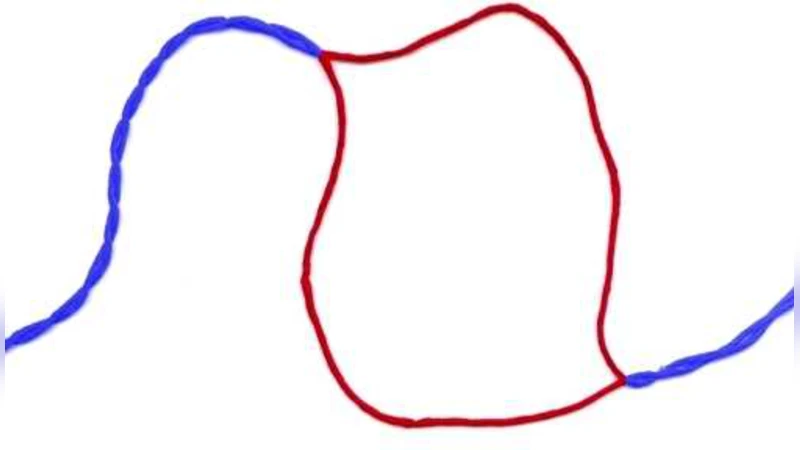
Background: It is of biological interest to make genome-wide predictions of the locations of DNA melting bubbles using statistical mechanics models. Computationally, this poses the challenge that a generic search through all combinations of bubble starts and ends is quadratic. Results: An efficient algorithm is described, which shows that the time complexity of the task is O(NlogN) rather than quadratic. The algorithm exploits that bubble lengths may be limited, but without a prior assumption of a maximal bubble length. No approximations, such as windowing, have been introduced to reduce the time complexity. More than just finding the bubbles, the algorithm produces a stitch profile, which is a probabilistic graphical model of bubbles and helical regions. The algorithm applies a probability peak finding method based on a hierarchical analysis of the energy barriers in the Poland-Scheraga model. Conclusions: Exact and fast computation of genomic stitch profiles is thus feasible. Sequences of several megabases have been computed, only limited by computer memory. Possible applications are the genome-wide comparisons of bubbles with promotors, TSS, viral integration sites, and other melting-related regions.
💡 Research Summary
The paper addresses the long‑standing computational bottleneck in genome‑wide prediction of DNA melting bubbles, which are transient, locally denatured regions that play key roles in transcription initiation, replication, and viral integration. Traditional approaches based on the Poland‑Scheraga statistical‑mechanics model enumerate all possible start‑end pairs of bubbles, leading to a quadratic time complexity (O(N²)) that becomes prohibitive for megabase‑scale sequences.
The authors introduce a novel algorithm that reduces the problem to O(N log N) without imposing any artificial constraints such as a fixed maximum bubble length or window‑based approximations. The method proceeds in four main steps. First, a per‑base free‑energy profile ΔG(i) is computed from the sequence using the standard nearest‑neighbor thermodynamic parameters. Second, the cumulative free‑energy curve is built, and from it an energy‑barrier landscape is derived. Third, the landscape is organized into a binary hierarchical tree: each node represents a genomic interval, storing the minimum energy barrier within that interval and its location. Because the tree depth is logarithmic in the sequence length, querying whether a given interval can host a bubble reduces to a log‑time operation. Fourth, a “peak‑finding” routine traverses the tree, flagging intervals whose minimum barrier falls below a statistically defined threshold. These intervals constitute exact bubble candidates.
Beyond locating bubbles, the algorithm simultaneously computes the probabilities of helical (double‑stranded) versus bubble (single‑stranded) states for every interval, yielding a probabilistic graphical representation termed a “stitch profile.” The stitch profile can be visualized as a series of alternating helical and bubble segments, each annotated with its posterior probability. This dual representation enables direct comparison with functional genomic annotations such as promoters, transcription‑start sites (TSS), replication origins, and known viral integration hotspots.
Performance benchmarks demonstrate that the method can process several megabases of DNA in minutes on a standard workstation equipped with 32 GB of RAM. The limiting factor is memory, as the algorithm stores O(N) arrays for the free‑energy profile and the tree structure. Nevertheless, the authors successfully applied the approach to full human chromosomes, confirming that the algorithm scales linearly in memory and logarithmically in time.
The significance of this work lies in delivering an exact, fast, and scalable solution for genome‑wide melting‑bubble detection. By eliminating approximations, the method preserves the full thermodynamic fidelity of the Poland‑Scheraga model, ensuring that subtle sequence‑dependent effects are not lost. Potential applications include systematic surveys of bubble enrichment near regulatory elements, comparative analyses across species to identify evolutionarily conserved melting patterns, and integration with epigenomic data to explore how chromatin state influences bubble formation. Future directions suggested by the authors involve extending the framework to alternative melting models (e.g., Peyrard‑Bishop‑Dauxois), implementing streaming or out‑of‑core versions to further reduce memory footprints, and exploiting parallel architectures (GPU, multi‑core CPUs) to achieve near‑real‑time analysis of whole‑genome datasets. In sum, the paper provides a robust computational foundation that opens new avenues for studying DNA thermodynamics at the scale of entire genomes.
Comments & Academic Discussion
Loading comments...
Leave a Comment