Local Conservation Laws and the Hamiltonian Formalism for the Ablowitz-Ladik Hierarchy
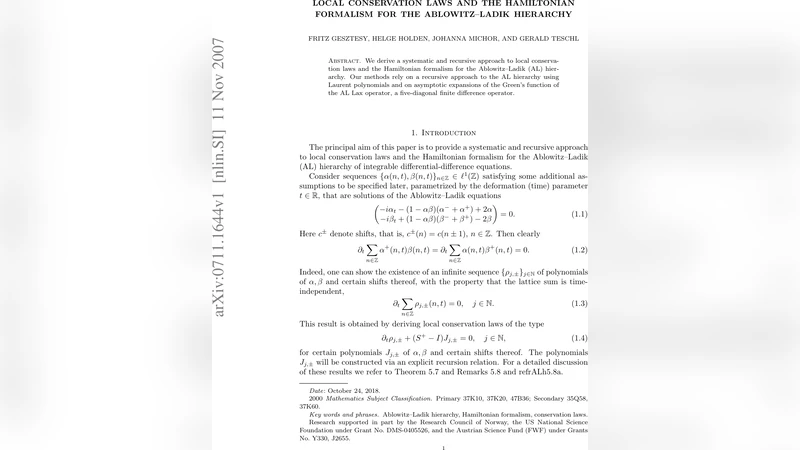
We derive a systematic and recursive approach to local conservation laws and the Hamiltonian formalism for the Ablowitz-Ladik (AL) hierarchy. Our methods rely on a recursive approach to the AL hierarchy using Laurent polynomials and on asymptotic expansions of the Green’s function of the AL Lax operator, a five-diagonal finite difference operator.
💡 Research Summary
The paper presents a comprehensive and recursive framework for deriving local conservation laws and the Hamiltonian formalism of the Ablowitz‑Ladik (AL) hierarchy, a prototypical integrable discrete nonlinear Schrödinger system. The authors begin by formulating the AL Lax operator as a five‑diagonal finite‑difference matrix acting on sequences ({u_n}_{n\in\mathbb{Z}}). They then introduce two fundamental Laurent polynomials, (F_n(z)) and (G_n(z)), whose coefficients encode the hierarchy’s dynamics. By establishing a precise recursion relation between these polynomials, the authors generate an infinite tower of conserved densities in a systematic way, avoiding the ad‑hoc calculations that have traditionally plagued the field.
A central technical achievement is the asymptotic expansion of the Green’s function (G(z;n,m)) of the Lax operator in both the large‑(z) and small‑(z) regimes. The expansion yields, for each lattice site (n), a hierarchy of local densities (\rho^{(k)}_n) that are polynomial expressions in the fields and their shifts. Summation over the lattice recovers the familiar global integrals of motion, confirming that the local densities correctly reproduce known conservation laws. Crucially, the local formulation makes explicit the spatial distribution of each invariant, opening the door to refined analyses of energy transport, soliton interactions, and numerical stability.
The Hamiltonian structure is constructed via a Poisson bracket of the standard Ablowitz‑Ladik form, \
Comments & Academic Discussion
Loading comments...
Leave a Comment