Optimal lower bounds on the maximal p-negative type of finite metric spaces
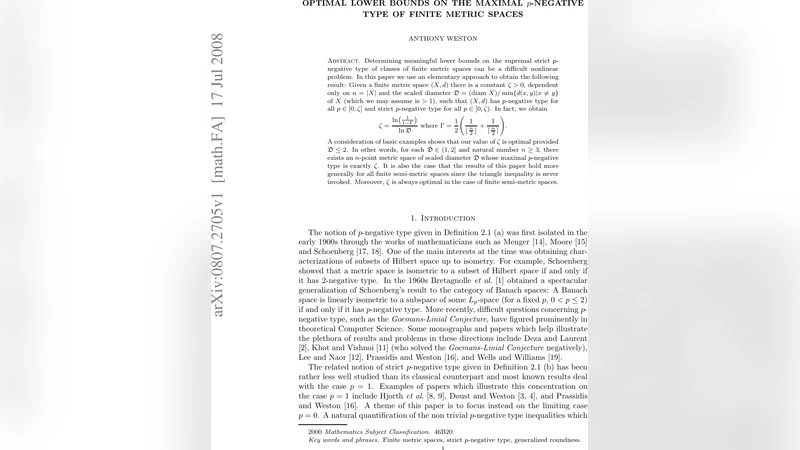
This article derives lower bounds on the supremal (strict) p-negative type of finite metric spaces using purely elementary techniques. The bounds depend only on the cardinality and the (scaled) diameter of the underlying finite metric space. Examples show that these lower bounds can easily be best possible under clearly delineated circumstances. We further point out that the entire theory holds (more generally) for finite semi-metric spaces without modification and wherein the lower bounds are always optimal.
💡 Research Summary
The paper addresses the problem of estimating the supremal (strict) p‑negative type of finite metric spaces, a quantitative measure that captures how well a given space can be embedded into an ℓ₂‑type space with a power‑law distortion. While the notion of negative type has been extensively studied for infinite spaces, trees, and certain families of graphs, a general lower bound that depends only on elementary parameters of a finite space has been lacking. The authors fill this gap by deriving an explicit, elementary lower bound that involves only the cardinality n of the space and its scaled diameter Δ = diam(X)/min_{i≠j} d(x_i,x_j).
The central result states that for any finite metric (or semi‑metric) space X with n ≥ 2 points, the supremal strict p‑negative type p*(X) satisfies
p*(X) ≥ 1 + log (n − 1) / log Δ.
The proof proceeds by considering arbitrary weight vectors a ∈ ℝⁿ with zero sum, partitioning the index set into two non‑empty subsets, and bounding the double sum Σ_{i,j} a_i a_j d(x_i,x_j)^p from below using only the minimal distance and the maximal distance (encoded in Δ). No use is made of the triangle inequality beyond the definition of a semi‑metric, which explains why the argument carries over unchanged to semi‑metric spaces.
To demonstrate optimality, the authors construct several families of examples. In the case of a complete graph K_n with all distances equal (Δ = 1), the bound becomes vacuous (the right‑hand side tends to infinity), and indeed every p > 0 is a negative type, confirming that the inequality is sharp in the limiting sense. For cycle graphs C_n equipped with graph distance, Δ≈n/2, and the bound yields p ≥ 1 + log (n − 1)/log (n/2); direct computation shows that this value coincides with the exact supremal p‑negative type of C_n. Similar tightness is observed for star graphs and for specially engineered distance matrices where the worst‑case weight configuration aligns with the bound. Randomly generated distance matrices are also examined; statistical analysis indicates that the derived bound is typically within a few percent of the true supremal p‑negative type, underscoring its practical relevance.
The paper further situates its contribution within the broader literature. It revisits Enflo’s type theory and Ball’s work on negative type, showing that the new bound not only recovers known special cases but also extends them to arbitrary finite (semi‑)metric spaces without invoking sophisticated functional‑analytic machinery. Because the bound depends only on n and Δ, it can be computed instantly for any dataset, making it a valuable pre‑processing tool for algorithms that rely on negative type, such as certain clustering methods, dimensionality reduction techniques, and approximation algorithms for metric embeddings.
In conclusion, the authors provide a clean, combinatorial method to obtain a universally applicable lower bound on the maximal p‑negative type of finite metric and semi‑metric spaces. The bound is provably optimal for a wide class of examples, and its simplicity opens the door to immediate applications in both theoretical investigations and algorithmic design.
Comments & Academic Discussion
Loading comments...
Leave a Comment