Group Divisible Codes and Their Application in the Construction of Optimal Constant-Composition Codes of Weight Three
The concept of group divisible codes, a generalization of group divisible designs with constant block size, is introduced in this paper. This new class of codes is shown to be useful in recursive constructions for constant-weight and constant-composi…
Authors: ** - **Yeow Meng Chee** (Senior Member, IEEE) – Nanyang Technological University, Singapore - **Gennian Ge** – Zhejiang University
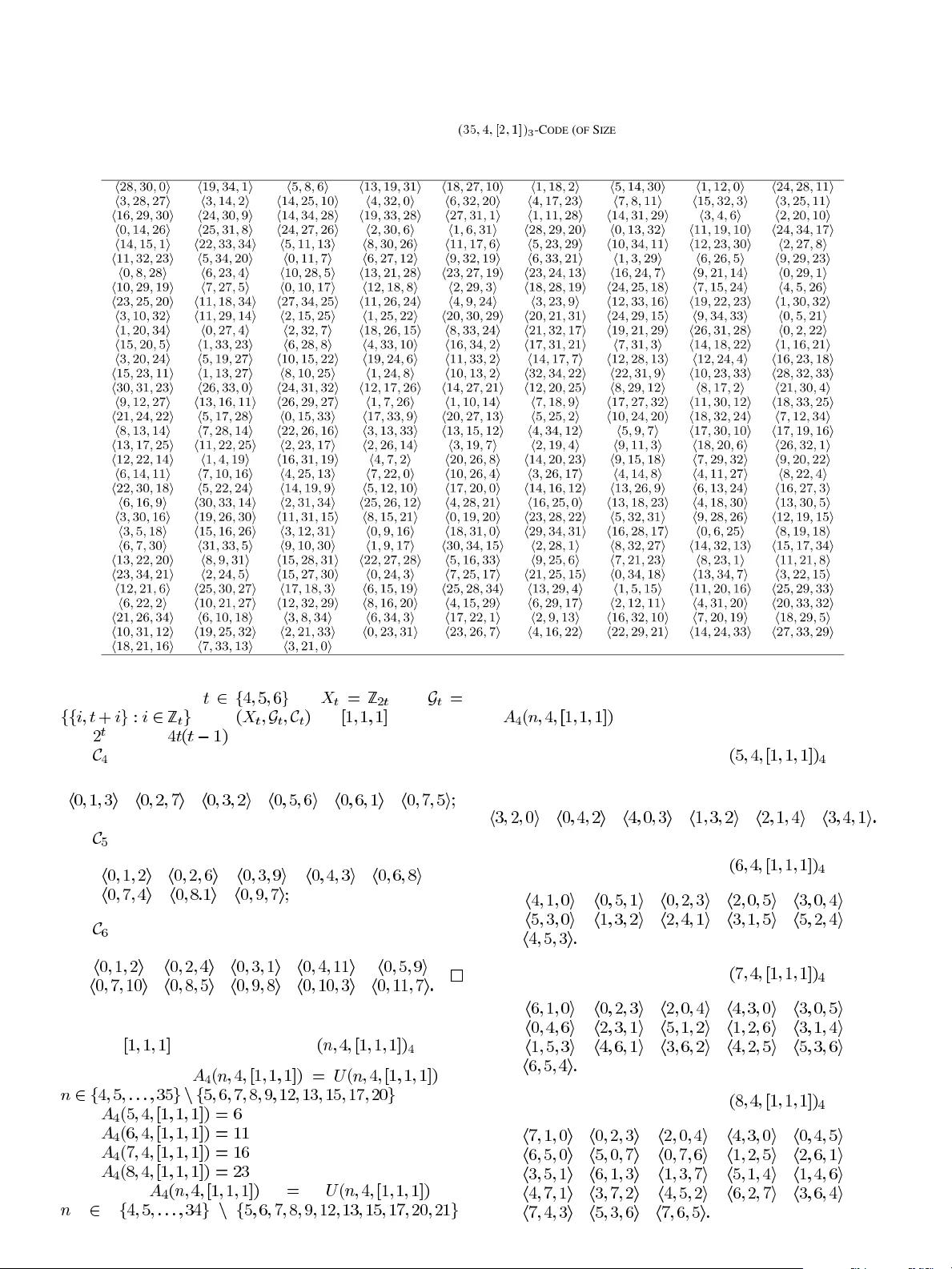
3552 IEEE TRANSA CTIONS ON INFORMA TION THEOR Y , VOL. 54, NO. 8, A UGUST 2008 Group Di visible Codes and Their Application in the Construction of Optimal Constant-Composition Codes of W eight Three Y eow Meng Chee , Senior Member , IEEE , Gennian Ge, and Alan C. H. Ling Abstract— The concept of group divisible codes, a generalization of group divisible designs with constant block size, is introduced in this paper. This new class of codes is shown to be useful in recursive constructions for constant-weight and constant-composition codes. Large classes of group divisible codes are constructed which en- abled the determination of the sizes of optimal constant-composi- tion codes of weight three (and specified distance), leaving only four cases undetermined. Previously , the sizes of constant-composition codes of weight three were known only for those of sufficiently large length. Index T erms— Constant-composition codes, group divisible codes, group divisible designs, recursiv e constructions. I. I NTR ODUCTION O NE generalization of constant-weight binary codes as we enlarge the alphabet from size two to beyond, is the con- cept of constant-composition codes. The class of constant-com- position codes includes the important permutation codes and hav e attracted recent interest due to their numerous applications, such as in determining the zero error decision feedback capacity of discrete memoryless channels [1], multiple-access communi- cations [2], spherical codes for modulation [3], DNA codes [4], [5], po werline communications [6], [7], and frequenc y hopping [8]. While constant-composition codes have been used since the early 1980s to bound error and erasure probabilities in decision feedback channels [9], their systematic study only be gan in late 1990s with Sv anström [10]. T oday , the problem of determining the maximum size of a constant-composition code constitutes a central problem in their in vestigation [6], [7], [11]–[20]. Our interest in this paper is in determining the maximum sizes of constant-composition codes of weight three. The techniques Manuscript receiv ed September 20, 2007; revised April 3, 2008. The work of Y. M. Chee was supported in part by the Singapore National Research Foundation, the Singapore Ministry of Education under Research Grant T206B2204 and by the Nanyang T echnological Univ ersity under Research Grant M58110040. The work of G. Ge w as supported by in part by the National Natural Science Foundation of China under Grant 10771193, the Zhejiang Provincial Natural Science Foundation of China, and the Program for New Century Excellent T alents in University. This work was done when A. C. H. Ling was on sabbatical leav e at the Division of Mathematical Sciences, School of Physical and Mathematical Sciences, Nanyang T echnological University , Singapore. Y. M. Chee is with the Division of Mathematical Sciences, School of Phys- ical and Mathematical Sciences, Nan yang T echnological Univ ersity , Sing apore 637371, Singapore (e-mail: ymchee@ntu.edu.sg). G. Ge is with the Department of Mathematics, Zhejiang University , Hangzhou 310027, Zhejiang, China (e-mail: gnge@zju.edu.cn). A. C. H. Ling is with the Department of Computer Science, Univ ersity of V ermont, Burlington, VT 05405 USA (e-mail: aling@emba.uvm.edu). Communicated by T. Etzion, Associate Editor for Coding Theory. Digital Object Identifier 10.1109/TIT.2008.926349 introduced in this paper are built upon the authors’ earlier re- sults [12], where pairwise balanced designs and group di visible designs are used to obtain optimal constant-composition codes of suf ficiently large lengths. W e remarked in that paper that the techniques developed therein, together with deeper methods in combinatorial design theory , can be used to derive optimal con- stant-composition codes of all lengths, except for a small fi- nite set. In this paper, we show how this can be done by intro- ducing the concept of gr oup divisible codes and applying it to the problem of determining the sizes of optimal constant-com- position codes of weight three. The power of group divisible codes lies in their similarity to group divisible designs, which allow the use of W ilson-type constructions [21], [22]. W e begin by revie wing some coding theoretic terminology and notations. The set of integers is denoted by . The ring is denoted by , and the set of nonnegati ve integers and positiv e integers are denote by and , respectively. The notation is used for multisets. All sets considered in this paper are finite if not obviously infinite. If and are finite sets, denotes the set of vectors of length , where each component of a vector has value in and is indexed by an element of , that is, , and for each .A - ary code of length is a set for some of size . The elements of are called codewor ds . The Hamming norm or the Hamming weight of a vector is defined as . The distance induced by this norm is called the Hamming distance , denoted , so that , for . The composition of a vector is the tuple , where . For any two vectors , define their support as . W e write instead of and also call the support of . A code is said to ha ve distance if for all .I f for every codeword , then is said to be of (constant) weight .A -ary code has constant composition if e very codeword in has composition .A -ary code of length , distance , and constant composition is referred to as an - code . The maximum size of an -code is denoted and the -codes achieving this size are called optimal . Note that the following operations do not affect distance and weight properties of an -code: i) reordering the components of ; ii) deleting zero components of . 0018-9448/$25.00 © 2008 IEEE CHEE et al. : GR OUP DIVISIBLE CODES AND THEIR APPLICA TION 3553 Consequently , throughout this paper , we restrict our attention to those compositions , where . Suppose is a codew ord of an -code, where . Let . W e can represent equiv alently as a -tuple , where . . . Throughout this paper , we shall often represent code words of constant-composition codes in this form. This has the advantage of being more succinct and more flexible in manipulation. Since the distance between any two distinct codew ords of a constant-composition code of weight is at least two and at most , and that , are pairwise disjoint if has distance ,w eh a v e Pr oposition 1.1: if if if . Pr oof: Let . When , the op- timal -code contains all vectors with composition as codew ords. When , all codew ords must have disjoint supports. No pair of codew ords in a -code can be distance apart. Henceforth, we need only concern ourselv es with when we study constant-composition codes of weight three. II. S T A TE OF A FF AIRS Constant-composition codes of weight three can be classified as follows: i) and ; ii) and ; iii) and . The value of is a classical result in bi- nary constant-weight codes and is gi ven below (note that when is odd, and so the value of , which can be obtained from Proposition 1.1, is omitted). Theor em 2.1 (Schönheim [23], Spencer [24]): if and if and The value of was in vestig ated by Svanström [10], [19] and Chee et al. [12]. Svanström [10], [19] determined that and for all , and determined that if is ev en. In trying to determine for odd, the authors recently discovered a result based on the clo- sure of pairwise balanced designs that enables the determination of for all suf ficiently lar ge , from just a single ex- ample of an optimal -code, provided obeys a certain bound [12]. Using this technique, the following was sho wn: i) for all ; ii) for all sufficiently large ; iii) for all , except for and e xcept possibly for ; iv) for all sufficiently large ; v) , for all . The purpose of this paper is to determine the following: i) for all ; ii) for iii) for all ; thereby completing the determination of the sizes of optimal constant-composition codes of weight three, e xcept for four cases. Let The bounds when hav e already been established previously [12], [19], so we focus on the construction of constant-composition codes meeting these upper bounds. III. G R OUP D IVISIBLE D ESIGNS AND G ROUP D IVISIBLE C ODES Central to our construction are the notions of gr oup divisible designs and a generalization that we call group divisible codes . W e begin by defining them. A. Gr oup Divisible Designs A set system is a pair , where is a finite set of points and , whose elements are called blocks . The or der of the set system is , the number of points. F or a set of nonnegati ve integers , a set system is said to be - uniform if for all . Let be a set system and be a par- tition of into subsets, called groups . The triple is a group divisible design (GDD) when ev ery -subset of not 3554 IEEE TRANSA CTIONS ON INFORMA TION THEOR Y , VOL. 54, NO. 8, A UGUST 2008 contained in a group appears in exactly one block and for all and . W e denote a GDD by -GDD if is -uniform. The type of a GDD is the multiset . W e use the exponential notation to describe the type of a GDD: a GDD of type is a GDD where there are exactly groups of size . A parallel class in a GDD is a subset such that each point is contained in exactly one block in , and a holey parallel class is a subset such that for some , each point is contained in exactly one block in , and no point of is contained in any block in ; in other words, is a partition of .A r esolvable GDD (RGDD) is a GDD in which can be partitioned into parallel classes, and a -frame is a -GDD in which can be partitioned into holey parallel classes. In particular, a -frame is called a Kirkman frame . W e have the follo wing known results on the existence of RGDD’s and frames. Theor em 3.1 (Rees and Stinson [25], Rees [26]): There exists a -RGDD of type if and only if , and ,e x - cept when . Theor em 3.2 (Stinson [27]): A Kirkman frame of type exists if and only if , and . Theor em 3.3 (Adding P oints to a F rame): Let . Suppose there exists a -frame of type . Then there exists a -GDD of type , where . Pr oof: Let for be holey parallel classes missing a picked group . Then , where is a -GDD of type . A Latin squar e of side is an array in which each cell contains a single element from a symbol set of cardinality , such that each element of appears exactly once in each row , and exactly once in each column. A transversal design is a -GDD of type . A Latin square of side is equiv alent to a . The following result on the ex- istence of transversal designs (see [28]) is used without explicit reference throughout the paper. Theor em 3.4: Let denote the set of positive integers such that there exists a . Then, we have i) ; ii) ; iii) ; iv) . GDDs of dif ferent types can be obtained from transversal de- signs by truncating groups (Hanani [29]) or truncating blocks. Theor em 3.5 (T runcating Gr oups): Let be an integer , . Let . Suppose that there exists a . Let be integers satisfying . Then there exists a -GDD of type . Theor em 3.6 (T runcating Blocks): Let be an integer , , and let . Suppose there exists a . Then there exists a -GDD of type . Pr oof: Delete points lying in the same block from a . Another useful notion is that of an incomplete transversal design .A n incomplete tr ansversal design of gr oup size , bloc k size , and hole size , denoted is a quadruple such that i) is a -uniform set system of order ; ii) is a partition of into subsets, called gr oups , each of size ; iii) , with for all ; iv) ev ery -subset of is either • contained in and not contained in any blocks of ; • contained in a group and not contained in any blocks of ;o r • contained in neither nor a group, and contained in exactly one block of . Theor em 3.7 (Heinrich and Zhu [30]): For ,a n exists if and only if . B. Gr oup Divisible Codes Giv en and , the restriction of to , written , is the vector such that if if The constriction of to , written , is the vector such that . A gr oup divisible code (GDC) of distance is a triple , where is a partition of with cardinality and is a -ary code of length , such that for all distinct , and for all . Elements of are called gr oups .W e denote a GDC of distance as -GDC if is of constant weight . If we want to emphasize the composition of the codewords, we denote the GDC as -GDC when ev ery has composition . The type of a GDC is the multiset . As in the case of GDD’s, the exponential notation is used to describe the type of a GDC. The size of a GDC is . Note that an -code of size is equi valent to a -GDC of type and size . Example 3.1: Let , and be the set of all cyclic shifts of the vector . Then is a -GDC of type , and is an optimal -code of size six. Example 3.2: Let , and be the set of all cyclic shifts of the vectors CHEE et al. : GR OUP DIVISIBLE CODES AND THEIR APPLICA TION 3555 Fig. 1. Wilson’s Fundamental Construction for GDDs. . Then is a -GDC of type , and is a -code of size . Often, constant-composition codes of larger size can be ob- tained from GDCs via the following simple observation. Pr oposition 3.1 (F illing in Gr oups): Let . Suppose there exists a -GDC of type and size . Suppose further that for each , there exists a -code of size , then there exists a -code of size . In particular, if and , are of constant composition , then is also of constant composition . Pr oof: Let be a -GDC of type and let . For each , we put a -code on . Now , the distance between any two codew ords from codes on distinct groups is , and the distance between any two codew ords, one from and one from a code on a group, is at least . Since , the resulting code is an -code. Example 3.3: Filling in the groups of the -GDC of type in Example 3.2 with a trivial -code of size one giv es a -code of size . This con- stant-composition code is optimal. There is an obvious generalization of Proposition 3.1 to allow filling in of only some of the groups, not necessarily all the groups. The example below illustrates this. Example 3.4: Filling in four of the five groups of the -GDC of type in Example 3.2, with a trivial -code of size one, gives a -GDC of type having size . The following is another useful construction for constant- composition codes from GDC’s. Pr oposition 3.2 (Adjoining P oints): Let . Suppose there e xists a (master) -GDC of type and size , and suppose the following (ingredients) also exist: i) a -code of size ; ii) a -GDC of type and size for ; iii) a -GDC of type and size if . Then, there exists a -code of size Furthermore, if the master and ingredient codes are of constant composition, then so is the resulting code. Pr oof: Let be a -GDC with , and let be a set of size disjoint from . Let be a -code and let be a -GDC for each . Then is the required -code of size . T o apply Propositions 3.1 and 3.2, we require the existence of lar ge classes of GDCs. The ne xt theorem is a direct analogue of W ilson’s Fundamental Construction for GDDs [21] (shown in Fig. 1), applied to GDCs. Theor em 3.8 (Fundamental Construction): Let be a (master) GDD, and be a weight function. Suppose that for each , there exists an (ingredient) -GDC of type . Then there exists a -GDC of type . Fur- thermore, if the ingredient GDC’s are of constant composition , then is also of constant composition . Pr oof: For each , let be a -GDC of type , where Then is a -GDC of type , where If in the Fundamental Construction, for all , the construction is also known as inflating the master GDD by . The follo wing results provide large classes of GDDs for the constructions described above. 3556 IEEE TRANSA CTIONS ON INFORMA TION THEOR Y , VOL. 54, NO. 8, A UGUST 2008 T ABLE I G ROUPS AND P RESTRUCTURES OF S OME f 3 ; 4 g -GDD S .N OTE T HA T D ENOTES THE S ET f x 2 : a x b g Theor em 3.9 (Colbourn, Hoffman, and Rees [31]): Let . There e xists a -GDD of type if and only if the following conditions are all satisfied: i) if then ,o r and ,o r and ,o r ; ii) or ; iii) or ; iv) or ; v) . Theor em 3.10 (Br ouwer , Schrijver , and Hanani [32]): There exists a -GDD of type if and only if and i) or and or ;o r ii) or and ;o r iii) and or ;o r iv) , with the two exceptions of types and , for which -GDD’s do not exist. Theor em 3.11 (Rees and Stinson [33]): A -GDD of type exists if and only if either i) and ; or ii) and ; or iii) and . Theor em 3.12 (Ge and Rees [34]): There exists a -GDD of type for every and with , except for and except possibly for . IV . S OME S MALL GDD S , GDC S , AND O PTIMAL C ODES In this section, we present some small GDDs, GDCs, and op- timal constant-composition codes, whose existence is required in establishing subsequent results. A. Some -GDDs T o construct small -GDD’s, we use the hill-climbing al- gorithm described in [35]. Suppose is a -GDD. W e call the set the pr estructur e of the GDD. On given a prestructure, the hill-climbing algorithm quickly finds a set of blocks of size three that can be added to complete it to a -GDD of a specified type. Pr oposition 4.1: There exist -GDDs of the following types: i) ; ii) ; iii) ; iv) ; v) ; vi) ; vii) . Pr oof: The groups and prestructures for -GDDs of the required types are provided in T able I. W e omit listing the blocks of size three since they exhibit no particular structure, are space-consuming, and can be found easily and quickly with a hill-climbing algorithm. W e refer the interested reader to the first author’s web- site at https://www1.spms.ntu.edu.sg/ym- chee/34gdd.php for a complete description of these GDDs. B. Some Optimal -Codes Pr oposition 4.2: for all . Pr oof: has been shown to hold for by Svanström [19] and for all by Chee et al. [12]. An optimal -code is giv en in T able II. C. Some -GDC (3) Pr oposition 4.3: There exists a -GDC (3) of type and size , for . CHEE et al. : GR OUP DIVISIBLE CODES AND THEIR APPLICA TION 3557 T ABLE II C ODEWORDS OF AN O PTIMAL (35 ; 4 ; [2 ; 1] ) -C ODE ( OF S IZE 291) Pr oof: For each , let , and . Then is a -GDC(3) of type and size , where • is the set of all cyclic shifts of the vectors • is the set of all cyclic shifts of the vectors • is the set of all cyclic shifts of the vectors D. Some -GDC(4) and Optimal -Codes Pr oposition 4.4: for , and i) ; ii) ; iii) ; iv) . Pr oof: for , has been prov en by Chee et al. [12]. The remaining values of are established via computer search as follows. i) The six codew ords of an optimal -code are ii) The 11 codew ords of an optimal -code are iii) The 16 codew ords of an optimal -code are iv) The 23 code w ords of an optimal -code are 3558 IEEE TRANSA CTIONS ON INFORMA TION THEOR Y , VOL. 54, NO. 8, A UGUST 2008 v) The 210 codewords of an optimal -code are giv en by the quasi-cyclic shifts with length \ of vi) The 595 codewords of an optimal -code are given by the cyclic shifts of Pr oposition 4.5: There exists a -GDC(4) of type and size . Pr oof: Let and . Then is a [1,1,1]-GDC(4) of type and size 96, where is the set of cyclic shifts of the vectors Pr oposition 4.6: There exists a -GDC(4) of type and size . Pr oof: Let and . Then is a -GDC(4) of type and size , where is the set of cyclic shifts of the vectors Pr oposition 4.7: There exists a -GDC(4) of type and size . Pr oof: Let and . Then is a [1,1,1]-GDC(4) of type and size 600, where is the set of cyclic shifts of the vectors Pr oposition 4.8: There exists a -GDC(4) of type and size . Pr oof: Adjoin one point to a -GDC(4) of type and size (which exists by Theorem 7.1) using an optimal -code as ingredient to obtain a -code of size . This code contains an optimal -code. Removing this code giv es a -GDC(4) of type of size . V. D ETERMINING THE V ALUE OF The value of has been completely determined for the cases [19] and [12]. In this section, we solve the case completely. W e consider three congruence classes of . Pr oposition 5.1: for all . Pr oof: Let . Inflate a -GDD of type (which exists by Theorem 3.9) by two using a -GDC(4) of type and size six (which exists by Example 3.1) as ingredient. This giv es a -GDC(4) of type . Adjoining three points to this -GDC(4) of type using an optimal -code of size (which exists by Proposition 4.2) and a -GDC(4) of type and size (which exists by Example 3.4), gives a -code of size which is optimal. Pr oposition 5.2: for all . Pr oof: Let .T a k ea -GDD of type (which exists by Theorem 3.9) as the master GDD and apply the Funda- mental Construction with . This gi v es a -GDC(4) of type . The required ingredient -GDC(4) of type and size six exists by Example 3.1. Adjoining three points to this -GDC(4) of type using an optimal -code of size nine (which exists by Proposition 4.2) and a -GDC(4) of type and size (which exists by Example 3.4), gives a -code of size which is optimal. Pr oposition 5.3: for all . Pr oof: Let .T a k ea -GDD of type (which exists by Theorem 3.9) as the master GDD and apply the Funda- mental Construction with . This gi v es a -GDC(4) of type . The required ingredient -GDC(4) of type and size six exists by Example 3.1. Adjoining three points to this -GDC(4) of type using an optimal -code of size (which exists by Proposition 4.2) and a -GDC(4) of type and size (which exists by Example 3.4), gives a -code of size which is optimal. CHEE et al. : GR OUP DIVISIBLE CODES AND THEIR APPLICA TION 3559 T ABLE III S OME f 4 ; 5 ; 6 g -GDD S T ABLE IV S OME [1 ; 1 ; 1] -GDC(3) Cor ollary 5.1: for all . Pr oof: Follo ws from Propositions 4.2, 5.1, 5.2, and 5.3. VI. D ETERMINING THE V ALUE OF Pr oposition 6.1: There exist -GDD’s of the types listed in T able III. Pr oof: For types , and , truncate points from aT D . For types and , truncate points from a TD . For type , truncate points from a TD .F o r type , truncate points from a TD . For type , truncate points from a TD . For type , truncate points from a TD . Pr oposition 6.2: for . Pr oof: Inflate a -GDD of type (provided by Proposition 6.1) by two to obtain a -GDC(3) of type . The required ingredient -GDC(3) of types having size , respectively , all exist by Proposition 4.3. The size of the resulting -GDC(3) is giv en in T able IV. No w adjoin points to this -GDC(3), where is given in T able IV. The -codes so obtained are optimal. VII. D ETERMINING THE V ALUE OF Chee et al. [12, Lemma 21] have prov en that if is odd and , then . Hence, we focus first on establishing results for -codes of odd lengths. W e begin with some general constructions for GDCs and optimal codes. A. General Constructions Theor em 7.1: There exists a -GDC(4) of type and size , for all . Pr oof: Let be a Latin square of side with entries from the set , and with its rows and columns also indexed by . Define the bijection , for , and let denote the Latin square obtained from by replacing each entry of by . It is easy to see that , and are pairwise disjoint , that is, for each , the entries in cell of , and are all distinct. Define the -GDC of type , where and is the entry in cell of and is the entry in cell and is the entry in cell of W e claim that is a code of distance four. Indeed, for distinct , the property of a Latin square ensures that .I f and , then since and are disjoint, then and can share at most two nonzero coordinates. Howe ver , these coordinates must receiv e different values by our construction. Thus, is a -GDC(4) of type and size . Cor ollary 7.1 (T ripling Construction): Let be an odd pos- itiv e integer. If , then we hav e Pr oof: Fill in the groups of a -GDC(4) of type and size , which exists by Theorem 7.1, to obtain a -code of size Hence, we have . Similarly , to prov e , we adjoin a point and fill in the 3560 IEEE TRANSA CTIONS ON INFORMA TION THEOR Y , VOL. 54, NO. 8, A UGUST 2008 groups of a -GDC(4) of type and size with an -code of size . Theor em 7.2 (Prime P ower Construction): Let be a prime power with . Suppose there is a generator in the finite field such that the following conditions hold: 1) is a quadratic residue; 2) . Then . In partic- ular , we have for . Pr oof: Let be the generator of the finite field satis- fying the above two conditions. Let and consider the code . Obviously , is a code of length and constant composition . W e show that has distance four and size . Since meets the above two conditions, it can be easily checked that any two codewords can share at most two nonzero coor- dinates. Suppose and , where If , then and , unless , a contradiction. Hence, if , then . If , then if (1) and (2) we have , which gives , implying . How eve r, implies that (1) and (2) can hold only if , a contradiction. Therefore, at most one of (1) and (2) can hold. Consequently , if , then . The proof above also shows that all codewords in are dis- tinct, for otherwise there would be two codew ords that are dis- tance zero apart. It follows that the size of is . Finally , for primes , we can take , respectiv ely. Example 7.1: The 1081 code words of an (optimal) -code are giv en by , where . The idea of Theorem 7.2 can be extended to a compu- tational search procedure for optimal -codes when . W e dev eloped an algorithm to look for such that and is an optimal -code. W e call the base codewor ds . W e have been successful in determining optimal -codes in the following instances. Pr oposition 7.1: for . Pr oof: i) For , take as base blocks and . ii) For , take as base blocks , and . iii) For , take as base blocks and . iv) F or , take as base blocks and . v) For , take as base blocks , and . B. Odd Lengths: (Mod 6) W e first consider the easy case of . Pr oposition 7.2: for all , and . Pr oof: For , inflate a -GDD of type (which exists by Theorem 3.9) by three to obtain a -GDC(4) of type . The required ingredient -GDC(4) of type and size exists by Theorem 7.1. Adjoining one point to this -GDC(4) of type using an optimal -code of size (which ex- ists by Proposition 4.4) giv es an -code of size For , inflate a -GDD of type (which exists by Theorem 3.9) by three to obtain a -GDC(4) of type . The required ingre- dient -GDC(4) of type and size e xists by The- orem 7.1. Adjoining one point to this -GDC(4) of type using an optimal -code of size and an optimal -code of size (which exist by Proposition 4.4) gi ves an -code of size For , inflate a -GDD of type (which exists by Theorem 3.9) by three to ob- tain a -GDC(4) of type . The required in- gredient -GDC(4) of type and size exists by The- orem 7.1. Adjoining one point to this -GDC(4) of type using an optimal -code of size CHEE et al. : GR OUP DIVISIBLE CODES AND THEIR APPLICA TION 3561 and an optimal -code of size (which exist by Proposition 4.4) gi ves an -code of size The above establishes for all .F o r ,w eh a v e by Proposition 4.4. For ,w eh a v e by Proposition 7.1. For ,w eh a v e by Theorem 7.2. Cor ollary 7.2: There exists a -GDC(4) of type and size , for . Pr oof: Observe that the codes of length constructed in Proposition 7.2 contains a -code of size . Removing this -code of size gives a -GDC(4) of type . T aking then giv es the required result. C. Odd Lengths: (Mod 4) W e establish a general construction for optimal -codes, , from -GDDs. Theor em 7.3: If there exists a -GDD of type , and there exists a -code of size for each , then there exists a -code of size . Pr oof: Let be a -GDD of type with blocks of size three and blocks of size four. Then and satisfy Now inflate by four using a -GDC(4) of type and size (which exists by Theorem 7.1), and a -GDC(4) of type and size 96 (which exists by Propo- sition 4.5) as ingredients. This gives a -GDC(4) of type having size . Now adjoin one point to this GDC to obtain a -code of size T o apply Theorem 7.3, we require classes of -GDDs provided below. Pr oposition 7.3: There e xists a -GDD of the following types: i) ; ii) ; iii) , for and ; iv) , for . Pr oof: i) T ak e a TD and pick a block . Removing this block and deleting each of the points from the groups and blocks where they occur gives a -GDD of type . -GDDs of types can be obtained by truncating a group of a TD . ii) The existence of -GDD’s of types and has already being established in Proposition 4.1. iii) By Theorem 3.9, a -GDD of type exists for all and . By Theorem 3.12, a -GDD of type exists for all . T runcate two points from the group of size nine of this GDD to obtain a -GDD of type for . What remains is to sho w the ex- istence of -GDDs of types and . T o con- struct these, let be a Kirkman frame of type , which exists by Theorem 3.2, and let be a holey parallel class with , for some . By Theorem 3.3, adding one point to this frame giv es a -GDD of type , while adding three points giv es a -GDD of type . iv) First, we prove the existence of a -GDD of type . For odd , take a -GDD of type (which exists by Theorem 3.1) as the master GDD and apply the Fundamental Construction with weight function assigning weight two to the points in the groups of size three, and weight in to the points in the remaining groups to obtain a -GDD of type . The required ingredient -GDD’s of types for e xist by Theorem 3.9 and an ingredient -GDD of type exists by taking a and truncating a block by three points. For even , take a -RGDD of type (which exists by Theorem 3.1), ha ving as its partition into parallel classes. Now let and consider Then is a -GDD of type . 3562 IEEE TRANSA CTIONS ON INFORMA TION THEOR Y , VOL. 54, NO. 8, A UGUST 2008 As for the case when is odd above, apply the Fun- damental Construction to obtain a -GDD of type . Finally , fill in the group of size of a -GDD of type by a -GDD of type (from i) above) to obtain a -GDD of type . Theor em 7.4: for all . Pr oof: Propositions 4.4 (with Corollary 7.1), 7.1, 7.2, and 7.3 (with Theorem 7.3) establish the theorem for all , and . For , inflate a -GDD of type (which exists by Theorem 3.9) by 11 using an ingredient -GDC(4) of type and size (which exists by Theorem 7.1) to obtain a -GDC(4) of type and size . Now fill in the groups of this GDC with optimal -codes to ob- tain a -code of size 2926, which is optimal. The remaining values of with are established via computer search. i) The 990 codewords of an optimal -code are given by the cyclic shifts of ii) The 1176 codew ords of an optimal -code are given by the cyclic shifts of iii) The 2080 codew ords of an optimal -code are given by the cyclic shifts of D. Odd Lengths: (Mod 4) First, we settle the case . Pr oposition 7.4: for all . Pr oof: Apply Corollary 7.1 with Proposition 4.4 and The- orem 7.4 to establish the theorem for and . The remaining v alues of with are established via computer search: i) The codew ords of an optimal -code are given by the cyclic shifts of ii) The codew ords of an optimal -code are given by the cyclic shifts of Next, we give a construction, similar to Theorem 7.3, for optimal -codes, , from -GDDs. Theor em 7.5: Suppose there exists a -GDD of type . Then , where . Pr oof: Let be a -GDD of type , with blocks of size three and blocks of size four. Then and satisfy (3) Now inflate by four using a -GDC(4) of type and size 48 (which exists by Theorem 7.1), and a -GDC(4) of type and size (which exists by Propo- sition 4.5) as ingredients. This gives a -GDC(4) of type having size . Now adjoin 19 points to this GDC using i) a -code of size , ii) a -GDC(4) of type and size (which exists by Corollary 7.2), as ingredients to obtain a -code of size which simplifies to using (3). Theor em 7.6: Suppose there exists a -GDD of type , and . Then , where . Pr oof: Let be a -GDD of type , with blocks of size three and blocks of size four. Then and satisfy (4) Now inflate by four using a [1,1,1]-GDC(4) of type and size 48 (which exists by Theorem 7.1), and a [1,1,1]- CHEE et al. : GR OUP DIVISIBLE CODES AND THEIR APPLICA TION 3563 GDC(4) of type and size 96 (which exists by Proposition 4.5) as ingredients. This giv es a [1,1,1]-GDC(4) of type having size . No w adjoin 11 points to this GDC using i) a -code of size , ii) a -GDC(4) of type and size (which exists by Proposition 4.8), as ingredients to obtain a -code of size which simplifies to , using (4). T o apply Theorems 7.5 and 7.6, we require classes of -GDDs provided belo w. Pr oposition 7.5: There e xists a -GDD of the follo wing types: i) with and ; ii) with and ; iii) and with . Pr oof: i) When , take a -RGDD of type (which exists by Theorem 3.1), having as its partition into parallel classes. Now let , and consider Then is a -GDD of type . ii) For , completing parallel classes of a 3-RGDD of type giv es a -GDD of type . Theorem 3.9 gives 3-GDD’s of types with and . iii) For , completing parallel classes of a 3-RGDD of type giv es a -GDD of type . T runcating a group of a 4-GDD of type gives -GDD’s of types with . Theor em 7.7: for all . Pr oof: Since the case of is covered by Proposition 7.4, we need only to consider the cases of . Proposition 7.5 together with Theorem 7.5 es- tablish the theorem for all with . This leaves with to be considered. These small orders of are and Most of them hav e been constructed previously except for .F o r , we ha ve by Propo- sition 4.4. For ,w eh a v e by Theorem 7.2. For ,w eh a v e by Proposition 7.2. For , apply Theorem 7.6 to a -GDD of type (which exists by Proposition 4.1). For , we have GDC(4)s of types and by Propo- sitions 4.6 and 4.7. Adjoin an extra point and fill in three of the four groups of a -GDC(4) of type and size 600 with an -code of size 55 to obtain a -GDC(4) of type and size . T ake a TD and truncate it to obtain a -GDD of type . Give weight to ob- tain a -GDC(4) of type and size . Now ad- join 11 extra points and fill in the groups of this GDC with a -GDC(4) of type and size and an optimal -code to obtain a -code of size , which is optimal. For the remaining values of , apply Corollary 7.1 to obtain the desired codes noting that . E. Even Lengths Theorems 7.4 and 7.5 combine to show that for all odd . Chee et al. [12, Lemma 21] have proven that if is odd and , then . Combining with Proposition 4.4, it follows that for all ev en , except possibly for . from Corollary 7.1 (noting ). VIII. S UMMAR Y The following summarizes the results obtained in this paper and [12], giving the best state of knowledge about the sizes of optimal -ary constant-composition codes of weight three, for . Main Theor em: i) For all integers if if if . ii) For all integers if if if . iii) For all integers if if if if if if except possibly for . 3564 IEEE TRANSA CTIONS ON INFORMA TION THEOR Y , VOL. 54, NO. 8, A UGUST 2008 iv ) For all integers if if if if . IX. C ONCLUSION W e introduced the concept of group divisible codes, which share similarities with group divisible designs that allow the use of po werful W ilson-type constructions. This class of codes was shown to play an important role in determining the size of op- timal constant-composition codes. In particular , the sizes of op- timal constant-composition codes of weight three (and specified distance) are determined, leaving only four outstanding cases. W e are optimistic that group divisible codes will find further applications in the determination of optimal constant-composi- tion codes and constant-weight codes. R EFERENCES [1] I. E. T elatar and R. G. Gallager, E. Arikan, Ed., “Zero error decision feedback capacity of discrete memoryless channels, ” in BILCON’90: Pr oc. 1990 Bilkent Int. Conf. New T r ends in Commun., Contr., Signal Pr ocessing , 1990, pp. 228–233. [2] A. G. D’yachkov , “Random constant composition codes for multiple access channels, ” Pr obl. Contr. Inf. Theory/Pr oblemy Upravlen. T eor. Inform. , vol. 13, no. 6, pp. 357–369, 1984. [3] T. Ericson and V. Zinoviev, “Spherical codes generated by binary par- titions of symmetric pointsets, ” IEEE T rans. Inf. Theory , v ol. 41, no. 1, pp. 107–129, 1995. [4] O. D. King, “Bounds for DNA codes with constant GC-content, ” Elec- tr on. J. Combin. , vol. 10, no. 1, 2003. [5] O. Milenko vic and N. Kash yap , On the Design of Codes for DNA com- puting , ser. Lecture Notes in Computer Science. Berlin, Germany: Springer-V erlag, 2006, vol. 3969, pp. 100–119. [6] W. Chu, C. J. Colbourn, and P. Dukes, “Constructions for permutation codes in powerline communications, ” Des. Codes Cryptogr. , vol. 32, no. 1–3, pp. 51–64, 2004. [7] C. J. Colbourn, T. Kløve, and A. C. H. Ling, “Permutation arrays for powerline communication and mutually orthogonal Latin squares, ” IEEE T rans. Inf.. Theory , vol. 50, no. 6, pp. 1289–1291, 2004. [8] W. Chu, C. J. Colbourn, and P. Dukes, “On constant composition codes, ” Discrete Appl. Math. , vol. 154, no. 6, pp. 912–929, 2006. [9] I. Csiszar and J. K orner , Information Theory: Coding Theorems for Discr ete Memoryless Channels . New Y ork: Academic, 1981. [10] M. Svanström, “T ernary Codes W ith W eight Constraints, ” Ph.D. dis- sertation, Linköpings Univ ersitet, , Sweden, 1999. [11] G. T. Bogdanova and S. N. Kapralo v, “Enumeration of optimal ternary codes with a given composition, ” Pr oblemy P er edac hi Informatsii , v ol. 39, no. 4, pp. 35–40, 2003. [12] Y. M. Chee, A. C. H. Ling, S. Ling, and H. Shen, “The PBD-closure of constant-composition codes, ” IEEE T rans. Inf. Theory , vol. 53, no. 8, pp. 2685–2692, 2007. [13] W. Chu, C. J. Colbourn, and P. Dukes, “T ables for constant composi- tion codes, ” J. Combin. Math. Combin. Comput. , vol. 54, pp. 57–65, 2005. [14] C. Ding and J. Y in, “Algebraic constructions of constant composition codes, ” IEEE Tr ans. Inf. Theory , v ol. 51, no. 4, pp. 1585–1589, 2005. [15] C. Ding and J. Y in, “Combinatorial constructions of optimal con- stant-composition codes, ” IEEE Tr ans. Inf. Theory , vol. 51, no. 10, pp. 3671–3674, Oct. 2005. [16] C. Ding and J. Y in, “A construction of optimal constant composition codes, ” Des. Codes Cryptogr. , vol. 40, no. 2, pp. 157–165, 2006. [17] C. Ding and J. Y uan, “A family of optimal constant-composition codes, ” IEEE T rans. Inf. Theory , vol. 51, no. 10, pp. 3668–3671, 2005. [18] Y. Luo, F.-W. Fu, A. J. H. V inck, and W. Chen, “On constant-com- position codes over Z ,” IEEE T r ans. Inf. Theory , vol. 49, no. 11, pp. 3010–3016, 2003. [19] M. Svanström, “Constructions of ternary constant-composition codes with weight three, ” IEEE T r ans. Inf. Theory , vol. 46, no. 7, pp. 2644–2647, 2000. [20] M. Svanström, P. R. J. Östergård, and G. T. Bogdanova, “Bounds and constructions for ternary constant-composition codes, ” IEEE Tr ans. Inf. Theory , vol. 48, no. 1, pp. 101–111, 2002. [21] R. M. W ilson, “An existence theory for pairwise balanced designs. I. Composition theorems and morphisms, ” J. Combin. Theory Ser. A , vol. 13, pp. 220–245, 1972. [22] R. M. Wilson, “An existence theory for pairwise balanced designs. II. The structure of PBD-closed sets and the existence conjectures, ” J. Combin. Theory Ser. A , vol. 13, pp. 246–273, 1972. [23] J. Schönheim, “On maximal systems of k -tuples, ” Studia Sci. Math. Hungar , vol. 1, pp. 363–368, 1966. [24] J. Spencer, “Maximal consistent families of triples, ” J. Combin. Theory , vol. 5, pp. 1–8, 1968. [25] R. Rees and D. R. Stinson, “On resolvable group-divisible designs with block size 3, ” Ars Combin. , vol. 23, pp. 107–120, 1987. [26] R. S. Rees, “T wo ne w direct product-type constructions for resolvable group-divisible designs, ” J. Combin. Des. , vol. 1, no. 1, pp. 15–26, 1993. [27] D. R. Stinson, “Frames for Kirkman triple systems, ” Discr. Math. , vol. 65, no. 3, pp. 289–300, 1987. [28] R. J. R. Abel, C. J. Colbourn, and J. H. Dinitz, , C. J. Colbourn and J. H. Dinitz, Eds., “Mutually orthogonal Latin squares (MOLS), ” in The CRC Handbook of Combinatorial Designs , 2nd ed. Boca Raton, FL: CRC, 2007, pp. 160–193. [29] H. Hanani, “Balanced incomplete block designs and related designs, ” Discr. Math. , vol. 11, pp. 255–369, 1975. [30] K. Heinrich and L. Zhu, “Existence of orthogonal Latin squares with aligned subsquares, ” Discr. Math. , vol. 59, no. 1-2, pp. 69–78, 1986. [31] C. J. Colbourn, D. G. Hoffman, and R. Rees, “A new class of group divisible designs with block size three, ” J. Combin. Theory Ser. A , v ol. 59, no. 1, pp. 73–89, 1992. [32] A. E. Brouwer, A. Schrijver, and H. Hanani, “Group divisible designs with block-size four , ” Discr. Math. , vol. 20, no. 1, pp. 1–10, 1977. [33] R. Rees and D. R. Stinson, “On the existence of incomplete designs of block size four ha ving one hole, ” Utilitas Math. , vol. 35, pp. 119–152, 1989. [34] G. Ge and R. Rees, “On group-divisible designs with block size four and group-type 6 m ,” Discrete Math. , v ol. 279, no. 1-3, pp. 247–265, 2004. [35] Y. M. Chee and A. C. H. Ling, “Uniform group divisible designs with block sizes three and n ,” Graphs Combin. , vol. 18, no. 3, pp. 421–445, 2002.
Original Paper
Loading high-quality paper...
Comments & Academic Discussion
Loading comments...
Leave a Comment