Escherlike quasiperiodic heterostructures
We propose quasiperiodic heterostructures associated with the tessellations of the unit disk by regular hyperbolic triangles. We present explicit construction rules and explore some of the properties exhibited by these geometric-based systems.
Authors: A. G. Barriuso, J. J. Monzon, L. L. Sanchez-Soto
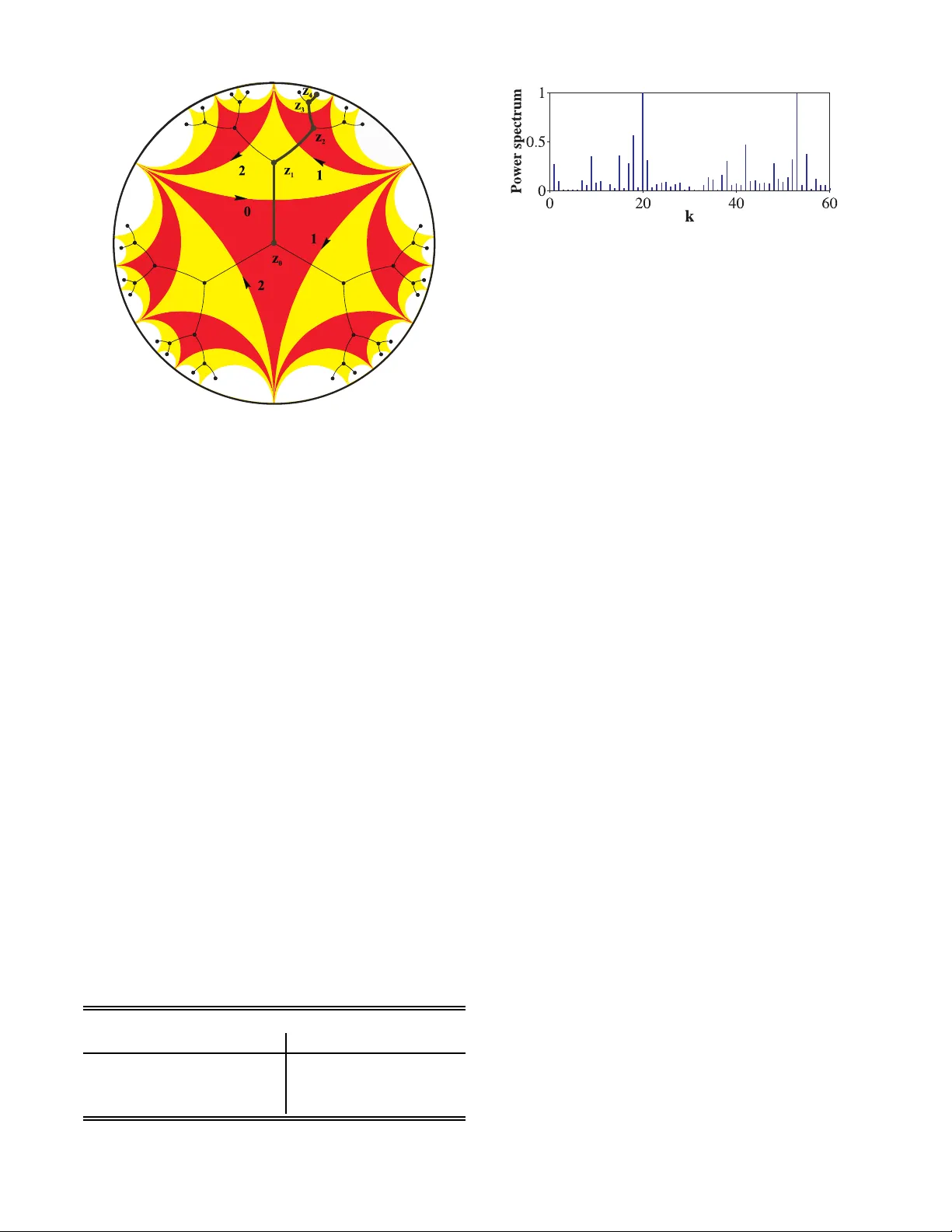
Escherlik e quasiperiodic heterostru ctur es Alberto G. Barriuso, 1 Juan J. Monz ´ on, 1 Luis L. S ´ a nchez-Soto , 1 and Anton io F . Costa 2 1 Departamento d e ´ Optica, F acultad de F ´ ısica, Univer sidad Co mplutense, 280 40 Mad rid, Spain 2 Departamento de Matem ´ aticas Fundamentales, F acultad de Ciencias, Universidad Nac ional de Edu caci ´ on a Distan cia, Senda del Re y 9, 28040 Madrid, Spain (Dated: No vemb er 3, 2018) W e propose quasiperiodic heterostructures associated with the tessellations of the unit disk by regular hyper - bolic triangles. W e present explicit construction rules and explore some of the properties exhibited by these geometric-based systems. P A CS numbers: 61.44.Br , 68.65.Cd, 71.55.Jv , 78.67.Pt Quasiperiod ic (QP) s ystems ha ve been receiving a lot of at- tention ov er the last years [1]. The interest was originally mo- ti vated by the theoretical predictions that they should manifest peculiar electron and pho non critical states [2, 3 ], associa ted with high ly frag mented fractal energy spectra [4, 5, 6]. On the o ther han d, the practical fabrication o f Fibo nacci [7] and Thue-Mo rse [8] superlattices h as trigge red a n umber of exper- imental ach iev ements that ha ve provided new insigh ts into the capabilities of QP structures [9]. I n par ticular , possible optical applications have deserved majo r atten tion and som e intrigu- ing p roper ties h ave been demon strated [10, 11, 12, 13]. Un- derlying all these theoretical and exp erimental efforts a cr u- cial fundam ental question remains conc erning whether QP de- vices would achieve b etter p erform ance th an usual per iodic ones for some specific application s [14]. The QP sy stems consider ed th us far rely f or their explicit construction in substitution al rules amon g the eleme nts o f a basic alp habet. In the co mmon case of a two-letter alpha- bet { A, B } , the algor ithm takes th e form A 7→ σ A ( A, B ) , B 7→ σ B ( A, B ) , where σ A and σ B can be any strin g of the letters. The sequenc es ge nerated after n applications of the algorithm are of significance in fields as diverse a s cryptog ra- phy , tim e-series analy sis, and cellular au tomata [15]. In ad- dition, th ey have in teresting alg ebraic p roperties, which are usually characterized by the nature o f the ir Fourier or multi- fractal spectra [16]. W e wish to appr oach the problem f rom an altern ativ e g e- ometrical perspective. T o this end, we first observe that in many prob lems of physical inter est [ 17] the letters of the al- phabet can be iden tified with one-dim ensional linear lo ssless systems (i.e., with two inp ut and two outp ut ch annels). Un- der these general conditio ns, it turns out th at the associated transfer m atrix be longs to the group SU(1,1 ), which is also the basic symmetry gro up o f the hyperbolic geometr y [1 8]. In consequen ce, th e unit disk appears as the natural arena to dis- cuss the ir p erform ance [19, 20, 21]. Since in the Eu clidean plane, QP beh avior is intimately linked with tessellations, one is un failingly led to consider th e role of h yperb olic tessella- tions in the unit disk , much in the spirit o f Escher’ s master- piece woodcut Cir c le Limit I II [2 2]. The answer we propose is promising : th e tessellations by different regular polygo ns provide new sequenc es with properties that may op en avenues of research in this field. A QP system can thus be seen a s a word generated by stacking different letter s of the basic alphab et. T o be spe- cific, we fo cus our attentio n on th e optical resp onse. Let us consider o ne of these letters (which in practice is made o f se veral p lane-para llel laye rs), which we assume to be san d- wiched b etween two semi-in finite identical ambient ( a ) an d substrate ( s ). W e suppo se mono chroma tic plane wav es in- cident, in ge neral, from b oth the ambient and th e substrate. As a result of m ultiple reflectio ns in all the in terfaces, the to- tal electric field can be decomposed in terms of forward- and backward-traveling plane wav es, denoted by E (+) and E ( − ) , respectively . If we take these compo nents as a vecto r E = E (+) E ( − ) , (1) then the a mplitudes at both the a mbient and the substrate s ides are related by the transfer matrix M E a = M E s . (2) It can be shown that M is of the fo rm M = 1 /T R ∗ /T ∗ R/T 1 /T ∗ , (3) where the complex num bers R an d T are, respectively , the overall reflection and transmission coefficients for a wav e in- cident f rom th e amb ient. The condition det M = +1 is equi v- alent to | R | 2 + | T | 2 = 1 , and then the set of transfe r matrices reduces to the group SU(1,1 ). Obviously , the matrix of a word obtained by putting togeth er letters of the alp habet is the prod- uct of the m atrices representing each one of them, tak en in the approp riate order . In many instances we are inter ested in the transfo rmation proper ties of field quo tients rather than th e field s th emselves. Therefo re, it seems n atural to consider the complex numbers z = E ( − ) E (+) , (4) for b oth ambient and substrate. The action of the matrix gi ven in Eq . ( 2) c an b e then seen as a fu nction z a = f ( z s ) that can be appr opriately called the transfer function. From a geomet- rical viewpoint, this functio n defines a tr ansforma tion of the 2 complex plane C , map ping the point z s into the point z a ac- cording to z a = β ∗ + α ∗ z s α + β z s , (5) where α = 1 /T and β = R ∗ /T ∗ . W hen no light is in cident from the substrate, z s = 0 and then z a = R . Equation (5) is a bilinear (or M ¨ o bius) transformation . One can check that the unit disk, the external re gion a nd the un it circle remain in v ari- ant un der (5). This un it disk is then a model fo r hyp erbolic geometry in which a line is repr esented a s an arc of a circle that meets the b ounda ry of th e disk at righ t ang les to it (and diameters are also pe rmitted). In this mo del, we ha ve three different kind s of lines: intersecting, parallel ( they inte rsect at infinity , which is precisely the b oundar y of th e disk) and ultraparallel (they are neither intersecting nor parallel). T o class ify the possible action s it proves convenient to work out th e fixed poin ts of the tra nsfer f unction ; that is, the field configur ations such that z a = z s ≡ z f in Eq . (5), whose solutions are z f = 1 2 β n − 2 i Im( α ) ± p [T r( M )] 2 − 4 o . (6) When [T r( M )] 2 < 4 the action is elliptic an d it h as only one fixed point inside the unit disk. Since in th e Eu clidean geom- etry a ro tation is characterized for having only one inv ariant point, this action can be appr opriately called a hy perbo lic ro- tation. When [T r( M )] 2 > 4 the action is h yperbo lic and it has two fixed po ints, b oth on the bound ary of the u nit d isk. The geodesic line joining these two fixed points r emains inv ariant and thus, by analogy with the Eu clidean case, this action is called a hyper bolic tr anslation. Finally , when [T r( M )] 2 = 4 the action is pa rabolic and it has on ly o ne (d ouble) fixed point on the bo undar y of the unit disk. As it is well known, SU(1, 1) is isomorp hic to the group of real unimodu lar matrices SL(2, R ), which allows us to trans- late the ge ometrical structur e d efined in the unit d isk to th e complex upper semiplane, recovering in this way an alter na- ti ve model of the hy perbolic geometry tha t is u seful in some applications. The notion of perio dicity is in timately connected with tes- sellations, i.e., tilings by identical re plicas of a unit c ell (o r fundam ental d omain) that fill the plane w ith no overlaps and no gaps. Of special interest is th e case when the primiti ve cell is a r egular polygo n with a fin ite area [ 23]. In th e Euclidean plane, the associated regular tessellation is generically noted { p, q } , wh ere p is the numbe r of poly gon edges and q is th e number of po lygon s that mee t at a vertex. W e recall that ge- ometrical con straints limit the po ssible regular tilings { p, q } to those verify ing ( p − 2)( q − 2) = 4 . This inc ludes the classical tilings { 4 , 4 } (tiling b y squar es) and { 6 , 3 } ( tiling by hexagon s), plus a third one, the tiling { 3 , 6 } by triang les (which is dual to the { 6 , 3 } ) . FIG. 1: ( color online). A realisti c implementation of the generators A and B (together with A − 1 ) of the tessellations by hyperbolic triangles in (7). The external layers (in blue) are made of cryolite (Na 3 AlF 6 ), while t he central medium (in bro wn) is zinc selenide (ZnSe). The wa veleng th in vacuu m is λ = 610 nm and normal incidence (from left t o right) has been assumed. The corresponding thicknesses are express ed in nanometers. On th e co ntrary , in the hyp erbolic disk regular tilings exist provided ( p − 2)( q − 2 ) > 4 , which now leads to an infinite number of possibilities. An essential ingred ient is th e way to o btain fu ndamen tal polyg ons. These po lygon s are d irectly connected to th e discrete sub group s of isometries (or co ngru- ent mapp ings). Such group s ar e called Fuchsian gro ups [24] and p lay for the hy perbolic geo metry a role similar to that o f crystallograp hic g roups for the Euclidean geometr y [25]. A tessellation of the hype rbolic plan e by regular poly- gons has a sym metry gro up that is gener ated by reflections in geodesics, which are inversions across circles in the unit disk. These geodesics co rrespon d to edges or axes of symmetry of the polygo ns. Th erefor e, to construct a tessellation of th e unit disk one just has to built one tile and to dup licate it b y using reflections in the edges. In this Letter , we co nsider o nly th e simple example of a tes- sellation by trian gles with vertices in th e unit cir cle, alth ough the treatmen t can be extended to other p olygo ns. The key idea is to consider the Fu chsian gro up g enerated by an ellip- tic tran sformatio n whose fixed point is the middle of an edge of the triangle an d a parabo lic o ne with its fixed point in the opposite vertex. Pr oceeding in this way we get A = 1 + i/ √ 3 1 / √ 3 1 / √ 3 1 − i / √ 3 , (7) B = 2 i/ √ 3 − 1 / √ 3 − 1 / √ 3 − 2 i/ √ 3 . The fixed point of A is − i ; while for B th e fixed point in the disk is i (2 − √ 3) . In Fig. 1 we show a possible w ay in which these matrices c an be implemented in terms of two comm only employed materials in optics. Note that, in p hysical term s, the inverses m ust be c onstructed as indep endent systems, al- though in our case only A − 1 must b e consid ered, since the action of B − 1 coincides with that of B . In Fig. 2 we h av e sho wn the tessellation ob tained by trans- forming the fundamental tr iangle with the F uchsian group 3 FIG. 2: (color online). Tiling of the unit disk with t he matrices (7). The marked points are the barycenters of the t riangles in the tessel- lation and all of them are the transformed of the origin by a matrix that hav e as reflection coefficient the complex number that links the origin with the center of the triangle. generated by the powers of { A , B } ( and th e in verses). This tri- angle is equ ilateral w ith vertices at the points − i , exp( iπ / 6) and exp( i 5 π / 6) (which are the fixed po ints of A , AB and BA , respectively). Mo reover , all the other triangles are equal, with an area π . In the figure we hav e plotted also the barycenters of each triangle tog ether with the resulting tree (that is c alled the dual gra ph of the tessellation), which turn s out to be a Farey tree [26]. In fact, each line con necting two of these bary cen- ters rep resent the a ction of a word ( with alp habet { A , B } and the in verses). T o give a n e xplicit construction ru le for the possible words, we pro ceed as fo llows. First, we arb itrarily assign the num- ber 0 to th e u pper side of the f undame ntal triangle, while the other two sides ar e clockwise n umber ed as 1 an d 2. It is easy to c onvince oneself that th is assignm ent fixes o nce fo r all the number ing f or the sides of the oth er triangles in th e tessella- tion. Howe ver , the se triangles can be distinguished by the ir orientation (as seen from the cor respond ing barycen ter): th e clockwise oriented are filled in red , while the cou nterclock - T ABLE I: E xplicit rules to obtain the barycenter z n +1 from the z n . W e ha ve indicated th e correspo nding transformations, which depend on the color jumps and the sides crossed by going from z n to z n +1 . red → yello w yello w → red Side Trans A n +1 B n +1 T rans A n +1 B n +1 0 B n B n A n B n B n B n B n A − 1 n B n B n 1 A n A n A n B n A − 1 n A − 1 n A n A − 1 n B n A n 2 A − 1 n A − 1 n A − 1 n B n A n A n A − 1 n A n B n A − 1 n FIG. 3: (color online). Normalized structure factor for the word (made of 60 lett ers) connecting t he origin with the point z 8 in the zig-zag path sho wn in Fig. 2. wise a re filled in y ellow . In sho rt, we have determined a fun- damental coloring of the tessellation [27]. T o ob tain on e bary center z n +1 from the previous one z n , one looks first at the cor respond ing color jump. Next, the ma- trix that take z n into z n +1 depend s on the numb ering of the side (0, 1 , or 2 ) one must cr oss, and ap pear in the ap propr iate column “Trans” in T ab le I . The next g eneration is obtain ed much in the sam e way , except for the fact th at A n and B n must be replaced b y A n +1 and B n +1 , respectively , as in dicated in the T able. In obtainin g recursiv ely an y word, the origin is de- noted as z 0 and the matrices A 0 and B 0 coincide with A a nd B . W ith this rule, o ne can co nstruct any word proceed ing step by step. For example, th e word that tr ansform z 0 into z 5 in the zig-zag path sketched in Fig. 2 results z 0 → z 1 : B , z 1 → z 2 : BA − 1 B , z 2 → z 3 : BA − 1 B , z 3 → z 4 : BA − 1 A − 1 BAAB , z 4 → z 5 : BA − 1 A − 1 BABAAB . (8) Obviously , th e total word is ob tained by composing these par - tial words. In fact, one can show tha t given a n a rbitrary sequenc e o f nonzer o integers { k 1 , k 2 , . . . , k r } , the word r epresented by the transfer matrix M ( s, k 1 , . . . , k r ) = B s 1 A k 1 BA k 2 . . . BA k r B s 2 , (9) where { s 1 , s 2 } ⊂ { 0 , 1 } , tran sforms the origin in a bary center of the tessellation. Giv en th e geometric regularity o f the construction sketched in th is Letter , the sequences obtained must play a key r ole in the theory an d practice o f QP systems. Of course, to put for- ward the relevant ph ysical featur es of these sequence s, th ere are a numb er of quantities one can look at. Per haps one of the most app ropriate o nes to assess the perfo rmance o f these systems is the structure factor [15]. For a word M (compo sed of L letters) we d efine a num erical sequen ce f n by assignin g 1, e 2 π i/ 3 , an d e − 2 π i/ 3 to th e letters B , A , and A − 1 , r espec- ti vely . Next, we calculate the discrete Fourier tran sform of the 4 sequence f n F k = L − 1 X n =0 f n exp − 2 π ik n L , (10) where k = 0 , 1 , ..L − 1 . The stru cture factor ( or power spec- trum) is ju st | F k | 2 . In Fig. 3 we h av e plotted this structure factor in te rms of k for the word conne cting th e o rigin with the point z 8 in the zig-zag path of Fig. 2. The pea ks r ev eal a rich be havior: a f ull an alysis of th ese q uestions is outside the scope of this Letter and will be presented else where. As a final and r ather technic al r emark, we no te that the quo - tient of the hyper bolic disk by the Fu chsian gro up gen erated by A and B is a 2 -orbif old of genus 0, with a co nical point of order two and a cu sp. E ach word as g iv en in Eq. (9) repre- sents a hyper bolic tran sformation o f the disk, and the axis of the transformation is pr ojected onto a closed geodesic of such an or bifold. This provid es an orbifold inter pretation o f ou r QP sequences. In su mmary , we expect to h av e pre sented new sch emes to generate QP sequ ences based on hyp erbolic tessellations of the unit disk. Ap art fr om th e intrinsic beauty of th e f ormalism, our preliminar y results seem to be qu ite enco uragin g f or f uture applications of these systems. The au thors wish to express their warmest gr atitude to E. Maci ´ a an d J. M . M ontesinos f or th eir h elp and in terest in the present work. [1] E. Maci ´ a, Rep. Prog. Phys. 69 , 397 (2006). [2] S. Ostlund and R. Pandit, Phys. Re v . B 29 , 1394 (1984). [3] M. K ohmoto, B. Suthe rland, and K . Iguc hi, Phys. Rev . Lett . 58 , 2436 (1987). [4] M. K ohmoto, L. P . Kadanof f, and C. T ang, Phys. Rev . Lett. 50 , 1870 (1983). [5] A. S ¨ ut ¨ o, J. S tat. Phys. 56 , 525 (1989). [6] J. B ellissard, B . Iochum, E. Scoppola, and D. T estard, Comm. Math. Phys. 125 , 527 (1989). [7] R. Merlin, K. Bajema, R. Clarke, F . Y . Juang, and P . K. Bhat- tacharya, Phys. Re v . Lett. 55 , 1768 (1985). [8] R. Merlin, K. Bajema, J. Nagle, and K. Ploog, J. Phys. C olloq. 48 , C5 503 (1987). [9] V . R. V elasco and F . Garc´ ıa-Moliner , P rog. Surf. Sci . 74 , 343 (2003). [10] S. T amura and F . Nori, Phys. Rev . B 40 , 9790 (1989). [11] M. S. V asconcelos and E. L. Albuque rque, Phys. Rev . B 59 , 11128 (1999). [12] D. Lusk, I. Abdulhalim, and F . P lacido, Opt. Commun. 198 , 273 (2001). [13] A. G. Barriuso, J. J. Monz ´ on, L. L. S ´ anchez-Soto, and A. Fe- lipe, Opt. Express 13 , 3913 (2005). [14] E. Maci ´ a, Phys. Rev . B 63 , 205421 (2001). [15] Z. Cheng and R. Savit, J. Stat. Phys. 60 , 383 (1990). [16] V . W . Spinadel, Nonlinear Anal. 36 , 721 (1999). [17] E. Maci ´ a and R. Rodr ´ ıguez-Oliv eros, Phys. Rev . B 74 , 144202 (2006). [18] H. S. M. Coxeter , Non-Euclidean Geometry (Uni ve rsity of T oronto Press, T oronto, 1968). [19] T . Y onte, J. J. Monz ´ on, L. L. S ´ anchez-Soto, J. F . Cari ˜ nena, and C. L ´ opez-Lacasta, J. Opt. Soc. Am. A 19 , 603 (2002). [20] J. J. Monz ´ on, T . Y onte, L. L. S ´ anchez-Soto, and J. F . Cari ˜ nena, J. Opt. Soc. Am. A 19 , 985 (2002). [21] A. G. Barriuso, J. J. Monz ´ on, and L. L. S ´ anchez-Soto, Opt. Lett. 28 , 1501 (2003). [22] H. S. M. Coxeter , Math. Intell. 18 , 42 (1996). [23] H. Ziesch ang, E. V ogt, and H. D. Coldew ay , Surfaces an d planar discontinuous gr oups , vol. 835 of Lect. Not. Math. (Springer , Berlin, 1980 ). [24] L. R. Ford, Automorph ic functions (Chelsea Publising Com- pany , Ne w Y ork, 1972). [25] A. F . Beardon, The geometry o f discr ete gr oups (Springer , Berlin, 1983). [26] M. R. S chr ¨ oder , Number Theory in Science and Communication (Springer , Ne w Y ork, 2006), 4th ed. [27] B. Gr ¨ unbaum and G . C. Shepard, T i lings and P atterns (F ree- man, Ne w Y ork, 1987).
Original Paper
Loading high-quality paper...
Comments & Academic Discussion
Loading comments...
Leave a Comment