An ESPRIT-based approach for Initial Ranging in OFDMA systems
This work presents a novel Initial Ranging scheme for orthogonal frequency-division multiple-access networks. Users that intend to establish a communication link with the base station (BS) are normally misaligned both in time and frequency and the go…
Authors: Luca Sanguinetti, Michele Morelli, H. Vincent Poor
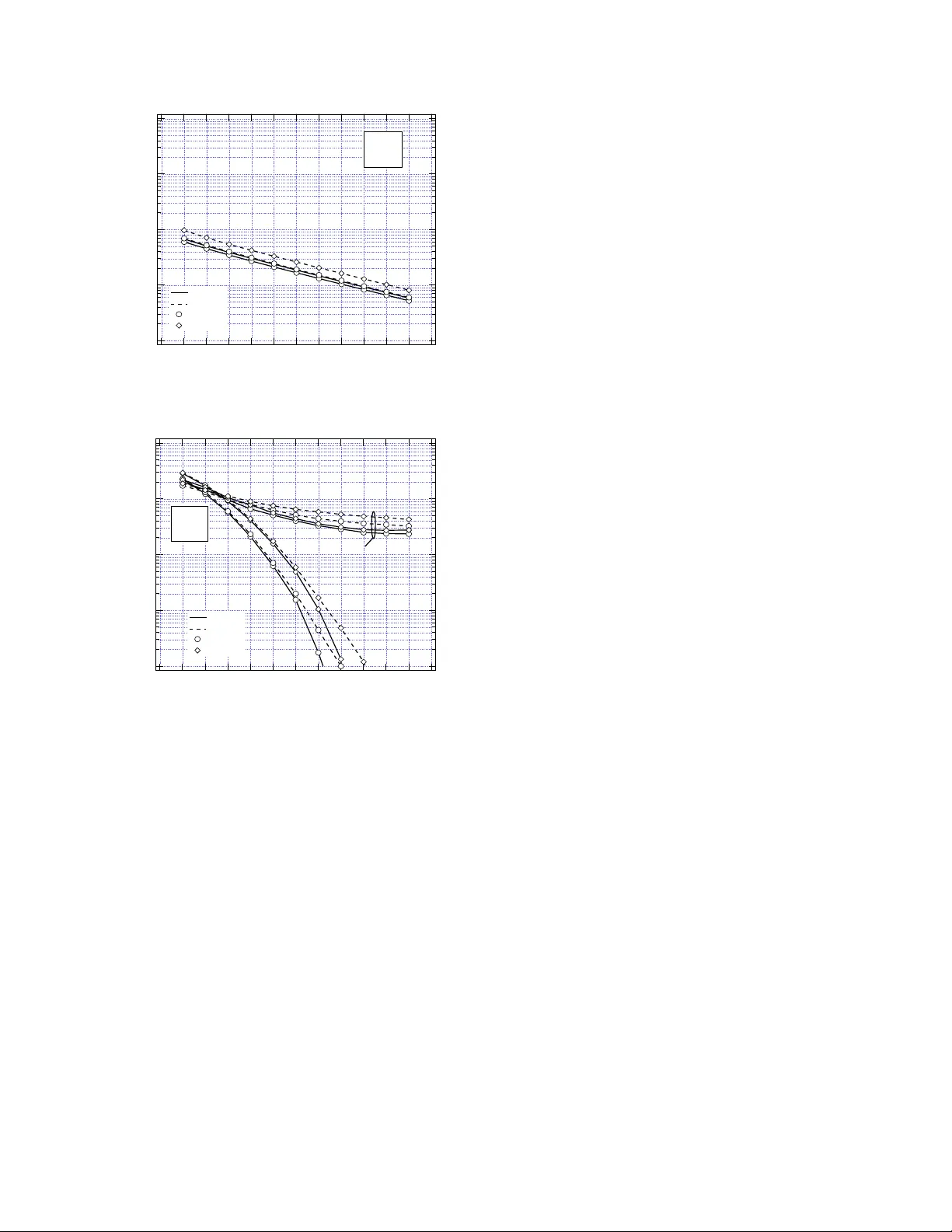
AN ESPRIT -B ASED APPRO A CH FOR INITIAL RANGING IN OFDMA SYS TEMS Luca Sanguinetti* and Michele Mor elli Univ ersity of Pisa Department of Information Engineering Pisa, Italy luca.sanguinetti, michele.morelli@ iet.unipi.it H. V incent P oor Princeton Unive rsity Department of Electrical Engineering Princeton, NJ USA poor@princeton.edu ABSTRA CT This work presents a novel Initial Ranging scheme fo r orthog - onal frequency-d ivision multiple-access networks. Users that intend to establish a co mmunica tion link with the base sta- tion (BS ) are no rmally m isaligned both in time and freq uency and the goal is to jointly estimate their timing er rors and car - rier frequen cy offsets with respect to the BS local refere nces. This is accom plished with affordable comp lexity by resorting to the ESPRIT algo rithm. Computer simulations are used to assess the effectiv eness of the pr oposed solution and to m ake compariso ns with existing alternatives. 1. INTR ODUCTION A major impairment in orthog onal frequency-d ivision multiple- access (OFDMA) networks is the remar kable sen siti vity to timing errors and carrier fre quency offsets (CFOs) between the uplink signals and the base station (BS) local r eferences. For this reason, the IEEE 80 2.16e- 2005 standard fo r OFDMA- based wireless metropolitan area networks (WMANs) speci- fies a synch ronization p rocedu re called Initial R ang ing (IR) in which subscrib er stations that intend to establish a link with the BS transmit pilot symbo ls on dedicated subcarr iers using specific ran ging cod es. Once the BS has detec ted the pres- ence of these p ilots, it has to estimate some f undam ental pa- rameters of rang ing sub scriber stations (RSSs) such as timing errors, CFOs and power levels. Initial sync hronizatio n an d power contro l in OFDMA w as originally discussed in [1 ] and [2] while similar solutions can be fou nd in [ 3]-[4]. A dif ferent IR approach has r ecently been propo sed in [5]. Here, each RSS tra nsmits pilo t streams over adjacent OFDMA blocks using orth ogon al spread ing co des. As lo ng as channel variations are negligib le over the r anging period, signals of different RSSs can b e easily separated a t the BS as they remain orthog onal after p ropag ating throu gh the ch annel. Timing info rmation is e ventually acq uired in an iterativ e fashion by exploiting the au tocorre lation prop erties *This work was completed while the author was with Prince ton Uni- versi ty and it was supported by the U.S. National Science Foundat ion under Grants ANI-03-3880 7 and CNS-06-25637. of the recei ved samples ind uced by the u se of the c yclic p refix (CP). All the aforemen tioned schem es are deri ved under the as- sumption of pe rfect freq uency alignment be tween th e rec eiv ed signals and the BS local reference. Howe ver , the occurrence of residual CFOs resu lts into a lo ss of orth ogon ality among ranging codes and m ay compr omise th e estimation ac curacy and detection capability of the IR process. Moti vated by the above pr oblem, in the present work we propo se a n ovel r ang- ing scheme f or OFDMA n etworks with in creased robustness against frequency error s an d lo wer computational complexity than the m ethod in [5]. T o co pe with the large numbe r of pa- rameters to be recovered, we adop t a t hr ee-step procedur e. I n the first step the num ber of active codes is estimated b y re- sorting to the min imum descrip tion length ( MDL) prin ciple [6]. Then, the ESPRIT (Estimation o f Sign al Parameter s by Rotational Inv arian ce T echniques) [7] algorithm is employed in the seco nd and thir d steps to detect which codes are ac- tually active and de termine the ir co rrespond ing timing erro rs and CFOs. 2. SYSTEM DESCRIPTION AND SIGNAL MODEL 2.1. System description W e conside r an OFDMA system employing N subcarriers with index set { 0 , 1 , . . . , N − 1 } . As in [5], we assume that a ranging time-slot is co mposed by M consecutive OFDMA blocks where the N av ailable subcarr iers are grou ped into ranging subchann els and data subcha nnels. The fo rmer are used b y th e active RSSs to com plete th eir r anging pr ocesses, while the latter are assigned to data sub scriber stations (DSSs) for data tra nsmission. W e denote by R the number of ra nging subchann els and assume that each of them is divided in to Q subband s. A given subb and is com posed of a set of V adja- cent su bcarriers wh ich is called a tile . T he su bcarrier indic es of the q th tile ( q = 0 , 1 , . . . , Q − 1) in the r th subchan nel ( r = 0 , 1 , . . . , R − 1) are collected in to a set J ( r ) q = { i ( r ) q + v } V − 1 v =0 , where the tile index i ( r ) q can be chosen a daptively acco rding to the actu al channel cond itions. Th e only co nstraint in the selection of i ( r ) q is that d ifferent tiles must be d isjoint, i.e ., J ( r 1 ) q 1 ∩ J ( r 2 ) q 2 = ∅ for q 1 6 = q 2 or r 1 6 = r 2 . Th e r th ranging subchann el is thus composed of QV subcar riers with indices in the set J ( r ) = ∪ Q − 1 q =0 J ( r ) q , while a total of N R = QV R ranging subcarriers is a vailable in each OFDMA block. W e assume that each subchan nel can be a ccessed by a maximum numb er of K max = min { V , M } − 1 RSSs, which are separated by means of orthogo nal code s in both the tim e and frequency do mains. The codes are selected in a pseudo- random fashion from a pr edefined set { C 0 , C 1 , . . . , C K max − 1 } with [ C k ] v, m = e j 2 π k ( v V − 1 + m M − 1 ) (1) where v = 0 , 1 , . . . , V − 1 cou nts th e subcar riers within a tile and is used to perf orm spreadin g in the frequ ency do- main, wh ile m = 0 , 1 , . . . , M − 1 is the block index by which spreading is don e in the time do main acr oss the rangin g time- slot. As in [5], we assum e that different RSSs select dif fer ent codes. Also, we assume that a selected code is employed b y the correspo nding RSS over all tiles in th e con sidered su b- channel. W ithout lo ss of generality , we concen trate on th e r th subchann el and denote by K ≤ K max the number o f simulta- neously active RSSs. T o simplify the notation, the subch annel index ( r ) is dropp ed hencefo rth. The sign al tran smitted by the k th R SS propagates thr ough a multipath chan nel characterize d by a channel imp ulse re- sponse (CIR) h ′ k = [ h ′ k (0) , h ′ k (1) , . . . , h ′ k ( L − 1)] T of length L (in sampling pe riods). W e den ote by θ k the timing erro r of the k th RSS expr essed in sampling intervals T s , w hile ε k is the frequen cy offset normalized to the subcarr ier spacing. As discussed in [8], durin g IR the CFOs are only due to Doppler shifts an d/or to estimation er rors an d, in consequen ce, they are assumed to lie within a small fraction of the su bcarrier spacing. T iming o ffsets depend on the distanc e of the RSSs from the BS an d the ir maxim um value is thu s limited to th e round trip delay from th e cell bou ndary . In or der to elimi- nate interblock in terferen ce (IBI), we assume that du ring the ranging process the CP length comp rises N G ≥ θ max + L sampling periods, where θ max is the maximu m expected tim- ing error . Th is assumption is not restrictive as initialization blocks are usu ally precede d by long CPs in many standard- ized OFDMA systems. 2.2. System model W e denote by X m ( q ) = [ X m ( i q ) , X m ( i q + 1) , . . . , X m ( i q + V − 1 )] T the discrete Fourier tran sform ( DFT) outputs cor- respond ing to the q th tile in the m th OFDMA blo ck. Since DSSs h ave su ccessfully co mpleted th eir IR processes, th ey are perfectly align ed to the BS r eferences and the ir signals do not contribute to X m ( q ) . In co ntrast, the presen ce of uncom- pensated CFOs destroys ortho gonality among ranging signals and gives rise to in terchann el interf erence ( ICI). The latter results in a disturb ance term plu s an attenu ation of the use- ful sign al co mpon ent. T o simplify th e an alysis, in the ensu- ing d iscussion the disturban ce term is treated as a zero-me an Gaussian rando m variable while the signal attenuation is co n- sidered as par t of the ch annel impu lse respon se. Under the above assump tions, we may write X m ( i q + v ) = K X k =1 [ C ℓ k ] v, m e j mω k N T H k ( θ k , ε k ,i q + v )+ w m ( i q + v ) (2) where ω k = 2 π ε k / N , N T = N + N G denotes the du ration of the cyclically extended b lock and C ℓ k is the code matrix selected by the k th RSS. T he quantity H k ( θ k , ε k ,n ) is the k th equivalen t chan nel freq uency response over the n th subcar rier and is given by H k ( θ k , ε k ,n ) = γ N ( ε k ) H ′ k ( n ) e − j 2 π nθ k / N (3) where H ′ k ( n ) = P L − 1 ℓ =0 h ′ k ( ℓ ) e − j 2 π nℓ/ N is the tru e channe l frequen cy respon se, while γ N ( ε ) = sin( π ε ) N sin( πε/ N ) e j π ε ( N − 1) /N (4) is the attenuation factor induced by the CFO. Th e last term in (2) accoun ts for backgrou nd noise plu s interf erence and is modeled as a circu larly symmetr ic comp lex Ga ussian r andom variable with zero- mean an d variance σ 2 w = σ 2 n + σ 2 I C I , where σ 2 n and σ 2 I C I are the average noise a nd ICI p owers, respec- ti vely . From (3) we see that θ k appears only as a phase shift across the DFT outp uts. The reason is that the CP d uration is longer than the maximum expected propagation delay . T o proceed furth er , we assume that the tile width is much smaller than the channel coh erence ban dwidth. In this case, the ch annel re sponse is nearly flat over each tile and we may reasonably replace the quantities { H ′ k ( i q + v ) } V − 1 v =0 with an av erag e frequency respo nse H ′ k ( q ) = 1 V V − 1 X v =0 H ′ k ( i q + v ) . (5) Substituting ( 1) and (3) into (2) an d b earing in mind (5), yields X m ( i q + v ) = K X k =1 e j 2 π ( mξ k + vη k ) S k ( q ) + w m ( i q + v ) (6) where S k ( q ) = γ N ( ε k ) H ′ k ( q ) e − j 2 π i q θ k / N and we have de- fined the quantities ξ k = ℓ k M − 1 + ε k N T N (7) and η k = ℓ k V − 1 − θ k N (8) which are referred to as the effective CFOs and timing errors, respectively . In the following sections w e show how the DFT outputs { X m ( i q + v ) } can be explo ited to identify the active cod es and to estimate the correspond ing tim ing errors and CFOs. 3. ESPRIT -BASED ESTIMA TION 3.1. Determination of the number of active codes The first prob lem to solve is to determin e th e numbe r K of activ e cod es over the considere d ran ging subchan nel. For this purp ose, we collect the ( i q + v ) th DFT o utputs across all rang ing blocks into an M -d imensional vector Y ( i q,v ) = [ X 0 ( i q + v ) , X 1 ( i q + v ) , . . . , X M − 1 ( i q + v )] T giv en by Y ( i q,v ) = K X k =1 e j 2 π v η k S k ( q ) e M ( ξ k ) + w ( i q,v ) (9) where w ( i q,v ) = [ w 0 ( i q + v ) , w 1 ( i q + v ) , . . . , w M − 1 ( i q + v )] T is Gaussian distrib uted with zero mean and cov ariance matr ix σ 2 w I M while e M ( ξ ) = [1 , e j 2 π ξ , e j 4 π ξ , . . . , e j 2 π ( M − 1) ξ ] T . From the above equ ation, we o bserve that Y ( i q,v ) h as the same structur e as measur ements of multiple uncorr elated sources from an ar ray of sensors. Hence, an estimate of K can be obtained by performing an e igendeco mposition (EVD) of the co rrelation matrix R Y = E { Y ( i q,v ) Y H ( i q,v ) } . I n prac- tice, h owe ver , R Y is not av ailable at the receiver and must be replaced by so me suitable estimate. One po pular stra tegy to get an estima te of R Y is based on the forward-b ackward (FB) p rinciple. Following this appro ach, R Y is replaced by ˆ R Y = 1 2 ( ˜ R Y + J ˜ R T Y J ) , where ˜ R Y is the sam ple correlation matrix ˜ R Y = 1 QV V − 1 X v =0 Q − 1 X q =0 Y ( i q,v ) Y H ( i q,v ) (10) while J is the exchange matrix with 1’ s o n the anti-diago nal and 0’ s elsewhere. Arrangin g the eigenv alues ˆ λ 1 ≥ ˆ λ 2 ≥ · · · ≥ ˆ λ M of ˆ R Y in n on-incr easing order, we can find an es- timate ˆ K of the number of acti ve codes by apply ing th e MDL informa tion-theo retic criterion . This amounts to look ing for the minimum of the following o bjective fun ction [6] F ( ˜ K ) = 1 2 ˜ K (2 V − ˜ K ) ln( M Q ) − M Q ( V − ˜ K ) ln ρ ( ˜ K ) (11) where ρ ( ˜ K ) is the r atio between the geometric and arithmetic means of { ˆ λ ˜ K +1 , ˆ λ ˜ K +2 , . . . , ˆ λ M } . 3.2. Frequency estimation For simplicity , we assume that the nu mber of acti ve cod es has been pe rfectly estimated . An estimate of ξ = [ ξ 1 , ξ 2 , . . . , ξ K ] T can be fo und by app lying the ESPRIT algorithm to the model (9). T o elab orate on this, we arr ange th e eigen vectors of ˆ R Y associated to the K largest eigen values ˆ λ 1 ≥ ˆ λ 2 ≥ · · · ≥ ˆ λ K into an M × K matrix Z = [ z 1 z 2 · · · z K ] . Next, we consider the matrices Z 1 and Z 2 that are ob tained by c ollecting the first M − 1 rows and the last M − 1 rows of Z , respectiv ely . The entries of ξ a re finally estimated in a decouple d fashio n as ˆ ξ k = 1 2 π arg { ρ y ( k ) } k = 1 , 2 , . . . , K (12) where { ρ y (1) , ρ y (2) , . . . , ρ y ( K ) } are the eig en values o f Z Y = ( Z H 1 Z 1 ) − 1 Z H 1 Z 2 (13) and ar g { ρ y ( k ) } d enotes the phase angle of ρ y ( k ) taking val- ues in the interval [ − π , π ) . After c omputin g estimates o f th e ef fective CFOs thro ugh (12), the problem arises of m atching each ˆ ξ k to the c orre- sponding code C ℓ k . This amo unts to fin ding an estimate o f ℓ k starting from ˆ ξ k . For t his purpo se, we denote by | ε max | the magnitud e of the maximum expected CFO and ob serve from (7) th at ( M − 1) ξ k belongs to the interval I ℓ k = [ ℓ k − β ; ℓ k + β ] , with β = | ε max | N T ( M − 1) / N . It follows th at the ef fec- ti ve CFOs can be u niv ocally mapp ed to the ir correspo nding codes as long as β < 1 / 2 since only in th at c ase intervals { I ℓ k } K k =1 are disjoint. The acqu isition r ange of the frequency estimator is thu s limited to | ε max | < N / (2 N T ( M − 1 )) an d an estimate of the pair ( ℓ k , ε k ) is computed as ˆ ℓ k = round ( M − 1) ˆ ξ k (14) and ˆ ε k = N N T ˆ ξ k − ˆ ℓ k M − 1 ! . (15) It is worth noting th at the arg { ·} fu nction in (12) has an in- herent ambiguity of m ultiples of 2 π , which translates in to a correspo nding ambig uity of th e quantity ˆ ℓ k by multiples of M − 1 . Hence, recalling that ℓ k ∈ { 0 , 1 , . . . , K max − 1 } with K max < M , a refined estimate of ℓ k can be found as ˆ ℓ ( F ) k = [ ˆ ℓ k ] M − 1 (16) where [ x ] M − 1 is the value o f x reduced to the inter val [0 , M − 2] . In the sequel, we refer to (15) as the ESPRIT -b ased fr e- quency estimator (EFE). 3.3. Timin g estimation W e call X m ( q ) = [ X m ( i q ) , X m ( i q + 1 ) , . . . , X m ( i q + V − 1)] T the V - dimension al vector of th e DFT ou tputs corr espond- ing to the q th tile in th e m th OFDMA block. Th en, from (6) we hav e X m ( q ) = K X k =1 e j 2 π mξ k S k ( q ) e V ( η k ) + w m ( q ) (17) where w m ( q ) = [ w m ( i q ) , w m ( i q + 1) , . . . , w m ( i q + V − 1)] T is Gaussian distributed with zer o mean and covariance ma- trix σ 2 w I V while e V ( η ) = [1 , e j 2 π η , e j 4 π η , . . . , e j 2 π ( V − 1) η ] T . Since X m ( q ) is a superposition of c omplex sinusoidal s ign als with rando m amplitudes embedded in white Gaussian noise, an estimate of η = [ η 1 , η 2 , . . . , η K ] T can still b e obtained by resorting to the ESPRIT algo rithm. Follo wing the previous steps, we first compute ˆ R X = 1 2 ( ˜ R X + J ˜ R T X J ) with ˜ R X = 1 M Q M − 1 X m =0 Q − 1 X q =0 X m ( q ) X H m ( q ) . (18) Then, we define a V × K matrix U = [ u 1 u 2 · · · u K ] who se columns ar e the eigenvectors o f ˆ R X associated to th e K largest eigenv alues. The effecti ve timin g errors are eventually esti- mated as ˆ η k = 1 2 π arg { ρ x ( k ) } , k = 1 , 2 , . . . , K (19) where { ρ x (1) , ρ x (2) , . . . , ρ x ( K ) } ar e the eigen values o f U X = ( U H 1 U 1 ) − 1 U H 1 U 2 (20) while the matrices U 1 and U 2 are o btained by collecting the first V − 1 rows and the last V − 1 rows of U , respectively . The q uantities { ˆ η k } K k =1 are eventually used to fin d esti- mates ( ˆ ℓ k , ˆ θ k ) of the associated ranging code and tim ing er- ror . T o accomplish this task, we let α = θ max ( V − 1 ) / (2 N ) . Then, recalling th at 0 ≤ θ k ≤ θ max , from (8) we see that ( V − 1 ) η k + α falls into the range I ℓ k = [ ℓ k − α ; ℓ k + α ] . I f θ max < N / ( V − 1 ) , th e q uantity α is smaller than 1 /2 and, in consequence, intervals { I ℓ k } K k =1 are disjoint. In this c ase, there is o nly on e pair ( ℓ k , θ k ) that results into a given η k and an estimate of ( ℓ k , θ k ) is fou nd as ˆ ℓ k = round (( V − 1 ) ˆ η k + α ) (21) and ˆ θ k = N ˆ ℓ k V − 1 − ˆ η k ! . (22) As do ne in Sect. 3.2, a refined estimate of ℓ k is ob tained in the form ˆ ℓ ( f ) k = [ ˆ ℓ k ] V − 1 . (23) In the sequ el, we r efer to (22) as the ESPRIT -based timin g estimator (ETE). 3.4. Code detection From (16) and (2 3) we see t ha t two distinct estimates ˆ ℓ ( F ) k and ˆ ℓ ( f ) k are av ailab le at the receiver fo r each code ind ex ℓ k . These estimates ar e no w used to decide which codes are actually ac- ti ve in th e con sidered rang ing subchann el. For this pu rpose, we define tw o sets I ( f ) = { ˆ ℓ ( f ) k } K k =1 and I ( F ) = { ˆ ℓ ( F ) k } K k =1 and observe that, in th e absenc e of any detec tion error, it should be I ( f ) = I ( F ) = { ℓ k } K k =1 . Hence, for any code matrix C m we suggest the following detection strategy if m ∈ I ( f ) ∩ I ( F ) = ⇒ C m is declared detected if m / ∈ I ( f ) ∩ I ( F ) = ⇒ C m is declared undetected . (24) In th e downlink respon se message, th e BS will ind icate o nly the detected codes while unde tected RSSs mu st restart their ranging pr ocess. In the sequel, we refer to ( 24) as the ESPRIT - based code detector (ECD). 4. NUMERICAL RESUL TS The inv estigated system has a total of N = 1024 subcar- riers ov er an uplink bandwidth of 3 MHz. The sampling period is T s = 0 . 33 µs , co rrespond ing to a sub carrier dis- tance of 1 / ( N T s ) = 296 0 Hz. W e assum e that R = 4 sub - channels are a vailable fo r I R. Each subch annel is divided into Q = 16 tiles unifo rmly spaced over the signal spectrum a t a distance of N /Q = 64 subcarrier s. The number of sub- carriers in any tile is V = 4 while M = 4 . T he discr ete- time CIRs have L = 12 taps which a re mo deled as inde- penden t an d circularly symmetric Gaussian random variables with zer o means a nd an exp onential power delay pro file, i.e., E {| h k ( ℓ ) | 2 } = σ 2 h · exp( − ℓ/ 1 2) for ℓ = 0 , 1 , . . . , 11 , w here σ 2 h is chosen such that E {k h k k 2 } = 1 . Channels of differ - ent users are statistically in depend ent of each other and are kept fixed over an entire time-slot. W e co nsider a maxim um propag ation delay o f θ max = 204 sampling period s. Rang- ing b locks are prece ded by a CP o f length N G = 25 6 . The normalized CFOs are unifo rmly distributed over the interval [ − Ω , Ω] and vary at each run. Recalling that the estimation range of EFE is | ε k | < N / (2 N T ( M − 1)) , we set Ω ≤ 0 . 1 . 10 -4 10 -3 10 -2 10 -1 10 0 P f 22 20 18 16 14 12 10 8 6 4 2 0 -2 SNR, dB FLM Ω = 0.05 Ω = 0.1 K = 2 K = 3 ECD Fig. 1 . P f vs. SNR for K = 3 when Ω is 0. 05 or 0.1. W e begin b y invest igatin g th e perf ormance of ECD in terms of probability of making an incorrect dete ction, say P f . Fig. 1 illustrates P f as a function of SNR = 1 /σ 2 n . The number o f acti ve RSSs is 3 while the maximum CFO is e ither Ω = 0 . 0 5 o r 0.1. Compar isons are made with the r anging scheme proposed by Fu, Li and Minn (FLM) in [5]. The re- sults o f Fig . 1 indicate th at ECD perfor ms remark ably better than FLM. Fig. 2 illu strates the roo t m ean-squar e erro r (RMSE) of the frequen cy estimates obtaine d with EFE vs. SNR for K = 2 or 3 and Ω = 0 . 05 or 0 .1. W e see that the accuracy of EFE is satisfactory at SNR values of practical interest. Moreover , EFE has virtually the same perform ance as K o r Ω incr ease. The perform ance of the timing estimators is measured in 10 -4 10 -3 10 -2 10 -1 10 0 Frequency RMSE 22 20 18 16 14 12 10 8 6 4 2 0 -2 SNR, dB Ω = 0.05 Ω = 0.1 K = 2 K = 3 EFE Fig. 2 . RMSE vs. SNR f or K = 2 or 3 when Ω is 0.05 or 0.1. 10 -4 10 -3 10 -2 10 -1 10 0 P ( ε ) 22 20 18 16 14 12 10 8 6 4 2 0 -2 SNR, dB FLM Ω = 0.05 Ω = 0.1 K = 2 K = 3 ETE Fig. 3 . P ( ǫ ) vs. SNR for K = 2 o r 3 when Ω is 0. 05 or 0.1. terms of p robability o f making a timin g error, say P ( ǫ ) , as defined in [8]. An er ror ev ent is declare d to occur whenever the estimate ˆ θ k giv es r ise to IBI during the data section of the frame. Th is is tantamount to saying that the timing error ˆ θ k − θ k + ( − N G,D + L ) / 2 is larger than zero or s maller than − N G,D + L − 1 , where N G,D is the CP length during th e d ata transmission phase. In the sequel, we set N G,D = 32 . Fig. 3 illustrates P ( ǫ ) vs. SNR as ob tained w ith E TE and FLM. The number of acti ve codes is K = 2 or 3 while Ω = 0 . 05 or 0 .1. W e see that ETE provides m uch better results than FLM. 5. CONCLUSIONS W e have pr esented a new rangin g meth od f or OFDMA sys- tems in which uplink signals arriving a t the BS are impaired by frequency errors in addition to timing misalignments. The synchro nization par ameters of all ra nging users are estimated with affordab le complexity throug h an E SPRIT -b ased ap proach . Compared to previous works, the propo sed scheme exhibits increased r obustness against residual f requen cy errors and can cope with situations wh ere the CFOs ar e as large as 1 0% of the subcarrier spacing. 6. REFERENCES [1] J. Krin ock, M. Sing h, M. Paff, A. Lonkar, L. Fu ng, and C.-C. Lee, “Comme nts on OFDMA ranging scheme de - scribed in IEEE 80 2.16a b-01/0 1r1, ” T ec h. Rep., IE EE 802.1 6 Broad band W ireless Access W ork ing Group, July 2001. [2] X. Fu and H. Min n, “Initial up link synchro nization and power contr ol (rang ing pr ocess) f or OFDMA sy stems, ” in Pr o ceeding s of the IEEE Global Communicatio ns Con- fer ence (GLOBECOM) , Dallas, T exas, USA, Nov . 29 - Dec. 3, 2004, pp. 3999 – 4003. [3] H. A. Ma hmoud , H. Arslan, and M. K. Ozd emir , “Initial ranging for W iMAX (80 2.16 e) OFDMA, ” in Pr ocee d- ings of the IEEE Military Commu nication s Confer ence , W ashington, D.C., October 23-25, 2006, pp. 1 – 7. [4] Y . Z hou, Z. Zhang, and X. Zhou , “OFDMA initial ranging for IE EE 8 02.16 e based on time -domain an d frequen cy-domain ap proach es, ” in Pr oceedings of the Internation al Confer ence on Commu nication T echno logy (ICCT) , Guilin, China, November 27-30 , 20 06, pp. 1 – 5. [5] X. Fu, Y . Li, and Hlaing Min n, “ A new ran ging method for OFDMA systems, ” IEEE T ransaction s o n W ir eless Communicatio ns , vol. 6 , no. 2, p p. 6 59 – 669 , February 2007. [6] M. W ax an d T . Kailath, “Detection of signa ls by in forma- tion the oretic cr iteria, ” I EEE T rans.actions o n aco ustic, Speech and Signal Pr ocessing , vol. ASSP-33, pp. 3 87 – 392, April 1985. [7] R. Roy , A. Paulraj, and T . Ka ilath, “ESPRIT - direction- of-arrival estimation b y subspace rotation method s, ” IEEE T ransactio ns on Acoustic, Speech and Signa l Pr o- cessing , vol. 37, no. 7, pp. 984 – 995, July 1989. [8] M. More lli, “T iming and frequen cy synch ronizatio n for the uplin k of an OFDMA system, ” I EEE T ransactions on Communication s , vol. 52, no. 2, pp . 296 – 3 06, Feb . 2004.
Original Paper
Loading high-quality paper...
Comments & Academic Discussion
Loading comments...
Leave a Comment