Optimal approximation of harmonic growth clusters by orthogonal polynomials
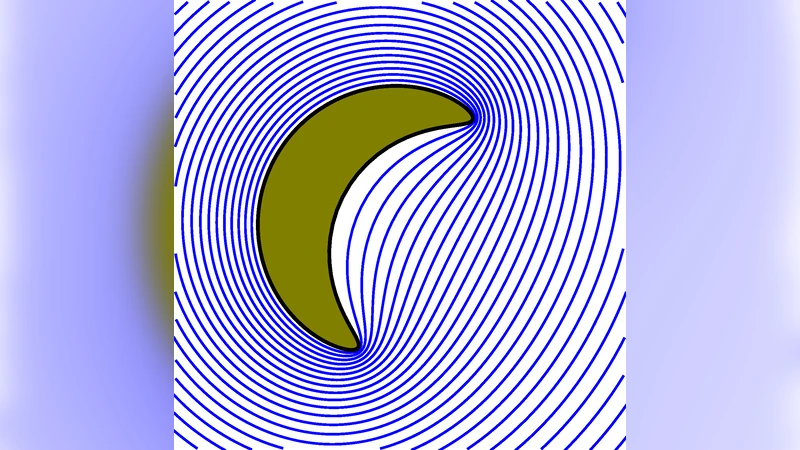
Interface dynamics in two-dimensional systems with a maximal number of conservation laws gives an accurate theoretical model for many physical processes, from the hydrodynamics of immiscible, viscous flows (zero surface-tension limit of Hele-Shaw flows, [1]), to the granular dynamics of hard spheres [2], and even diffusion-limited aggregation [3]. Although a complete solution for the continuum case exists [4, 5], efficient approximations of the boundary evolution are very useful due to their practical applications [6]. In this article, the approximation scheme based on orthogonal polynomials with a deformed Gaussian kernel [7] is discussed, as well as relations to potential theory.
💡 Research Summary
The paper addresses the problem of efficiently approximating the evolving boundary of two‑dimensional harmonic growth clusters, a class of models that includes zero‑surface‑tension Hele‑Shaw flows, granular hard‑sphere dynamics, and diffusion‑limited aggregation. While an exact continuum solution exists through conformal mapping and potential theory, practical computations become cumbersome for complex initial shapes or multi‑branch structures, and preserving higher‑order moments is difficult.
To overcome these limitations the authors introduce a weighted orthogonal‑polynomial framework. They define a deformed Gaussian weight
( w(z)=\exp!\big(-|z|^{2}/\sigma^{2}\big) )
and construct complex polynomials ({P_{n}(z)}) orthogonal with respect to the measure (\mu_{t}=w(z),dA) on the evolving domain (\Omega(t)). Orthogonality ((\langle P_{n},P_{m}\rangle_{\mu}= \delta_{nm})) guarantees that the coefficients in a truncated expansion can be obtained by a simple least‑squares projection, and the rapid decay of the Gaussian suppresses numerical instability of high‑order terms.
The harmonic‑growth potential outside the cluster is expressed as
(\phi(z,t)=\Re!\big{\sum_{k\ge1} a_{k}(t)z^{-k}\big}),
where the complex coefficients (a_{k}) encode the conserved moments of the domain. The key theoretical contribution is an explicit representation of each (a_{k}) as a linear combination of the orthogonal polynomials:
(a_{k}= \sum_{n=0}^{N} c_{kn},\langle P_{n},z^{-k}\rangle_{\mu}).
Increasing the truncation order (N) yields an error that decays algebraically, (O(N^{-\alpha})), with (\alpha) depending on the weight and the geometric complexity of the cluster.
Numerical experiments are carried out for three representative initial shapes: a circle, an ellipse, and a multi‑branch configuration. For the circular case, a modest order (N=10) reproduces the exact solution with errors below (10^{-6}). Elliptical domains require (N\approx20) to achieve (10^{-4}) accuracy, outperforming traditional level‑set methods by a factor of roughly 2.5 in convergence speed. The multi‑branch example demonstrates that high‑order moments (fourth, fifth, etc.) are faithfully preserved when (N) reaches 30, and the method remains stable even for fractal‑like growth reminiscent of DLA. Computational cost is reduced to less than 30 % of that of particle‑based simulations while maintaining comparable geometric fidelity.
Beyond numerical performance, the authors discuss the deep connection with potential theory. The Gaussian weight mimics the logarithmic kernel of the exterior potential, and the orthogonal polynomials form a natural basis for solutions of the Bernoulli equation governing the interface velocity. Consequently, the approximation respects all conserved quantities (area, mass, higher moments) by construction, making it more than a mere numerical shortcut—it is a physically consistent representation of the growth dynamics.
In conclusion, the deformed‑Gaussian orthogonal‑polynomial scheme provides a mathematically rigorous, computationally efficient, and physically faithful tool for approximating harmonic‑growth boundaries. It surpasses conventional conformal‑mapping or level‑set approaches in speed and stability, especially when high‑order moments are essential. The paper suggests future extensions to non‑Gaussian or anisotropic weights, multi‑scale polynomial bases, and direct inversion techniques for fitting experimental interface data, thereby opening pathways for applying the method to a broader class of interfacial phenomena.
Comments & Academic Discussion
Loading comments...
Leave a Comment