Simulations of Large-scale WiFi-based Wireless Networks: Interdisciplinary Challenges and Applications
Wireless Fidelity (WiFi) is the fastest growing wireless technology to date. In addition to providing wire-free connectivity to the Internet WiFi technology also enables mobile devices to connect directly to each other and form highly dynamic wireless adhoc networks. Such distributed networks can be used to perform cooperative communication tasks such ad data routing and information dissemination in the absence of a fixed infrastructure. Furthermore, adhoc grids composed of wirelessly networked portable devices are emerging as a new paradigm in grid computing. In this paper we review computational and algorithmic challenges of high-fidelity simulations of such WiFi-based wireless communication and computing networks, including scalable topology maintenance, mobility modelling, parallelisation and synchronisation. We explore similarities and differences between the simulations of these networks and simulations of interacting many-particle systems, such as molecular dynamics (MD) simulations. We show how the cell linked-list algorithm which we have adapted from our MD simulations can be used to greatly improve the computational performance of wireless network simulators in the presence of mobility, and illustrate with an example from our simulation studies of worm attacks on mobile wireless adhoc networks.
💡 Research Summary
The paper addresses the growing need for high‑fidelity simulations of Wi‑Fi‑based wireless ad‑hoc networks and wireless grids, which are increasingly important as mobile devices communicate directly without fixed infrastructure. Such networks are characterized by highly dynamic topologies, frequent node mobility, limited bandwidth, and energy constraints, making accurate large‑scale simulation a challenging computational problem. The authors first identify two primary bottlenecks: (1) maintaining up‑to‑date network topology as nodes move, and (2) efficiently determining neighbor relationships for packet transmission in a system that may contain tens of thousands of nodes.
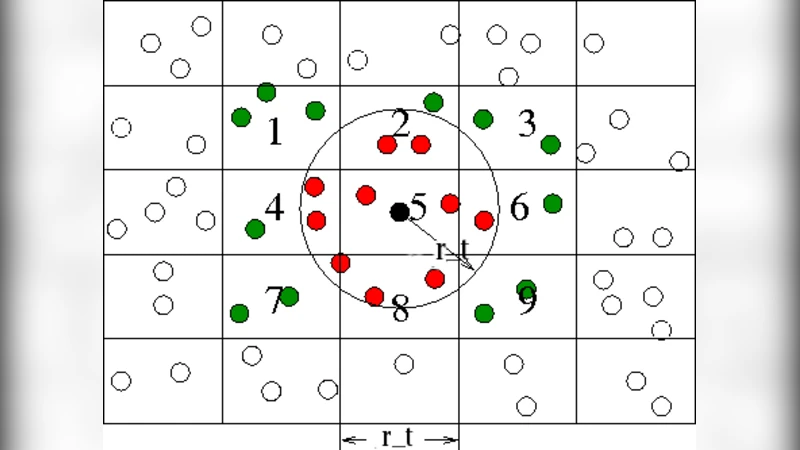
To overcome these issues, the authors borrow the cell‑linked‑list data structure from molecular dynamics (MD) simulations. The simulation area is divided into a regular grid of cells; each cell stores a list of the nodes currently residing within it. When a node needs to discover its communication partners, it only scans the nodes in its own cell and the adjacent cells, reducing the neighbor‑search complexity from O(N²) to O(N·k), where k is the average number of nodes per cell. Mobility updates are inexpensive because a node simply moves from one cell list to another as it changes position, eliminating the need for costly global reconstructions of the adjacency matrix.
The paper then tackles parallel execution. Using a domain‑decomposition approach, the overall simulation space is partitioned among multiple processors, each responsible for a subset of cells. Processors exchange boundary information (ghost cells) at regular intervals to keep inter‑processor interactions consistent. Two synchronization strategies are examined: conservative (ensuring no causality violations) and optimistic (allowing speculative execution with rollback). Empirical results favor the conservative scheme for its stability in the context of wireless packet timing and propagation delays.
A concrete case study demonstrates the practical impact of these techniques. The authors simulate the spread of a computer worm across a mobile ad‑hoc network. Mobility models include Random Waypoint and a city‑block model, while the physical layer follows the IEEE 802.11g path‑loss and fading characteristics. The worm propagates by infected nodes broadcasting malicious packets to nearby peers. When the cell‑linked‑list and domain‑decomposed parallelism are employed, the simulation runs more than ten times faster than a baseline simulator that uses naïve O(N²) neighbor searches, yet reproduces identical infection curves, peak infection times, and spatial spread patterns.
Beyond performance, the paper discusses broader implications. The authors argue that the same techniques can be extended to upcoming 5G/6G scenarios involving massive device densities, multi‑antenna (MIMO) beamforming, and edge‑cloud integration. Future work is suggested in three areas: (i) incorporating energy‑aware models for battery‑constrained devices, (ii) coupling the network simulator with machine‑learning‑driven traffic prediction to adapt parameters on the fly, and (iii) developing hybrid simulation frameworks that combine packet‑level fidelity with higher‑level analytical models for scalability.
In summary, the study demonstrates that cross‑disciplinary borrowing—specifically, adapting data structures and parallelization strategies from many‑particle physics simulations—can dramatically improve the scalability and realism of wireless network simulators. This advancement enables researchers and engineers to evaluate routing protocols, security mechanisms, and emerging wireless services on a scale previously limited to theoretical analysis, thereby bridging the gap between simulation and real‑world deployment.
Comments & Academic Discussion
Loading comments...
Leave a Comment