Satisfiability of Almost Disjoint CNF Formulas
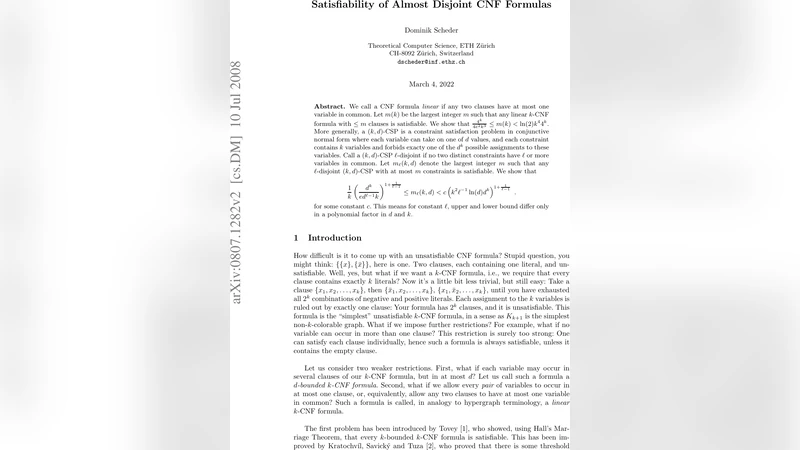
We call a CNF formula linear if any two clauses have at most one variable in common. Let m(k) be the largest integer m such that any linear k-CNF formula with <= m clauses is satisfiable. We show that 4^k / (4e^2k^3) <= m(k) < ln(2) k^4 4^k. More generally, a (k,d)-CSP is a constraint satisfaction problem in conjunctive normal form where each variable can take on one of d values, and each constraint contains k variables and forbids exacty one of the d^k possible assignments to these variables. Call a (k,d)-CSP l-disjoint if no two distinct constraints have l or more variables in common. Let m_l(k,d) denote the largest integer m such that any l-disjoint (k,d)-CSP with at most m constraints is satisfiable. We show that 1/k (d^k/(ed^(l-1)k))^(1+1/(l-1))<= m_l(k,d) < c (k^2/l ln(d) d^k)^(1+1/(l-1)). for some constant c. This means for constant l, upper and lower bound differ only in a polynomial factor in d and k.
💡 Research Summary
The paper investigates the satisfiability thresholds of CNF formulas and their generalizations under strong structural restrictions. A CNF formula is called linear if any two clauses share at most one variable. For a fixed clause width k, let m(k) denote the largest integer such that every linear k‑CNF formula with at most m(k) clauses is guaranteed to be satisfiable. The authors determine tight asymptotic bounds for m(k):
\
Comments & Academic Discussion
Loading comments...
Leave a Comment