Optimal Direct Sum and Privacy Trade-off Results for Quantum and Classical Communication Complexity
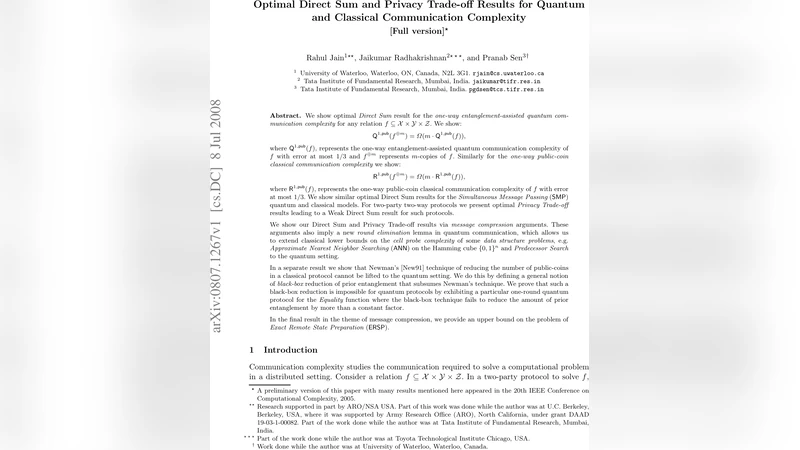
We show optimal Direct Sum result for the one-way entanglement-assisted quantum communication complexity for any relation f subset of X x Y x Z. We show: Q^{1,pub}(f^m) = Omega(m Q^{1,pub}(f)), where Q^{1,pub}(f), represents the one-way entanglement-assisted quantum communication complexity of f with error at most 1/3 and f^m represents m-copies of f. Similarly for the one-way public-coin classical communication complexity we show: R^{1,pub}(f^m) = Omega(m R^{1,pub}(f)), where R^{1,pub}(f), represents the one-way public-coin classical communication complexity of f with error at most 1/3. We show similar optimal Direct Sum results for the Simultaneous Message Passing quantum and classical models. For two-way protocols we present optimal Privacy Trade-off results leading to a Weak Direct Sum result for such protocols. We show our Direct Sum and Privacy Trade-off results via message compression arguments which also imply a new round elimination lemma in quantum communication. This allows us to extend classical lower bounds on the cell probe complexity of some data structure problems, e.g. Approximate Nearest Neighbor Searching on the Hamming cube {0,1}^n and Predecessor Search to the quantum setting. In a separate result we show that Newman’s technique of reducing the number of public-coins in a classical protocol cannot be lifted to the quantum setting. We do this by defining a general notion of black-box reduction of prior entanglement that subsumes Newman’s technique. We prove that such a black-box reduction is impossible for quantum protocols. In the final result in the theme of message compression, we provide an upper bound on the problem of Exact Remote State Preparation.
💡 Research Summary
The paper establishes optimal direct‑sum theorems for both one‑way entanglement‑assisted quantum communication (Q¹,pub) and one‑way public‑coin classical communication (R¹,pub) for any relation f⊆X×Y×Z. Specifically, for error parameters ε,δ∈(0,½) with ε+δ<½, it proves Q¹,pub,ε(f⊕m)=Ω(δ³·m·Q¹,pub,ε+δ(f)) and the analogous bound for R¹,pub. The same linear scaling holds in the simultaneous‑message‑passing (SMP) model for any number of rounds k.
The core technique is a message‑compression framework. In the classical setting, if Alice’s one‑way message carries at most k bits of mutual information about her input, the protocol can be replaced by a deterministic one‑way protocol whose message length is O(k). In the quantum setting, using the Substate Theorem (both classical and quantum versions), a similar compression is achieved: a one‑way quantum protocol without prior entanglement and with information ≤k can be transformed into a one‑way protocol with prior entanglement whose classical message is O(k) bits.
From these compression results the authors derive a new round‑elimination lemma for quantum communication. If a t‑round protocol P has first and second messages of lengths ℓ₁ and ℓ₂ (Alice starts), there exists a (t‑1)‑round protocol where Bob starts and the first message length is ℓ₂·2^{O(ℓ₁/k)}. This lemma enables the transfer of classical cell‑probe lower bounds (e.g., for Approximate Nearest Neighbor on the Hamming cube and predecessor search) to the quantum cell‑probe model.
The paper also studies privacy‑loss trade‑offs. For two‑way quantum protocols without prior entanglement, let k_A and k_B denote the privacy losses of Alice and Bob under a product input distribution. The authors show that such a protocol can be compressed into a one‑way protocol with prior entanglement whose single classical message from Alice to Bob has length k_A·2^{O(k_B)} bits. An analogous result holds for classical protocols. Thus low privacy loss forces a large communication cost, establishing a quantitative privacy‑communication trade‑off.
In addition, the authors prove that Newman’s technique for reducing public‑coin randomness cannot be lifted to the quantum setting. They define a black‑box notion of prior‑entanglement reduction that subsumes Newman’s method and demonstrate, via a one‑round quantum Equality protocol, that any such reduction can improve the amount of prior entanglement by at most a constant factor.
Finally, the paper gives an upper bound for Exact Remote State Preparation (ERSP): any exact remote preparation of a quantum state from a set Z can be achieved with O(log |Z|) bits of communication, matching known bounds for approximate state transmission while guaranteeing exactness.
Overall, the work unifies direct‑sum, message‑compression, round‑elimination, privacy‑trade‑off, and entanglement‑reduction results, providing a comprehensive advancement in the understanding of both quantum and classical communication complexity.
Comments & Academic Discussion
Loading comments...
Leave a Comment