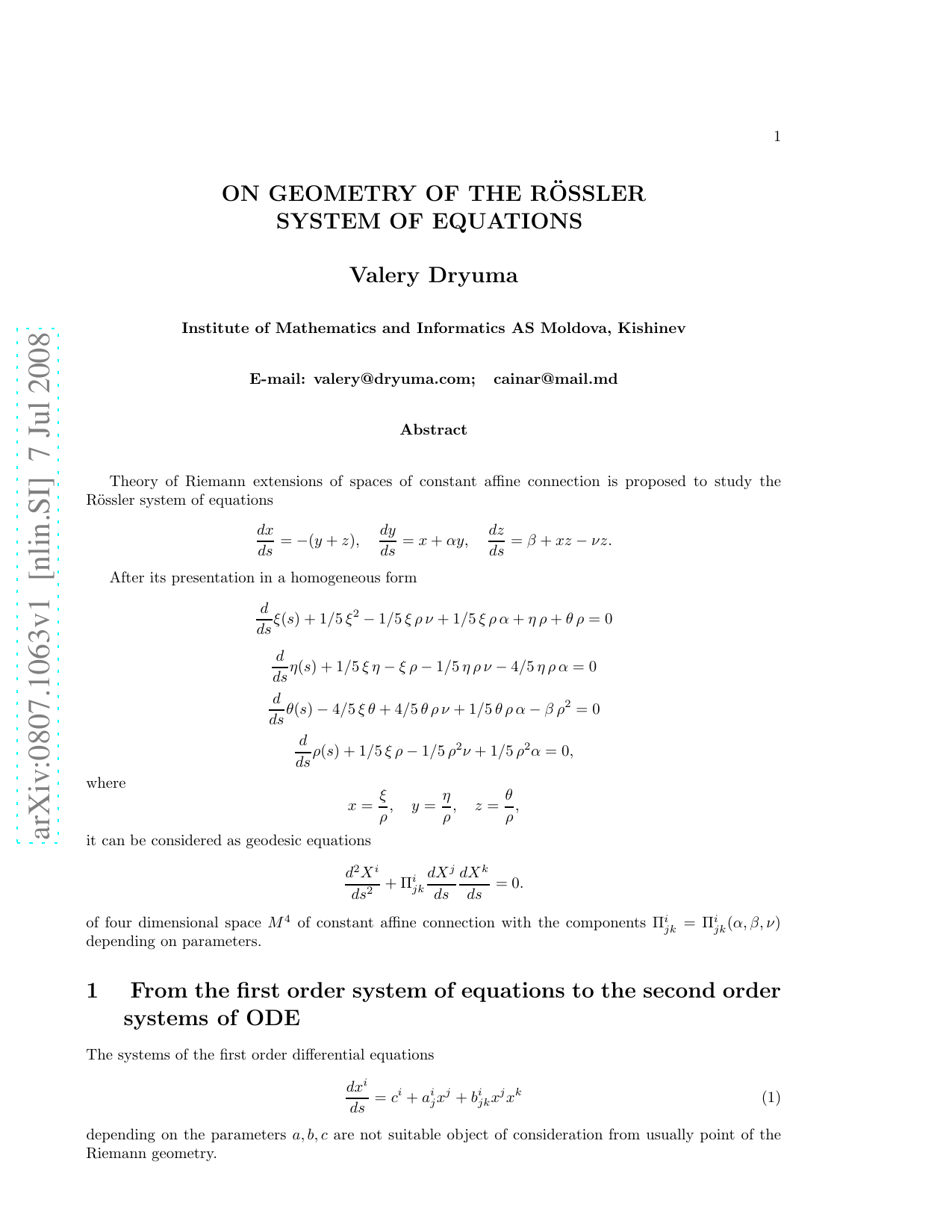
On a basis of theory of Riemann extension of the space of constant affine connection associated with the R\"ossler system of equations relations between its parameters are investigated.
Deep Dive into On Geometry of the R"ossler system of equations.
On a basis of theory of Riemann extension of the space of constant affine connection associated with the R"ossler system of equations relations between its parameters are investigated.
it can be considered as geodesic equations
of four dimensional space M 4 of constant affine connection with the components Π i jk = Π i jk (α, β, ν) depending on parameters.
1 From the first order system of equations to the second order systems of ODE
The systems of the first order differential equations
depending on the parameters a, b, c are not suitable object of consideration from usually point of the Riemann geometry.
The systems of the second order differential equations in form
dx k ds dx j ds = 0 (2) are best suited to do that. They can be considered as geodesic of affinely connected space M k in local coordinates x k . The values Π i jk = Π i kj are the coefficients of affine connections on M k . With the help of such coefficients can be constructed curvature tensor and others geometrical objects defined on variety M k .
2 From affinely connected space to the Riemann space
We shall construct the Riemann space starting from a given affinely connected space defined by the systems of the second order ODE’s.
With this aim we use the notion of the Riemann extension of nonriemannian space which was used earlier in the articles of author.
Remind the basic properties of this construction. With help of the coefficients of affine connection of a given n-dimensional space can be introduced 2n-dimensional Riemann space D 2n in local coordinates (x i , Ψ i ) having the metric of form
where Ψ k are an additional coordinates. The important property of such type metric is that the geodesic equations of metric (3) decomposes into two parts ẍk
and
where
and R l kji are the curvature tensor of n-dimensional space with a given affine connection. The first part (4) of the full system is the system of equations for geodesic of basic space with local coordinates x i and it do not contains the supplementary coordinates Ψ k .
The second part (5) of the system has the form of linear N × N matrix system of second order ODE’s for supplementary coordinates Ψ k
Remark that the full system of geodesics has the first integral
which is equivalent to the relation
where µ, ν are parameters. The geometry of extended space connects with geometry of basic space. For example the property of the space to be Ricci-flat R ij = 0 or symmetrical R ijkl;m = 0 keeps also for an extended space.
It is important to note that for extended space having the metric (3) all scalar curvature invariants are vanished.
As consequence the properties of linear system of equation (5)(6) depending from the the invariants of N × N matrix-function
under change of the coordinates Ψ k can be of used for that. First applications the notion of extended spaces for the studying of nonlinear second order ODE’s connected with nonlinear dynamical systems have been considered by author (V. Dryuma 2000Dryuma -2008)).
To investigation the properties of the Rössler system equations
we use its presentation in homogeneous form
The relation between both systems is defined by the conditions
Remark that for a given system
Such type of the system can be rewriten in the form
which allow us to consider it as geodesic equations of the space with constant affine connection.
In our case nonzero components of connection are
The metric of corresponding Riemann space is The system of second order differential equations for additional coordinates can be reduced to the linear system of the first order equations with variable coefficients
where A i , B i , C i , E i are the functions of the variables x, y, z, u).
Properties of such type of the systems can be investigated with help of the Wilczynski invariants.
In theory of Riemann spaces the equation
can be used to the study of the properties of spaces.
For the eight-dimensional space with the metric (10) corresponded the Rössler system we get the equation on the function ψ(x, y, z, u, P, Q, U, V ) = θ(P, Q, U, V )
This equation has varies type of particular solutions. A simplest one is ψ(x, y, z, u, P, Q, U, V ) = e (ν-α)P -5 Q+5 U+V at the conditions on parameters of the Rössler system
As examples obtained by direct substitutions we get the quadratic solution
with conditions ν = 8/3 α, β = arbitrary.
Cubic solution
(60
and arbitrary coefficients l , m, k , n.
A polynomial solution of degree four
Remark that the properties of of such type of solutions depend on parameters and may be highly diversified.
More complicated solutions of the Laplace equation can be obtained by application of the method of (u, v)-transformation developed in the works of author.
also gives useful information about the properties of Riemann space.
In particular the condition F (x 1 , x 2 , …, x i ) = 0 where function F (x i ) satisfies the equation ( 12), determines (N -1)-dimensional hypersurface with normals forming an isotropic vector field.
For the space with the metric (10) the eikonal equation on the function ψ(x, y, z, u, P, Q, U, V ) = η(P, Q, U, V ) takes the form
A simplest solution of this equation is
wi
…(Full text truncated)…
This content is AI-processed based on ArXiv data.